Archives » SF

For Interzone 254

The Seventh Miss Hatfield cover

A few days ago my latest Interzone Review book arrived. The review is due on Jul 31st so, World Cup or not, I’ll need to get going on it soon.

The book is titled The Seventh Miss Hatfield and was written by Anna Caltabiano. According to the Orion website it’s, “A spellbinding debut from a hugely talented young author, featuring time-travel, 19th-century New York, unrequited love and a mysterious portrait…” Notwithstanding that word “debut” it appears to be Ms Caltabiano’s second novel. I missed out on her first, All That is Red, probably because it doesn’t appear to be SF related.

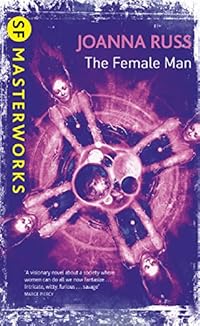
The Female Man by Joanna Russ

Gollancz SF Masterworks, 2010, 209 p, plus 5p epigraph and Introduction. Originally published in 1975.

The Female Man cover

One day a woman called Janet Evason appears on a street in the US. She is from the future, from a planet named Whileaway where a cataclysm wiped out all men hundreds of years before Janet’s birth. Her appearance makes her a celebrity and occasions disbelief at the mere possibility of a manless society. This US is in a parallel timeline to ours where the Great Depression is still ongoing and the Second World War never happened. She is, of course, Janet Evasdaughter but as the book tells us, Evason “is your translation.” Her path crosses that of Jeannine Dadier, who is in an unsatisfactory relationship with a man called Cal but feels pressurised to marry – especially by her mother. “Someone is collecting J’s” as we also meet Joanna, a woman from something very like our own 1970s who may indeed be a representation of the author, and Jael Reasoner from a world where men and women are at war.

This set-up gives Russ opportunity to elaborate on the many iniquities which men pile upon women. In the intervening forty or so years since the novel was first published many things have changed but others have not. Russ’s strictures still have power. Of motherhood Joanna says, “This is the most important job in the world. That’s why they don’t pay you for it.”

The book’s structure is disjointed and bitty, though, the many asides a distraction from the unfolding of story but these asides are one of the means by which Russ is pointing up her concerns.

Science Fiction is the perfect medium for thought experiments; SF is never really about the future. In its particular highlighting of how things might (still) be different in terms of sexual equality The Female Man was – and remains – an important book in the history of SF and in its evolution.

Curiosity corner. We had “waked” for “woke.” Is this a US usage? Also gay appeared in the sense of homosexual – as long ago as 1975!

Blue Shifting by Eric Brown

Pan, 1995, 264p.

Blue Shifting contains short stories and novellas from Brown’s early career, two of them are original to the collection. Looking back at them it is striking how many of his recurring themes and tropes mark these tales. The typical Brown character is a misfit of some kind or a man awkward with women; a common plot driver is of people’s pasts hounding their presents; the typical setting is an artist’s colony or else somewhere secluded, usually on a far-flung planet.

The Death of Cassandra Quebec
Eva Hovanda, a minor artist, attends the celebration of the twentieth anniversary of the creation of the sole true work of art by Nathaniel Maltravers (a commemoration of the death of his wife) and rediscovers her wiped memories of the event.

Piloting
On Nea Kikhládes, a world of augmented and even Supra Sapient humans, the Primitivist artist Benedict Wellard is preparing his final piece. The pilot he has requested to animate the fifteen years dead body of his daughter plays an unexpected role. This story is slightly flawed by the fact that Brown withholds a crucial item of information until the denouement.

The Art of Acceptance
An oddly affecting love story – or two – set in Brown’s Engineman universe but firmly on Earth. A tale of cloning, disfigurement and, two other familiar Brown tropes, a private detective and Eastern influence. Despite the title, no artists though.

The Disciples of Apollo
A man suffering from a terminal condition known as The Syndrome goes (after selling his classical record collection! Nothing dates so fast as the future) to a hospice where those so afflicted wait to die. He eventually, and for the first time, finds love.

Elegy Perpetuum
An artist who contends that an enduring work of art is worth more than an individual’s life is faced with a fateful decision.

The Song of Summer
A middle-aged man returns to the scene of his youth and his first, lost, only, love.

Epsilon Dreams
A well-plotted tale set on Altair II in a time when the penalty for murder is memory wiping and Encoded Identity Inserts allow personalities to be transferred to other bodies after death. Brown brings both these elements together in another story of emotional shipwreck.

Blue Shifting
At 5 am every day, surrounded by a blue radiance, Gregory Janner mysteriously shifts location from continent to continent. Eventually he falls in with a group of others similarly afflicted. This story did contain the rather pleasing typo of a “billowed” command, but also the more oxymoronic construction, “markedly unremarkable.”

In all these stories, as with those of a major influence on Brown’s work, Michael G Coney, well reflected in this book, the focus is always on human motivation, on how much of an emotional driver both love and loss are. This is SF with a human heart.

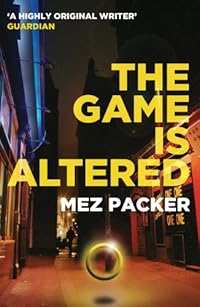
The Game Is Altered by Mez Packer.

Tindal Street Press, 2012, 348p. Reviewed for Interzone 240, May-Jun 2012.

The Game Is Altered cover

Lionel Byrd’s mother died three days after his birth. He was adopted by her best friend, Judy, and brought back to Britain from Kenya. However he is mixed race and his adoptive family are all white. Only his father, David, and sister, Lilith, regard him with any affection while his mother and her two sons treat him coldly. In childhood the two boys subjected him to “games” in which he was the butt of their cruelty, describing him (apparently after Blade Runner) as a replicant and, at one point, nearly hanging him. His recall of these events is hazy as an accident when he was ten has deprived him of many of his childhood memories.

As an adult he is estranged from his adoptive family, apart from his sister, and lives a lonely existence in a grotty flat in a rundown district near a “Health Centre” which is a cover for people-trafficking and prostitution. He is aloof at work despite attempts to befriend him, his closest companion is his cat Buddha, and he fantasises about a girl he has seen in the street with whom he is convinced he has made a connection. While friendly with his barber, a West Indian whose speech is rendered demotically and doesn’t like Lionel’s taking up of dreadlocks, he has a close relationship only with Lilith and escapes from mundane reality into an immersive computer game called CoreQuest where his avatar is Ludi, a much more active persona. His father’s final illness leads to Lionel’s re-entanglement with his adoptive family and revelations about the circumstances of his adoption.

The novel is on the whole well written but its structure is problematic. It is divided into chapters dealing with Lionel’s life, each usually followed by an epigraph relating to gaming, then a segment from the game. These latter – escalating through the game’s levels – are related from Ludi’s viewpoint in a partly debased form of English. Irritatingly, Packer does not always sustain this street language throughout the game segments’ lengths.

We are intended to draw parallels between the characters in Lionel’s world and avatars in the game but these sections do not add to the story. References to the possibly elusive nature of reality – the phrase, “It’s only a game,” appears in Lionel’s narrative several times; a character says, “People are so programmed,” – are not enough to justify the conceit embodied within them nor the presence of the gaming chapters. There is also the problem that in games there is no jeopardy. Why should the reader care about the characters within them when they are not real and can be resurrected at will?

As a result the novel as presented is unsatisfying, particularly to readers of speculative fiction, who are used to the mixing of the real with the fantastic – or paranoia – and even the melding of reality with games. Packer seems either to be unaware of or unconcerned with the literary antecedents.

This is a pity as the main narrative is well handled and, until it begins to unravel somewhat in the latter stages, convincing. It could stand alone, without the game aspect, and be entirely coherent – though of course not SF. The attempts to suggest a degree of futurity, such as the coinage “Google device” for a hand-held computer-like phone, are ill thought-through (even when shortened to “Google”) and there is insufficient foreshadowing of Lionel’s ultimately shaky grasp on the real world.

The website of the book’s publisher (Tindal Street Press) states it does not consider submissions, among other genres, of Sci-Fi (sic) nor Fantasy. In those circumstances it does seem strange to be reviewing one of their books for Interzone. Yet its back cover blurb says “for readers of …, Cory Doctorow, China Miéville and Neal Stephenson.” Very odd. But then again despite its trappings “The Game Is Altered” overall does not read as SF, nor Fantasy.

Reelin’ In The Years 31: After The Goldrush

A Neil Young song with some SF imagery. It was a hit for Prelude whose cover had some nice harmonies.

I present both versions for comparison purposes.

Prelude: After The Goldrush

Neil Young: After The Goldrush

The Dervish House by Ian McDonald

Gollancz, 2010. 472p.

After Africa (Chaga – aka Evolution‒s Shore -, Kirinya and Tendeleo’s Story,) India (River Of Gods, Cyberabad Days) and Brazil (Brasyl), in The Dervish House McDonald now turns his attention to Turkey: specifically Istanbul.

The novel is set several years after Turkey has finally gained EU membership and joined the Euro (perhaps a somewhat more remote possibility now than when McDonald was writing) in an era when children can control real, mobile, self assembling/disassembling transformers and adults routinely use nanotech to heighten awareness/response in much the way they do chemical drugs at present. The fruit of what may have been a prodigious quantity of geographical and historical research is injected more or less stealthily into the text.

The main plot is concerned with a terrorists group’€™s plans to distribute nano behaviour changing agents designed to engender a consciousness of mysticism, if not of the reality of God/Allah. The resultant, what would otherwise be magic realist visions of djinni and karin, is thereby given an SF rationale.

In the interlinked narratives of those who live in and around an old Dervish House in Adam Dede Square, and covering events occurring over only four days, there are subplots about contraband Iranian natural gas, corrupt financial institutions and insider dealings, the circumscription of non-Turkish minorities, tales of youthful betrayal and frustrated love, not to mention the discovery of an ancient mummy embalmed in honey, which last gives the author the opportunity to deploy a nice pun on the phrase honey trap. The usual eclectic McDonald conjunction of disparate ingredients, then, and somehow amid all this he manages to finagle football into the mix as early as page two. Fair enough, though; Turkey’s fans are notoriously passionate about the game.

While not quite reaching the heights of Brasyl or River Of Gods, The Dervish House still has more than enough to keep anyone turning the pages.

One typographical quibble: the formula for carbon dioxide ought to be rendered as CO2 rather than CO2, though. To a Chemist like me there is a world of difference between the two.

free hit counter script