Archives » Second World War

A War Memorial, Hebburn Cemetery

Hebburn, in Tyne and Wear, is a kind of ancestral home for me. My maternal grandmother was brought up there before her parents moved to Glasgow where she met my grandfather.

It’s a fairly typical north of England post-industrial town. I didn’t spot any Art Deco there, though.

We did pass a cemetery with the Commonwealth War Graves sign. This was Hebburn Cemetery. At the centre of the cemetery is a chapel in front of which lies a war memorial:-

Cemetery Chapel and a War Memorial, Hebburn Cemetery

The war memorial is a Cross of Sacrifice on an octagonal plinth. Inscribed round the base of the upper plinth, “Their name liveth for evermore.”

A War Memorial, Hebburn

To the left of the memorial as you approach it up the drive is a sculpture named “Poppies in steel,” with a sign saying, “You have done your duty, to honour you is ours” – Friends of Hebburn Cemetery, September 2019.

Poppies in Steel War Memorial, Hebburn Cemetery

A war memorial bench is nearby:-

War Memorial Bench, Hebburn Cemetery

I gather Hebburn’s main War Memorial is elsewhere. Looking at the aerial view in the link I see it’s actually close to the cemetery. Maybe next time we’re down there.

Memorials in Sunderland City Library and Art Centre

In Sunderland City Library and Art Centre were two war memorial items.

125th Tank Regiment Roll of Honour:-

125th Tank Regiment Roll of Honour

A Great War memorial bowl inscribed for Private G W Micklin, Durham Light Infantry, missing 26/9/1915, and, “He answered his duty,” with some Sunderland lustre ware behind:-

War Memorial Bowl in City Library and Art Centre, Sunderland

Sunderland Memorial Wall

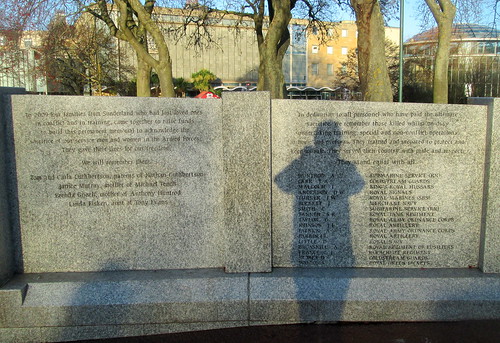
Between Sunderland War Memorial and Mowbray Park a memorial wall has been erected to commemorate those who have served in conflicts since the Second World War and to honour Sunderland’s post-World War 2 fallen.

The first section commemorates non-combat deaths in war:-

War Memorial Wall, Sunderland

The rest of the wall is a sobering reminder of the many conflicts in which British soldiers have lost their lives since 1945.

Palestine and India:-

Palestine and India Memorial Wall, Sunderland

Malaya and the Cold War:-

Malaya and Cold War Memorial Wall, Sunderland

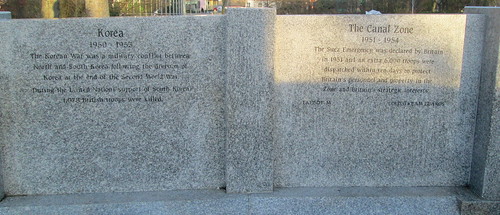
Korea and the Canal Zone:-

Korea and Canal Zone Memorial Wall, Sunderland

Kenya and Cyprus:-

Kenya and Cyprus Memorial Wall, Sunderland

Aden, Radfan and Suez:-

Aden, Radfan and Suez Memorial Wall, Sunderland

Borneo, Northern Ireland and Oman Dhofar:-

Bornoe, Northern Ireland, Oman Dhofar Memorial Wall, Sunderland

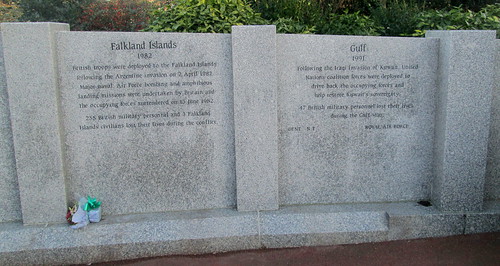
Falkland Islands and Gulf War:-

Falkland Islands, Gulf War, Memorial Wall, Sunderland

Bosnia, Kosovo, Sierra Leone:-

Bosnia, Kosovo, Sierra Leone Memorial Wall, Sunderland

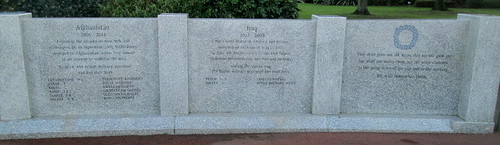
Afghanistan and Iraq, plus Ode of Remembrance:-

Afghanistan and Iraq Memorial Wall, Sunderland

Sunderland War Memorial

Sunderland’s War Memorial lies just off the road which runs past Mowbray Park. It’s a granite column topped by a bronze figure of Victory. The dedication is, “”A tribute to our glorious dead.”

Sunderland War Memorial

Its west aspect bears the Great War dedication, 1914-1918:-

Sunderland War Memorial, 1914-1918 Dedication

From north:-

War Memorial, Sunderland, From North

From east. Second World War dedication, 1939-1945:-

Second World War Dedication, War Memorial, Sunderland

In the Park, near to the Memorial is a Memorial bench:-

War Memorial Bench, Sunderland

Bishop Auckland War Memorial, Auckland Tower, Mining Art Gallery

Bishop Auckland‘s War Memorial lies in Market Place, a very short walk from Auckland Castle. It is inscribed, “1914 – 1919. To the men of Bishop Auckland who fought and fell in the Great War their fellow citizens have erected this memorial,” with below, “1939 – 1945. In memory of those who in a later generation made the same sacrifice as those to whom this memorial was erected.”

Bishop Auckland War Memorial

Bishop Auckland War Memorial from west (Auckland Tower – part of the Auckland Project – behind. Unfortunately it was too windy that day for us to be allowed access to all of the Tower but it is possible when conditions are calmer.) This side of the Memorial is inscribed, “Greater love hath no man than this that a man lay down his life for his friends,” with the additional dedication below, “1950 – 1953. In memory of those who gave their lives in the Korean War.”

Bishop Auckland War Memorial From West

From North. The inscriptions read, “God made trial of them and found them worthy of himself,” and, “2001 – 2004. In remembrance of those who gave their lives in the Afghanistan conflict.”

Bishop Auckland War Memorial from North

War Memorial from east. Inscribed, “The souls of the righteous are in the hands of God,” with, below, “1982. In remembrance of those who gave their lives in the Falklands conflict.” The entrance to Bishop Auckland’s magnificent Mining Art Gallery – also part of the Auckland Project – can be seen to the right here:-

War Memorial, Bishop Auckland, from East

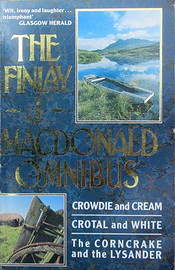
The Corncrake and the Lysander by Finlay J Macdonald

In The Finlay J Macdonald Omnibus, Warner Books, 1988, 187 p. First published 1984.

The Finlay J Macdonald Omnibus cover

This final instalment of the author’s childhood memoirs sees him, having at the second attempt passed the bursary exam, finally off to the “big” school in what he perceives as the metropolis of Tarbert though by wider standards it is little more than a village. In his new school the headmaster “didn’t really expect boys to behave themselves – he had seen too many boys for that – but he did expect them not to get caught.”

Before that, though, the author had time to aid Old Hector, debilitated by malaria contracted in his sole journey away from the village as a seaman, with milking his cow daily – which has the side advantage of providing the opportunity to have a sly smoke without the knowlegde of his parents. Hector wasn’t really old but his infirmity meant he depended on others, a dependency made worse by the death of his sister who had dedicated her life to looking after him. Macdonald, in considering how Hector would have to sell his cow when he leaves for school, conceived of the idea of advertising for a household companion ‘with a view to matrumony’ for Hector, a plan kept secret between the two of them. (Later, however, Macdonald’s father surprises him with his knowledge of Finlay’s part in the scheme. How did he know? “You never could spell matrimony.”) The first replies were unsuitable in various ways but in Macdonald’s absence at school someone did come to fulfil both aspects of the design. These machinations give the opportunity for some light humour as does the visit of the Moderator of the General Assembly of the Church of Scotland, that particular incumbent being a Gaelic speaker.

There is a more reflective aspect to the text when the author mentions the melancholy of being present when a language goes into its death throes. (Though nearly ninety years on from the times described here the Gaelic language still manages to survive.) The assumption in the village and more widely on Harris and elsewhere in the Hebrides was that to get on a child had to get out, that not to do so would be a failure, a factor which would inevitably lead to a hollowing out of life on the islands. Macdonald’s going to the big school was a first step on that journey. This quality of Macdonald’s memoir is of a piece with one of the perennial considerations of the Scottish novel; the sense of nostalgia, of things lost, of a strange incompleteness. I suspect that is one of the hangovers of the Union of the Parliaments and the formation of the United Kingdom in 1707. Macdonald also has the Scottish novelist’s eye for landscape description.

Macdonald’s growing to adulthood lay under the shadow of the looming Second World War. There is a grand set piece when the lads who have signed up are piped on to the ferry to the mainland to join their regiment, the ill-fated 51st Highland Division. This was before the actual formal commencement of hostilities when, “Nobody heard Chamberlain’s declaration of war on the Sunday because, in the Hebrides in those days, radio sets were never switched on on a Sunday – not even for the news.” The “wireless” in those days had vagaries of its own which is illustrated by the author with a comparison that is now itself outdated, “the sudden demise of the accumulator tended to have the sort of explosive effect that the telephone bill has nowadays on a house with daughters.” Macdonald’s thoughts on the whole matter are expressed by the sentiment that, “Nobody ever had a ‘good’ war and I can’t imagine how anyody could coin the phrase in cynicism or in jest.” He had a near escape himself when he and his brother unscrewed the spikes from a mine that had floated onto the shore and then hammered them onto their door as a makeshift knocker. His father was appalled when he discovered this.

He himself had been a sniper in the Great War (a conflict to which he never referred) and would not touch a gun since. So it is that on one of Macdonald’s returns home for the holidays he is surprised to find his father kitted out in khaki and with a rifle. He had joined the Home Guard. He allows Macdonald one shot of the rifle (wildly inaccurate of course) but on practice with his platoon merely jerks the rifle instead of firing it.

The drawbacks of progress are illustrated by the demise of the corncrake whose cry is Macdonald’s abiding memory of his childhood and whose habitat was destroyed by the improvement of the soil’s richness by the application of fertiliser reducing their scrub ground cover. Also the local oysters and wolf mussels die out because the run-off from the new internal toilets was being directed straight into the sea. The Lysander in the title refers to an RAF spotter plane which patrolled the waters round the islands in search of U-boats.

It is odd to see words such as ‘carry-out’ and ‘screwtops’ given quotation marks but English was Macdonald’s second language.

Pedant’s corner:- focussed (focused,) a closing inverted comma where there hadn’t been an opening one, Coolins (a curious Anglicisation given Macdonald’s Gaelic childhood, in most texts in English Skye’s mountains are spelled as in Gaelic, Cuillins,) “since the balances of males to females was totally disproportionate” (the balance … was,) some commas missing before or after pieces of direct speech, miniscular (x2, minuscular,) “honoured more in the breech” (breach.)

Tynemouth Priory and Castle (iii)

Outbuildings looking back towards Castle:-

Tynemouth Castle Outbuilding

Outbuildings as seen from east:-

Ruins at Tynemouth  Castle and Priory

Chapel?:-

Tynemouth Priory Ruins

The prominence on which the Castle and Priory stand made it an ideal point to place military defences.

Remains of World War 2 gun emplacements:-

Tynemouth  Castle, Tyne and Wear

World War 2 artillery piece on wall beyond old graves:-

Tynemouth Castle and Priory Fortification

The gun itself:-

Tynemouth  Castle and Priory Artillery Piece

Markinch War Memorial 2019

Markinch War Memorial and Bench just after Remembrance Day 2019:-

Markinch War Memorial and Bench

Closer view:-

Markinch War Memorial 2019

War Memorial Crosses, Markinch, 2019:-

War Memorial Crosses, Markinch, 2019

Perth Academy War Memorial

Perth Academy’s War Memorial is on the wall of the school hall.

Long View, War Memorial, Perth Academy. The boards above the War Memorial give the names of the various people who were Dux of the school over the years.

Long View, War Memorial, Perth Academy

The Latin inscription to the top of the memorial itself, “Academiae Bertyhanae Olim Cives Bella Caduci Omnia et Ipsos Pro Patria Dederunt,” I think translates as, “To the citizens of Perth Academy who gave up their precious lives in battle.” In 2019 two “ghost” soldiers were on the seat in front of the memorial:-:-

Perth Academy War Memorial 2019

Close View. Great War Names above then, “Dulce et Decorum Est Pro Patria Mori.” “MCMXXXIX-MCMXLV” above the lower board – for Second World War.

Perth Academy War Memorial Close View

Soldiers’ Information, beside Perth Academy War Memorial:-

Soldiers' Information, Perth Academy War Memorial

Flowers of the Forest project details:-

War Memorial, Perth Academy

Flowers of the Forest display, Perth Academy:-

Flowers of the Forest, Perth Academy

Memorials, Black Watch Museum, Perth

Last October we again visited the Black Watch Museum in Perth. This time I took better photos of the various memorials in its grounds.

Iraq Cross, 2003 and 2004. Great War anniversary fence behind:-

Iraq Memorial, Black Watch Museum, Perth

Iraq and Afghanistan 2007 and 2009:-

Iraq and Afghanistan Memorial, Black Watch Museum, Perth

Great War Memorial. In memory of the 300 men of the Black Watch who died in the Great War. “Their name liveth for evermore”:-

Great War Memorial, Black Watch Museum, Perth

Second World War Memorial. “Greater love hath no man”:-

Second World War Memorial, Black Watch Museum, Perth

Northern Ireland and Kosovo Memorial:-

Northern Ireland and Kosovo Memorial, Black Watch Museum, Perth

free hit counter script