Archives » Scottish Fiction

Something Like Happy by John Burnside

Vintage, 2014, 253 p.

Like all Burnside’s prose this collection is exquisitely written. The best word to describe the effect he produces is, perhaps, liminal. The places where his stories are set are familiar, recognisable as the real world, but also strange, somewhat askew.

Something Like Happy is the tale of two siblings, Stan and Arthur McKechnie, as told by Fiona the sister of Stan’s girl-friend, Marie. The McKechnies are infamous in the town (a source of friction between Marie and her parents) but Arthur, whom Fiona only knows of through her work at the bank, is the quiet one of the family with his own strange ways. Occasionally he borrows stuff from Stan without permission.

Slut’s Hair is apparently the name for the stuff which gathers in dark corners where nobody has cleaned. Here a woman with an overbearing husband who has just removed one of her teeth with pliers since the dentist will be too expensive discovers some when she thinks it is a mouse. Her husband will not be pleased either way.

Peach Melba is the delicacy prepared for the narrator in his youth by the mysterious female owner of the House of Ice-Cream on the day that has haunted him for the rest of his life.

Sunburn is narrated by a man who, possibly due to an incident in his adolescence, cannot help every year on the first day of summer going out into the sun and falling asleep.

The title of Perfect and Private Things is taken from a poem ‘The Smiles of the Bathers’ by Walden Kees. The tale is of a not happily married woman lecturer, “She had learned long ago that matrimony was not so much the occasion of romantic desire as its final, and inescapable, cure,” whose annual ritual of sending flowers anonymously to one of her students is, this year, tainted by the presence in the pub where she has a drink after visiting the florist of a group of students.

Godwit relates how Jamie’s mate Fat Stan, goes off the rails after Jamie prefers to spend time with a girl rather than him, which is an extremely reductive description of a thoughtful, finely wrought story.

The Bell-Ringer is narrated by another woman in a becalmed marriage. From a Slovakian background (with family in unmarked graves, presumably Holocaust victims) she lives in her husband’s family home and finds it unsettling, imagining the ears of listeners from times past. Her unease with life is assuaged a little by taking up bell-ringing at the local church but crystallises when her sister-in-law reveals she is having an affair.

The Deer Larder updates the ghost/fairy story for the internet age. The narrator suffers from iritis and after a day of treatment receives an email – apparently by mistake – from someone called Martin trying to entice a former lover back. Its mention of Maupassant bypasses him at first but subsequent emails draw him into wondering if he is being tantalised by an author relating Martin’s experiences. The emails stop but the story doesn’t.

The Cold Outside is what a man who has just had a diagnosis of terminal cancer and regretting the distance (physical and emotional) between his wife and his daughter feels he has more in common with than his everyday life.

In A Winter’s Tale a young lad left in temporary charge of a junk shop one afternoon brightens the place up with Christmas decorations before being rudely interrupted.

Lost Someone describes an incident from earlier story Godwit from another viewpoint. The incident, when it comes, is bewildering to the narrator but not the reader.

In Roccolo a woman on the Amalfi coast makes it her project every year to initiate a young boy holidaying in her Father’s villa complex into her strange activities with birds in the roccolo.

The Future of Snow features a policeman looking out for a wandering man whose wife died in the snow a couple of Christmases ago. She apparently mistook the day of a clandestine meeting with the policeman and slipped and fell off the path.

Pedant’s corner:- Mathers’ (Mathers’s,) semester (the British usage is term,) staunch (stanch.)
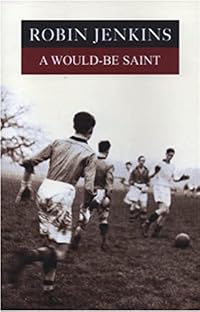
A Would-Be Saint by Robin Jenkins

B&W Publishing, 1994, 233 p.

Despite the impression that might be given by the front cover the would-be saint in question is not an aspirant to play football in the colours of either Paisley’s or Perth’s best known football teams (or, given the story’s setting in time, even at The Gymnasium) but is instead one Gavin Hamilton, who at first seems a fairly normal lad growing up in the village of Auchengillan. We are shown Gavin’s immersion in village life through the lens of the Great War where his father is off fighting. The tone of the writing in these early chapters portends his father’s inevitable death. All Gavin’s young life he has had no contact with his father’s parents due to some dispute that occurred before he was born but his grandmother introduces herself to him one day in the street, a fact he instantly knows he must conceal from his mother.

In the post-war years Gavin secures a scholarship to Cadzow Academy which creates a barrier with his contemporaries as they shy away from his now perceived difference. At the Academy he forms a friendship with a lad called McIntyre from the intervening town of Lendrick whom he meets on the bus taking him there on his first day. Apart from McIntyre the only other pupil who has time for him is Rachel Hallad, whose father is a writer. However, McIntyre’s father is ill and not long for the world.

When McIntyre has to leave, Jenkins gives us a reflection of that stoicism instilled by the lads’ background and times. “If they had been men they would have shaken hands, if they had been girls or women they would have embraced or kissed cheeks. Being boys, and Scottish boys at that, they nodded, smiled, and turned away.”

Gavin’s life trajectory is changed again when his mother also dies. His grandmother and grandfather come to look after him and he is immediately removed from the Academy as his grandmother thinks folks like them should not get above themselves, (grandfather doesn’t get a say,) so instead of University and perhaps a teaching career he ends up with a job with a solicitor in Lendrick.

Gavin is graced by his talent as a footballer and his involvement with the Church. As right half for Lendrick Rangers he helps them win the Junior Cup which brings to the town much needed glory a time of joblessness in the 1930s. He takes the opposition’s buffetings with equanimity and never retaliates. He is clean living (his prospective fiancée Julia, the solicitor’s daughter, is frustrated by his lack of interest in physical matters) as opposed to the team’s other stalwart the notoriously dissolute Grunter Houliston, whose resolute displays meant there was “no necessary connection between a man’s private morals and his public performance, whether as a footballer, a clergyman, or a politician.”

It is when the Second World War comes, though, that Gavin’s real difference shows itself. Kind to a fault, his beliefs mean that he decides he must become a conscientious objector. The relevant Board sends him to work in forestry in the far west of Scotland. Those who live locally do not much take to having conchies nearby but again Gavin shows his indifference to other’s ideas and again shows his prowess in a football match arranged between the forestry workers and the villagers. Even here, though, Gavin is as strange to most of the men he works with as with his fellow villagers in Auchengillan.

The early parts of the book – and not just the football aspect – reminded me of the same author’s The Thistle and the Grail, (some of the incidents have close similarities,) while the forestry scenes echoed The Cone Gatherers. Its structure is made oddly bifurcated by the two settings (village and forestry) but all the characters ring true and come to life on the page. As a depiction of rural Scottish life in the mid part of the twentieth century and of a man apart, A Would-Be Saint is excellent.

Pedant’s corner:- bannister (banister,) Iron Brew (did Jenkins not wish to use the brand name, Irn Bru?) “Mind you ain fucking business” (your ain,) ice-flow (ice-floe.)

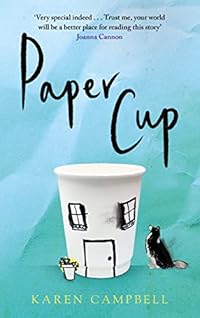
Paper Cup by Karen Campbell

Canongate, 2022, 334 p.

I was inspired to read this book by a very complimentary review it received in The Guardian several months ago. Having now done so I can only concur with that assessment. Campbell writes very well. There are no undue frills to her prose – perhaps as a result of her history as an author of crime novels – but she communicates effectively and insightfully.

The protagonist is Kelly, a woman very down on her luck and with an acute alcohol dependency problem. She is stumbled on in George Square, Glasgow, by an inebriated hen party (in my young day that sort of enterprise was known as a bottlin’ – not a word I ever expected to write in a review.) The bride-to-be takes pity on Kelly and hands her the bag of pound coins she had collected in return for granting a kiss to each man the party had encountered that night. The future bride also inadvertently leaves behind her engagement ring, which Kelly picks up along with the information the bride is from Gatehouse (of Fleet,) a location Kelly knows well as she was brought up in (relatively) nearby Kircudbright. A bag of money not being the thing to donate to an alcoholic, Kelly of course buys drink with it.

The next day Kelly witnesses a gruesome bus accident in Royal Exchange Square where several people are injured. She uses her coat – manky though it was – to try to stanch the bleeding of a man who had all but ignored her on the steps of the Gallery of Modern Art, quitting the scene before the authorities arrive.

At the drop-in centre which he runs Kelly relates her experiences to Dexy, who has a soft spot for her, before she decides to leave Glasgow at least for a while, accepting a lift south from lorry-driver Craig, and maybe try to return the engagement ring. On the journey, Kelly’s thoughtfulness is revealed through her conversation with Craig. But she is still skittish and does not want to rely on others, alighting at Portpatrick where she spends the night in a disused lighthouse with Critall windows. An encounter with a group of US religious types plying her with leaflets gives her the idea of following the Pilgrim Trail through Galloway. The locations she passes through – Glenluce Abbey, St Ninian’s Cave, the Isle of Whithorn, Wigtown – were all made more redolent for me by the fact I have visited them. (As indeed I have Gatehouse and Kircudbright.) On the way she rescues from a barn a mistreated puppy she calls Collie(-flower) which becomes her bosom companion.

In her absence Kelly has become a minor heroine in Glasgow due to journalist Jennifer Patience publishing her act of compassion, identifying her from a photo taken after the accident when Kelly was coming to the man’s aid. This leads to her occasionally being recognised by minor characters whose interest in her she believes is occasioned by her taking Collie from its owner.

The book is not quite entirely seen from Kelly’s angle. Jennifer, Craig and Dexy all have a few passages related from their viewpoints. However, this is Kelly’s story, the salient points of Kelly’s life recalled by her in italicised passages relating her childhood closeness to her sister Amanda, her journey into alcoholism (with few sober interludes) and the trigger for her descent, a drunken mistake which led to her imprisonment for two years. The travails of being part of the benefits system, the series of Catches-22 which she endured, the all-but impossibility of getting out of the traps of joblessness and homelessness are starkly laid out by Campbell.

This might have been a bleak novel but Campbell’s insight into Kelly’s situation, her illumination of Kelly’s humanity, lift it out of thoughts of despair. The cruelties of her world are also lessened by Kelly’s fortitude (despite her lapses,) her caring for Collie, her determination to return the ring and the frequent kindness of strangers.

If the book has a weakness it is perhaps the dénouement, where reconciliation and redemption are possibly achieved a little too easily. As an account of a life on the margins, though, it is excellent.

Pedant’s corner:- “A skein of oncoming motorbikes blare past” (a skein … blares past.) Midgies (Midges,) “staining the glass with colour though it is clear” (implies coloured glass isn’t clear. If you can see through it, the it is clear – whatever colour it is,) Darren Carruthers’ (Carruthers’s.) “‘It’s a wee big snug’” (a wee bit snug,) “the Ettrick Shepherd” (usually the Shepherd bit is capitalised too,) “a row of small cups and saucers line a shelf” (a row … lines a shelf,) “a slab of cod, crisp and golden” (cod? In a Scottish chippie? Haddock is the usual fare,) “she has no clue where, or what time, or where” ( don’t know why where is repeated,) a missing end quote mark when a piece of dialogue is interrupted by description (x 1,) crenulations (crennellations.)

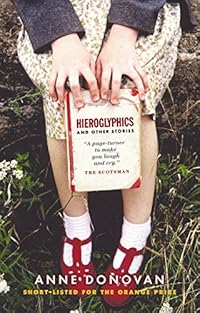
Hieroglyphics by Anne Donovan

Canongate, 2004, 173 p.

This is a fine collection of short stories by the author, whose novels Buddha Da, Gone Are the Leaves and Being Emily I enjoyed immensely. As a glance at the titles shows, most of the stories here are written in very broad Glasgow dialect.

Title story Hieroglyphics is narrated by Mary, a schoolgirl who cannot read nor write because all she sees is the letters “diddlin aboot.” Inspired by her knowledge of Egyptians her class studied in Primary School she can however express herself using pictograms.
Clare, the narrator of All That Glisters, is also a schoolgirl. Her father is bedridden from asbestosis but she brightens his life with a Christmas card she made for him using glitter pens. The ending is bitter sweet.
The Ice Horse is a rocking horse kept in the cold shed at Anna’s grandfather’s home. Her dearest wish is to look into its un-ice-covered eyes.
Virtual Pals is in the form of an exchange of emails between Siobhan and Irina. The latter was supposed to live in Shetland but her replies are emailed from Jupiter. This gives Donovan the opportunity to comment on the mores of young teenage life in Glasgow.
In Dear Santa another young girl who feels her younger sister is her parents’ favourite swithers about asking Santa for what she really wants for Christmas.
Wanny the Lassies is the tale of a schoolgirl causing problems for her male teacher through an essay indicating he had inappropriate relations with her.
A Chitterin Bite draws a parallel between the betrayal of a young girl by the friend she goes swimming with who drops her by taking up with a boy, to her later affair with a married man.
Me and the Babbie tells of the intense bond a mother feels with her new-born son.
In Away in a Manger a mother and her child go to see the Christmas Lights in Glasgow’s George Square. Both are shocked to see a homeless man in the background of the nativity tableau.
The Doll’s House her father made for her is being decorated by a mother for her son.
While out Brambling a woman and her child get lost.
A mature student takes some children for drama classes in The Workshop. It brings her into close contact with their male teacher.
Marking Time tells of a South European immigrant to Glasgow who remembers his time sweeping the beach of his home town when news of a bequest reaches him.
A Ringin Frost is the story of a woman whose husband is the only person who can warm her cold heart.
In A Change of Hert a woman searches for the reason why her husband’s preferences have changed after his heart transplant.
Dindy is told in short paragraphs illustrating fragments of memory.
Loast is narrated by an unmarried woman losing in old age her memory for words.
Zimmerobics is the bright idea of a young woman to lighten the existence of people in an old folks’ home.

Pedant’s corner:- “chitterin bite” (usually spelled chittery bite,) “aware that this eyes scan the room” (his eyes,) “painted the it coral pink” (no ‘the’ needed,) “round the the cars” (has a ‘the’ too many.)

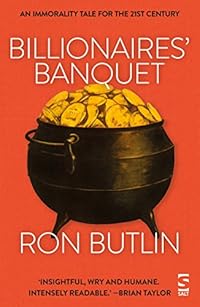
Billionaires’ Banquet: an immorality tale for the 21st century by Ron Butlin

Salt, 2017, p.

The story is split between 1985, when its main characters first meet as residents at Barclay Towers in Edinburgh, and events surrounding the Occupy protests of 2005. In 1985 Hume is drifting, waiting to find a job after his University degree. His more or less girlfriend Cat’s thoughts are ruled by mathematics. Ex-theology student St Francis is obsessed with finding the proper arrangement of his furniture. One night they are joined in the flat by DD (Diana the Damned as she calls herself) who accompanies Hume to a party. Soon Cat has taken herself off and Hume is in a long-term relationship with DD. St Francis befriends Megan, who had been begging on the streets – a new, shocking, thing in Thatcher’s Britain. Hume’s efforts to begin to make money lead to a role providing butling services to the middle classes.

Twenty years later Hume has made it and has conceived the idea for a Billionaires’ Banquet where the rich will consume only rice and water for the evening – at enormous cost – for charity. Hume’s embroilment with the activities of Melville, an Edinburgh gangster, will lead to complications for Hume, DD – now an addict on happy pills – St Francis, Megan, who has her head screwed on as far as Melville’s likely reactions to Hume’s decision to go it alone are concerned, and Cat, returned from her professorship in Australia for a conference only to get caught up unwillingly in the Occupy protests.

This precis sounds like the book is a thriller but it really isn’t. It’s an examination of youthful naivety and the compromises people make when finding their place in the world. It’s also a between the lines commentary on the change in public mores brought on by the Thatcher years. The characters are entirely believable (though DD’s later reliance on drugs for her to function is a bit overdone. Then again, it has a plot purpose.) However, the leap of twenty years between the two halves of the story jars a little. Butlin’s writing has some sharp observations and is never less than engaging.

Pedant’s corner:- “a dice” (dice is plural, one of them is a die,) “to get off his ass” (arse,) Spanis (Spanish,) paus (pause,) “ordinary men and woman” (women.)

Clydesiders at War by Margaret Thomson Davis

B&W, 2002, 252 p.

This is the third in Thomson’s trilogy which I only picked up because the second of the series had scenes set at the Empire Exhibition held in Glasgow in 1938. This one carries on the interrelated stories of the Cartwright and Gourlay families into the Second World War.

The book starts with the reconciliation of Wincey, who had fled her upper middle class home after the demise of her abusive grandfather – a death for which she erroneously felt responsible – to find refuge with the resolutely working class Gourlays. Davis again contrasts the welcoming acceptance of the Gourlays with the sterility of the Cartwright family’s relationships. Mrs Cartwright, Wincey’s grandmother is a stand out in this regard but has fewer appearances in this third instalment.

Wincey begins to spend her weekends at her parents’ home but still stays with the Gourlays during the week. Her mother, Victoria, is always pained by the fact that she refers to the Gourlays’ house as home. The war, when it comes, impinges on everything. The Doctor who became Wincey’s man friend but whom she can’t quite commit to because of her childhood trauma joins the navy and dies at Dunkirk. Malcy, the widower of Charlotte Gourlay (who was killed in a car accident in book two,) receives disfiguring injuries in the evacuation. Two of the Gourlay sisters are killed in the Clydebank blitz. Wincey’s parents become estranged by their war work; she as a nurse, he in the Home Guard.

All this is told in a workmanlike prose that is always easy to read but somehow unsatisfying. The characters have little emotional depth and sometimes are mere mouthpieces for events in the wider world. The chronology of those events is also frequently out of skew. There is too much telling, not enough showing, and occasional unnecessary asides elaborating on things the reader knew, or can work out for, him- or herself.

Moreover, the central development in the book – the rapprochement between Wincey and Malcy – is psychologically unconvincing. It is almost as if Davis herself had forgotten how things stood between them in Book Two.

Her trilogy is an echo of a past age but not really a close examination of it.

Pedant’s corner:- “‘But she makes that angry the way she treats you’” (But she makes me that angry the way she treats you’,) “the government were telling people” (the government was telling people,) a missing opening quote mark t the beginning of a piece of direct speech, “London was now the bombers primary target” (bombers’,) “‘she doesn’t mean it as slight on you’” (as a slight,) “with Nicholas in the part” (with Nicholas in the past.) “‘Tell her I asking for her’” (I’m asking,) homeopathic/homeopathy (several times; homoeopathic/homeopathy, or, even better, homœopathic/homœopathy,) a missing question mark, “saying’ Grow your own, can your own’” (saying, ‘Grow your own, can your own’.)

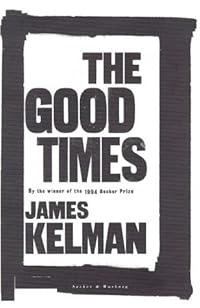
The Good Times by James Kelman

Secker & Warburg, 1998, 252 p, including ii p Contents.

This is a collection of Kelman’s short stories. Most contain West of Scotland phrases and dialogue. Two are written in absolutely standard English (apart from the contractions for was not, did not, could not etc – which appear without apostrophes throughout the book.) I Was Asking a Question Too concerns a man who notes down snippets he thinks are important from the books he reads, and Some thoughts that morning, the random musings of a commuter on the Glasgow Underground heading east from Hillhead to Kelvingrove.

The other stories feature; a man good at climbing buildings, rones and roofs; another, fond of books, who is happy at the changes garden work has made in his physique; workplace gripes and arguments; a married man scaring his family by contemplating swimming over a nuclear submarine; a conversation in a Job Centre queue; a young father imagining what it would have been like to have worked as a fur trapper; a man going through stages of despair and disorganisation after his woman has left him; another at odds with his wife as they browse a charity shop; one more finding himself reminiscing about his schooldays as he nurses his drinks in a pub while waiting for his wife to turn up; another tries to dodge being seen as he appears to be drowning a cat; another muses on how relationships turn sour, someone thinks about how viscous his blood is when he cuts himself preparing vegetables; a divorcee of five years is annoyed when his mate uses him as cover for cheating on his wife; a man of no fixed abode rambles the south coast and remembers his past life; a couple banter about her woman’s intuition; a young man tries to fathom out his girlfriend; a middle-aged insomniac thinks things could be worse.

In the longest story, Comic Cuts, a group of Scottish men gathered in someone’s house in London after a night in the pub shoot the breeze while waiting for soup that never arrives. Their conversation is full of digressions, interruptions and non-sequiturs, and not without intellectual hi-jinks.

Reminiscing about the times when Scotland regularly beat the English at football gives us the thought, “Funny thing but we were a crabbit bunch of bastards at the same time. Nowadays every cunt gubs us and we’re fucking cheery about it. Maybe if we stopped being so fucking cheery we’d start winning again. The tartan army and aw that crap, we used to be the worst hooligans of the fucking lot. See this stuff about good-natured fans? it’s a load of shite.”

One of the protagonists is of the opinion, “Men are more romantic than women of course that goes without saying,” but goes on to say, “It’s just how I am, a demonstrative person, a most untypical Scottish male.”

Pedant’s corner:- “See this stuff about good-natured fans? it’s a load of shite.” (See this stuff about good-natured fans? It’s a load of shite.”) “in the off chance” (on the off chance,) bolls, (as in ‘testicles’; I don’t see the need to change the spelling from balls,) a tendency to render proper nouns in the lower case, jiggerey-pokery (usually spelled jiggery-pokery,) “a piece on jam” (I’ve always understood the phrase to be ‘a piece and jam’,) “highjack a dialogue” (why not hijack?) “If you think ought of severity” (aught of severity,) a missing full stop.

Morning Tide by Neil M Gunn

Chivers, 1993, 371p. First published 1931.

Like Highland River, this is a tale steeped in Gunn’s experience of growing up in the coastal village of Dunbeath in Caithness. The viewpoint character is Hugh MacBeth, youngest son of the family but old enough to be tasked with collecting mussels with which to bait his father’s fishing nets. Part One is a slow unfolding of the realities of living slightly away from the small community but nevertheless enmeshed in it and displays a deep knowledge of the fishing life and empathy for a child on the cusp of early manhood. Hugh’s sister Grace has been away working in a city but recently returned home. He is mildly disturbed by meeting her walking along the road one evening with Charlie Chisholm, with whom his other sister, Kirsty, apparently has an understanding. His father is an accomplished seaman but his mother is opposed to any venturing out in boats by his elder brother Alan, since the McHughs’ other son, Finlay, had drowned several years before. The dramatic climax comes when Alan has offered to take a place in another man’s boat due to a crewman’s indisposition. A storm brews up shortly after the boats are out and a magnificently described passage shows us the perils of trying to make safe harbour in a raging sea and the fears of the women – and men – on the shore. Alan’s boat grounds just outside the harbour mouth but lines cast out from the shore help all to safety. In the meantime Hugh’s father’s boat appears doomed to all the observers when it materialises out of the rolling swells. Yet he times the approach and angle to the small harbour entrance to catch a wave surging into its shelter.

Part Two sees Hugh’s initiation into the company of older men and involvement in a ploy to poach salmon from the upper reaches of the local river, on the return from which he overhears Kirsty and Charlie Chisholm having a serious conversation about their relationship. By this time Alan has resolved to make a life for himself in Australia, an outcome which his mother much prefers to a life on the boats even though she is unlikely ever to see him again.

Hugh’s interactions with his peers and elders and theirs with him and each other are all firmly rooted. Understated love, minor betrayals, low-key heroism, the exigencies of a hard life (when doctors are only available by calling at their houses and even then may be out on a call) are all implied rather than underlined. This is a fine novel.

Pedant’s corner:- Magus (elsewhere Magnus.) “Bows rained on his own face” (Blows rained,) page 40 refers twice to Sandy – this is the name given to another character not in the scene. It is Hugh who is, and Hugh who is meant. “Icredible” (Incredible,) “a light in Morags” (Morag’s,) “tears navigating he zigzag furrows” (the zigzag furrows,) a missing full stop. “Ner’er” (Ne’er,) “a breat of snow” (a breath.) His conused mind” (confused,) “thrust two half-crowns into this pocket” (his pocket.) “He seemed to playing a game” (to be playing a game,) “he grilse rolled in his jersey” (the grilse.) “Cast they bread upon the waters” (Cast thy bread) not yet riches (nor yet riches.)

Lobsters on the Agenda by Naomi Mitchison

House of Lochar, 1997, 251 p, plus ix p Introduction by Isobel Murray and i p About the Author. First published 1952.

This is a deceptively unshowy tale of a week in a Highland district in which apparently nothing much happens but by the end a lot has been resolved. It starts with widow Kate Snow, a trained doctor but now not practising – only occasionally called in as a locum – milking her cows, and receiving a visit from a man called Chuckie with the news that a cache of lobsters belonging to Matta has been stolen. This is a shocking circumstance as it means someone from the local community is responsible. Thereafter the question of the lobsters pops up from time to time – at least until the explanation is revealed near the end – but the main preoccupation of the village of Port Sonas is whether or not it ought to have a Village Hall. There is also an incident involving one of the boarded-out children from Glasgow being treated unfairly by the man of the house where she is billeted and an outbreak of measles in a family from up the valley. The Hall is the most easily dealt with issue at hand; others such as the state of the roads and whether or not there will ever be a bridge built across the loch to shorten the locals’ journeys require much more investment. Kate of course being a modern-minded person and indeed a District Councillor is in favour of the Hall and becomes chairwoman of the committee set up to facilitate it. Despite her status as a doctor and District Councillor Kate is still the subject of sexism, asked by a male Councillor if she knows anyone suitable – as if it’s up to her to find a cleaner for the school toilets.

Naturally most of the opposition comes from the churches, not so much the Established Church but the more hardline Free Presbyterians and even harder line Wee Frees. At one point Kate thinks about some women who speak against the Hall. “They wanted to believe evil. They were brought up to think in terms of sin. They would have liked to have sinned themselves, to have some pleasant memories to brood over – as most of the men had. But when you think of sin in terms of sex and when birth control is ill understood, women can’t afford to sin.” This is also an example of the novel’s more or less candid approach to sexual matters. The question of the nature of relations between men and women is more open here than in most Scottish books of the novel’s era. Lad about town (well village) Donnie Cameron, dragged to church every Sunday by his staunch father, is set to make a “godly union” with his cousin from Halbost but, though never seen with them, finds time to dally with lassies – especially one always referred to as Kenny’s Chrissie. She in turn, via a lawyer, sends Roddy MacRimmon a letter accusing him of being the father of her (still not showing) baby. While not denying spending time with her he is adamant he is innocent of that particular offence. “‘She never had her skirt up. Not for me.’”

Opposition to the Hall is not intrinsic. Through Kate the author tells us “any association that was not directly of the church was a distraction, was a temptation and a leading away from the true race and the only goal. Therefore all such things were evil, whatever good earthly intention they might have, aye all, Boy Scouts, political parties, the Women’s Rural Institutes, the Farmer’s Union, above all anything which in any way encouraged games, dancing, the heathen Highland pipes or any other thing to do with the body where Satan might enter to seize from there on the soul.” The most strict local Minister, Mr Munro, was “mainly troubled in the Lord over two things. One was the Roman Catholic Church, forever assailing the realm of Scotland, and the other was the Port Sonas Village Hall.” He had come to the conclusion that Village Halls were part of a Papist plot. This, despite the fact that, from the text, there appear to be no Roman Catholics at all in Port Sonas.

The fear of modernity is at the heart of it, not lost on Kate herself, as she says to a friend, “‘Odd, isn’t it? These things which have come in our own time: the cinema and the wireless, and both breaking up the community! And when there’s the television, we won’t need to go out of our own lonely room.’” Her attitude to the churches is perhaps reflective of Mitchison’s own, “‘If once we could start treating the Ministers like ordinary decent folk, we’d get help out of the churches instead of the harm they mostly do. ….. You know there are a few folk who contrive to be good without the fear of hellfire at their tails. But maybe we’ll not manage to treat the Ministers right till they stop wanting to be treated as something special.’”

A curious addition to the list of characters is a member of the Highland Panel, come to assess the possibility of allocating funds for the Hall. This is a “‘Mrs Mitchison from Carradale. She writes books.’” This may be an attempt by the author to deflect suspicion that Kate is in fact her avatar. I also mused on whether this is where Orhan Pamuk might have got the idea of referring to himself in his novels. But I don’t suppose there’s any reason to believe he’s ever read Scottish Fiction of any kind, still less Mitchison.

The concerns over change in the community are bound up with the thought that the Highland way of life is in danger. Kate puts this into perspective when she thinks, “You could sum up the Highland way of life, she thought, if you were unkind, in four words: devilment, obligement, refreshment, buggerment.”

This novel is steeped in that way of life, speech patterns and all, only aspects of which now remain seventy years on, yet the capacity for gossip and innuendo, interest in other folk, is a human perennial. These are recognisable people, behaving in familiar ways.

Pedant’s corner:- commas before and at the end of a piece of direct speech in a continuing sentence are routinely omitted, “The Revie’s had come” (Revies,) oursel’s (this is ‘ourselves’. It’s a plural so does not need that apostrophe,) gunwhale (gunwale, and spelled as such on the next page.) “‘Were you thinking ou an extension, Dugal?’” (printer’s typo? ‘u’ for ‘n’? ‘thinking on’,) a-hold (ahold,) an end quote mark inserted into the middle of a speech, Bits’ (Bits’s.) “‘So long as it’ no’ me’” (it’s,) crochety (crotchety,) rhodies (x 3, rhoddies,) Balnafearcha (elsewhere always Balnafearchar,) “all it’s horrible narrowness” (its,) “an seven-day incubation period” (a seven-day,) Angus’ (x 2, Angus’s,)

To Be Continued by James Robertson

Or, Conversations with a Toad Penguin, 2017, 332 p.

The Scottish novel is not noted for humour, nor even light-heartedness. Neither can that be attributed to the author of this one, whose previous forays into the realms of Scottish letters have dealt with serious issues – Covenanting times, meetings with the Devil, slavery, the independence question, and the Lockerbie bombing. Yet this can only be described as a comic novel. There’s really not another way to describe a book in which not just one but three characters have conversations with, and a couple of sections are narrated by, a member of the species Bufo bufo – the common toad (though it describes itself as uncommon.)

Douglas Findhorn Elder’s life is drifting. Having taken voluntary redundancy from his job at the Spear newspaper, his relationship with Sonya Strachan foundering, his mother dead, his father Thomas Ythan Elder in a care home, he has moved back into the parental home. On the way to the funeral of a former colleague on his fiftieth birthday on a bus that is stuck in traffic he reflects ruefully on his situation. That evening, stepping out onto a patio – what his father called the sitootery, or in inclement weather the raindaffery, or even the naechancery, but when it’s bitter cold, the skitery – he finds himself having a conversation with a toad; a toad whom they mutually agree to name Mungo Forth Mungo (since the Elder family always gives itself a middle name after a Scottish river,) a toad which gives him a different perspective on life.

The early chapters detail Douglas’s somewhat drab existence and include an awkward encounter with Sonya’s daughter Paula, a commentary by Ollie Buckthorn – still on the Spear’s payroll – on the exquisite embarrassments of the procedure to obtain a sample for the bowel cancer screening test plus the frustrations of a visit to the home where his dementia struck father is now living.

The main plot motors up when Douglas is asked by the Spear’s editor to undertake a series of (fee unspecified) freelance pieces on the Idea of Scotland, to gauge how the nation sits after the Independence referendum. During this encounter Douglas lets us know he hates the word ‘heft.’ “Book reviewers use it to describe tedious literary novels that they feel obliged, tedium notwithstanding, to admire.” The series is to start with an interview with forgotten near centenarian novelist Rosalind Munlochy, who lives in a house called Glentaragar somewhere in the wilds of Argyll.

Both Douglas’s conversations with Mungo (which are numbered) and the extracts from Rosalind Munlochy’s biography which he provides us with are concluded with the words [To be continued] thus giving the novel its title.

The journey to Glentaragar will not be easy. Sonya has refused Douglas’s request to use their car and he will have to travel by public transport. As it turns out he is deposited at a request stop at the apparently deserted Shira Inn and, since it’s quiet, is asked to man the bar by Malcolm the manager while he goes off on a quest of his own. A musician called Stuart Crathes MacCrimmon drops in and starts to drink the place dry, as do various groups of tourists. A woman named Xanthe who seems to know the place well calls in, starts to help and takes a shine to Douglas.

The next day both Xanthe and MacCrimmon have vanished and Douglas makes his way to the Glen Araich Lodge Hotel, near Glentaragar, to find the manager, Ruaraidh MacLagan, is identical to McCrimmon but will not admit it. It is here that a subplot involving the whiskies Glen Gloming and Salmon’s Leap enters the picture.

Yet more confusion awaits Douglas once he has hitch-hiked to Glentaragar and finds the house’s general factotum Corryvreckan is also a double (triple!) for MacCrimmon and MacLagan and moreover that Rosalind Munlochy’s granddaughter Poppy is actually the Xanthe he’d met the day before. In her case the reason is simple, she had wanted to check Douglas out before allowing him to interview her grandmother. The fact that she had checked him out thoroughly does not ameliorate his initial discomfort.

Rosalind, though, is engaging and an obliging interviewee, “‘People wade in it’ (knowledge) ‘now without any sense of direction or any notion of what it is they are wading in,’” but is at cross purposes as she believes Douglas has come to inquire into a family secret relating to Rosalind’s daughter (Poppy’s mother.)

The tanglings of the plot are cleverly worked. Corryvreckan turns out to be an Englishman who had sought a bolthole. Poppy says of him, “‘he went native. It’s not uncommon in the Highlands.’” The whisky sub-plot links in both to Corryvreckan’s present and past and to Douglas’s life in Edinburgh. Unlikely connections are established – in one case re-established. Ends that had not seemed loose are tied up. The novel finishes affirmatively.

Along the way Mungo Forth Mungo has some of the best lines, “If someone tells you that there are already enough stories in the world, they are missing the point. The point is the world is stories,” and has a justified rant on the dispositions of human thought, “‘We, or our ancestors, have been around a hundred times longer than you, a thousand times longer …… You think you know more than we do …. that you are greater than any other living thing. But the toad, the toadstool, the ant, the blackbird, the deer, the daffodil, the jellyfish – you are less than all of these … You know nothing and have nothing and are nothing.’” A demonstration that a novel doesn’t need to have heft to have something worthwhile to communicate.

Pedant’s corner:- sailboat (sailing boat,) staunch (stanch.)

free hit counter script