Archives » Scottish Fiction

The Heart of Mid-Lothian by Walter Scott

The Edinburgh Edition of the Waverley Novels, Edinburgh University Press, 2011, 470 p plus 59 p Essay on the Text, 50 p Emendation list, 2 p list of end-of-line “hard” hyphens, 40 p Historical Note, 120 p Explanatory Notes, 50 p Glossary, 2p maps of Edinburgh, iv p General Introduction to the Edinburgh Edition, and iii p Acknowledgements. One of the Herald’s “100” best Scottish Fiction Books.

The Edinburgh Edition has sought to produce the nearest approximation to what Scott intended by using as base texts the first publications and Scott’s manuscripts of the relevant novels. The Heart of Mid-Lothian – the novel which, by way of a dance hall, provided the name for a Scottish Football Club – was seemingly the work which suffered most in the hands of such intermediaries as copyists, typesetters and editors. The length of the emendation list here attests to this. In this edition the explanatory notes work out at an average of four for every page of text! To consult them with this frequency would have interrupted the flow of reading so for the most part I left them till I had finished the novel, only consulting them during its course when absolutely necessary.
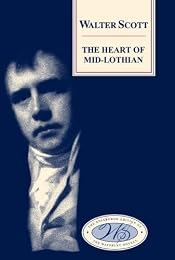
The Heart of Mid-Lothian cover

The story is supposedly set down by one Jedidiah Cleishbotham as one of his Tales of My Landlord, Peter Pattieson, only he had it from conversations in an inn with three gentlemen he had helped rescue from deposition in a river by an upturned coach, two of whom were lawyers and the other once jailed through indebtedness. This is of course merely a framing device to introduce a story whose beginnings lie in the Edinburgh tolbooth (the gaol situated at the Heart of Mid-Lothian) and the Porteous riots of 1736 where a commander of the city guard was lynched after being pardoned for killing innocent civilians during a disturbance at an earlier public hanging. The story places in the tolbooth at the time Effie Deans, awaiting trial for concealment of her pregnancy, a crime taken to be evidence of intent to murder the child when it was born. Her lover, it turns out, was involved with instigating the riots and had immediately before the birth placed Effie and hence their son into the hands of old acquaintances of his who were less than reliable. Effie’s post-partum indisposition due to puerperal fever renders her incapable of accounting for her son’s whereabouts.

Effie is the daughter of David Deans, a staunch Presbyterian of the old school, a former Covenanter still unreconciled to the modern practices of the Church of Scotland and its accommodation with the State. Effie’s half-sister, Jeanie, has it in her power to prevent Effie’s conviction but due to her conscience and strict upbringing will not swear falsely that Effie informed her of her condition. As a result, Effie is found guilty and sentenced to death. Jeanie resolves to walk to London to enlist the help of the Duke of Argyle to petition the King for a pardon. While her encounters en route make for a novel whose parts are an interconnected artistic whole they do seem a little implausible. However, if you like loose ends to be successfully tied up you won’t be disappointed.

As with Rob Roy Scott’s wordiness can be wearing at first, but I soon accommodated myself to it.

While Jeanie is the undoubted heroine of the book the whole may also be seen as an exploration of the ramifications of an unjust law. From the perspective of two hundred years on Effie’s predicament exemplifies a pronounced tendency among religions to make women the gatekeepers to male sexuality and to punish them rather than their equally (in many cases more) culpable partner for any transgressions. I suppose women were and are easier to identify as culprits since the evidence of “sin” becomes all too readily apparent. It nevertheless reflects the not yet eradicated widespread misogyny (itself an expression of fear of women’s capabilities and of rejection; a manifestation of deep seated insecurity) prevalent throughout history.

There is, though, a reading in which The Heart of Mid-Lothian is actually a chronicle of the life of David Deans, his steadfastness and surety, and also a marking of the beginnings of the long, slow fading of the Covenanting mindset, still not quite extinguished.

Pedant’s corner:- As in Rob Roy; stupified, plus sunk, shrunk, sprung, sung, rung, run for sank, shrank, sprang, sang, rang, ran. These are Scottish usages at the time Scott was writing and still survive in some everyday speech. We also had wrang for wrung (once, but elsewhere wrung appeared) and flang for flung. The editors do say that Scott would add flourishes to certain instances of the letter “u” which may have led to some of these. Despite the care which the editors have taken we also had whichshould (which should,) ofhabitual (of habitual,) the hangman is designated the Doomster on page 217 (twice) but on page 218 is referred to as the Dempster, whisht (as I noted on Keith Roberts’s The Lordly Ones this is nowadays usually spelled wheesht but obviously Scott did not,) the text has Dumbartonshire – or shires – but the emendation list mentions one instance where Scott’s manuscript has Dunbarton Shires. I believe the spelling has altered through time, reverting to Dunbartonshire for the county by 1914. In the historical note: Presbbytery (Presbytery.) In the explanatory notes: “is a now an obsolete usage” (has one too many indefinite articles,) Galations (Galatians.)
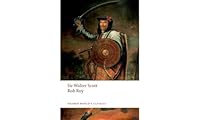
Rob Roy by Sir Walter Scott

Oxford World’s Classics, 2008, 505 p including advertisement to the first edition, author’s introduction, postscript, Scott’s notes, editor’s notes and glossary + xl p acknowledgements, introduction, note on the text, select bibliography, a chronology of Sir Walter Scott and a map of Rob Roy’s Country.

One of the 100 best Scottish Books

 Rob Roy cover

Well, this is odd. The book’s title is Rob Roy and while that gentleman does appear within it it is not until over 100 pages in that he first crops up and even then his name is not revealed as such. The narration is in the first person by one Francis (Frank) Osbaldistone, son of a self-made man in London, who has been disowned by his father for not going into the family business and banished to the ancestral home in Northumberland. It is on the journey north that Frank encounters a certain Mr Campbell as well as a Mr Morris who is over protective of the contents of his luggage.

At Osbaldistone Hall (whose inhabitants, unlike the proud Protestant Frank, are all, barring their Scottish gardener, Andrew Fairservice, Catholics) Frank meets and falls under the spell of the unconventional Diana Vernon, the niece of his uncle Sir Hildebrand, and encounters the villain of the piece, his cousin Rashleigh. Both contrive to save Frank from the charge of robbing Mr Morris by enlisting the aid of Mr Campbell. At the Hall Frank notices unusual goings-on at night but his deference to Diana ensures he does not inquire into their nature too closely.

After some longueurs at the Hall the plot kicks into gear when news reaches Frank of the potential ruin of his father which requires he travel to Glasgow to enlist the help of his father’s trading partners to recover sums of money Rashleigh has spirited away. Here he again encounters Mr Campbell, whose true nature as Rob Roy is finally revealed. Bailie Nicol Jarvie also becomes his travelling companion as they venture into the Southern Highlands where various perils to do with the planning and thwarting of the 1715 Jacobite rebellion are surmounted. During these, Rob Roy’s wife, Helen MacGregor, is presented as a fearsome creature (one of Scott’s notes suggests she had good reason to be so) and the Highlanders as some sort of equivalent of North American natives.

Even in all this Rob Roy still appears almost peripherally and as a character fails to spring to life. Another oddness is that Frank’s agency throughout the tale is limited to that of onlooker. (Spoilers follow.) Frank’s success in his quest to recover his father’s fortune owes more to Diana Vernon and Rob Roy than his own efforts and his father turns out in any case to have all but made good his reverses himself. In the latter stages of the book a quite frankly (ahem) ridiculous combination of circumstances sees all obstacles to Frank’s future fortunes and happiness removed. This is all carried through with a degree of prolixity in the prose which may be typical of early nineteenth century novels in general and Scott in particular but presents something of a barrier to modern readers. Perseverance reduces that problem, though.

Scott’s status as the begetter of the historical novel as a genre is founded on tales such as this and Kurt Wittig regarded him, along with Robert Burns, as at the high water mark of Scottish literature.

Pedant’s corner:- In Ian Duncan’s introduction: premiss (I prefer premise.) Otherwise: stupified (stupefied,) “domini regis” followed immediately by “Damn dominie regis” (one or the other spelling of domini surely?) acquaintance’ (acquaintance’s) and the archaic spellings dulness, tædium, sate (though sat appeared once,) Bagdad, fagots (faggotts,) winded (wound,) jailor (or is this a conflation of jailer and gaolor?) Bucklivie (Buchlyvie,) and Aberfoil (Aberfoyle.) Sprung, sunk and rung were used consistently where sprang, sank and rang are the modern usages.

Black and Blue by Ian Rankin

Orion, 1997, 399 p including 2 p Afterword and 1 p Acknowledgements.

This novel appears in both the 100 best Scottish Books list and in the Herald’s “100” best Scottish Fiction Books.

 Black and Blue cover

It is the eighth of Rankin’s Rebus novels and sees Inspector John Rebus, banished to Craigmillar for various indiscretions, and investigating the suspicious death of Allan Mitchison, an oil worker who had made unfortunate connections. It is not long before Rebus is once more ruffling feathers, both of his superiors and of the criminal fraternity. His nose for the truth and the links he makes to a current serial killer nicknamed Johnny Bible (because of the similarities of his murders to the famous Bible John case of the 1960s) leads Rebus to Glasgow, Aberdeen, Shetland and an oil-rig in the North Sea. Meanwhile he is incidentally trying to deal with his over-fondness for alcohol and also being stalked by a TV crew looking into a possible miscarriage of justice from early in Rebus’s career. It’s all admirably well plotted and suitably twisted and turned. If a bit too much when Rebus himself is questioned for one of Johnny Bible’s murders.

Where it broke down for me was the interpolation into the story of “Bible John” himself, returned to Scotland from time spent in the US where he had married, now an executive in the oil business, not at all pleased that some upstart is stealing his thunder, and whose viewpoint we inhabit at the end of several of the chapters. I think my unease would have been the case even without the renewed interest in Bible John which struck between the writing of Black and Blue and its publication and the later possibility that Bible John was/is convicted killer Peter Tobin. To me it seemed Rankin portrays his “Bible John” as a more intelligent, even thoughtful, individual than he in fact was/is.

On Aberdeen’s dependence on oil money Rebus reflects that the oil won’t be there for ever. “Growing up in Fife Rebus had seen the same with coal: no one planned for the day it would run out. When it did hope ran out with it.” True as far as it goes. Except the coal didn’t run out: there’s still plenty coal under Fife or the Firth of Forth. It was government policy to shut mines – mostly to destroy workers’ rights and trade union influence.

Yes, it deals with one of the most high profile Scottish criminal cases of the twentieth century and has Tom Nairn’s dictum on the conditions for Scotland’s rebirth as a section’s epigraph but I can see no compelling reason why this book should be in a top one hundred.

Pedant’s corner:- halogen orange (of street lights? Sodium orange, yes,) there were a couple (was,) there were a few (was,) a team were (was,) – the text is littered with singular nouns followed by plural verbs – Geddes’ (appeared several times, yet once we had what I would prefer, Geddes’s,) there were dozens fit the description (fitted,) popadums (it’s usually poppadums,) Stevens’ (Stevens’s,) disks (even for computers the British English is still discs,) dishels, (???) thirty-five mils (mil; an abbreviation subsumes its plural, even when it’s written as it’s spoken,) ‘Laying low.’ (Lying low; but it was in dialogue and lying low appeared in text later,) Forres’ (Forres’s,) sat (sitting,) McIness’ (McIness’s.)

Satellite 5 and New Books

 Secret Language cover
 Pelquin's Comet cover

At the weekend I was away again, this time in Glasgow for the Satellite 5 Science Fiction Convention.

I met up with a few old friends from the Scottish SF scene, was a member of a panel on the subject of Writing Space – How do SF writers an­d artist­s make their fu­tur­istic tech­nology be­liev­able? And does it really mat­ter i­f they don’t? (I don’t think I made an idiot of myself.)

I was also introduced briefly to the editor of Shoreline of Infinity, a new SF magazine/ezine and a potential home for stories.

Not to mention buying a copy of Neil Williamson’s latest story collection Secret Language published by NewCon Press, so hot off the presses it hasn’t been officially released yet.

And that nice man Ian Whates, publisher at NewCon, gave me a copy of his Pelquin’s Comet as his thank you for doing the proof-reading on it.

In Another Light by Andrew Greig

Pheonix, 2004, 510 p.

In Another Light cover

Love, sex and death again; but literature’s subject matter doesn’t get any bigger. And Greig deals with them superbly.

In In Another Light it is death which is the early preoccupation of Eddie Mackay, though love and sex do get a look in. Prior to the immediate events of the novel Eddie suffered from hydrocephalus as a result of a colloid cyst which meant fluid built up in his brain. He therefore feels the imminence of extinction everywhere, “‘Because I was nearly dead once and I’m trying to live with that.’” During his recovery from having a shunt fitted to drain the fluid from his brain to his stomach Eddie experiences the presence of his dead father, who according to Eddie’s mother had, long before she met him, been sent home in disgrace from Malaya after an affair with his superior’s wife. Eddie doubts the truth of this but sets out to find as much as he can about his father’s time in the colony. Eddie is working for a tidal generation project whose headquarters overlook Scapa Flow in Orkney. The jungle drums and the tangled relationships of Stromness become a running theme in the book. Of comments about his liaison with Mica Moar, another of Greig’s complicated female characters (a bit – but only a bit – like Kim Russell in Electric Brae) he says, “‘In my experience there’s only one way to keep a secret in a wee town’ … ‘Plant the sapling of truth in a forest of rumours.’”

This strand of the book, delivered in a first person past tense looking back over the path which brought Eddie to the final scene, with occasional present tense interludes setting that scene, is intertwined with a third person present tense narration of the voyage of his father Sandy, as he was then known, to Penang in Malaya and his brief sojourn there. Medical graduate Sandy hopes to improve the birth survival rates in Penang’s maternity hospital. The boat out is a hotbed of illicit goings on of which deeply moral Sandy is mildly contemptuous. The acquaintances he makes on the trip, US citizen Alan Hayman and the two Simpson sisters, Ann and Adele, “both beautiful, one a gazelle” the elder of whom, Adele, is married and chaperoning the younger, are fateful. A further sister, Emily, also on the boat, is still a child. Each chapter contains several sequences from both stories, generally alternating. The greeting, “‘Oh, there you are,’” bounces around the two narratives. Both strands are thick with metaphor. The descriptions of Orkney and Penang make them almost characters in themselves – particularly Orkney. Certain images also resonate between the two locations.

The text is seasoned with sly critiques of Scottish attitudes, “I was in joyous life-affirming Scottish mode that morning and no mistake.” “Scotland’s a place where everyone explains what is not possible, that it’ll all end in tears, we’re here to make the best of a bad job then die and get a good rest till we’re woken up to be informed we’re damned.” To Sandy’s traditional toast “‘Here’s tae us, wha’s like us? Gey few – and they’re aa deid’” Hayman says, “‘You guys, you can’t even celebrate without bringing death into it.’”

Eddie’s thoughts occasionally stray back to the subject of death. He raises with us the question of “How are we to live in the face of the sure and certain knowledge we will lose parents, friends, lover, the whole shebang and caboodle?” only to answer it immediately with, “Wholeheartedly. Of this one thing I am sure.” Later he tells us, “It’s such a simple and shallow thing, death, only there’s no bottom to it and no way across.”

He reflects that maturity is, “knowing you’ve more or less arrived at yourself and the world will keep changing but you won’t much, and then living with that,” while, “Pure lust, I’d noticed, eventually collapses under the weight of its own contradictions – rather like capitalism, but much quicker.” However, “We need meaning, I thought. The world might not have any, but we need it,” and, “Meaning is something we have to make.”

Greig’s numerous characters are all well drawn, their behaviour sometimes unexpected and contrary. I wouldn’t go quite so far as the cover quote (from The Times) “It will be a long time since a book has made you care as much.” Not for me. At least not since the same author’s Fair Helen. He seems to have a gift for it. Add in computer programmes for generating music from tidal movements, the compromises of secret service work in the colonies, a thoroughly worked through plot (which admittedly may be a little too neatly tied in,) the perennial failure of true love (or lust) to run smooth and the whole thing’s a delight.

Pedant’s corner:- “‘I’d left my [gas] mask back in the Mess’” (the Mess? In the trenches in WW1?) Brechin Pier (does Brechin have a pier?) “for a while neither of them speak” (neither speaks.) “Stacked alongside the reference books are a series of different coloured hardback files” (is a series,) baragraphs (barographs,) the phrase, “he was sad under his funny,” (seems to be missing a final word,) furlough (is more a USian usage,) “The Moonlight Band play foxtrots” (plays,) “a think about what the heck’s he’s getting into,” (what the heck,) sub-periphrenaic abscess (a google search for sub-periphrenaic yields only a quote from In Another Light: Andrew Greig,) whigmalerie (spelling of Scots words can be variable but this is usually whigmaleerie,) murmers (murmurs,) Theramin Dr Who electronic music (Theremin: also Dr Who’s electronic instrument wasn’t a theremin which as an instrument should be lower case,) “he scooped more peanuts down his maw” (I suppose it could mean stomach here,) “a group of macaque monkeys come running” (a group comes,) “He’s stares” (He stares,) whispy (context suggests wispy,) tweaked it it (one it is enough,) an assortment of … appear (an assortment appears,) Siouxie and the Banshees (doesn’t she spell it Siouxsie?) vocal chords (it’s cords,) Arshak Sarkies’ (Sarkies’s,) for completeness’ sake (completeness’s,) light defraction (diffraction? refraction? or is this a portmanteau word Greig has invented?) became (in a present tense narration this should be becomes.)

Fergus Lamont by Robin Jenkins

Canongate Classic, 1990, 351 p, including iii p introduction by Bob Tait. One of the Herald’s “100” best Scottish Fiction Books.

 Fergus Lamont cover

“Half Scotland sniggered and the other half scowled, when in letters to The Scotsman and The Glasgow Herald I put forward my suggestion that prisoners in Scottish jails be allowed to wear kilts, as their national birthright, if such was their wish.”

How can you not take an instant liking to a book of which the above is its first sentence? It certainly invites you to read on. Who can this quaintly opinionated, and perhaps ridiculous, individual be?

The interest in the kilt, though, is a marker. It is narrator Fergus Lamont’s signature apparel. One of those garments was the last gift he received from his mother before she walked into the local loch. She had married a man not Fergus’s father, left him for another – richer and much, much older – but had come back supposedly because of Fergus. She claimed Fergus’s true father was the son of the Earl of Darndaff – though others in the town said it was the under butler. However her fiercely Protestant (and resolutely anti-Catholic) father refused to speak to her, tipping her over the edge, not that that affected him. “My grandfather did not allow my mother to be buried in her own mother’s grave; nor did he go to her funeral. He displayed atrocious callousness; yet, by the sheer effrontery of faith, he compelled most people to think of him as a Christian of formidable and magnificent staunchness.” Fergus’s grandfather, like all those who profess to know the will of God, displays enormous self-righteousness. “‘You may be sure, Fergus, that if people are deserving of His help the Lord will not withhold it.’” Fergus is not convinced. “Young though I was, it seemed to me that it was really my grandfather himself who decided whether or not people deserved Jesus’s help…. There were some people with whom God, in my grandfather’s opinion, was displeased.”

The young Fergus had unthinkingly accepted the state of things; anti-Catholicism, the subtle social gradations of single-end, room-and-kitchen, two rooms and kitchen, up to the big houses in the west end of town. His nominal father, John Lamont, “wouldn’t say I was better or worse, but I was different. Whether this had anything to do with my having an earl for one grandfather, and a man of serious religious principles – he really meant a hypocrite – for the other, he wasn’t clever enough to say.”

Through his early life Fergus’s aspirations to his aristocratic connection grow but as his headmaster tells him, “‘You must bear in mind, Fergus, that the Scots landed gentry are a tribe apart. They do not speak like us. They go to considerable trouble and expense to avoid speaking like us. They are sent to exclusive English schools, to acquire their characteristic accent and peculiar habits.’” While recognising others’ sense he may not be quite what he seems he fakes it enough to achieve officer status – not to mention an MC – in the Great War and the attentions of a writer of romantic fiction (well aware of his humble origins) who more or less drags him into marriage. Though, as author, Jenkins does not dwell overlong on this aspect, a fear of being found out – even on the part of those who are perfectly competent – is a common emotion for a Scot. Throughout his life Fergus can never quite shake off the conflict between his compassion for those he has left behind and his reluctance to return without enough to show for having left.

The sense of distance engendered by his presumed, or actual, parentage (the identity of his sire is never revealed to us) allows Fergus to reflect on the foibles and dichotomies of his countrymen. “I was watching, I realised vaguely, a clash between two traditions in Scotland, that of love of learning and truth, and that of Calvinist narrow-minded vindictiveness.” “To the stern Calvinist no one was innocent, not even a new-born baby.” “Here was another conflict between two aspects of the Scottish soul…. mendacious sentimentality… and ironic truthfulness.” “It seemed to me that since Scotland was small, proud, poor, and intelligent, with a long history, she, better than any country I could think of… had an opportunity to create a society in which poverty and all its humiliations had been abolished, without refinement and spirituality being sacrificed. In the past the Scots had lost too many battles because, while waiting for the fighting to begin, they had been given prayers instead of second helpings.” The middle class “had throughout the centuries set up in Scotland a morality that put the ability to pay far in front of the necessity to forgive and love.” “For generations in Scotland bursary-winners and gold medallists have passed out of schools and universities, fixed in the belief that nothing has a value that cannot be marked out of a hundred. This is the reason why the Scots have failed as artists and patriots, but succeeded as engineers and theologians.” “Luckily the Scots are not a demonstrative or philoprogenitive race.” “Scotsmen do not find it easy to speak frankly of love, especially the physical aspects, without some protective coarseness. We call the act houghmagandy, and, alas, in the performance we are too apt to make it measure up or rather down to that crude term.”

But there is a kind of hope. “It is not the goodness of saints that makes us feel there is hope for humanity: it is the goodness of obscure men.”

When Fergus’s wife feels he is a hindrance to her social climbing and forces him out he takes the opportunity of a bequest to repair to the district of East Gerinish on Oronsay. Here he meets Kirstie McDonald, a child of nature, strong of limb and dressed in men’s clothes. They move in to his ancestral home (on his mother’s side) scratching a living from the poor soil. Of the local minister he is told, “He had nine children; eleven really, for two had died in infancy. Mrs Caligaskill was always ailing,” and thinks, “Without having seen this Caligaskill I hated him…. He represented that mixture of sanctified lust and hypocrisy which had stunted the soul of Scotland for centuries.” The passages dealing with this ten year long not-quite idyll, in many ways the time of Fergus’s life, do not linger on the page in the way those on his childhood did. In any case it is over too soon and island life is perhaps more judgemental than in the towns of the mainland. Only Kirstie had really accepted him. The doctor called in on her death warns Fergus, “‘You broke their rules. So did she. If one of them was to let a fit of pure Christianity get the better of him the Lord might be pleased, but I’m damned sure his congregation and colleagues wouldn’t,’” and, “‘You’re presupposing that tolerance is in itself a good thing. Not many people really believe that. Most of us are prepared to tolerate only what we understand and approve of.’” As a result the funeral has to be improvised. “‘Four ministers were asked,’ I replied. ‘All refused.’” Nevertheless the men of the island turn out in respect for Kirstie.

The promise that first sentence had of light-heartedness is not bourne out by the rest of Fergus Lamont which has a more serious mien. As a dissection of early to mid twentieth century Scottish mores and attitudes it is probably unexcelled.

Pedant’s corner:- peaver (usual spelling is peever,) medieval, the griping of buttocks (gripping?) “‘what she cannot know … that my books,’” (what she cannot know…is that my books…) Betty T Shields’ (Betty T Shields’s,) wheehst (usually the spelling is wheesht,) had never stank (stunk,) septagenarian (septuagenarian) a long (along.) “By cool Siloam’s shady hills” (Fergus – or Lamont – misremembers this. It’s actually shady rills.)

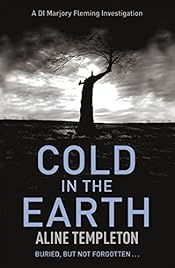
Cold in the Earth by Aline Templeton

Hodder, 2006, 366 p. One of the Herald’s “100” best Scottish Fiction Books. Returned to a threatened library.

Cold in the Earth cover

Set against the backdrop of the late 1990s foot-and-mouth outbreak this is a police procedural crime novel whose main viewpoint character is Detective Inspector Marjory Fleming,* wife of a farmer and mother of two children. Also prominent is the figure of Laura Sonfeldt, a psychologist newly returned to Britain from New York (and a failed marriage) and resolved to find out what happened to her sister who had disappeared from home over ten years before. There are also odd passages from the viewpoint of an at first mysterious third woman who is estranged from her family, the invitation by the author being for us to believe this is Laura’s sister.

For all I know the treatment may be typical of a crime novel, my acquaintance with that genre isn’t extensive, but I found it programmatic, with excessive information dumping and, for me, too much of a ‘by the numbers’ vibe to the writing. An underling with an annoying habit? ✔. A subordinate who is a loose cannon? ✔. Problematic relationships – this time with the detective’s father – ? ✔. A strained marriage? ✔ – but only because of the stress induced by the foot-and-mouth quarantine and subsequent slaughter. And the body, though we know from the somewhat overwritten prologue a murder has already taken place, doesn’t appear till page 136, a third of the way through the book, which seems a touch reticent. Then too there was a strained striving for an unusual angle with the introduction of therianthropy as an aspect of the character of one of the suspects. Then there was that coyness with regard to the third narrative viewpoint.

Detective/crime novels are not really my thing so the above ought to be read in that light but this novel was one of the entries in the Herald’s list of 100 best Scottish Fiction books (see link in this post’s header.) I severely doubt it would get close to my top 800. It did however contain the impeccably Scottish reflection, “It spoke to him, this countryside, in a language he’d all but forgotten at a level too deep to explain even to himself,” so fair dos.

*I did wonder if Templeton’s use of the name Marjory Fleming was somehow related to “Pet Marjory.” It is otherwise quite a coincidence.

Pedant’s corner:- his gas on a peep (at a peep,) Menzies’ (Menzies’s,) Jake Morgan, (Jake Mason,) bairns and weans used interchangeably, ‘Would I of done that if..?’ (Even in dialogue it irritates me that it wasn’t ‘Would I have done that?’)

The Holy City by Meg Henderson

Black and White, 2010, 321 p.
One of the Herald’s “100” best Scottish Fiction Books. Returned to a threatened library.

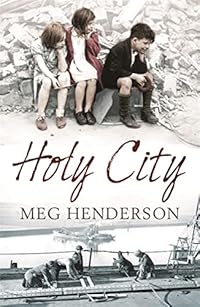
 The Holy City cover

The Holy City is narrated as the rememberings of near pensioner Marion Katie Macleod, who, at the age of eleven, lost all of her family – mother, father, brothers, sister, grandparents – in the Clydebank Blitz, hence found herself alone while resolving to look after Davy Ryan, the seven year-old neighbour in the bed beside her in the hospital where they were both recovering from wounds sustained in the bombings. This is a subject not unfamilar to me since a close friend of my parents had an elder brother killed in Clydebank during the bombing and was separated from his family – with nothing but the night clothes he was wearing at the time – and not restored to them for three years.

The book deals not only with the misfortunes Marion suffered as a result of the bombs but also the effects that war had both on her and other Clydebank residents. Interspersed in the text is the history of the town from the 1930s, encompassing the heyday and post-war demise of the shipyards and the workers’ treatment therein, the rise and fall of the Singer sewing machine factory – a significant landmark and employer in the town till its clock was demolished and the Japanese began to produce cheaper sewing machines in the millions. The Holy City was the name that had been given to the part of Clydebank which suffered most damage during the Luftwaffe raids as it apparently bore a resemblance to Jerusalem.

Henderson’s depiction of the community of working people rings true enough, their humour, camaraderie, the deep sense of ‘Us and Them’, their resentments – among which was the fact that the casualty figures were massaged (the text says for the sake of morale elsewhere) – their betrayal by economic circumstance. Marion is a resourceful and combative protagonist but the historical passages read more like pieces of journalism than a memoir. The picture of Jimmy Ryan – whom she marries when he returns from the war as the only means she has to keep her promise to herself to protect his brother Davy – as too damaged by his experiences as a Commando to function properly in civilian life again, withdrawn, unable to sustain a relationship, is well done. Henderson also highlights the scandal of the asbestos which has to be brushed off Jimmy every night on his return from work in the yards (which also permeated the air and covered the ground so that children could throw sodden clumps of it at each other) and leads to his premature death.

The text refers to the myth (sic) of ‘We can take it’ especially as regards the inhabitants of the equally devastated Liverpool in terms of “The reality was there was no choice. The people took it because they were forced to take it” by not being allowed to flee to the surrounding countryside (or being sent back if they did.) There may be some truth to the supposed official thought that bombing attacks led to the chance to shoot down German aeroplanes but there is a circularity to the proposition that lack of (civilian) targets would then give the German pilots pause. Would it? Yes losses did lead the Luftwaffe to give up daylight bombing in favour of night-time raids (the same was true for the RAF over Germany) yet there would still have been no shortage of targets. The raids on Clydebank may have been purely terror inspired – Hitler’s military attentions had by that time turned to the Soviet Union – but they had a strategic sheen. Despite the Luftwaffe’s lack of success in undermining British morale the thought persisted – on both sides – that bombing could win or at least shorten the war, witness the Allies continued air attacks on Germany till the war’s end; to achieve which end actually required ground troops to take and occupy Germany. But for the people being bombed there really was no choice. You either carry on with life as best you can in the circumstances or give up. Most British victims of bombing had nowhere else to go. So too for the Germans.

While Marion is an engaging, resourceful character and the conversations she engages in are lively – and occasionally barbed – there is something a little stilted about the whole. The historical interludes, though interesting, aren’t well enough integrated, the incident with which the novel starts and whose ongoing ramifications intersperse the narrative is not come back to sufficiently often, the loose ends are tied up a bit too neatly, showing too much of the authorial hand. The Holy City is good, well worth reading certainly. But a contender for entry in a list of 100 best Scottish books, though? Not for me.

Pedant’s corner:- Marion describes Helensburgh as by the seaside (I wouldn’t.) She also says it is six miles from Clydebank (make that 17.) The details of the sinking of the Bismarck are also wrong. There is a reference in dialogue to ‘wanno they science fiction stories, ye know the wans, where an impostor takes ower somebody’s life.’ Were these a common enough currency in the late 1940s to invite such a comparison?

The Secret Knowledge by Andrew Crumey

Dedalus, 2013, 234 p.

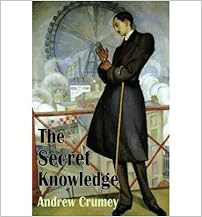
The Secret Knowledge cover

In The Secret Knowledge Andrew Crumey has done something out of the ordinary. He has illustrated a corollary of the Schrödinger’s cat scenario – the possibility of multiple worlds – in a piece of fiction written in realistic terms. His characters discuss the possibilities but in the text it is never really spelled out that different scenes take place in different worlds. We must infer it from the narrative. Utilising the concepts of quantum physics in a literary form has always been one of Crumey’s concerns, though, and here he also returns to another of his familiar themes, music.

The chapters alternate between the historical and the present day starting in Paris in 1913 where composer Pierre Klauer has just completed a piano piece (entitled Le Savoir Secret, hence – in part – our novel’s title,) has also just proposed to his girlfriend Yvette but kills himself (off-stage) moments later. In our time, Paige, a student of piano, has just been assigned the tutelage of part-time concert performer David Conroy after giving up a course in English because she loves music more. Conroy gives to her to play a manuscript that has just come into his possession. A manuscript written by an unknown French composer and entitled The Secret Knowledge.

We then go back to 1919 just prior to the “Battle of George Square” in Glasgow where a newly arrived young French man befriends socialist John Quinn outside an Engineering Works. The Frenchman stirs up a meeting and is of course named Pierre Klauer. So. Did Klauer actually die in 1913, or not? (According to one Schrödinger outcome it can be both – or neither.) There follows a narrative which skips between the doings of Conroy and Paige, Yvette (who marries Klauer’s friend Louis Carreau,) to 1924 where Theodor Adorno meets a man who introduces himself as Klauer, Spain in 1940 where Carreau – who had stolen Klauer’s manuscript for Yvette – has an encounter with the philosopher Walter Benjamin who then kills himself in the belief he will be returned to France and the Nazis, and 1941 where Adorno meets Hannah Arendt. During these the same scene may be returned to but is shown to be subtly different.

But as Conroy says, “Art is always inconsistent,” and, “Truth is not something we discover consciously; it discovers us.” He also muses on his disappeared wife, “It’s only when they surprise you that you find out your ignorance. We expect continuity, not paradox.” About a part of Le Savoir Secret he feels, “this section is the dream of how things might otherwise have been, a path denied.”

In a passage which could be all about the writer’s art we have, “‘A performer knows all about the tricks of persuasion. Yes, the game was rigged, you were always meant to lose, but go on, take a card, see what you get.’” One of the characters conceives a future project, “a book of fragments, epigrammatic, or even surreal in character, apparent irrelevancies serving to create new, unintended meaning,” a book which, presumably, Crumey intended us to be reading in The Secret Knowledge.

Other notable pieces of dialogue include, “Lenin has” (succeeded) “in Russia. Make everyone think it’s a popular revolution when really it’s a coup: that’s genius.” Mention is made too of Louis Auguste Blanqui and the Mechanical Turk – which has seemed to crop up a lot recently in the books I have read.

Not the simplest of narratives then but immensely readable just the same. The actual secret of Klauer’s manuscript is not quite the tremendous revelation we might have hoped for though. Crumey here hasn’t quite achieved the heights he did in previous novels but The Secret Knowledge is still a remarkable rendering of quantum physics in the form of an accessible piece of fiction.

Pedant’s corner:- “he no longer tours, or records” (nor records,) Louis’ (Louis’s,) “the roll of a dice” (one of them is a die.) “The family she saw are gliding over the top” (the family is gliding.) Crumey is a serial offender here – “the family were” (the family was,) “around its upper balcony stand a crowd” (stands a crowd,) “a young couple huddle in one corner” (a couple huddles.)

The Herald’s 100 Best Scottish Fiction Books.

The Herald – formerly The Glasgow Herald – is, along with Edinburgh’s The Scotsman, one of the two Scottish newspapers of note. (Aberdeen’s Press and Journal and Dundee’s Courier could never compare; not least in circulation terms.)

I found the following list of The Herald’s 100 Best Scottish Fiction recommendations just under a year ago at a now defunct webpage http://www.heraldscotland.com/books-and-poetry/your-100-best-scottish-novels where only thirty works were actually given; with a solicitation to readers for further suggestions. Perhaps the page has been removed. It provides some fuel for future reading, though.

Of the 30, I have read 19 (asterisked below – where I also include from the Herald’s webpage the comments which accompanied the nominations, complete with any typographical and other errors.) Where applicable I have also linked to my review on this blog of that particular novel. Those in bold also appear on the list of 100 best Scottish Books.

1 The Death of Men, Allan Massie, 2004*
Anne Marie Fox says: Compelling as suspense and profound as a philosophical exploration of political ideologies and terrorism, ‘post-Christian’ consumer society and family.
2 The White Bird Passes, Jessie Kesson, 1958*
Alistair Campbell, Elgin, concludes: Writing of the highest quality, pared to poetic essence. The unforgettable tale of Janie’s childhood in crowded backstreets richly peopled by characters who live on the margins.
3 The Well at the World’s End, Neil Gunn, 1951*
Janet Feenstra recommends Gunn’s most personal novel: The metaphor of light reflects Gunn’s quest for personal enlightenment. Its optimism has relevance for Scotland now more than ever.
4 The Bridge, Iain Banks, 1986*
Allen Henderson, on Facebook, says: I’m a big Banks fan and for me, The Bridge just pips the Wasp Factory.
5 Cold in the Earth, Aline Templeton, 2005
Julia MacDonald, on Facebook, says: a novel with a clear description of Scottish towns and folk.
6 Fergus Lamont, Robin Jenkins, 1979
Ian Wishart, Edinburgh made this choice.
7 The Antiquary , Sir Walter Scott, 1816
Bryson McNail, Glasgow, writes of the second Scott entry to our list: It has some of the finest descriptive writing ever – the scenes and vistas open before you. It also has a great story line.
8 Joseph Knight, James Robertson, 2004*
Megan Mackie says: It is both a great story and a powerful history lesson rolled into one…a narrative of family relationships, betrayal and social justice told within the context of Scotland’s involvement in the slave trade.
9 Body Politic, Paul Johnston, 1999
Elaine Wishart, Edinburgh, concludes: As well as a great crime novel it paints a very very believable picture of Edinburgh as a city run for tourists – brilliant satire and cracking characters. I read it in one sitting.
10 A Disaffection, James Kelman, 1989*
Mark Barbieri says: Any one of Kelman’s novels could make the top 100 but the story of frustrated school teacher Patrick Doyle is his finest. Sad, honest, funny, vital, incomparable and simply brilliant..
11 The Holy City, Meg Henderson, 1997
Diane Jardine, Glasgow, says: Captured my home town with unnerving accuracy and helped me appreciate its psychology and community just a little bit more.
12 Young Art and Old Hector, Neil M. Gunn, 1942
Myra Davidson, Livingston, concludes: Wonderful depiction of childhood and old age. A Glasgow child, I was evacuated to a croft on Arran and I am still grateful for the introduction to a way of life I would not otherwise have had.
13 Whisky Galore, Compton Mackenzie, 1947
Elizabeth Marshall says: A lovely book that deserves to be included.
14 The House with the Green Shutters, George Douglas Brown, 1901*
Joan Brennan: This has to be among the very top of the finest 100 Scottish novels
15 Consider the Lilies, Iain Crichton Smith, 1968*
Derek McMenamin nominates the writer’s best known novel, about the Highland clearances.
16 Gillespie, J. MacDougall Hay, 1914*
Alan Mackie, Kinghorn says: An epic tale. And just as dark, if not darker than Crime and Punishment as an insight into what it means to be human. Not the happiest book but in terms of style and sheer enjoyment it is right up there with the best for me.
17 The Private Memoirs and Confessions of a Justified Sinner, James Hogg, 1824*
Kenneth Wright justifies his choice: Theology might not sound like a promising subject for fiction, but Hogg’s critique of the hardshell Calvinism that was Scotland’s religious orthodoxy c.1700 is compellingly expressed as ghost story, psychological thriller, earthy kailyaird comedy and drama of personal morality.
18 One Fine Day in the Middle of the Night, Christopher Brookmyre, 1999*
Vicky Gallagher says: I really enjoyed Christopher Brookmyre’s books, especially this one and A Tale Etched In Blood And Hard Pencil – very funny – very Glaswegian!
19 The Heart of Midlothian, Sir Walter Scott, 1818
Robert Miller is convinced it’s a forgotten masterpiece: This book has a real Scottish heroine and is very accurately based in a interesting time in Scottish history.
20 Greenvoe, George Mackay Brown, 1972*
Siobheann Saville says: Tragic, funny, poetic, descriptive – a book that has it all. Some of the passages read like poetry and have to be re-read several times. The wit and setting of ‘Local Hero’ and the family sagas of ‘Stars look down’ – a personal favourite I can read many times and still be surprised.
21 Sunset Song, Lewis Grassic Gibbon, 1932*
The first – and best – part of the Scots Quair trilogy explores several key issues, such as Scottish identity and land use, war, and the human condition. All bound up in an accessible, moving human tale. An evergreen classic.
22 The Prime of Miss Jean Brodie, Muriel Spark, 1961*
First published in the New Yorker magazine, the novel’s heroine was memorably brought to life by Maggie Smith, complete with the girls who comprised her “crème de la crème”. It’s a bitingly funny examination of love, relationships, and power.
23 Trainspotting, Irvine Welsh, 1993
The graphic portrayal of a group of junkies made a huge impact, helped by Danny Boyle’s film. Welsh added a sequel, Porno, and a prequel, Skagboys, is due out in 2012.
24 Kidnapped, Robert Louis Stevenson, 1886*
It may have been written as a “boys’ novel”, but the book’s basis in historical reality and its ability to reflect different political viewpoints elevates it to a far higher place, drawing praise from such figures as Henry James and Seamus Heaney.
25 The Thirty-Nine Steps, John Buchan, 1915*
The first of five novels to feature Richard Hannay initially appeared in serialised form in Blackwood’s Magazine. A rollicking good read ¬- if rendered slightly outdated by its kanguage and attitudes – it inspired British soldiers fighting in the WWI trenches, and the various film versions cemented its place in the literary canon.
26 Lanark, Alasdair Gray, 1981*
Gray’s first novel but also his crowning glory: a marvellous mixture of storytelling, illustration, and textual subversion which set the tone for his future work. The author cited Kafka as a major influence, but just about any interpretation of his words is possible…and that’s the fun.
27 Black and Blue, Ian Rankin, 1997
Not everyone will agree with this choice, but Rankin is the acknowledged king of Tartan Noir, and the eighth Inspector Rebus book won him the Crime Writers’ Association’s Macallan Gold Dagger.
28 The Princess and the Goblin, George MacDonald, 1872
This son of Aberdeenshire’s fantasy is regarded as having had a seminal influence on children’s literature, with such luminaries as Mark Twain and GK Chesterton paying homage. Film versions of the book have not been huge successes, but it appears in the 100 Classic Book Collection compiled for the Nintendo DS.
29 Clara, Janice Galloway, 2002
Galloway first came to prominence with The Trick is to Keep Breathing, but Clara, based on the life of the composer’s wife Clara Schumann and which won her the Saltire Book Award, is seen as her finest achievement.
30 The Expedition of Humphry Clinker, Tobias Smollett, 1771*
Born in Renton, West Dunbartonshire, Smollett trained as a surgeon at Glasgow University, but moved to London to find fame as a dramatist. A visit back to Scotland inspired his final novel, a hilarious satire on life and manners of the time. His fiction is thought to have influenced Dickens.

free hit counter script