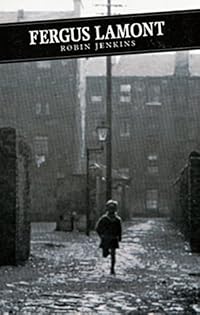
Fergus Lamont by Robin Jenkins
Posted in Reading Reviewed, Scottish Fiction, Scottish Literature at 12:00 on 1 April 2016
Canongate Classic, 1990, 351 p, including iii p introduction by Bob Tait. One of the Herald’s “100” best Scottish Fiction Books.
“Half Scotland sniggered and the other half scowled, when in letters to The Scotsman and The Glasgow Herald I put forward my suggestion that prisoners in Scottish jails be allowed to wear kilts, as their national birthright, if such was their wish.”
How can you not take an instant liking to a book of which the above is its first sentence? It certainly invites you to read on. Who can this quaintly opinionated, and perhaps ridiculous, individual be?
The interest in the kilt, though, is a marker. It is narrator Fergus Lamont’s signature apparel. One of those garments was the last gift he received from his mother before she walked into the local loch. She had married a man not Fergus’s father, left him for another – richer and much, much older – but had come back supposedly because of Fergus. She claimed Fergus’s true father was the son of the Earl of Darndaff – though others in the town said it was the under butler. However her fiercely Protestant (and resolutely anti-Catholic) father refused to speak to her, tipping her over the edge, not that that affected him. “My grandfather did not allow my mother to be buried in her own mother’s grave; nor did he go to her funeral. He displayed atrocious callousness; yet, by the sheer effrontery of faith, he compelled most people to think of him as a Christian of formidable and magnificent staunchness.” Fergus’s grandfather, like all those who profess to know the will of God, displays enormous self-righteousness. “‘You may be sure, Fergus, that if people are deserving of His help the Lord will not withhold it.’” Fergus is not convinced. “Young though I was, it seemed to me that it was really my grandfather himself who decided whether or not people deserved Jesus’s help…. There were some people with whom God, in my grandfather’s opinion, was displeased.”
The young Fergus had unthinkingly accepted the state of things; anti-Catholicism, the subtle social gradations of single-end, room-and-kitchen, two rooms and kitchen, up to the big houses in the west end of town. His nominal father, John Lamont, “wouldn’t say I was better or worse, but I was different. Whether this had anything to do with my having an earl for one grandfather, and a man of serious religious principles – he really meant a hypocrite – for the other, he wasn’t clever enough to say.”
Through his early life Fergus’s aspirations to his aristocratic connection grow but as his headmaster tells him, “‘You must bear in mind, Fergus, that the Scots landed gentry are a tribe apart. They do not speak like us. They go to considerable trouble and expense to avoid speaking like us. They are sent to exclusive English schools, to acquire their characteristic accent and peculiar habits.’” While recognising others’ sense he may not be quite what he seems he fakes it enough to achieve officer status – not to mention an MC – in the Great War and the attentions of a writer of romantic fiction (well aware of his humble origins) who more or less drags him into marriage. Though, as author, Jenkins does not dwell overlong on this aspect, a fear of being found out – even on the part of those who are perfectly competent – is a common emotion for a Scot. Throughout his life Fergus can never quite shake off the conflict between his compassion for those he has left behind and his reluctance to return without enough to show for having left.
The sense of distance engendered by his presumed, or actual, parentage (the identity of his sire is never revealed to us) allows Fergus to reflect on the foibles and dichotomies of his countrymen. “I was watching, I realised vaguely, a clash between two traditions in Scotland, that of love of learning and truth, and that of Calvinist narrow-minded vindictiveness.” “To the stern Calvinist no one was innocent, not even a new-born baby.” “Here was another conflict between two aspects of the Scottish soul…. mendacious sentimentality… and ironic truthfulness.” “It seemed to me that since Scotland was small, proud, poor, and intelligent, with a long history, she, better than any country I could think of… had an opportunity to create a society in which poverty and all its humiliations had been abolished, without refinement and spirituality being sacrificed. In the past the Scots had lost too many battles because, while waiting for the fighting to begin, they had been given prayers instead of second helpings.” The middle class “had throughout the centuries set up in Scotland a morality that put the ability to pay far in front of the necessity to forgive and love.” “For generations in Scotland bursary-winners and gold medallists have passed out of schools and universities, fixed in the belief that nothing has a value that cannot be marked out of a hundred. This is the reason why the Scots have failed as artists and patriots, but succeeded as engineers and theologians.” “Luckily the Scots are not a demonstrative or philoprogenitive race.” “Scotsmen do not find it easy to speak frankly of love, especially the physical aspects, without some protective coarseness. We call the act houghmagandy, and, alas, in the performance we are too apt to make it measure up or rather down to that crude term.”
But there is a kind of hope. “It is not the goodness of saints that makes us feel there is hope for humanity: it is the goodness of obscure men.”
When Fergus’s wife feels he is a hindrance to her social climbing and forces him out he takes the opportunity of a bequest to repair to the district of East Gerinish on Oronsay. Here he meets Kirstie McDonald, a child of nature, strong of limb and dressed in men’s clothes. They move in to his ancestral home (on his mother’s side) scratching a living from the poor soil. Of the local minister he is told, “He had nine children; eleven really, for two had died in infancy. Mrs Caligaskill was always ailing,” and thinks, “Without having seen this Caligaskill I hated him…. He represented that mixture of sanctified lust and hypocrisy which had stunted the soul of Scotland for centuries.” The passages dealing with this ten year long not-quite idyll, in many ways the time of Fergus’s life, do not linger on the page in the way those on his childhood did. In any case it is over too soon and island life is perhaps more judgemental than in the towns of the mainland. Only Kirstie had really accepted him. The doctor called in on her death warns Fergus, “‘You broke their rules. So did she. If one of them was to let a fit of pure Christianity get the better of him the Lord might be pleased, but I’m damned sure his congregation and colleagues wouldn’t,’” and, “‘You’re presupposing that tolerance is in itself a good thing. Not many people really believe that. Most of us are prepared to tolerate only what we understand and approve of.’” As a result the funeral has to be improvised. “‘Four ministers were asked,’ I replied. ‘All refused.’” Nevertheless the men of the island turn out in respect for Kirstie.
The promise that first sentence had of light-heartedness is not bourne out by the rest of Fergus Lamont which has a more serious mien. As a dissection of early to mid twentieth century Scottish mores and attitudes it is probably unexcelled.
Pedant’s corner:- peaver (usual spelling is peever,) medieval, the griping of buttocks (gripping?) “‘what she cannot know … that my books,’” (what she cannot know…is that my books…) Betty T Shields’ (Betty T Shields’s,) wheehst (usually the spelling is wheesht,) had never stank (stunk,) septagenarian (septuagenarian) a long (along.) “By cool Siloam’s shady hills” (Fergus – or Lamont – misremembers this. It’s actually shady rills.)
Tags: kilts, Robin Jenkins, Scottish Fiction
