Archives » Scottish Fiction

The Brilliant and Forever by Kevin MacNeil

Polygon, 2016, 251 p.

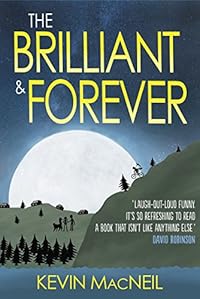
 The Brilliant and Forever cover

The Brilliant and Forever (B&F) of the title is an annual literary competition set on a Hebridean island, an island inhabited by humans – and talking alpacas. Everyone (and alpaca) on the island seems to be a writer or at least aspires to that state. The B&F is the highlight of the year and open to outsiders. There are two Decisions to be made, one by the Judges and one by the People. The judges’ winner gets signed up to a prestigious agency and an advance on a book deal.

The situation allows MacNeil to explore different kinds of demarcation. Not only is there discrimination and prejudice between (some) humans and the alpacas but the humans are divided between whitehousers (privileged) and blackhousers (less so) and there is even distinction among the alpacas from the island’s north and its south.

Our unnamed narrator – a devotee of haiku-kery, a culinary style limited to a certain number and kind of ingredients – is best friends with the human Macy and the alpaca Archie, who has the unfortunate habit of dribbling constantly (and therefore has to be accompanied everywhere by his spittoon) and is attempting to promulgate a catchphrase, “It’s like a jazz thing you don’t get.” As a writer himself Archie has entered the B&F – the first alpaca to do so for some time.

The entries to the competition are given in full. If you were to be uncharitable you could say MacNeil has found a way to shoehorn more than a few totally unrelated short stories into the format of a novel but you also have to admit it’s ingenious.

In amongst all this we have the aperçus, “‘Somehow, despite it all, something will be okay. That’s the best anyone can hope for,’” and “‘a writer tells lies to reveal greater truths and a politician tells half-truths to reveal greater lies.’”

The landscape description is a typically Scottish trait, here exemplified by, “In the broad expanse below – the mellow moorland and the flat, mirrored lakes and the muted sea and the sleeping villages – ” (though that lakes really ought to be lochs,) and there was a nice pun I hadn’t seen before; Lance Pharmstrong.

I was not entirely convinced by the stated response to the consequences following on from the People’s Decision but I shall not indulge in any spoilers. MacNeil’s is certainly an idiosyncratic and unique voice in the modern Scottish novel.

Pedant’s corner:- smartass (smartarse, please,) Madison Gardens (Madison [Square?] Garden? It was about cycling so may have been a play on Madison; but it should still be Garden,) mic (it was always mike in my day,) stoved in (staved in,) “out of his cakehole. ‘-you have….’” (comma after cakehole instead of full stop,) “how the majority were voting” (was,) he lay a plastic bag on the table (laid.) Many plus points for the wonderful portmanteau word gloominous as in “gloominous sky”.

The Vanishing Act of Esme Lennox by Maggie O’Farrell

Headline Review, 2007, 284 p.

One of Scotland’s favourite books.

The Vanishing Act of Esme Lennox cover

In modern day Edinburgh Iris Lockhart is juggling life with her (married to someone else) lover Luke, her step-brother Alex and her business running a women’s clothes shop when she receives a phone call from a psychiatric unit informing her she now has legal responsibility for a great-aunt of whose existence she was previously unaware. This is Esme Lennox, born in India, where she had a gruesome experience when her younger brother Hugo died of typhoid while her parents and sister Kitty were away from home. The family subsequently returned to Edinburgh where Esme’s independent-mindedness and refusal to conform to the norms in school and social life of that time created problems: problems which eventually led to incarceration in an asylum. (In those days it only took the signature of a GP to lock up an inconvenient woman at a husband’s or father’s request. The woman could spend decades interned, only being released when the institutions began to shut down.)

Iris cannot confirm Esme’s identity as her father is dead, her mother has never heard of such an aunt and Iris’s paternal grandmother, Kitty, suffers from Alzheimer’s. She nevertheless takes her great aunt in when the hostel Esme was assigned turns out to be a dreadful place.

The lives of Iris and Esme are told in a close third person while Kitty’s first person stream of consciousness reminiscences are presented as if they were ramblings but within them are contained kernels of truth.

O’Farrell’s control of her material is masterly. (There may be one small foreshadowing misstep where long before the reveal we are given a clue to the mystery in a two-line paragraph which is repeated later. Maybe there are those who would have missed it on its first appearance but I would have thought once ought to have been enough.) The sections dealing with Esme’s time in India and those of the present day are handled with equal facility. Beautifully written and engaging.

Pedant’s corner:- “of husbands at the end of their tethers” (husbands, so that should be ends of their tethers,) the crew were scurrying (was,) “‘Aren’t I?’” (Okay, she was an ex-pat; but her parents were Scottish, it should be ‘Amn’t I?’) “‘You getting on one of your things about this, aren’t you?’” (You’re,) booties (they were for a baby, so bootees.)

Young Art and Old Hector by Neil M Gunn

Souvenir Press, 1985 reprint from 1942, 255 p. One of the Herald’s “100” best Scottish Fiction Books

On finishing this uplifting book I reflected that it depicts a kind of relationship which either no longer exists or will expire shortly. Young Art is eight or so years old, hence not well versed in the ways of the adult world. His friend and confidant, Old Hector, the ancient of their small village, is a repository of sagacity, wisdom and local knowledge. Their warm, mutual affection shines through the prose describing their interactions. These days I fear the world of the young is so divorced from that of the old that common ground such as Art and Hector have here would be very hard to find.

Young Art and Old Hector is another chronicling of a way of life that was passing – had passed at the time of writing. This is one of the perennial themes of Scottish literature. Hector says to Art, “‘I know every corner of this land, every little burn and stream, and even the boulders in the stream. And I know the moors and every lochan on them. And I know the hills, and the passes, and the ruins, and I know of things that happened here on our land long long ago, and men who are long dead I knew, and women. They are part of me. And more than that I can never know now.’” Hector tells Art, “‘There are many places, many many places, with names that no-one knows but myself, and they will pass away with me.’” Whereupon Art asks Hector to teach them to him so that they won’t die. That instinct may have been what prompted Gunn to write this novel. Whatever, while people still read old books the past is never entirely dead.

There isn’t really much of a plot, what there is revolves around an illicit still set up to produce whisky for a wedding party, the authorities’ attempts to catch those operating it and their subsequent outwitting, but Gunn’s facility in entering the mind of a child is superb. An example of Art’s misunderstanding of grown up ways is his conclusion that courting must be a very bad thing. A conclusion only compounded when his hand is innocently held by a young girl. Gunn makes the comparison with the second childhood of the elderly but emphasises it does not entirely hold, especially in their differing perceptions of time.

Hector has a few good lines. “Old Hector maintained that money wasn’t everything… and in his young days people didn’t hanker after it so greedily as they did now.” To the objection that had they been more alive to it they might not have been cleared out of the Clash in the time of evictions he replies, “‘It was the lairds and the factors who were keen on the money, and it’s because they were keen on the money that they drove the people forth.’” Hector also says “‘I have not observed that it’s the people who are out to make money who are the helping kind…. the more they make the grippier they become.’” “‘Whenever the prime concern in life is money-making then you have trickery and brutality and wrong.’” “‘Human dealings are founded – founded – not on money but on what is fair and just all round.’” He relates how the legalisation of distilling in effect stole the people’s drink from them and had not left them “‘wherewith to buy it.’”

And here’s a thought that feels almost quaint in this modern age. “‘What’ asked Art, ‘is the most wonderful thing in the world.’ ‘A kind heart,’ answered Old Hector.”

Pedant’s corner:- On the book’s back cover; Donal (in the text it is always Donul.) Otherwise: dike (dyke is the preferred British spelling for an embankment or low wall,) primeval (I prefer primaeval,) “‘Are there? “I have never’, said Mary-Anne” (has the comma misplaced outside the quotation marks,) “and t but half the size” (has the space for the “i” of it but the “i” itself is missing,) “does not now what to make of me” (ditto the “k” of “know”,) “Every littl place (ditto the e of little,) paradisaical (I’ve only ever seen this as paradisiacal before but it’s an accepted variant.) A big thumbs up for “Amn’t I?”

The Cutting Room by Louise Welsh

Canongate, 2003, 300 p. One of both the 100 best Scottish Books and Scotland’s favourite books.

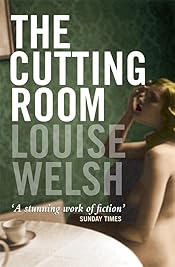
The Cutting Room cover

A narrator known only as Rilke – I don’t believe we are ever vouchsafed his given name – is an auctioneer and valuer for a struggling auction house in Glasgow. He receives a call to inspect the contents of a house for clearance and complete the sale quickly. The contents consist of good stuff and could save the auction house’s finances. In its attic there are rare first editions of notorious books but he is asked by the deceased’s heir – an elderly sister – to destroy them. Amongst them Rilke finds some disturbing photographs which appear to show the murder of a young woman. Intrigued by this mystery he spends most of the book trying to investigate the photographs’ origins instead of looking after the house-clearance. This brings him into closer contact with the shady side of Glasgow life than is healthy before the mystery is resolved.

The Cutting Room is written with a literary sensibility, is full of well-drawn characters and has many fine descriptive passages. While it does yield the satisfaction that detective/crime fiction provides it goes beyond that. It is a novel, pure and simple. (Well, actually not that pure – and not really simple either.) And Rilke is an unusual protagonist for a crime novel. As a debut novel I found it more accomplished than Ian Rankin’s Knots and Crosses and James Oswald’s Natural Causes. I’ll be reading more from Welsh.

Pedant’s corner:- the Great Western Road (I’ve only ever heard this referred to as Great Western Road; no definite article,) each others eyes (each others’ eyes,) burglarised (No! The word is burgled,) two missing end [and one beginning] quotation marks, our monthly sail (sale,) “in a herd that shook the ground with the weight of their hooves” (leave aside the fact that herd is singular so it should be its hooves, it isn’t the hooves’ weight that shakes the ground, it’s the buffaloes’,) thrupney bits (yes that corruption of threepenny was pronounced that way, but it was always spelled thruppenny,) asshole (arsehole,) a boy had watched “the first moon launch”, dedicated himself to space exploration, twenty years later became an astronaut, only to vomit copiously the whole time in mission after mission; his “hermetically sealed sick bags still orbit the moon” (that would be “the first moon landing” not launch, plus; the last orbit of the moon was in 1972, only three years – not twenty – after the first. Those sick bags might be in Earth orbit but would be nowhere near the Moon.) “Other ungodly titles lesbian are known by” (lesbians; but it was in a pamphlet, these are notoriously misspelled,) “aren’t I?” (Grrr! The speaker is Scottish; she would say “amn’t I?”,) shtoom (usually spelled schtum or shtum,) “I was coming warn you” (coming to warn you,) the Ukraine (the speaker is Ukrainian; they just say Ukraine, no “the”,) medieval.

Body Politic by Paul Johnston

NEL, 2003, 349 p

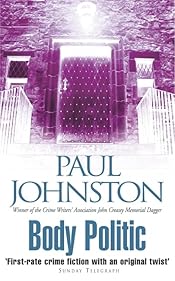
The Body Politic cover

The first publication of this novel was in 1997 when the date in which it is set, 2020, was a considerable time away. That makes it read a bit oddly in 2016.

Edinburgh – like many other parts of the UK – is independent, home to a never-ending tourist drawing festival, from which the city derives most of its income. It is run by the Enlightenment Council of City Guardians, which comes across as a sort of muted cross between a local Council, the Committee of Public Safety and a Kirk Session. The city’s citizens lead a circumscribed existence, unruly beards are obligatory, television, private cars and crime are banned, as is blues music – a problem for former city guardian Quintilian Dalrymple who at the novel’s start is asked by Katharine Kirkwood to find her missing brother. Before long however, a body is discovered whose murder bears remarkable similarities to those of the Ear, Nose and Throat Man from several years before. Dalrymple, as the expert on the previous crimes (and instrumental in their ceasing,) is roped back in to the Enlightenment’s police force (called guardians) to investigate. What follows is the usual tale of corruption, red-herringry and interconnectedness; though carried off with great skill. The crime element is pretty standard fare (as far as my reading of the genre goes) the bureaucratic hassles associated with the policeman’s/policewoman’s lot lent an air of strangeness by the unusual background. Various villains are unmasked, the murderer not whom you might expect. Kirkwood’s brother’s disappearance is peripheral to that aspect of the plot and only really exists to provide Dalrymple with a love interest.

Despite its (altered) future setting this cannot really be considered Science Fiction. In form and content it is more of a crime novel than anything else, there is no speculation involved. Quite why it appeared on the Herald’s list of “100” best Scottish Fiction Books, I’m not sure. I can only think that the Enlightenment might be supposed to be a peculiarly Scottish conception. It has Calvinistic undertones but the things it tolerates – encourages even – have traditionally been frowned upon at best and more usually excoriated.

Somewhat prophetically there is the line, “The USA had reverted to the self-obsession that’s a hallmark of their history.”

Pedant’s corner:- “didn’t use to mind” (didn’t used to,) had lead to (led to,) reponse (response,) “I wanted to sit down badly” (how can anyone sit down badly? – I think Johnston meant “I badly wanted to sit down,”) Mary, Queen of Scots’ (Mary, Queen of Scots is singular so; Mary, Queen of Scots’s,) “The USA had reverted to the self-obsession that’s a hallmark of their history,” (its history; unless you’re talking pre-American Civil War when the United States were referred to in the plural.)

Emotionally Weird by Kate Atkinson

Black Swan, 2015 reprint of a 2000 publication, 489 p

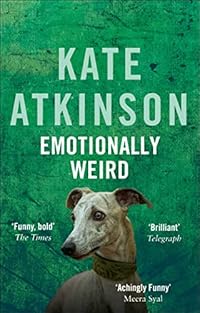
 Emotionally Weird cover

During this, Atkinson’s narrator (by implication Atkinson herself) is at pains to emphasise that it is a comic novel. It is mainly the tale of the student life in 1972 of Effie Stuart-Murray (Effie Andrews as she had thought of herself) ostensibly narrated to, and frequently interrupted by, her mother (who is not her mother) interleaved with said (not)mother’s relation to Effie of her convoluted origins. Extracts from the ongoing novels of some of the characters – including Effie’s own, which Emotionally Weird as a whole is not – appear at odd intervals. All this requires the use of seven or so different fonts (not including italics) to differentiate the various strands.

This is fine as far as it goes – and it is always welcome to find in a novel those fine Scottish words rammy, stushie and stramash (the use of which indicates Atkinson can truly be considered a Scottish writer,) not to mention a Dundee setting – but it is not enough to defuse analysis of a book’s faults by including criticism of it within it. “Too many characters” Effie’s not-mother tells her, and later, “a welcome piece of exposition” to which the reader can only say “indeed.”

Effie’s ongoing failures to deliver essays when they are due is a backdrop to various comings and goings between members of the University staff, students and a private investigator called Chick. There are some wry observations but few if any laugh out loud moments. The intrusion of fantasy elements – possible ghosts, pseudo magic realism, the use of authorial omnipotence to rewind and change events – only adds to the rather unfocused feel. Comic, after all, does not mean anything goes. Curious foreshadowings of Atkinson’s Life After Life and echoes of Behind the Scenes at the Museum exist in her predilection for scenes depicting drowning.

At the sentence level the writing is fine, good even, the characters’ interactions are well observed, their motivations psychologically plausible. The trouble is Effie’s student days are really entirely separate from the circumstances of her birth. While the two story strands are intermingled, sometimes with extremely short jump cuts, they are not really connected except that they both involve Effie. A lampooning of early 1970s campus culture is all very well and might not have been enough to carry the novel on its own – especially when it is elongated beyond its ideal length as it is here – but Effie’s unusual beginnings and relationship with her not-mother do not distract from this. In the end Emotionally Weird just goes on too long to too little effect but within it some seeds of Atkinson’s future triumphs can be discerned.

Pedant’s corner:- still caked in Monro mud (these hills are called Munros,) Cousins’ (Cousins’s,) “and the Hun were” (the Hun was,) “Murdo fell at Mons” (in the previous paragraph he had signed up at age fifteen, three months after his brother “crossed to France”. The battle at Mons was in August of 1914, was followed by a retreat and the British Army did not get back there till November 1918,) “‘if you can’t manage the math’” (the British usage is maths and this USian character had been in Britain long enough to adapt but to be fair to Atkinson I suppose she wouldn’t have,) Descartes’ (Descartes’s; it’s pronounced “day-cart” for goodness’s sake, and its possessive therefore must be “day-cart’s”,) a range of…. farm buildings were (a range was,) primeval (I prefer primaeval,) one of the instances of jumping from strand to strand is a transition which adopts the new font one sentence too early, bouef bourguignonne (bouef bourguignon, or bouef à la Bourguinonne) “‘Jings, crivens and help me Boab’” (jings, crivvens and help ma boab,) Jenners’ carrier bags (Jenners’s,) Scalectrix (it’s spelled Scalextric,) tapsie-teerie (I thought at first this might be a mishearing by Atkinson of the more usual tapselteerie/tapsalteerie but I checked and the Dictionary of the Scots Language has it as a variant,) men-o’-wars (men-o’-war,) Effie Andrews’ (Effie Andrews’s.)

Scotland’s Favourite Book

In a programme on BBC 1 Scotland last night the results of a poll to discover Scotland’s favourite book were announced.

These were apparently voted on from a long list of thirty books.

As usual the titles marked in bold I have read; italics are on my tbr pile.The ones marked by a strike-through I may get round to sometime.

An Oidhche Mus Do Sheol Sinn (The Night Before We Sailed) by Angus Peter Campbell
Garnethill by Denise Mina
Harry Potter & The Philosopher’s Stone by J.K. Rowling
How Late It Was, How Late by James Kelman
Imagined Corners by Willa Muir
Knots & Crosses by Ian Rankin
Laidlaw by William McIlvanney
Lanark by Alasdair Gray
Life After Life by Kate Atkinson
Morvern Callar by Alan Warner
Rob Roy by Sir Walter Scott
So I Am Glad by A.L. Kennedy
Sunset Song by Lewis Grassic Gibbon

The Adventures of Sherlock Holmes by Arthur Conan Doyle
The Cone Gatherers by Robin Jenkins
The Cutting Room by Louise Welsh
The Panopticon by Jenni Fagan
The Prime of Miss Jean Brodie by Muriel Spark
The Private Memoirs and Confessions of a Justified Sinner by James Hogg
The Strange Case of Dr Jekyll and Mr Hyde by Robert Louis Stevenson
The Testament of Gideon Mack by James Robertson
The Thirty-Nine Steps by John Buchan
The Trick is to Keep Breathing by Janice Galloway

The Vanishing Act of Esme Lennox by Maggie O’Farrell
The Wasp Factory by Iain Banks
The White Bird Passes by Jessie Kesson

The Wire in the Blood by Val McDermid
Trainspotting by Irvine Welsh
Trumpet by Jackie Kay
Under the Skin by Michel Faber

Thanks to my working through of the 100 best Scottish Books and the Herald’s “100” best Scottish Fiction Books I have read nineteen of these, with two on the tbr and others maybe to consider.

I suspect that in the fullness of time some of the more modern of them will fall away from public affection.

My strike rate for the final top ten was 7/10. The list (in descending order) was:-

10. The Private Memoirs and Confessions of a Justified Sinner by James Hogg
9. The Adventures of Sherlock Holmes by Sir Arthur Conan Doyle
8. Knots & Crosses by Ian Rankin
7. Trainspotting by Irvine Welsh
6. Harry Potter & The Philosopher’s Stone by J K Rowling
5. The Prime of Miss Jean Brodie by Muriel Spark
4. The Thirty-Nine Steps by John Buchan
3. Lanark by Alasdair Gray
2. The Wasp Factory by Iain Banks
1. Sunset Song by Lewis Grassic Gibbon

I am particularly pleased that James Hogg’s The Private Memoirs and Confessions of a Justified Sinner made it here and the strong showing of Alasdair Gray was also welcome. Personally I don’t think The Wasp Factory is Iain Banks’s best book but only one from each author was on the long list.

Gibbon’s Sunset Song was the one I predicted to the good lady would come first. Since its publication it has been an enduring favourite with Scottish readers.

Whisky Galore by Compton Mackenzie

Penguin, 1999, 298 p, plus 4 p Glossary of Gaelic Expressions.

 Whisky Galore cover

One of the 100 best Scottish Books and also in the Herald’s “100” best Scottish Fiction Books.

The Second World War has brought hard times to the islands of Great and Little Todday. Supplies of whisky are running out as priority is given to exporting to the US to help pay for the war. Incomer Sergeant-major Odd has returned to the island from war duty to marry Peggy, George Campbell has just surprised himself by proposing to Catriona but dreads telling his mother the news. Captain Waggett worries the local Home Guard, of which he is in charge, are slacking too much and that morale on the islands has become dangerously defeatist.

The fog-induced wreck of the SS Cabinet Minister with its cargo of high-grade whisky changes everything. Suddenly all the men become bonhomous, Peggy’s father agrees to the wedding occurring soon and a fortified George tells his mother to come to terms with his plans or leave for her sister’s on the mainland.

The phrase “whisky galore” (uisge beatha gu leòir) appears even before the wreck as the locals yearn wistfully for a normal delivery. In the glossary of Gaelic expressions Mackenzie notes that gu leòir (as “galore”) is almost the only Gaelic phrase to pass into English so nearly like the original.

Gentle fun is poked in different directions. The text tries to render the muted plosives and fricatives of native Gaelic speakers, crumple for “grumble”, “Chust efferything iss a tisaster.” Sergeant-major Odd’s English speech patterns are signified by “r”s appearing at the ends of words in which they have no place (Africar, Burmar and Indiar) and his inability to pronounce Gaelic words such as rèiteach is repeatedly emphasised.

Structurally the novel is a bit of a mess. The fulcrum of the novel is the wreck but too much time is spent establishing and entrenching the situation before it. The wreck itself occurs off-stage, as does all its plundering. Too many characters’ individual stories are followed in too little depth and the book dribbles away with the experiences of Odd’s mother, whose first appearance is only in the second last chapter, on attending the wedding.

It is all light-hearted stuff to be sure and will undoubtedly have provided some leaven in those dark post-war still rationed days when the novel was first published in 1947 but it represents whisky as only a benign influence, none of its ravages receives even the briefest mention. In a Scotland then, as now, with alcohol too often a blight on too many lives, that is gilding the lily more than a touch.

But this is to criticise the book for something it was never intended to be. This is pure entertainment and written as such. No deep enduring message, except perhaps the continuing allure of Western Isles scenery, is to be drawn from it. Though he would probably have been delighted at the thought I doubt even Mackenzie would have expected it to appear on a list of 100 best Scottish books.

Pedant’s corner:- lay down (lie down – this was in Sergeant-major Odd’s dialogue though and will be a deliberate representation of his speech; his mother also refers to a “lay in bed”,) dimunitive (diminutive – ditto so perhaps a deliberate misspelling by Mackenzie,) mcvements (movements,) if I’d only have know in time (known,) “a man with a white walrus moustache from Inverness” (moustaches come from Inverness?) for goodness’ sake (goodness’s,) “‘I though it would be’” (thought,) portentious (portentous,) ringmarole (rigmarole – but it was in dialogue,) toothe-paste (elsewhere is tooth-paste,) “dropped in Snorvig, Each with his” (each,) wating (waiting,) Coloenel (Colonel,) “would probably had said” (have said,) Miss Cuffins’ (Miss Cuffins’s,) I’l (I’ll – but in a letter so may have been an intentional error by Mackenzie,) St Enoch’s station (it was St Enoch,) Caberfèidh (had previously been spelled [unusually] Cabarfèidh,) ready for to start (no need for that “for”,) ‘I never like a place so much in all my life’ (liked.)

Public library and other stories by Ali Smith

Hamish Hamilton, 2015, 228 p

 Public Library cover

Borrowed from a doomed library.

The book cover and spine have “Public library” as the title but the colophon shows “ Public library ” (actually struck through several times.) As is usual in Smith’s output the left hand margin is justified but the right hand one is not – curiously, though, the acknowledgements page has the reverse. The prefatory “Library” is an apparently true story about Smith and her publisher coming across a building emblazoned Library; but it’s an exclusive club instead. Smith’s stories are interleaved with Smith and her correspondents’ memories of libraries and their importance to civilised life. These interludes are entitled “that beautiful new build”, “opened by Mark Twain”, “ a clean, well-lighted place”, “the ideal model of society”, “soon to be sold”, “put a price on that”, “on bleak house road”, “curve tracing”, “the library sunlight”, “the making of me” and “the infinite possibilities”.

As in Smith’s previous collections the short stories included here tend to have similar structures whereby the narrator will start off on one course and then veer onto another, and on occasion a return to the first topic will occur.

In Last the narrator sees a wheelchair-bound woman has been left behind on a train. While she tries to effect a rescue she muses on the changing meanings of various words.
Good voice is narrated by a woman who speaks to her dead father and ruminates on the First World War.
In The beholder a woman who has suffered a series of life altering events finds a growth on her chest. It seems to be a rose.
The poet relates the life story of the poet Olive Fraser whom Smith imagines being inspired by finding printed music on the binding (made from recycled old paper stock) of one of Walter Scott’s Waverley novels.
The human claim dwells on the unlikely connection between an unauthorised credit card transaction and the fate of D H Lawrence’s ashes.
The ex-wife has a woman trying to come to terms with breaking up from her ex-wife because she was so obsessed with Katharine Mansfield. In it Smith says, “What the writer does is not so much to solve the question but to put the question.” She also utilises the word pompazoon; as Mansfield did.
In The art of elsewhere the narrator tells of her desire to come upon some kinder, better, less constrained existence.
After life. A man is twice reported dead; both times falsely. The second time no-one cares. This leads him to muse on the vitality shown in the Mitchell and Kenyon films of turn of the twentieth century life.
In The definite article the narrator has an epiphany after lingering in Regent’s Park on the way to an important meeting.
Grass A book of Robert Herrick poems brings to the narrator’s mind an incident which occurred when she was minding her father’s shop during an Easter break in her finals year.
In Say I won’t be there the narrator has an ongoing discussion with her partner about not revealing the contents of her recurring dream which features Dusty Springfield (about whom her partner knows a lot more than her.) She tells us the dream instead.
And so on’s narrator ruminates on a friend who died young and her illness-induced imaginings that she was a work of art in the process of being abducted.

Pedant’s corner:- to not sway (not to sway,) ones bones (one’s bones,) H G Wells dream (H G Wells’s,) ‘We bought the book in Habitat, before Habitat became defunct.’ (Habitat isn’t quite yet defunct. It still has some outlets in a few Homebase stores.)

The Antiquary by Walter Scott

The Edinburgh Edition of the Waverley Novels, Edinburgh University Press, 2011, 541 p, plus 37 p Essay on the Text, 48 p Emendation list, 2 p list of end-of-line “hard” hyphens, 7 p Historical Note, 72 p Explanatory Notes, 18 p Glossary, i p Foreword, vi p General Introduction to the Edinburgh Edition, and iii p Acknowledgements. One of the Herald’s “100” best Scottish Fiction Books.

See my review of The Heart of Mid-Lothian for the intent behind the Edinburgh Edition of the Waverley Novels.

The Antiquary cover

We start in Edinburgh where the titular antiquary, Mr Oldenbuck, known as Oldbuck of Monkbarns, is awaiting the arrival of a coach to take him to South Queensferry to catch the tide there. He makes the acquaintance of a Mr Lovel, also to be travelling on the coach and on to the same final destination, the town of Fairport, near which lies Oldbuck’s estate of Monkbarns. Oldbuck is forever animadverting on the derivations of place names and the like and seeking out antiquarian antecedents for objects – and is often mistaken in his attributions. The usual longueurs and prolixity which beset Scott’s novels are again present, here exacerbated by the novel taking a long time to get into its stride. Different plot strands are set off and pursued and these appear at first to be almost occurring at random. Only about two thirds of the way through do the connections between several of the characters become apparent and that in a way which is immediately obvious to the modern reader but may well have been more of a novelty in Scott’s time. As with The Heart of Mid-Lothian the strands are eventually tied together a bit too neatly and in this case perfunctorily.

Scott here rather over-indulges in nominative descriptivism. We have mention of a Dr Dryasdust, the local minister is Mr Blattergowl, the bailiff Mr Cleansweep, Mrs Mailsetter deals with the post, the butcher’s wife is Mrs Heukbane, Mrs Shortcake is married to the baker, and there is a German con-man, Herman Dousterswivel.

Despite its title the book focuses more on the gaberlunzie (i.e. licenced beggar) Edie Ochiltree, than on Oldbuck. We first meet Ochiltree when he contradicts Oldbuck’s views about the presence of remains of a Roman camp on the latter’s estate by saying, “I mind the bigging o’t,” (in other words the structure’s origins lie within living memory) but thereafter he is the active force in many of the scenes. He also speaks in very broad Scots. This surely must have been disconcerting to Scott’s English readers on first publication, but it is of course the marker of his importance to Scottish literature.

Pedant’s corner:- on the inside cover flap; Lovell (the text always has Lovel.) The usual Scott renderings, sprung, sunk, sung, etc as per the Scottish usage of the time but here also run for ran. Similarly we have the usual stupified, but then, surprisingly, stupefaction. In one case a new speaker’s new paragraph is not indented. “‘He had had the pleasure,’ Lovel answered, ‘to see her at Mrs Wilmot’s, in Yorkshire.’” (Since it is Lovel who is speaking – about himself – should that “he” not be “I”? Or else remove the quote marks.) “No. I.,” (Scott’s punctuation?) At least three different spellings of ecstasy (two of them with an x,) invaasion (an explanatory note says this is the spelling in Scott’s manuscript. I can only think this indicates an idiosyncratic pronunciation by Ochiltree.) In the explanatory notes; “(who gave his name both to the Cameronian sect)” (????) Hary (Harry, as in Blind Harry, author of the poem The Wallace,) tansfer (transfer,) marriage marriage (unnecessary repeat of marriage.)

free hit counter script