Archives » Science Fiction

The Clarke Award 2024

I don’t know when they were posted (perhaps when I was away) but the nominees for this year’s Arthur C Clarke Award are listed on its website.

They are:-

Chain-Gang All Stars by Nana Kwame Adjei-Brenyah

The Ten Percent Thief by Lavanya Lakshminarayan

In Ascaension by Martin MacInnes

The Mountain in the Sea by Ray NaylerS

Some Desperate Glory by Emily Tesh

Corey Fah Does Social Mobility by Isabel Waidner

I have read none of them.

Earth Abides by George R Stewart

Black Swan, 1985, 362 p.  Cover art by Eduardo Paolozzi.

During the late twentieth century this was considered as a classic Science Fiction novel of the post-apocalyptic variety.  I bought it many moons ago but somehow never got round to it till now.

Our protagonist Isherwood Williams is bitten by a rattlesnake when out on a hunting expedition. When he recovers he finds the human world has succumbed to a disease of some sort. Cities and roads are mostly deserted (the book was first published in 1950 when cars were much scarcer than they are now) but infrastructure – electricity, water, fuel – is still working. Overcoming his reluctance to use what wasn’t his property he takes a car and rides from his home in California across what was the US to the east coast and finds very few people have survived. Those who have, are disorientated and demoralised though three “negroes” have gone back to living off the land. Williams (in what is to modern eyes clearly a racist assumption) thinks they are more suited to this due to the way they lived before.

Back home in California he sets about life on his own but one day, when the electricity has finally failed and the street lights have faded away he notices a light at night. This leads him to a woman called Emma and the pair get together. Emma is of black ancestry so Williams’s racism is not too overt. (But then again in such a situation you could not afford to be overly choosy.) Emma is a resourceful and wise woman so it is just as well.

The pair set about surviving as best they can and even decide to have children. Along with a man called Ezra and the family he had collected around himself they form a community, which over the years grows and forms rituals of its own. Ish’s hand-held hammer becomes a totem, the long-lost Americans (of which to his community he is the last) and their accomplishments held in awe by the younger members. The difficulties of coming to terms with a new mode of life and of meeting other survivors or their communities  are explored briefly but mostly this is the story of Ish.

Some of the seeds of later post-apocalypse novels – especially the ‘cosy catastrophes’ of 1960s British SF – can be discerned in this book, so in that sense it can still be seen as a classic.

Pedant’s corner:- “extra ordinarily pleased” (extraordinarily,) “upon articles of dust” (particles of dust,) “but he heard only far off, the rasp and crackle of static” (needs a comma before ‘only’, “had take command” (had taken,) wistaria (x2, wisteria,) “whimpered her sleep” (whimpered in her sleep,) grape-fruit (grapefruit,) “what might, by generous interpretation, he called a social group” (be called a social group,) generaly (generally,) “electrical impluses” (impulses,) a missing comma before a piece of direct speech (x 2.) “Near by a smooth rock surface” (Nearby,) youngesters (youngsters,) geograhy (geography,) feminity (femininity,) Mohenjadaro (Mohenjo-daro.)

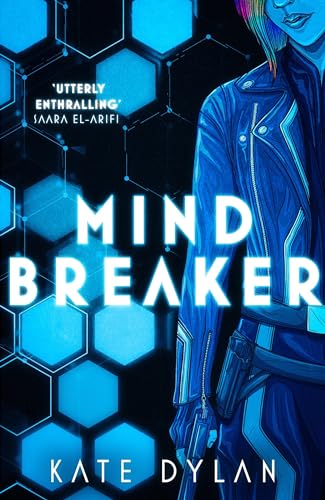
Mindbreaker by Kate Dylan

Hodder & Stoughton, 2023, 309 p. Reviewed for ParSec 9.

In the aftermath of a nuclear war Indra was brought up in the Order, a religious sect fanatically opposed to technology, whose members are marked out by a crescent moon branded on one cheek. Despite (or because of) this indoctrination she was fascinated by computers which led her to befriend Nyx, who calls her God Girl. One night they were caught in a radioactive storm and, because of her brand, refused shelter till it was too late, unless they had radical medical intervention. Her mother refused to countenance anything so ungodly as nanite repair therapy but her father okayed it, at the cost of rejection from the sect. Nyx was fine but Indra’s rare susceptibility to acute onsite nanite rejection meant the treatment did not work. The Glindell Corporation offered her a way out through Neural Transcendence, the process of uploading a human mind to an artificial drive, a MindDrive housed in a titanium shell.

Not long after the process but before Indra’s old body has been reconstituted in a layer of FleshMesh designed to allow her to experience all the normal senses along with the enhanced ones the new body brings, she began to have dreams and flashback memories which her conscious mind could not reconcile. Dreams of being underwater, of infiltrating a building, of entering the Order’s compound.

As readers we are ahead of Indra here. In a story such dreams are rarely just dreams. So it proves. This is perhaps a trope in which author Kate Dylan ought not to have indulged but her writing is vivid and Indra’s personality engaging – though she does have a tendency to act without considering the consequences. It is Indra’s wish to untangle the dreams and also find her true self in her new existence which propel the plot. Given she literally embodies hi-tech it is a bit of a stretch that she apparently cannot shrug off the thoughts and sayings of the Order’s Leader Duval, which continue to impinge on her along with memories of her mother and father. It is her consciousness that something is wrong, though, the blanks in her post-upload memories, the flashbacks to events she feels viscerally but cannot account for, the feeling she is being used, which lead to her attempt to break free from Glindell’s clutches, taking up with Nyx and an organisation styling itself the The Analogue Army which opposes corporations such as Glindell. In this she is accompanied by Tian, the Glindell researcher who had been assigned to her, but who has now come under her spell.

The backstreet removal of both Indra’s and Tain’s physically implanted NDAs, (the requirement for its employees to accept such devices is one of the indications that Glindell is not a benign outfit, another is that Indra’s MindDrive is legally questionable) is an indicator of the level of technology available in this post-apocalypse world. Indra of course can switch her senses off. Tian can’t, but the nanites in her blood can repair her tissue damage quickly.

There are plenty of plot twists and turns and not a little high-paced adventure still to come in Mindbreaker, yet despite Indra’s artificial body Dylan never lets us lose sight of Indra’s human origins. The novel could even be seen as an examination of whether uploading such as Indra has undergone would mean ceasing to be human.

The following did not appear in the published review.

Pedant’s corner:- Written in USian, so snuck for sneaked, lay for lie, etc, etc. Otherwise; “wackjobs” (usually spelled whackjobs,) “personal affects” (effects,) “from the face of the earth” (Earth,) “proof that the company’s been flaunting the laws of nature” (flouting the laws,) claxon (several times; klaxon,) “complimenting the shine of his many piercings” (complementing,) “but will only combust when exposed to extremely high heats” (extremely high heat.) “What a difference a few credits make” (what a difference “X” makes, where X = ‘a few credits’,) “that would have easily bankrupt my Order” (bankrupted.) “Her indignance rises to match mine” (indignation,) “my Orders’ deaths” (Order’s,) duffel (spelled duffle at one point,) “once and for good” (conflates two different phrases, ‘once and for all’ and ‘for good’,) “dispatched of them” (conflates two different phrases, ‘despatched them’ and ‘disposed of them’,) “a new crop of my missing memories rear up” (a new crop …. rears up,) “there are whole years’ worth of nursery rhymes, and bedtime stories, and sang mnemonics” (sung mnemonics.)


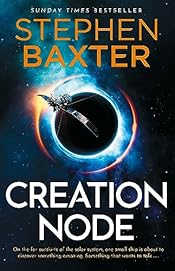
Creation Node by Stephen Baxter

Gollancz, 2023, 443 p, including 3 p Afterword. Reviewed for ParSec 9.

In 2255 humanity has recovered from the ravages of climate change on Earth and extended into the Solar System. Earth is dominant, with a stranglehold on the Lunar Consortium’s expansionary plans and its helium-3 extraction exports via control of the supply of nitrogen needed as a buffer gas. However, schemes are in hand for Earth to mine the gas giants for helium-3 to fuel a nuclear fusion engine which will cut journey times across the Solar System from decades to years. A third group called Conservers does not wish to deplete the Solar System’s resources but has sent out the Shadow, a ship powered by solar sails, to the Oort Cloud to investigate the possibility of Planet Nine orbiting there.

Planet Nine, as found, could fall into the venerable SF category of Big Dumb Object, except it’s not big – it’s an apparent black hole, ten times Earth-mass – and it’s not dumb. Salma, a teenager born on the voyage, discovers its Hawking radiation harbours patterns. It is sending out a message. As soon as the Shadow’s crew echoes the signal back, the Hawking radiation changes form and the galaxy’s central core simultaneously turns red from a quasar emanation. As coincidences go this would be an almighty one but how could a signal sent in the here and now cause an event to have occurred thousands of years ago so many light years away? The quasar’s red light bathes the whole Solar System and starts to increase the temperatures of every orbiting body within it, slowly but inexorably. This, however, is a challenge which is nothing but background for most of the book.

Standing off some distance away, the Shadow’s crew then sends the second pattern back to the object. It expands immediately to a larger size and forms a surface with one Earth standard gravity. And on that surface lies a cylindrical container. The three crew members sent down to the surface find it has an alien inside, an alien which resembles a bird but with human resemblances. This is swiftly dubbed Feathers. Creation Node is not just a BDO novel, then, but also a first contact one. Communication with Feathers is almost impossible except by gesture so who, or what, she is, is a mystery. Both the Earth authorities and the Lunar Consortium decide it is imperative to send missions to Shadow’s location as soon as possible.

A lot of the earlier part of the book (sometimes spoiled by information dumping of the ‘she knew’ variety and intermittent references to several of the characters wearing black pendants; a decorative choice never fully explained) is taken up with Earth’s preparations of its fusion powered ship, Cronus, to launch from Saturn orbit and the Lunar Consortium’s unannounced mission to join it. This is something of a drag on the ongoing story in the Oort cloud (albeit with a set piece collision in space to be described.) We could charitably interpret this longueur as Baxter trying to convey the time scale involved. Even with the new drive the joint mission to the changed black hole takes eleven years.

The climax of the novel is almost literally (but not quite, since Baxter tips us the wink to its existence in earlier short chapters) a deus ex machina, the manifestation of a creature with god-like powers which can move both itself and our humans between universes and across space and time. Both Planet Nine and the quasar are under its control, the details of which I’ll leave to the reader to discover. It presents a dilemma to the humans at the site, though.

Baxter’s immersion in SF shines through, Creation Node contains more than a few nods to Arthur C Clarke – sunjammers, space elevators, an enigmatic object that eventually provides a path to elsewhere in the universe – to please longstanding SF buffs. Its invocations of other universes and the vastness of time tickle the sense of wonder but the humans its tale is fashioned around are not its primary focus. Ideas are the thing here. This is good old SF for the good old SF reader.

Pedant’s corner:- “to the second. Hawking set” (has no need of that full stop,) Feathers’ (several times; Feathers’s) “‘when we first found here’” (found her makes more sense,) “had managed to assemble of fair-sized heaps of the stuff” (doesn’t need the ‘of’ before fair-sized,) “desertification was increasing such places as the Sahel” (was increasing in such places,) “seemed to rise to a crescendo” (the crescendo is the rise, not its climax,) “nothing remained to be sucked out” (it wasn’t sucked out, it was pushed out into a vacuum – which Baxter implicitly acknowledges two lines later with “after the initial plume of lost air had pushed stuff out into space,) a missing open quote mark before a piece of direct speech, “‘these are all stones are deep black’” (either ‘these are all stones which are deep black’ or these stones are all deep black’,) “twenty thousand years of emitted a galaxy core heat” (doesn’t need that ‘a’.)

ParSec Keeping Me Busy Again

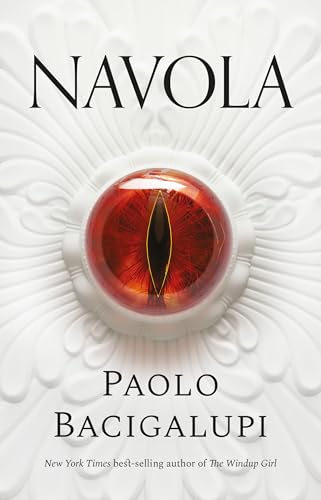
This time with Navola by Paolo Bacigalupi.

I’ve not read the blurb yet.

However, Bacigalupi is an author I have read before. See here and here.

But not for some time.


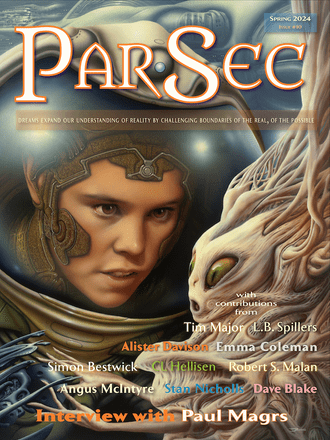
ParSec 10


ParSec 10 became available for purchase yesterday.

This issue contains my reviews of the short story collection Elephants in Bloom by Cécile Cristofari and the novel Floating Hotel by Grace Curtis.

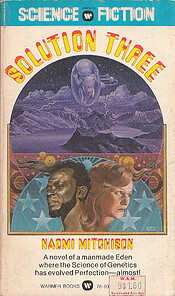
Solution Three by Naomi Mitchison

Warner Books, 1975, 140 p.

In this sometime future, humankind has suffered many emergencies – among them a population crisis. Eventually, due to contributions from two people now known only as Him and Her, it settled on what is called Solution Three. To filter out aggression, heterosexual reproduction has been replaced – at least in the mega-cities – by clones of Him and Her. Clone Mums look after these children until they are old enough for strengthening, a process intended to replicate the stresses and strains of the lives of Him and Her and meant to lead the children to wisdom but about which they afterwards do not speak.

In this society, overseen by The Council, heterosexual sex is regarded as an obscenity except for within a group known as the Professorials and for those living in remote communities.

As one character explains, before Solution Three “Inter-sexual love, resulting in the birth of children, had been necessary. When it not only ceased to be necessary, but was seen as a menace, then the logic of history made itself felt. That age-old sexual aggression changed to non-aggressive love of man for man and woman for woman, overt aggression dropped” in the same curve as population did.

Further science-fictional gloss is provided by references to spray-on clothes but for trips outwith the mega-cities fabric ones are to be preferred.

What plot there is centres around a problem with cereal crops in Asia. Use of particular strains to the exclusion of others means that the food production system may not be robust. This leads to some of the characters beginning to question whether relying on the clones for the future of humanity may not be altogether wise.

As in Mitchison’s only other foray into SF which I have read, Memoirs of a Spacewoman, (and in contrast to her historical and Scottish fiction) there is again too much telling and not enough showing. Another of her SF works, Not by Bread Alone, is on my tbr pile. Will it suffer similarly?

Pedant’s corner:- “certain funguses” (fungi,) “Monte Video” (is this an old spelling of Montevideo?) “koala bears” (now called koalas, since they’re not bears,) “bath rooms” (bathrooms?) a missing end quote mark. chupatties (now spelled chapattis.) “Jean murmured, You’re forgetting’.” (Jean murmured, ‘You’re forgetting.’) “For a minute of two” (a minute or two,) elment (element,) “been dealth with” (dealt with.)

ParSec Magazine Blog Tour and Discounts!

ParSec magazine, for which as you know I review SF and fantasy books, is having a promotion (see the Facebook post here) where a tour of seven blogs can be found reviewing issues 1-6 + 9 in a succesion of links each of which has a discount code for 25% off issues 1-9. Read and enjoy.

The links start at Fantasy Book Nerd here.


Europa Deep by Gary Gibson

Brain in a Jar Books, 2023, 353 p. Reviewed for ParSec 9.
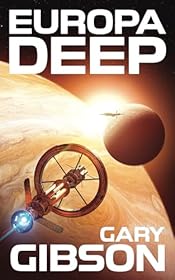
In the aftermath of an extremely virulent virus called the Whispers, which may or not have been man-made, optimised humans (Opts) such as Cassie White are widely held to have had something to do with it and subject to prejudice as a result. Somewhere around the same time there was also an AI war after which the Chinese People’s Republic was replaced by the New Chinese Republic (NCR.)

Cassie’s optimisation has given her an overwhelming need to be in space. Unfortunately, a side effect of her treatment was to be the sufferer of occasional blackouts. One such led to an accident on the Moon in which a coworker died. Drugs can control the symptoms but are not fully trusted – either by her or the wider world. She had been turned down for the first expedition to Jupiter’s moon Europa, on which her brother Chris was one of the crew. Its fate is shrouded in mystery and, most likely, disaster. Hence Cassie starts the book having to work underseas, the closest she can feel to the space experience. To her surprise a politician called Ketteridge, who had previously stirred up resentment against Opts, comes to her in secret with a proposition. His bait is a video of someone walking across the surface of Europa (could it be Chris?) and he wants her to join a second expedition to that moon to recover information valuable to him.

Earlier than our introduction to Cassie though, Gibson pulls off a similar sort of trick to the one Alfred Hitchcock gave us in Psycho, as a result of which the reader knows that two other operatives on the ship, Sally Braemar and Jeff Holland, are not who they claim to be.

Not that suspicion is lacking anywhere on board. Cassie’s replacement of the original crew member has flummoxed everyone, Commander Javier hates her for being responsible for that death on the Moon and fears a relapse on her part so keeps her in suspended animation throughout the trip and her subsequent involvement to a minimum, the others resent Braemar and Holland as possible spooks. Such a closely tied group containing possible traitors makes this aspect of the novel resemble an Alistair MacLean book. And unbeknown to them all, Marcus, Cassie’s last boyfriend, who when about to die of the Whispers had his brain downloaded into an AI (a group also now universally vilified and feared due to the war) has infiltrated his way on board and can observe them all through the ship’s robot repair machines. Plus a Chinese ship having on board another former lover of Cassie, a connection of which Javier is aware, is also on the way to Europa.

And the Yatagarasu, an AI controlled ship which made an unscheduled stopover at Europa, has since vanished from human ken.

All in all, plenty to keep us intrigued and turning the pages.

The remainder of the book deals with the obstacles Cassie has to overcome in getting to Europa’s sea floor in her search for Chris and with what she finds once she gets down there.

Gibson is good on the mechanics of underwater exploration and his descriptions of the extra-terrestrial life in Europa’s ocean do tickle the sense of wonder. A touch of mysticism, if not outright fantasy, tinges the fate of the first expedition, though.

Europa Deep is good solid (well a fair bit of liquid actually) stuff, ticking quite a few boxes. It will scratch the itch of the SF buff, ought to satisfy the thriller reader and even tease the horror taste buds.

The following did not appear in the published review.

Pedant’s corner:- “perhaps there were having a bad day” (they were having,) “she’d be damned if she’d spend one more time in this man’s presence” (I don’t see the need for that ‘one’. One more minute?) “ a few other of you” (a few others of you.) “There was a cheap hotel not from where she was” (not far from where,) Marcus’ (many times. Marcus’s, which did appear once,) Veles’ (many times, Veles’s,) “the cry of cicadas” (cicadas plural, so therefore ‘cries’,) “zero gravity” (technically there is still gravity; the more accurate term is free fall,) Karman Limit (elsewhere Kármán line.) “She pictured Braemar bursting into the lander at that moment, a wrench gripped in one hand and his eyes full of manic hatred” (the character Sally Braemar is female. The male was called Holland,) a missing colon between a message source identifier and its content. “Europa’s dark side” (I assume this meant the side of Europa permanently not facing Jupiter,) “went work in the NCR” (went to work,) N/O2 supply (strictly N2/O2 supply, though, whatever, the 2 ought to be a subscript,) skeptically (sceptically,) “as much to break the silence than anything” (as anything,) “none of them were Chris” (none of them was Chris.) “Rust and grime streaked its outer shell” (Would subsurface exploration suits for use on Europa really be made of iron?) span (spun,) Chris’ (Chris’s,) Necropolis’ (Necropolis’s.)

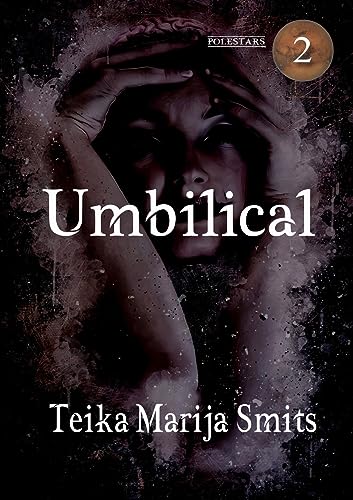
Umbilical by Teika Marija Smits

NewCon Press, 2023, 228 p.  Reviewed for ParSec 9.

This is the author’s first collection of stories, twenty-one in all, plus one poem. Sixteen of them were culled from appearances in a variety of outlets over the past ten years, five are making their first appearance in print. The contents range in genre over SF, fantasy, myth and horror, with stories sometimes crossing over their borders.

In general, literature deals largely with the themes of love, sex and death. Science Fiction tends to be more restrictive (love for example tends to be bypassed and sex for the most part avoided) but its signature feature is in making its metaphors literal. (The outstanding example of that here is the title story, about the bond between a daughter and her mother.) Fantasy, myth and horror act more as warnings and as stripped-down guides to human relationships.

In the first few stories here the theme of death seems to be a connecting thread but this does not then extend to the collection as a whole.

The poem, Icarus Dreams, opens proceedings and partly sets the tone by inviting Icarus to heed his father and rewrite his story. Smits is more than adequately equipped to provide new shapes to old tales. To that end there are herein updated treatments riffing on the Blackbeard and Theseus stories, while the Baba Yaga of Russian folklore meets an AI.

But the author has further strings to her bow. Elsewhere, moles on the skin are a marker of long, perhaps immortal, life, and carry the threat of incarceration to unravel their genetic secrets. We meet an AI repairman whose encounter with his charge becomes reminiscent of 2001: A Space Odyssey. One story (not narrated by Dr Watson) features Sherlock Holmes, but only in a bystanding part as he asks his psychic investigator – and female – cousin to help him. We have tales where a psychological decline follows the break-up of a relationship which had settled into routine, the Green Man appears to rescue a ravaged future Britain, a woman inherits a bookshop with an unusual kind of ghost, AI/human hybrids question each other over their origins – and the nature of God. One story centres on the reliving of bottled memories. There is an African inspired SF/fantasy cross-over. A woman falls in love with her witness protection AI android bodyguard, another tells of the lengths she went to in an attempt to get pregnant, a brother and sister hatch a plot to rescue their twin siblings from VR addiction in a warehouse, a female painter who sells pictures under her brother’s name finds she cannot hide her expertise from J M W Turner (with whom she shares the same reverence for sunlight,) two people celebrate their involvement with the commercial start-up of nuclear fusion at Sellafield, a woman on the point of death remembers incidents from her life while subjectively traversing a fantastical purgatorial maze.

Their telling requires a comprehensive array of authorial registers and Smits handles them all well, with very few infelicities. She is a talent to watch.

Pedant’s corner:- Theseus’ (x 2, Theseus’s,) focussing (x 2, focusing,) a missing comma before a piece of direct speech,  Holmes’ (x 2, Holmes’s, which appeared later,) shrunk (shrank,) focussed (x 3, focused,) sunk (sank,) Geena Davis’ (Davis’s,) “legs akimbo” (I doubt it. It’s extremely difficult to put your feet on your hips,) “and laid down again” (lay down again,) data used as a singular noun (that would be datum, data is plural,) Jesus’ (Jesus’s,) “the settings on each gamer’s capsule isn’t” (the settings … aren’t,)  “‘it’s okay to chop down all the forests and poison the soil.’?” (has that question mark in the wrong place. It ought to be where the full stop is,) “him and Kel had looked to the stars” (he and Kel,) James’ (x 3, James’s; annoyingly employed a few pages later.) “A trail of soapy bubbles stream after his fleeing form” (a trail streams.) Plus points, though, for using maw correctly as a stomach.


free hit counter script