Episodes by Christopher Priest
Posted in Fantasy, Reading Reviewed, Science Fiction at 12:00 on 10 September 2024
Gollancz, 2020, 360 p
 This is a collection of the late author‘s shorter work culled from throughout his career. Each story is prefaced by a ‘Before’ section saying how it came to be written and an ‘After’ section describing how the writing went and where the story was published. Priest’s writing is always controlled and well executed. In general it tends towards a feeling of unease, as if something is lurking below the surface or what has seemed to be reality morphs into something else but here I was surprised by how much of the contents leaned towards horror.
The Head and the Hand. A man who had become famous through allowing himself to be mutilated is persuaded out of retirement for a final cut.
A Dying Fall relates the thoughts that flash through a man’s mind as he is falling in front of a subway train. They are of travelling on a motorway in Belgium and of the training course in parachute jumping/sky diving he took there.
I, Haruspex is, I assume, in the mould of H P Lovecraft. (Priest’s ‘Before’word says it was solicited by a games company wanting something based on that author’s Cthulhu Mythos but he had no familiarity with that at all – similarly I have not. The company, while paying, never used the story and Priest later found a home for it elsewhere.) Effective in its own way it is told in an old-fashioned language of stilted particularity that, for a first person narration, is curiously distanced (not to mention distancing) and overladen with exclamation marks. After consuming his special meals, narrator James Owsley, descendant of a long line of haruspices, can halt or reverse time for a while. Off the Great Hall of his home, Beckon Abbey, lies a hagioscope over a pit which loathsome things are seeking to escape. In a nearby bog a German bomber plane is held in slow suspension as it crashes after being shot down, even though this is 1936. Someone, not a member of its crew, waves to him from the impending wreck and a voice speaks in his head.
Like the author’s novel The Space Machine, written as an hommage to H G Wells, Palely Loitering, a tale of time travel and thwarted love, bears the influence of Edwardian fiction. Despite including space travel (the McGuffin here – called the Flux Channel – was built to help launch a starship on its way,) the story has a resolutely antique feel to it. Its atmosphere of picnics and bandstands, its social and family dynamics were distinctly retro even in the 1979 in which it was first published. After the starship left, three bridges were built across the Flux Channel. The one leading straight across is the ‘Today’ bridge, two others, built at slight angles to the Channel, lead respectively to ‘Yesterday’ or ‘Tomorrow’. Our narrator as a boy one day leapt off the end of the ‘Tomorrow’ bridge and found himself thirty-four years in the future, where a young woman is pointed out to him by a man who says she is waiting for her sweetheart. The reader can from then fill in the gaps but Priest’s execution of the story is impressive.
An Infinite Summer again bears Edwardian hallmarks – but then part of it is set in 1903 where Thomas Lloyd is on the point of proposing to his intended, Sarah, when he is frozen by a camera-like device wielded by someone from the future. The frozen tableaux which result from these capturings can not be seen by contemporary passers-by but only by the unfrozen and the travellers from the future. The effect on Thomas wears off only in 1935 when he is free to move around again but has to wait more years for Sarah to unfreeze. In 1940 he, and Sarah’s image, are caught in the aftermath of the shooting down of a German bomber. The image of one of the bomber’s German crew held in suspension above a river after being captured by a freezer is unforgettable. I note the similarities here between this incident and the one in I Haruspex.
The Ament* is the tale of a man who was once part of a project to film two children, one male and one female, every week, to document changes during their growth and beyond, but who in his adulthood has dreams of committing murder. But are they dreams? The story is told in two alternating voices, his and a third person viewpoint.
The Invisible Men are those (not all men) who are detailed by their USian masters to spy on a British Prime Minister who feels he has to resign due to a financial scandal. (His statement that, “It’s British tradition for a public figure to resign his position if caught in the wrong,” seems altogether quaint now, 50 years after first publication.) His observations of his surroundings on a clandestine meeting on the Norfolk coast with his USian partner – a co-leader of a UK seemingly on the brink of becoming the 51st State – imbue the tale with a sense of foreboding.
The Stooge is employed by a stage illusionist to fake amazement at his tricks on being ‘randomly’ picked from his audience. The story’s title becomes doubly apposite.
In futouristic.co.uk a man responds to an email offering to sell him a time machine. It doesn’t work. For him.
Shooting an Episode presents the ultimate in reality TV, though it’s more like reality streaming. For its subjects no holds are barred. The trouble comes when our narrator has to go in amongst the participants to clean up their mess.
In The Sorting Out Melvina comes home late one night to find her door lying open having been forced. With increasing fear she moves through all her rooms, wondering if the man she has recently dumped has something to do with it, but a phone call reveals he is an hour away. Yet various of her books have been misplaced, their dust covers placed upside down, their normal, random arrangement systematised. One has been glued to a curtain.
In its ‘After’word Priest describes the gathering of books (which is what most readers do) as a kind of quiet madness. Well, all obsessions are. At least it’s a harmless madness.
*Amentia is the condition of feeble-mindedness or other general mental deficiency.
Pedant’s corner: Méliès’ (Méliès’s – especially since the final ‘s’ of Méliès is unsounded, thus demanding the apostrophe ‘s’ for its possessive,) maws (used for ‘mouth’; a maw is of course a stomach,) interlocuter (interlocutor,) aureole (areola,) Mrs Adams’ (Adams’s,) “more yachts were parked further away” (parked? Can you park a yacht?) “the king” (x 2, the King,) “the sort of problems the bank were concerned with” (the bank was concerned with,) soccer (football.)
 Hot off the presses and to be read for
 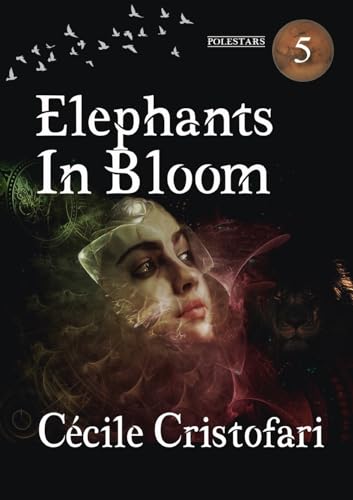 This is the author’s first collection of short stories. Ten of them appeared in a variety of publications over the past five years, eight are original to this book. Each is provided with an authorial afterword. Some of these mention Cristofari’s French background and the latitude she gains as a writer from having two languages to draw on. She casts her net wide, with settings ranging from prehistory through to the present day and beyond. A common thread running through them is ecological collapse and possible recovery from it, in perhaps a sign of recent events some feature characters living in the aftermath of a pandemic.
 On a future Earth where everyone is genetically designed to be perfect Dante McCall is a misfit. Viral treatments to cure his asthma didn’t take but instead warped his perceptions so that he was unfit for Normal interaction. He escapes a fire in the home where he lived and boards a spaceship about to launch. That ship is picked up by a rogue trader, the Mangueira. On board Mangueira, Dante, being Italian and knowing Spanish, can just about make out the language used aboard, Brazilian Portuguese due to the origin of its large crew. Its occupants are known to the rest of humanity as Malandros. Their ship-board life is dominated by samba dancing and singing. ‘Dancing changes body and brain chemistry and makes us more receptive, more reactive.’ Dante is at first as much of a misfit here as he was on Earth.
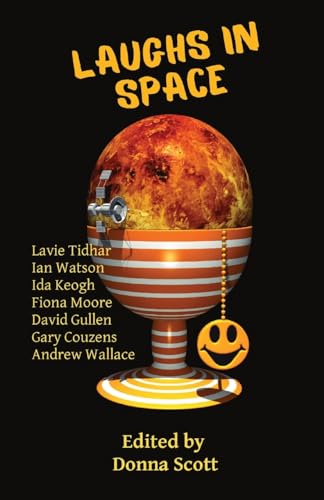 Hard on the heels of me finishing Nordic Visions for review for
  I happened to be in my local library the other day. The good lady and myself were looking at the new books section when she said, “What is speculative fiction?”
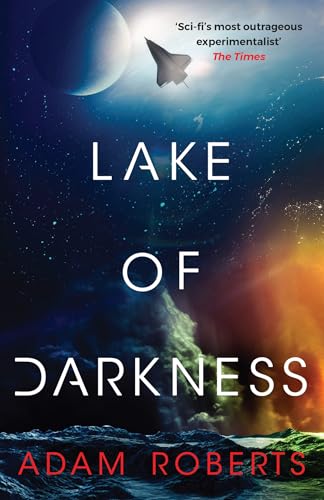 Yesterday, Lake of Darkness, the latest novel from Adam Roberts, was handed over by our postman.
 I seem to have progressed into reading Newman’s series of Planetfall novels backwards. Before Mars and Atlas Alone I did read in the correct order (3 before 4) but this is number 2 in the sequence and I have not yet read Planetfall, the first.