Archives » Salman Rushdie

Luka and the Fire of Life by Salman Rushdie

Vintage, 2011, 220 p.

This is a companion piece to Rushdie’s earlier book Haroun and the Sea of Stories, written for his son, but also as a defence of the art of story-telling. Like that novel this one could be described as a children’s book but there is plenty to delight the adult reader.

The hero this time is not Haroun but his younger brother Luka. Their father, Rashid Khalifa, is renowned for his storytelling abilities and known as The Shah of Blah from his ability to draw inspiration from what he calls the Ocean of Notions.

But Rashid has fallen ill and to save him Luka must seek out and bring back The Fire of Life that burns at the top of the Mountain of Knowledge. In his quest he is accompanied by Dog the bear and Bear the dog and a spirit presence calling himself Nobodaddy who is Rashid’s double and whose appearance becomes more transparent the more Rashid’s life wanes.

He it is who tells Luka, “Man is the story-telling animal.” In stories are his identity, his meaning and his lifeblood. By way of emphasis Nobodaddy asks, “‘Do rats tell tales? Do porpoises have narrative purposes? Do elephants ele-phantasise?’” This is typical of Rushdie’s style here of free association, word play and allusion. In a riff on time-travel stories there are mentions of the clock-bearing rabbit in Alice’s Adventures in Wonderland, intimations of Doctor Who, Time Bandits, Back to the Future, and A Connecticut Yankee at the Court of King Arthur.

Luka’s journey through the Magic Land up the River of Time takes him to the land of Oh-Tee-Tee (Ott,) where everything is done to excess, and whose Queen is referred to as the Insultana. All sorts of weird and wonderful things happen by way of P2C2E, Processes Too Complicated To Explain. Luka picks up other companions along the way, among them Elephant Birds (fearful of losing their memories in the Mists of Time they pass through,) and the great Native American mythological character Coyote. We also encounter an arid expanse of land called The Waste of Time.

Whether you can be doing with all this punnery depends upon your toleration of exuberant word play. Myself, I found it delightful.

The Magic Land of Luka’s journey is Rashid’s creation and Luka reminds its inhabitants that if they prevent him from restoring the fire of life to his father they will disappear along with him.

On returning home (Spoiler: this is a children’s tale after all, of course Luka returns home) Rashid admits to Luka he stole the idea of the few particular children who can defy Time’s power just by being born , and make us all young again, from his wife, Luka’s ma. “‘If you’re going to be a thief,’” he says, “‘steal the good stuff.’”

Well, you could say Rushdie has.

Pedant’s corner:- Pythagoras’ Theorem (Pythagoras’s,) “the stink of sulphur dioxide” (this is supposedly the result of rotting eggs. However the gas they give off is hydrogen sulphide, H2S; not SO2,) “reached a terrible crescendo” (No: the crescendo is the climb, not its end,)

Salman Rushdie

It ought to be obvious from the fact that on this blog I have reviewed four of his books, but I admire Salman Rushdie as a writer. Not everything he has written of course. Some books are better than others.

As a man however I cannot imagine how he carried on under the circumstances of his life. That perhaps is the most admirable thing about him.

Yet what was the alternative? To back down, to retreat into obscurity, to hide away from the world would have been understandable but it would also have been to give in. Let us be clear that that would have been giving in to bullying, yielding to intolerance, giving up the right to think for yourself.

Some people believe that what they have been told is the word of god trumps whatever anyone else might hold dear. That they may be mistaken in their beliefs does not seem to occur to them. And if their faith cannot stand criticism then it does not say much for what they believe in nor for the strength of that belief. If it is so fragile that it cannot bear criticism it is a poor, misbegotten thing. Maybe that is what these deniers of alternative views are afraid of.

When I read The Satanic Verses I could not see how it had blasphemed against Islam. I did not detect in it any reproof of that (or any other) religion nor, indeed, of its prophet. Only a counsel to treat religious texts judiciously and with due care. The book was, in any case, more concerned with other matters. (Or was it that which perhaps was its offence?)

In the light of the recent attempted murder of Rushdie – in full view of an audience, so making a not guilty plea somewhat laughable – George R R Martin of Game of Thrones fame has written a passionate defence of the right of a writer to write and of freedom of speech more generally. He says it much better than I could.

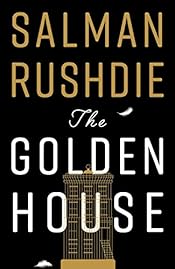
The Golden House by Salman Rushdie

Jonathan Cape, 2017, 376 p.

This book, as its title tells us, is about a house. Not merely the building where the family Golden lived once they came to the USA, but, too, the dynasty its inhabitants comprised. The title is also the name of the (scripted) documentary of the lives of those denizens of the Golden House which takes our narrator, René Unterlinden – obsessed with films, seemingly forever making reference to (among other things) scenes from movies he has watched – over ten years to complete. As a narrator he has some intermittent habits to do with this obsession, framing more than a few scenes in the book as if they were script extracts and sometimes ending a section with the same word.

Cut.

The eponymous house lies on Macdougal Street a little below Bleecker, with access to The Macdougal-Sullivan Gardens Historic District, a green space with fond memories for René as his now deceased parents also had a house there and access to the Gardens in the combined rear yards. The Golden house itself is owned by Nero Golden who adopted his first name after the last of the Julian emperors of Rome and his sons think of themselves as Julii. “‘In my American house,” he told them after they came to live in New York, “morality will go by the golden standard,’” without specifying exactly what he meant by that. As well as the father those sons have also been given Roman names, Petronius, Apuleius and Dionysus, but are known as Petya, Apu and Di. They all try to keep their origins hidden. If they were asked where they came from Nero instructed them to say, “Tell them we are make-believe people, frauds, reinventions, shapeshifters, which is to say, Americans.” While they are intensely secretive as regards family affairs Petronius does drop his guard at one point to quote Edwin* Leach’s variation on Tolstoy, “The family with its narrow privacy and tawdry secrets is the source of all our discontents.”

Aside – *Edwin is how I transcribed the name from the text but it seems Leach’s first name was Edmund.

Nero has two female attendants/fixers called Fuss and Blather. Another of the characters is named Frankie Sottovoce. Quite what point Rushdie is trying to make with this linguistic playfulness is a touch obscure. It is one of his hallmarks though. So too is digression, which in this book is burdened with more than a slice of over-elaboration.

It is when Nero encounters one Vasilisa Anayevna at a New Year party that the plot motors begin to drive up, dancing with him in a manner which indicates that she will never henceforth let him out of her clutches. René imagines Nero telling her, “My money for your beauty. Shake hands on that.” She moves into the Golden House with a pre-nup specifying no children but slowly works her wiles on Nero. The end result many years later is a child, Vespasian, whose name is a true expression of how the dynasty will pan out. René muses on his own behalf as well as of others’, “The motivations of desire are obscure even to the desirous, the desiring, and the desired…… And so without full knowledge of the why and wherefore, we inflict mortal wounds on those we love.”

The golden (ahem) era in which the book starts is soon overshadowed by political events in the wider USA where the beliefs that ‘now the only person lying to you is the expert who actually knows something. He’s the one not to believe because he’s the elite and the elites are against the people, they will do the people down. To know the truth is to be elite,” as his girlfriend Suchitra tells René are increasingly widespread. About the adherents of the Presidential candidate René calls the Joker, and who amplifies those attitudes René says, “In that bubble, gun murderers were exercising their constitutional rights but the parents of murdered children were un-American,” with a subsequent rant about all the orange-faced candidate’s failures somehow proving he was really a success, all his expressions of contempt for others proof of his compassion, how his world was a reversal, “In that bubble knowledge was ignorance, up was down, … lying was funny, and hatred was funny, and bigotry was funny, and bullying was funny, and the date was, or almost was, or might soon be, if the jokes worked out as they should, nineteen eighty-four.”

It must be said here that surely Rushdie is preaching to the converted? I doubt anyone likely to read this book will disagree with the criticisms inherent in these passages and those who do disagree with them will not ever be reading the book. But René’s conclusion that “The human race was savage not moral” is at best only partially true. “America’s secret identity wasn’t a superhero. Turns out it was a supervillain,” is, again, a neat syllogism but not yet entirely beyond question. Rushdie’s asseveration through René that “all writers are thieves” may perhaps have been inserted to defray criticism of his many deployments of incidents from films.

The Golden House of course deals with those eternal matters of love, sex and death, in the end reasonably effectively, but it comes on them by twisted and circuitous paths. The book is longer than it needs to be and too much – especially the backstory of Nero’s former existence in his ancestral homeland – is told not shown. His has always been an exuberant mode of expression but is hard to resist the thought that Rushdie here is too much in love with his wordplay and referential ways, that, like a fair few other authors, he has perhaps become too big – or too precious – to edit.

I note finally that Rushdie took pains to render the plural of puss (as in cat) as ‘pusses’ but there is really only one way to end this review.

Cut.

Pedant’s corner:- whiskey (whisky – it’s a British edition ffs,) “in spite of the repressible fact that Jefferson had owned slaves” (in context ‘reprehensible’ makes more sense but it was within a polemic about an aspect of the cuture wars so Rushdie may indeed have meant repressible,) Sophocles’ (x 2, Sophocles’s – in the text some names ending in ‘s’ are given ‘s’s’ as their possessive, others aren’t) “Ubah means ‘flower’ or ‘blossom’ in Somali” (no it doesn’t. In Somali it means ubah. In English it means ‘flower’ or ‘blossom’,) “New Year’s is for dancing” (now just eff off. It’s ‘New Year’; no apostrophe ‘s’,) Achilles’ (Achilles’s,) overdraught (overdraft,) Aeschylus’ (Aeschylus’s,) a sentence that was a question ended with no question mark, Odysseus’ (Odysseus’s,) “nor of fiction, neither” (the negative has already been expressed in the ‘nor’, so; ‘nor of fiction, either’.)

Bookshelf Travelling for Insane Times – Translated Fiction

Time for Reader in the Wilderness’s meme again.

These shelves contain my paperbacks of fiction translated from languages other than English. Evidence here of my usual suspects – Bohumil Hrabal, Mario Vargas Llosa, Naguib Mahfouz, Diego Marani, Gabriel García Márquez, Irène Némirovsky, Orhan Pamuk, but nearly all of these have been worth reading. In fact I would say there are no real duds here. The English language books on the lower shelf belong to the good lady and are shelved there because they fit into the space:-

Translated Fiction Bookshelves 1

Several really large hardbacks are too big to sit on the above shelves so have to be kept separately. These are not all translations but there is more Orhan Pamuk, more Naguib Mahfouz, more Irène Némirovsky, and then the English language Salman Rushdie. The John Updike omnibus is the good lady’s:-

Large Books Shelf

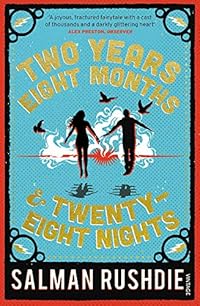
Two Years Eight Months and Twenty-Eight Nights by Salman Rushdie

Vintage, 2016, 296 p. Reviewed for Interzone 265, Jul-Aug 2016.

 Two Years Eight Months and Twenty-Eight Nights cover

The title is an indicator, clearly alluding to a famous collection of tales of wonder, promising (as it then does) exotic happenings, digressions, meanderings and stories within stories. Yet it is also somehow unmistakably Rushdian. Exotic but recognisable, aslant but accessible. In any case, I doubt any other present day author would invite comparison to such a well-known set of stories as the Arabian Nights. But the conceit doesn’t come from nowhere. If he perhaps hasn’t addressed the supernatural quite as directly in most of his previous novels there has nearly always been more than a hint of the strange, brushes with the uncanny, in Rushdie’s work. So here we have jinn (not genies, no, we don’t use that word any more) the Grand Ifrits, Zumurrud the Great, Zabardast the Sorcerer, Shining Ruby the Possessor of Souls – so slender he disappears when he turns sideways – Ra’im the Blood-Drinker, the source of all the world’s vampire stories, and the jinnia Dunia, otherwise known as Aasmaan Peri, aka the Sky Fairy and the Lightning Princess of Mount Qâf.

The narrative is couched as a looking back at the legendary time when the seals between the worlds eroded, a great storm struck the Earth and the Strangenesses began. Yet the story begins over 800 years earlier, in 1195, with the arrival at the house of the philosopher Ibn Rushd (Averroes) of a young homeless girl. This was Dunia, indulging her fascination with human men and her capacity for love. For two years eight months and twenty-eight nights they lived as man and wife and produced numerous offspring, whose descendants, all characterised by their lobeless ears, became the Duniazát. Not named after him as, “To be the Rushdi would send them into history with a mark upon their brow.” Ibn Rushd’s dispute with the philosophy of a predecessor, Ghazali, “Only fear will move sinful man towards God,” and who stated that things happen only because God wills them, provides us with disquisitions on God’s nature, “God is a creation of human beings; the clap-hands-if-you-believe-in-fairies principle.” These differences are played out on a grander scale during the war between the worlds that followed the Strangenesses.

During that time rationality crumbled. Some found their feet didn’t touch the ground and might float away so high that they died, others were weighed down so that they became crushed. A baby born during the storm caused outbreaks of sores on anyone corrupt or dishonest into whose vicinity she came. The irrational became commonplace. The Duniazát had inherited some of Dunia’s jinn powers and were invaluable in the final confrontations with the Grand Ifrits. The whole time of Strangeness lasted, of course, two years, eight months and twenty-eight nights.

Lines like, “If I get hurt in this putative affray of yours then I’m not an innocent bystander?” to a policeman from a musician at risk from the incitements of a rabid preacher show that the events of Rushdie’s life so far have contributed mightily to this – as, I assume, theirs must necessarily do for all but hack authors. Yet while the novel contains all Rushdie’s strengths, it also manifests and perhaps magnifies his faults. There is not much restraint here, there is a lot of telling, the treatment is, as ever, consciously literary and full of word play (Lebanonymous; “all the gold, men, in your sacks will not save you.”) Yet the retrospective narrator defuses any tension in the reader as to the eventual outcome. Rushdie also feels it necessary to define FTL despite name-checking eleven masters of the golden age of science fiction.

However, the book is mainly a meditation on the nature of story. “All our stories contain the stories of others and are themselves contained within larger, grander narratives.” “The first thing to know about made-up stories is that they are all untrue in the same way,” (which feels Tolstoyan but is certainly debatable.) “To tell a story about the past is to tell a story about the present.” That stories tell us what we are; we tell them in order to understand ourselves. Quite where the incursion of the supernatural leaves us with that one is rather problematic. “To recount a fantasy is to tell a tale about the actual.” Well, maybe. “If good and evil were external to Man, it became impossible to define what an ethical man might be,” is closer to the mark.

In general Rushdie is at his best when his flights of fancy are tethered more firmly to earthly events, more centred on his human characters which here are too thinly delineated. Two Years Eight Months and Twenty-Eight Nights is pyrotechnic, impressive even, undoubtedly worth reading, but, ultimately, curiously lacking in heart.

The following did not appear in the published review.
Pedant’s corner:- St Sebestian (Sebastian?) Nietzche (later rendered correctly as Nietzsche,) “when the princes’ attention was elsewhere” (yes it was princes, plural, ergo it should be attentions were,) bsattling (battling,) Rossonero, (Rossoneri.) In name (In the name,) one less sad angel face (one fewer – but it was narrated in tight third person,) waitstaff (that’s just a horrible conflation, waiting staff is entirely adequate,) knobkerry (I’ve only ever seen the spelling knobkerrie before,) scent to the lower world (sent.)

Latest Interzone Stuff

 The Paper Menagerie cover
 Two Years Eight Months and Twenty-Eight Nights cover

On Monday morning Interzone’s issue 264 dropped through the letter box. This one contains two of my reviews, a normal length one of Ken Liu’s collection The Paper Menagerie and other stories and a shorter one of City of Blades by Robert Jackson Bennett.

Meanwhile, waiting for me on my return from the continent was a copy of Salman Rushdie’s Two Years Eight Months and Twenty-Eight Nights, review to be delivered by the end of the month.

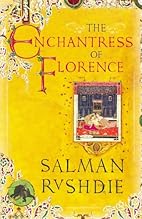
The Enchantress of Florence by Salman Rushdie

Jonathan Cape, 2008, 359 p.

The Enchantress of Florence cover

A foreigner turns up to the court of the Mughal Emperor, Akbar, at Fatehpur Sikri with a claim to be related to him and a tale to tell to justify it. The foreigner has called himself variously Uccello di Firenze, Mogor dell’ Amore (the Mughal of love) and Niccolò Vespucci. So begins this typical piece of Rushdian flamboyance.

Containing elements of fable, fairy tale and Rushdie’s usual dose of magic realism (among other things Akbar has managed to conjure up for himself an imaginary – and therefore perfect – wife) there is nevertheless something about the treatment that does not quite hit the mark. Rushdie has always been fond of digression, word games and allusions (in this case, for example, take the mercenaries Otho, Botho, Clotho and D’Artagnan) but it has to be said; in amongst the showing here, there is a lot of telling. As if to underline this there is a list of works consulted for research given in a bibliography.

Yet, as the author notes, “The untruth of untrue stories could sometimes be of service in the real world.” That is what fiction is for after all. But then again, “Those sceptics who by virtue of their sour temperament resist a supernatural account of events may prefer more conventional explanations.” Indeed.

It might seem, too, that in a novel entitled The Enchantress of Florence that the woman concerned could be expected to appear in the narrative somewhat earlier than two-thirds of the way through but while this is her story it is also the story of Akbar, of the Florence of the Medici (and the monk Giralomo,) and of three friends from that city, Antonino Argalia, last of the condottieri, Niccolò – ‘il Machia’ – Machiavelli (yes, that Machiavelli) and Agostino Vespucci (cousin to Amerigo.) It is also the tale of why the Mughal court had to leave Fatehpur Sikri.

The enchantress is Qara Köz, “Lady Black Eyes,” Akbar’s Great Aunt, sister of Babar the first Mughal, eliminated from the family history when she rejected a return from capture. Her enchantments seem to lie in the ability to entrance men, if only for a while. Her destiny is to pass through the hands of a warlord, to the Safavid Shah Ismail, to Antonino Argalia and finally to the New World with Agostino Vespucci. She has a companion, her mirror in all respects (bar one.) Yet she is an absence in the book, an emptiness around which Rushdie weaves his tale of folly, wisdom, hope and loss. Akbar is at the heart of it, a ruler wise to his surroundings and to the machinations of the power hungry. There is a barbed inversion of insular Western conceptions when Akbar muses that, “The lands of the West were exotic and surreal to a degree incomprehensible to the humdrum people of the East.”

A noteworthy aspect of this edition is that it is endowed with beautiful endpapers picturing at the front a detail from The Building of Fatehpur Sikri Palace from the Akbamama and at the rear from the Carta della Catena showing a panorama of Florence.

Pedant’s corner:- A 16th century Scottish pirate may well have been carrying letters of marque or even diplomatic credentials from Queen Elizabeth (of England) but I doubt he would treasure a locket containing her portrait. Equally he may have boasted of climbing all Scotland’s Munros but not in those terms. They were not named as such for a further three centuries. “I’d keeped her locked up” (keep,) rowboat.

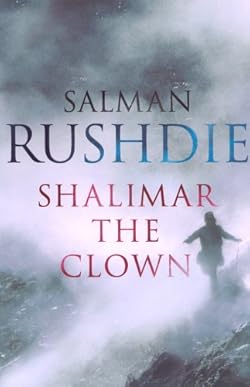
Shalimar The Clown by Salman Rushdie

QPD, 2005, 398p

Shalimar The Clown cover

After the relatively disappointing aberration of Fury this novel sees Rushdie return for his setting to the locales and interests from which he made his name. He treated with Indira Ghandi’s India in Midnight’s Children, Pakistan in Shame and Islam in The Satanic Verses, before returning to (modern) India with The Ground Beneath Her Feet. In Shalimar The Clown it is Kashmir on which he focuses. In this sense the novel’s start is misleading as it begins in California with the daughter of a former ambassador in the days leading up to his assassination by his chauffeur/factotum, the titular Shalimar the Clown.

The book ranges far and wide with many digressions. In a strange resonance with the previous book that I read the ambassador, Maximilian Ophuls, [why Rushdie chose for his character the name of a film director is somewhat obscure; to me at any rate] was a (Jewish) native of Alsace forced to flee, leaving the family printing business behind, after the Germans took over in 1940. He became a leading member of the French Resistance, was involved in US-French relations, emigrating to the US at the end of the war, and was appointed ambassador to India in the 1960s. This novel is not without incident.

The story arc of the book deals, though, with the relationship between Noman Sher Noman and Boonyi Kaul (both of whom, along with Max and his daughter are given sections of the book – I was going to say to themselves, but other characters pop up all the time all over the book, in typically Rushdiean profusion) and the two villages in Kashmir, Pachigam and Shirmal, where they grew up. It seems all of life is here; the picture of a community, a way of life, is detailed. The plot of the novel is almost buried at times – yet this is true of every section. And is the placid, comradely, nature of existence there before the tensions between India and Pakistan led to strife in the region a touch overplayed? Whatever, the growth of Islamic fundamentalist influence, the deterioration in the situation and the horror of communal conflict is well depicted. Neither the Pakistan backed Muslim terrorists nor the Indian Army are spared implicit criticism.

When Ophuls visits the villages Boonyi seizes her chance to escape, only to end up in a different kind of entrapment. Noman meanwhile burns for revenge. He is recruited as a terrorist and suppresses his character while training. In this context the use of his name (no man) as a signifier seemed perhaps a little trite.

A short review can only touch the surface of the myriad elements which go into a novel which, like this, tries to deal with a big issue. There has to be some kind of story on which to hang the subject matter but at times, here, the human dimension is lost in a surfeit of detail. Do we really, for example, need to know the history of the main characters’ parents? This is a trope which Rushdie has employed in previous books. (A similar trait annoyed me in Norman Mailer’s The Naked and the Dead where, every time the author switched to a new viewpoint, we were treated to the character’s whole life story to that point, fatally interrupting the novel’s flow.) In Shalimar The Clown moreover, many passages are told rather in the style of a historical narration than a novel. I shall not reveal the true identity of Shalimar, even though it’s not hard to guess.

While I could have done without the ascent into fantasy in the final section, Rushdie’s sympathies are always in the right place and, despite the various horrors the book describes, overall it is, as perhaps all fiction should be, life-enhancing. After Fury, it represents a return to form.

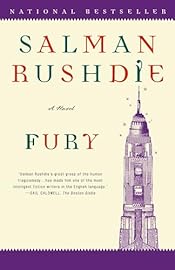
Fury by Salman Rushdie

Modern Library, 2002. 259p

Set mostly in New York Fury is perhaps the fruit of Rushdie’s move to the US after the restrictions necessitated by the fatwa made life in the UK less than congenial for him.

It is not a vintage work, no Midnight’s Children nor Shame. Too much is told, not shown. It also begins inauspiciously; with a very Dan Brownesque first sentence, “Professor Malik Solanka, retired historian of ideas, irascible dollmaker, and since his fifty-fifth birthday celibate and solitary by his own (much criticised) choice, in his silvered years found himself living in a golden age.”

Now, it could be said that Rushdie is playing with the reader, essaying a fable, but, really, three of those crudely dumped slivers of information are examples of newspaper prose and the knowledge they bring us ought to have emerged more organically during the course of the novel.

The novel deals with Solanka’s life after leaving his second wife. He was so full of fury he had almost killed her and their young son and he fled to New York to escape that horror becoming reality. He was also the creator of a TV series in which a doll called Little Brain hosted a kind of chat show where various historical and philosophical figures were interviewed. It became a cult hit, was taken up further, spawning the usual commercial opportunities attendant on success, but in the process was dumbed down. The doll masks which are one of the manifestations of the show-s popularity later become a plot point.

Rushdie’s usual scatter-shot referencing is present, not only to the Erinyes (Furies) of Greek myth – along with allusions to more popular culture – but also copious descriptions of SF stories (eg The Nine Billon Names of God) and films (Solaris, even – heaven help us – Star Wars.) The three Furies have their counterparts in the three women whom Solanka is involved with in the course of the book.

There is a sub-plot involving a republic known as Lilliput-Blefescu (where the doll masks take on a political significance) and which allows Rushdie ample scope for Swiftian allusions.

As a novel, Fury is too tied up in itself. Rushdie is riffing on his concerns but here his orotund, fabular style is distracting, the characters are not as rounded as in his earlier works and the plot not as engaging.

More from P P Arnold: The First Cut Is The Deepest

The song was of course written by Cat Stevens who transmogrified from a writer/performer of pop in the 60s to an acoustic singer-songwriter when they were in vogue in the 70s, then gave up music for religion (Islam) before returning in the noughties as Yusuf Islam – and now just Yusuf.

I bought his albums Tea For The Tillerman and Teaser And The Firecat at the time.

Ever since his criticism of Salman Rushdie over The Satanic Verses, where he appeared to endorse the fatwa, I’ve never been able to listen to them. I couldn’t bear to.

P P Arnold: The First Cut Is The Deepest

free hit counter script