Archives » ParSec

Braking Day by Adam Oyebanji

Jo Fletcher Books, 2022, 365 p. Reviewed for ParSec 3.
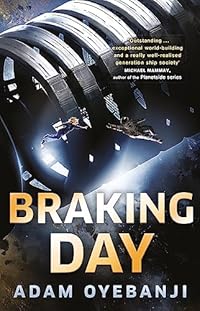
Every once in a while someone reinterprets an old SF trope, as if to show that newness isn’t necessarily a be-all and end-all, that even the hoariest of SF concepts can be dealt with in an altered light. Here, Oyebanji has taken the idea of the generation starship, stirred up its components and laid them out in a new configuration. And the result is something which for long-time readers of SF is almost nostalgic, but also verges on perfect.

The inhabitants of the Interstellar Space Vehicle Archimedes are onto the seventh generation on board but the ship is nearing its destination star Tau Ceti, and Braking Day is imminent. Lending distinctiveness to Oyebanji’s vision the ship has an unusual construction, between the forward shielding and the, for now silent, drive engine to the rear its body is made up of wheels named after old Earth countries, each rotating to produce artificial gravity but at different rates and in a contrasting direction to its neighbours’. Another divergence from the generation starship norm is the employment of those lift-like conveyances known as paternosters for movement between levels within a wheel.

Archimedes and its fleet companions Bohr and Chandrasekhar fled an Earth under the control of AIs with the (somewhat convoluted) acronym of LOKI, loosely organised kinetic intelligence, each “capable of reconfiguring itself as it learns and remembers” – dangerous both in and of themselves but also to their potential vulnerability to hacking. On board, these are anathema – unlike the implants all the ships’ inhabitants have inserted as children to allow them access to the hive and its information. Nevertheless the ship’s society is fairly rigidly stratified by occupation, especially between officers and crew, but its organisation means there is little but petty crime and there has been no conflict as such for generations.

The viewpoint character is Ravinder T MacLeod, whose family is a traditional thorn in the officers’ side but who is training to be an engineer and is the butt of remarks about his origins and frequently scruffy appearance. Water is a precious resource and used as a currency and his lowly status ensures he goes from one pay day to the next trying to conserve it. A trip to the officers’ wheel, Australia, where water abounds, marks a huge contrast between his existence and theirs. His best friend in training, Vladimir Ansimov, is also of humble background but his main companion is his perennially rebellious – albeit in a relatively minor way – cousin Roberta, known as Boz, a coding wizard. Her habitual smoking of cigarettes annoys Rav not only since it’s against ship regulations but also because he knows how knackered the recycling systems are. He takes a fancy to fellow trainee Sofia Ibori, unattainable due to her high-ranking lineage.

There is some dissent in the fleet in the form of a group known as BonVoyagers, who wish not to contaminate the Destination World as their ancestors did Earth but instead hope to journey the spaceways forever. Unlike the invocation of the ship’s name in the favoured expression of exasperation, “for Archie’s sake,” shipboard slang – sarding, gullgropers – is a little cloying at first but later contrasts effectively with usage on another ship.

Enough scope there you might think for any novel, but Oyebanji has still more for us. For a while it feels like he might even be about to give us a ghost story as down in the deepest part of the ship’s engines where Ravi has been sent on a repair job he hears a tapping sound which seems to be coming from outside the hull. On peering out of a porthole he sees a woman with dyed hair – something never seen on board – but also apparently impossible as she has no space suit. Blink and she is gone but he glimpses her the next day on one of the companionways. Ravi also begins to experience a recurring dream (or a recurring start to one.) In addition, memories that are not his and where the name indicators for genders appear to be reversed intrude into his consciousness. There is, though, a rational explanation for these events.

Further elements of mystery are added when Ravi sees the Captain and Chief Engineer examining an underfloor duct, he feels the drive turned on at low power late at night, discovers adaptations to the ship’s hull where rudimentary weapons have been attached, Boz is conscripted to devise software for a torpedo and the fleet is set to silent running. Something is out there and it is a threat.

Not the least of Braking Day’s pleasures is that its characters are rounded, with entirely human hopes, fears, motivations and flaws – and it is superbly plotted. Along the way Oyebanji conveys the attitudes imbued by growing up in a specific environment when Vlad compares the safety of shielding, bulkheads and life support to the exposure of life on a planet right next door to a star, with an atmosphere likely to be stripped away at any moment, and rhapsodises on the fifty square metres on Destination World he might enjoy – an almost unimaginably (to him) large amount of living space. Oyebanji makes this all real for us. This feels like how life on such a starship would be.

There is conflict here to be sure, even ordnance being set off, but what a pleasure it is (an unusual pleasure these days) to read an SF novel whose protagonists’ first resort is not to violence but to talking, diplomacy if you will. I doubt I’ll read a better SF novel this year.

Pedant’s corner:- When a chapter begins with a piece of dialogue the opening quote mark is missing, Petrides’ (Petrides’s,) Archimedes’ (Archimedes’s,) maws (these were mouths, not stomachs,) a missing comma at the end of a piece of dialogue, another at the beginning of a different piece, “the quiet whirr of power tools did their job” (whirr is singular, the pronoun ought to be too, ‘its job’, but then the sentence would need rejigged, ‘there was a quiet whirr as power tools did their job’,) andnightclubs (needs a space,) crewman (not crewmember, I note,) Outside the ship there are bits of ice on the superstructure. Since water is a currency on Archimedes these would surely be harvested, but in any case, exposed to vacuum would more likely sublime away before that could be done,) also drones for working outside the hull expend puffs of vapour as they manœvre, surely a waste of precious resources. “‘It’s has to be’” (It has to be,) “waiting for answer” (an answer,) “with the all the ship’s barristers” (that first ‘the’ is unnecessary.) “None of them were easy” (None of them was easy.) “He heard her a yell” (He heard her yell,) “of what had had once been” (only one ‘had’ needed,) grill (grille,) the Newton crewman (was a woman.) “If worse came to worst” (in my youth was always ‘if the worst came to the worst’.) “The cloud of numbers surrounding Ao Qin were already changing configurations.” (The cloud of numbers surrounding Ao Qin was already changing configuration’,) “theBohr” (needs a space,) “the use drugs to lower heartrate” (the use of drugs; heart rate,) “by LOKI’s” (LOKIs,) “‘you wanting it to different’” (it to be different.) “‘But,, sir –’” (has a comma too many.)
ParSec 6

ParSec 6 is now available to buy.

This is the issue that contains my reviews of Beyond the Burn Line by Paul McAuley and Percivous Escape by JJ Cook and A J Cook MD.

I have also received for review – for ParSec 7 – Cold Water by Dave Hutchinson, another novel set in his Fractured Europe universe.

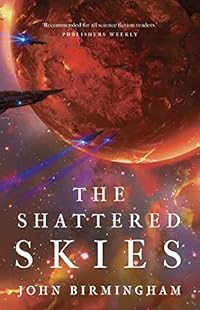
The Shattered Skies by John Birmingham

Head of Zeus, 2022, 509 p. Reviewed for ParSec 3.

While there are some scenes in this second instalment of Birmingham’s trilogy (for my review of the first see here) which feature Lucinda Hardy’s father Jonathyn, whose term in a debt defaulter’s prison on Batavia has been ended by the Sturm, the bulk of the text remains focused on the five main characters surviving from Book One, though four extra viewpoints also come into play: Sturm Captain Anders Revell, Sub-Commandant Domi Suprarto of the Imperial Javan Navy (whose organisation and command style seem to be modelled on that of the Japanese armed forces of the 1930s and 40s,) his superior, Imperial Volume Lord Juono Karna, plus Rinaldo Pac Yulin of the Yulin-Irrawaddy Combine. In the Natuna system the Javan and Combine ships of the latter three were running silent to weather a solar storm just as the Sturm attack on the Greater Volume’s zero point network occurred and so mostly avoided the fate of all those connected to it. Like Hardy, Suprarto finds himself unexpectedly in command after his officers’ brains were scrambled when they switched online again.

While the others, being adult, remain true to their earlier selves it is noticeable that Princess Alessia undergoes character development here in that she begins to blossom into her aristocratic heritage. Her tendency to use swear words does perhaps occur a mite quickly though. She drives most of the plot in this volume as, due to her revelation that her family maintained illegal and therefore secret engram vaults to restore their consciousnesses in case of the type of disaster which has just occurred, the occupants of the Defiant and Sephina’s new ship Arianne (named after her dead lover) set off to find such a cache at the space habitat called Lermontov in the Natuna system but first stop off at Descheneaux Station to rescue the few inhabitants and Armadalen Navy regulars who had not succumbed to the Sturm strike. Body strewn encounters ensue with the zombiefied but bloodthirsty remnants of humanity whose minds had been destroyed. (Why they do not turn on each other rather than seeking out “normal” humans is not explained. But then, of course, we would have had no gory battle scenes.) Hardy, though now a Commander, herself forms part of the rescue team, for which McLennan chides her as an unnecessary risk for a leader.

Hardy and McLennan put pressure on Princess Alessia to sign a declaration which would emancipate the many inhabitants of the Greater Volume who were de facto slaves. Despite the likelihood that if her family were to be revived they would declare it null and void she eventually agrees. This almost throwaway aspect of the book puts a gloss on our heroes’ determination to combat the Sturm. It smacks of a kind of desperation to show their cause is just. (Birmingham presumably intended this to stand comparison with another war during which an emancipation proclamation provided a higher purpose to its continuation. It doesn’t.) Alessia herself perceives later on that living conditions on Lermontov are harsher than she could have imagined. This is one more indication to the reader that the society for which her companions are fighting is probably not really worth defending.

As is common in second parts of trilogies there is a degree of marking time here. In particular the animosities the Javan Empire and the Combine have with the Armadalen Navy, even in the face of the advancing Sturm, take up most of the narrative.

Again we have an indicator of what may be Birmingham’s inspiration for the Sturm in that Pac Yulin (not the best example of a good guy it has to be said) says of them, “‘They do not just distrust the science. They despise and repress it.’”

In the climactic scene Birmingham plays a trick on his characters, and perhaps the inattentive reader. The logic of it was however implicit since early on in The Cruel Stars.

I suppose it is a defining feature of military SF but there is a degree of having and eating cake in describing scenes of mayhem and violence while insisting they are necessary. The Sturm are certainly monomaniacal and vindictively brutal to those with opposing views but Hardy, MacLennan, Sephina L’Trel and Booker are hardly less so.

There are nevertheless some pleasing grace notes. Intellect Herodotus’s interjection of, “‘I have no mouth and yet I must scream’” slightly misquotes Harlan Ellison, while the designation ‘SPY 7 sensor hooks’ may be an oblique reference to James Bond.

Again, the epilogue is a teaser for the next book in the trilogy. Despite the usual wallowing in carnage of the sub-genre and a tendency to overdo banter between his characters Birmingham has invested enough in them to make the reader persevere.

Pedant’s corner:- “he would have shook his head” (shaken,) “the conn” (always this spelling here. In The Cruel Stars it was spelled ‘conne’ but is usually given as ‘con’,) zero-point (elsewhere ‘zero point’.) “there were a couple of people like that” (there was a couple,) “less beatings” (fewer beatings,) “the hauler, which displaced less than one-quarter of the mass of Sephina’s luxury cruiser” (I am at a loss to see how a space-ship can displace any mass whatsoever. Unlike a boat, which displaces water, in space there is no material to displace. Why not just say ‘the hauler was only a quarter the size of Sephina’s luxury cruiser’,) sprung (x 2, sprang,) “‘We’re nae going to Earth’” (‘nae’ appeared like this several times. In the context of ‘not’ this should be, ‘We’re no’ going to Earth’ or more realistically, ‘We’re no’ goin’ tae Earth’,) “‘G’orn then, s’good for what ails you’” (That ‘r’ in ‘G’orn’ would not be there. He would have said, ‘Gaun, then’,) “H3 mines” (He3 mines,) “the dark maws of a dozen smaller hangars” (not ‘maws,’ these were not stomachs; they were mouths,) “Zaitsev Corporation” (elsewhere always ‘Zaistev’,) “bachelor party” (McLennan would have said ‘stag do’,) “half a millenia” (half a millennium,) “Muntions Sub-Intellect Number Six” (Munitions Sub-Intellect Number Six?) “the plane of the elliptical” (x 3, ‘the plane of the ecliptic’. An error like this somewhat undermines trust in Birmingham’s other astronomical terminology,) wracked (racked,) “3X normal” (3 x normal; as in ‘3 times normal’,) “none of them were protected” (none of them was protected,) “the castle atria” (there was only one, ‘the castle atrium’,) nannite (nanite,) a missing comma before a piece of direct speech. “‘They’ll puts boots on the deck to take them’” (put.)

Percivious Escape

You may have noticed on my sidebar the book Percivious Escape by J J Cook and A J Cook MD, which I have now finished.

No post about it will be appearing here for some time since this was the latest book I received from online magazine ParSec for review.

The review was for ParSec 6.

The Cruel Stars by John Birmingham

Head of Zeus, 2020, 489 p. Reviewed for ParSec 3.

Centuries ago a hardline segment of humanity, the Sturm, implacably opposed to genomic interventions, implants and bioware, was defeated and took itself off to far-flung reaches of space. In the interim the majority of humanity – at least its wealthier portions – has become used to relifes, their consciousnesses at intervals being decanted into younger cloned bodies, with neural backups held in case of accidents. Robotic artificial intelligences known as Intellects, each “an impossibly dense tear-drop of exotic matter and nanoscale wormhole processing matrices” perform many tasks. The human domain of the Greater Volume sprawls over the galaxy but even the quickest interstellar travel – carried out by folding space – takes subjective months to span it, though communications, through a zero point wormhole network, are much faster.

Birmingham’s story is told from five main viewpoints. Lieutenant Lucinda Hardy of the Royal Armadalen Navy, newly posted to a spaceship named the Defiant, is a first lifer with a pronounced case of impostor syndrome despite being decorated in her first military action during the Javan War; Frazer McLennan, of Scottish descent, is a veteran of the Terran Defence Force, on his seventh body and lately a prizewinning astroarchaeologist spending his time on the otherwise obscure planet Batavia where the Sturm had once crash-landed a ship; Sephina L’Trel is a kind of pirate whom we first meet in a firefight when her attempt to doublecross a group of Yakuza failed to go to plan; Princess Alessia Szu Suri sur Montanblanc ul Haq is a scion of a powerful family, much resentful of the apparently useless education to which she has been subjected; Corporal Booker 3-212162-930-Infantry is on death row, with a sadist as jailer. Occasional chapters are seen through the mind of Sturm Archon-Admiral Wenbo Strom.

This abundance of viewpoints is a little unwieldy at first as the shifts from one to the other tend to interrupt the flow and invites the question as to how they are all going to come together in the space of one book. The action soon kicks in though as a Sturm attack scrambles the minds of anything and anyone linked to the zero point network while their ships materialise in force.

Only the instant action of the Defiant’s Intellect to isolate itself from the ship’s systems to fight the intrusion saves its company but the commanding officers have been turned into ravening beasts and Lucinda has to take command. She gives orders for everyone to dump their neural mesh, without which the crew are left unconnected and face the risk of truly dying. The dumping involves expelling the mesh into the intestinal tract for removal in the usual way. Sephina barely escapes the Sturm attack with her life but her lover Arianne dies. Princess Alessia’s family is executed. She is captured and forced to cooperate with the Sturm but bravely uses eye-blinks to signal her resistance to the oral message she has to read. McLennan is also taken prisoner. But he and the Sturm have history. Booker brokers his life in return for helping his companions get away from the Sturm but only by having his consciousness decanted into a mechanical war rig. This moving of his consciousness from one machine to another neatly allows Birmingham to sideline the character for a while in an emergency external storage unit (a black box) but it is instrumental in the finale, wherein our heroes attempt to rescue the Princess.

Like the military characters here McLennan’s speech can tend to the earthy but personally it was delightful to see in an SF novel those less extreme but still expressive Scottish words numptie, walloper, dobber, skuddy and munter, (with jobbies perhaps a bit less relishable) but for true verisimilitude McLennan’s, “aren’t I?” really ought to have been, “amn’t I?”

Birmingham’s awareness of SF’s past is alluded to by his employment of the word soylent as a term for basic sustenance, and his alertness to present day concerns by a Sturm soldier’s assertion to McLennan, “But you will not replace us.”

Yet while the Sturm are frequently referred to as Nazis by our heroes, The Cruel Stars suffers from the flaw of most military SF in that the good guys are all but indistinguishable from their opponents in their willingness to resort to violence.

The Cruel Stars is incident packed, well plotted and has some relatable characters but the Sturm have not been beaten and the epilogue seems a bit too crudely designed to draw the reader towards the second of Birmingham’s trilogy.

Pedant’s corner:- a mixture of USian and “gaping maw” (it’s a stomach, not a mouth,) behooves (behoves,) “the chances …. was vanishingly small” (either ‘the chance … was’ or ‘the chances …were’ vanishingly small,) “the conne” (usually spelled ‘con’.) “Sirens and Klaxons sounded” (there’s no need for that capital ‘K’,) skuddy (usually spelled scuddy,) “the series of booms that followed were louder” (the series …was louder,) “that none of the deaed were about to reanimate” (none … was about to,) spit (spat.) “None of them were there by choice” (none of them was there by choice.) “There were a number of personal items” (there was a number.) “With that one convulsive leap he was free” (I couldn’t quite make up my mind if this cliché was exactly that or an ironic nod to the past of periodical fiction.) “Darkly complected” (is complected a proper word? ‘With a dark complexion’ would work fine,) “one ship, broken and venting flames” (venting flames in space? I don’t think so; flames require an oxygen supply to sustain themselves,) “if they try to scuttle the ship” (I would submit you can not scuttle a space ship. Destroy it, yes; scuttle it, no,) “but nae” (this was McLennan; that negative should be ‘but naw’,) “the Cub Scouts” (known in the UK as simply ‘the Cubs’,) “but we dinnae get them all” (didnae.)

Only This Once Are You Immaculate by Blessing Musariri

Solaris, 2021, 432 p. Reviewed for ParSec 3.

“Every traveller begins his journey in the Valley of Souls; the very first gift of new life. It is only this once he is Immaculate.” So we are told in the first chapter “The Beginning.” From then on narration is in four hands. Those of Azad, whose emergence from the Primary Cycle identified him as a spirit keeper, so therefore guardian to Immaculate travellers; of twins Aftab and Afya, Immaculate travellers at first inseparable and acting as one but later forced apart (they also have the ability to be so still they can avoid being seen;) and of their adopted brother Khaled, a Foundling, brought back to the valley through its single entrance/exit from a previous journey by the twins’ Uncle Azad.

Immaculate travellers are on their first journey, Foundlings’ journeys are renewed and redirected. There are other travellers – Intermediaries, Interconnectors, Meanderers, Sleepwalkers, Interruptors, Interlopers and Infiltrators – whose particular characteristics are enumerated in a kind of glossary. Part of the mythology of the background here involves the Uunu who know “the way of the Human, Being, Ancient Traveller. All Ancients are the guardians of the secrets of being, the last custodians of the pathway to the true Valley of Souls.”

Our narrators are on a quest, then, with Afya and Aftab having particular significance since they each carry hidden about their bodies a certain type of powerful stone.

In this scenario an Empire has fallen some time ago and the land is divided into Seven Territories over which various Generals rule, and squabble. It is through this landscape of potential conflict that Azad, Afya, Aftab and Khaled set out on their journey. The stones have importance as one of the Generals is keen to acquire them. On the travellers’ way they experience various hiccups, their trip on the ship the Nairobi Queen (which is captained by a woman called Wangui,) is hijacked by Kasim, the son of General Demissie, as a result of which the twins are separated, then they fall into the protection of perhaps the most interesting character, Zinhle, daughter of General Dingane, who is keen to impress on her father that, as leader of the Sons of Kalano, she is worthy of serving at his side, by way of winning the Donga torunament at Ishunka.

The fantastical adornments of all this are somewhat at odds with the main thrust of the narratives which are for the most part resolutely familiar in form, with the technology totally recognisable – motor vehicles, guns and ships are not described as in any way different from those of our present day. There is a prefatory map of the setting which appears to be the area taking in the Horn of Africa but barring one mention of the Gulf of Aden (and the name Nairobi Queen) the geography might as well be invented. The setting’s relationship to our time as readers is also undetermined; it could be the future, a completely different timeline but is more likely an outright fantasy world.

References to Bereko Mountain as the cradle of mankind, the navel of the world, might be a reflection of historical reality but the star ruby, whoever possesses which has the power not only to conjure up beings from other worlds but also the power to send them back; Infiltrators as mortal beings simply travelling at a different frequency, and so, as a result, difficult to see; the tree at Uunu guarding the entry to the vault of the Ancients’ power of Banishment, to which the Uunu, Custodians of the way, were granted the secrets and so managed to banish the Infiltrators once before; and that a second banishment will destroy all portals, all lie more in the fantastical sphere. Time itself is somewhat fluid; occasionally Azad harks back to a previous journey involving Hiro, Riitho and Anahita, of whom Kasim, Azad and Wangui are reincarnations (of a sort.)

Musariri’s approach is manifestly African, rightly making little or no concession to other literary traditions. Her background as a poet is often in evidence but her decision to structure the narrative in short chapters seen from four different viewpoints at times tends to hinder its flow. Her totally human characters are well drawn but those with fantastical attributes can suffer from that genre’s inherent tendency to lack of full roundness. As an overall vision, though, Only This Once You Are Immaculate is notable.

Pedant’s corner:- the text has many unusual placements of commas. Otherwise; Immaculate in the context of traveller is sometimes not capitalised, “Somewhere beyond that village begins the fortresses, the barbed wire..” (and many other objects of the verb; hence ‘begin’,) “in the hopes that” (in the hope that,) “outside of” (several times; ‘outside’.) None of those on board believe his words” (none … believes his words,) “you will have moulded yourself to bark and began to slip” (and begun to slip,) “‘What to do want with this man, brother?’” (‘What do you want with this man’) “method of hacking of a long slim offshoot” (method of hacking off a ..,) “making their way to and from” (to and fro,) “in the hopes of” (in the hope of,) “a metal grill” (grille,) “as I flit in an out” (in and out,) “and all is else is shades of darkness” (and all else is shades of.) “‘What is there?’ One of the Sons of Kalano asked’” (is one sentence; ‘What is there?’ one of the Sons of Kalano asked.’) There were at least two other instances of a capital letter in the middle of a sentence, or after a comma,) Rawha (elsewhere Rahwa,) “lead by” (led by,) “the Marauders fleets” (Marauders’,) a paragraph in a continuing speech not preceded by quote marks. “A short crop of curls frame her face” (a short crop … frames her face,) sunk (sank,) miniscule (minuscule.)

ParSec 5

The fifth issue of ParSec magazine has now gone live. It can be found (and bought) here.

This one contains my reviews of:-

The Bruising of Qilwa by Naseem Jamnia,

Best of British Science Fiction 2021 edited by Donna Scott,

and Neom by Lavie Tidhar

Another for ParSec

I was going to say that onto my doormat fell the latest book for me to review for ParSec, that is until I remembered that it had actually been left outside the door. So instead I’ll say it has arrived.

Whatever, the book is Beyond the Burn Line by Paul McAuley. The author is now a veteran of Britsih Science Fiction with well over twenty books to his name.

I think the review will appear in ParSec 6.

The Second Rebel by Linden A Lewis

Hodder & Stoughton, 2021, 508 p. Reviewed for ParSec 2.

This is the second in the author’s First Sister series, the first of which was reviewed in ParSec 1. The Solar System is divided between four political blocs, the Earth and Mars based Gean; the Icarii, settled on Venus and Mercury; the scotopic, gene-altered and usually put upon Asters, left with only the asteroid belt since combatant AIs known as Synthetics prohibit expansion further out in the system. The degree of catching up with the scenario required by anyone unfamiliar with the previous book is provided by some fairly noticeable early information dumping. The Gean and Icarii – usually at war – have only just contracted a ceasefire – mainly due to the actions of Astrid, formerly First Sister of the spaceship Juno but after the Gean takeover of that dwarf planet now First Sister of Ceres. Once more we see things from the viewpoints of both Astrid and of Icarii duellist Lito sol Lucius, but in addition this time we have two extra narrators, Lito’s sister Luciana, and his erstwhile duellist partner Hiro von Akira.

Astrid is on her way to Mars to attempt to persuade the Agora, the Sisterhood’s controlling council, to appoint her as Mother (head of the Sisterhood,) the previous incumbent having been assassinated in Book One. What she finds is corruption on a fairly large scale, with her familiar antagonist Aunt Marshae at the centre of it all. Hiro is now working counter to his Icarii origins but more particularly against his family. To assist their revolution Lito is tasked with rescuing an Aster asset from captivity while Luciana must steal information from the Akira family’s labs in order to produce a Genekey to undo Icarii genetic enhancements.

As an adventure story this is all fine, it is packed with incident and can be read for the thrills alone. But it is not without flaw. Chapters tend to end with a cliffhanger, which is not a weakness in itself, but with each repetition becomes a little more wearing. Astrid’s horror at the thought of girl orphans in care of the Sisterhood being handed over to serve in a brothel is more than a little strange given her history in the Sisterhood, whose members are required to provide sexual services to soldiers without demur; as she had been before her promotion to First Sister. (In this regard the deference shown by soldiers to Sisters of high rank is also odd, even if standing orders would probably mandate it.) Lewis’s use of the term ‘duellists’ for her Icarii military unit is a persistent nag. Yes, it conveys the idea of a pair of combatants; but here they work in tandem, not against each other. The more appropriate word, surely, which arguably would still evoke the required allusion, is ‘duallists’. Lewis also has a pronounced tendency to split infinitives. Compared to the previous book there is not much fleshing out of the scenario – a plus here is that the Synthetics finally come into the picture, albeit in a small way – but there is still the lack of resolution common to all middle instalments of series. Lewis’s twist in the final chapter, coming as it does more or less out of the blue, is perhaps a little too aimed at leaving the reader agog for the next book. Then, too, aspects of the prose in this one often betray signs of being written hastily. (There is a particularly convoluted acronym, AEGIS, the Agency for Ethical Guidance of Icarii Science.)

Lewis may believe her heart is in the right place. We are told, “It’s always the poorest who suffer the most in a societal tragedy,” and the Synthetic, Mara, says to Hiro, “‘I don’t think you can kill people and claim you’re doing so for peace,’” but there is the same apparent relish for violence for its own sake as in The First Sister, yet more gratuitously spilt blood and chopped heads, even while the fight/battle scenes remain somehow perfunctory, and unconvincing. Read for plot and intrigue though, and you may well be satisfied with The Second Rebel.

Pedant’s corner:- “Time interval later”/“within time interval” count: 21. Otherwise; “off of” “outside of” etc (many times; there is no need for the ‘of’,) “A darkened side room, what looks like a tiered lecture hall devoid of furniture” (that ‘what’ makes this read like one of Ernie Wise’s plays; ‘which looks’, or, ‘that looks’,) “none of them were on Ceres when it happened” (none of them was…,) a missing comma before a piece of direct speech, “the rotation of Jupiter” (x 2, Lewis meant ‘the orbit of Jupiter’,) swaths (swathes.) “The gravity is lighter” (this is in a place remembered fron childhood, the gravity would be exactly the same. It is not even a contrast with where the character had just been, as it’s on the same planet.) “Nestled beneath the end table at my side are a selection of tattered books” (Nestled … is a selection of,) “The chaise lounge” (x 6! Not a casual mistake or typo then. Lewis must believe this how ‘chaise longue’ is spelled,) characters frequently refer to inhabiting the galaxy (since expansion beyond the asteroid belt is banned by the Synthetics this is overblown, they inhabit only the Solar System.) “Minutes pass like seconds” (context implies the opposite, ‘Seconds pass like minutes’,) “everyone is hurriedly boarding crafts,” (the plural of craft as in ships – sailing or space – is craft,) “get ahold of” (get a hold of,) “the majprity of the crew are happy” (the majority … is happy,) “I see that the podships launched from the Leander are closing in on us on the command screen” (I see on the command screen that the podships launched from the Leander are closing in on us,) “none of them answer” (answers,) “I clench my eyes as they come for me” (clench my eyes ? This eye-clenching appeared once more,) “A sudden movement in the corner of my eye” (wouldn’t the whole eye be moving, then? The usual formulation is ‘seen from an eye’s corner’,) “Nother Rue” (Mother Rue would seem more likely.) “The group of Asters scatter” (scatters,) “and I am once against sealed into” (once again.)

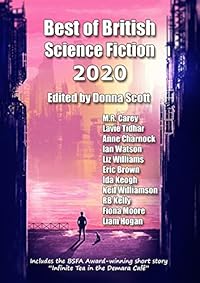
Best of British Science Fiction 2020 edited by Donna Scott

NewCon Press, 2021, 276 p. Reviewed for ParSec 2.

This summation of British SF published last year contains 26 stories, some very short and none even approaching novella length. They are culled from a wide variety of sources, range from jeus d’esprit to more serious endeavours and cover a wide variety of SF tropes. Reasons of space preclude in-depth consideration of individual works but these are all highly readable.

Donna Scott’s Introduction reflects on a Science-Fictional year as regards Covid and its lockdown scenario but that in 2020 SF writers did not concern themselves overly with that subject. Given the usual long lead time between writing and publication that isn’t too surprising. One story here that does confront disease, though, is Infectious by Liz Williams, which features the type of inversion of which SF writers are so fond. Here, infection is the latest forbidden thing to become desirably cool.
2020’s BSFA Award winning short story, Infinite Tea in the Demara Café by Ida Keogh where a man finds himself being propelled between the same café in parallel worlds incorporates a nice pun in its title. Fellow nominee Anne Charnock’s All I Asked For explores an early ramification of the artificial wombs, which Charnock dubs baby-bags, whose consequences she elaborated in her novel Dreams Before the Start of Time.
The book’s opener, War Crimes by M R Carey, deals with the effects of a time-bomb which was detonated in London. The army unit designated to deal those forever held in stasis in its aftermath does not dispose of bombs.
Blue and Blue and Blue and Pink by Lavie Tidhar is a little bit ho-hum, its tale of smuggling over a mysterious line curiously familiar.
The Savages by David Gullen is set on an alien planet where children are ‘they’ till their parents choose what sex they will be. The act of reproduction on this world lives up to the story’s title.
Lazarus, Unbound by Liam Hogan utilises AI controlled freezer cabinets for interstellar travel to extra-terrestrial colonies; or not as the case may be.
In The Cyclops by Teika Marija Smits the narrator can see wavelengths of light beyond the visible. The story’s style is reminiscent of Flowers for Algernon but Stephen Oram’s Chimmy and Chris, the narrative of the development of a human brain organoid, lies much closer to that template.
Brave New World by Oscar Wilde by Ian Watson describes a time travel expedition to scoop up Oscar Wilde from 1897 to take him to 2050 to write his masterpiece Brave New World.
Neil Williamson inundates a near future Glasgow where forced recycling is the basis of everyday life in Mudlarking.
Cofiwch Aberystwyth by Val Nolan, where that town has been devastated by a nuclear blast and the narrator is forced to come to terms with his past, must be one of the few SF stories to feature Welsh words. Each section’s title is in that language.
In Panspermia High by the ever reliable Eric Brown, a bufotoxin from outer space which has spent ten thousand years inhabiting cane toads conjoins with an Australian druggie.
The very short Exhibit E by L P Melling sees the Moon used as a canvas for an art work warning of environmental catastrophe.
A battle tank goes unusually rogue in Fiona Moore’s The Lori.
Wilson Dreams of Peacocks by Melanie Smith is set in a far future where Earth is long dead, humans’ bodies have evolved, and a woman uses a somnus kit to read the dreams of the eponymous Wilson.
Variations on Heisenberg’s Third Concerto by Eleanor R Wood has a neat premise; a physicist brings back the manuscript of said Concerto from a parallel world. Every time the piece is played, the score changes. And so do the worlds.
The World is on Fire and You’re Out of Milk by Rhiannon Grist is from the staring moodily at a can of baked beans school of narration. In a heat-scarred world, going shopping requires an all-but armour-plated expedition.
The last remaining wind turbine is the only power source remaining to the characters in James Rowland’s The Turbine at the End of the World, so must be kept in operation.
The remembrance of the number 70 is the key to enabling time travel in What Happened to 70 by C R Berry.
Rings Around Saturn by Rosie Oliver is an example of the kind of solid tale of Solar System exploration which had gone somewhat out of fashion. A near-bankrupt salvage operator has to brave the canyons of the rings of Saturn to gain her fortune.
London, the city, narrates The Good Shepherd by Stewart Hotson – or rather its controlling AI does. It fears it has been hacked but in tracking down the hacker comes to know itself.
Pineapples are not the Only Bromeliad by R B Kelly is a reworking of Romeo and Juliet. Two bots programmed to please humans find themselves irresistibly attracted to each other.
Like Clocks Work by Andi C Buchanan features a (not)generation starship, whose AI is slowly growing flesh, becoming human. Clocks are a symbol of the past to be remembered.
The only thing that makes SF out of ghost story Watershed by John Gilbey is its virtual setting. It is effective though.
Here Today by Geoff Nelder has an alien lifeform crash on Earth and transfer to the nearest consciousness.
From this evidence it would seem the British SF short story is in fairly rude health.

Pedant’s corner:- In the Introduction; “green grocer’s” (not of a grocer who was green; of a greengrocer.) In “About the Authors”; “in such places Dark Matter Magazine (in such places as Dark Matter Magazine, NewCon Press’ (NewCon Press’s.) Otherwise; focussed (focused.) “The team are still baffled” (the team is still baffled,) focussing (x 3, focusing,) “NASA want me to go” (NASA wants me to go,) “unimaginable in 1890s” (in the 1890s.) “Mum’s generation are blinded by …” (OK it’s a noun of multitude but ‘Mum’s generation is blinded by …’ still makes sense.) “Everything from … are dwindling resources” (Everything usually takes a verb in the singular; everything from …. is a dwindling resource?) “bad land left return to wilderness” (left to return,) from what they what they” (only one ‘what they’ needed,) “that had been left fall” (left to fall,) “she soon she fell” (she soon fell,) “I stepped placed a hand on her shoulder” (is missing a word – or three,) “a lose line” (a loose line?) “Nothing to edit out so.” (Again is missing words to make sense of it,) sprung (sprang,) Sun Tze (Sun Tzu?) “to deliver on their promise” (the promise was by a business; so, ‘on its promise’,) snuck (sneaked,) but “no way he was going to leave” (but no way was he going to leave.) “And then I laid down next to him” (then I lay down next to him,) “spilled out and span away” (spun away.) “The room span and pitched” (spun,) non-descript (nondescript.) “Down at the wall by the local shop, a man hunkers” (no need for the coma,) “she might have saw” (seen.) “She laid there in perfect stillness” (she lay there,) “army officers” (the ‘officers’ concerned were doing sentry duty. Army officers don’t do such menial tasks,) “decided to go see him” (to go to see him.) “Provium was an isotope of voron” (if they are isotopes their names would be the same. Isotopes are atoms of the same element, their separate identities are indicated by their different mass number, carbon-12/carbon-14 etc. But this is an altered universe, so…) “All missing page 70s” (Each would only have had one such page, so, ‘All missing page 70’,) “where a little bit of difference early on makes a hell of a lot of difference later on” (‘makes a hell of a difference later’ is more economical,) “‘I got you out jail’” (out of jail,) “of giant shark’s mouth” (of a giant shark’s mouth,) “and let it attach to emergency backpack” (to the emergency backpack, “last known position up the screen” (up on the screen.) “‘Looks like the stuff thinning is out there’” (‘Looks like the stuff is thinning out there’ makes more sense,) “the thinning ice and dust becomes shower of arcs” (either ‘a shower of arcs’, or, ‘showers of arcs’,) “pointing along line of least density” (along the line of least density.) “‘Any idea of our orientation the spaceship is with respect to…’” (of the orientation the ship is …) “latch onto” (latch on to,) focussed (focused,) donut (x 4, doughnut,) “the way the water and fuels slopes” (slope,) “will get to satellite” (to the satellite,) “to be picked up by another spaceship other than Miroslav’s” (by another spaceship apart from Miroslav’s is less clunky.) “There are an extremely large number of” (there is an extremely large number,) “who’s only recourse” (Good grief! ‘Who is only recourse?’ Does no-one understand the difference between a contraction and a possessive pronoun any more? – ‘whose only recourse’.) “|None of us like to admit our fallibilities” (none of us likes to admit,) “it had to the be the” (it had to be the,) “in a shell of hard calcium” (actually calcium carbonate,) focussed (again; focused,) “half a dozen of the little AI” (AIs,) “ended up wondering uncertsainly up Granville Place” (wandering,) one sentence implies pineapples are citrus flavoured; they are not. “In a just a few short weeks” (remove first ‘a’.) “Tinan might be taller on average” (taller than average.)

free hit counter script