Archives » ParSec

Neom

Neom is a forthcoming novel from the hand of Lavie Tidhar. It is the latest book I have received from ParSec for review.

You may have noticed from my sidebar I have only just finished reading the same author’s Unholy Land, a review of which I shall be posting here soon.

I don’t normally read books by the same author in close proximity to each other but in this case it is incumbent upon me.

Tidhar has been remarkably prolific of late. I note six of his recent books (seven including this) I have yet to catch up with. One is on my tbr pile but will be waiting a while now.

One more for ParSec

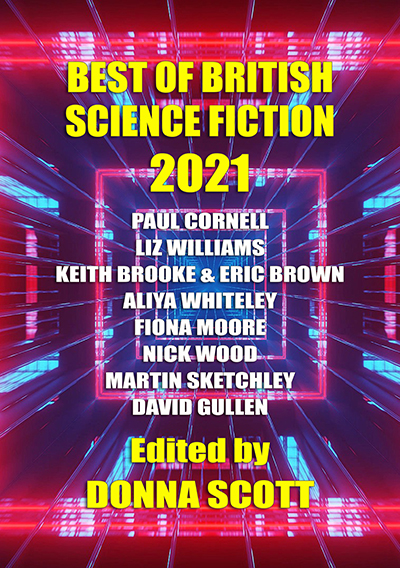
Best of British SF 2021 cover

Another gift from Parsec digital SF magazine has landed on my doormat; Best of British Science Fiction 2021 edited by Donna Scott.

I reviewed Best of British Science Fiction 2020, also edited by Donna Scott, for ParSec 2 and will be posting that review here soon.

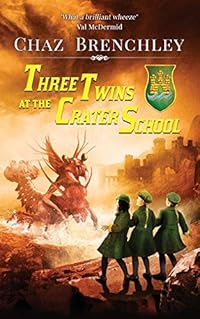
Three Twins at the Crater School by Chaz Brenchley

Wizard Tower Press, 2021, 345 p, £15.00. Reviewed for ParSec 2.

The pitch for this will have been straightforward enough. “English girls’ boarding school stories. On Mars.” Intriguing, perhaps hard to resist, promising an amalgamation of the teenage genre of chums and escapades and the Scientific Romance. Even if unacquainted with the precise inspiration (Elinor M Brent-Dyer’s Chalet School books, to the author of which this one is dedicated) the boarding school setting is surely well-known to most readers – though Mars may not be – liable to be greeted with enthusiasm for those with fond memories. Indeed, there are no fewer than ten encomia for the concept, from names recognisable and not, preceding chapter one.

To the Crater School, then, which occupies an old hotel on Mars on the shores of Crater Lake, built for tourists who never came and abandoned for years till the school was founded, situated beyond the end of the line, for which the nearest town, Terminus, at the hairpin junction – albeit via a cascade – of two canals, was named. The lake is home to merlins, mysterious and potentially dangerous Martian creatures (or perhaps, they too, like the humans, are imports; not all such background detail is fully sketched in) with a complicated life-cycle involving nymphs, naiads and imagos. (No, one of the girls corrects herself, the Latin plural is imagines.)

Add in that Mars is the furthest flung outpost of the British Empire of the Empress Eternal – a seemingly unaging Queen Victoria – recently engaged in a Great War with the Russia of a Tsar whose forces have captured both Martian moons, Deimos and Phobos, and glower down on the colonists using the telescopes the British were obliged to abandon, a steam driven funicular (which technically isn’t a funicular, do keep up,) not to mention an airship, and we have a mix to tease and entice.

A boarding school does of course embody the prime requisite of the children’s adventure story, the absence of parents, even if it is modified by the (only slightly) inhibiting existence of teachers, mistresses in this case. Parents, though, are a preoccupation of three of our characters, red-headed sisters Verity and Charm Buchanan whose artist mother has a mysterious secret to keep concealed but thought hiding them in plain sight at the Crater School while she went off on urgent business would be a good idea, and another new girl, Rachel Abramoff, separated, to her mind cruelly, from her twin Jessica, by parents who thought they should spend some time apart.

But three twins at the Crater School? Yes, because near identical Tawney and Tasha Miskin (like Rachel, of Russian origin) make up our quintumvirate of leads, though there is more than a passing role for the redoubtable Head Girl, Rowany de Vere.

Brenchley slightly updates this universe of aether ships, Great Game manoeuvrings and the truly indigenous sandcats when the Russians broadcast propaganda presented by a turncoat and using the call sign, Phobos calling. This is Phobos calling, but remains true to the times of Scientific Romance since boys are sent to public schools in England rather than kept on Mars. A somewhat odder inclusion is of farmers of Basque origin working the lands near the crater.

While not lacking in incident, the usual suspects of friendship, pluck and getting into scrapes, there is really little by way of plot except for the Buchanans being beset by Russian agents and Rachel’s campaign to be reunited with Jessica.

Despite Brenchley taking care also to embed allusions to Science Fiction (one of the pupils is named Pat Cadigan for example,) technically, since the Mars on display here is so unlike the one we know about in the real world, this ought to be classified as a fantasy, but being perhaps true to the (lack of) knowledge of Mars pertaining in the age when the schoolgirl tale was queen in that respect it can be given a pass. The introduction in the last few chapters of yet another girl, Pete, obsessed with steam engines, shrewdly amplifies the scope for sequels.

This is undeniably entertaining, if undemanding, reading, though there was a noticeable number of words or phrases irritatingly repeated in close proximity. For instance, “it was clear that” appeared in successive lines and there was a sentence beginning, “It was tolerably clear tolerably early on,” (was this sort of thing a habit of Brent-Dyer?) Using the spelling ‘mediaeval’ was a pleasing touch, however. In all though, while it will almost certainly delight fans of girls’ school stories there may not be quite enough Science Fictional content to elicit the same emotion in that audience. But they may be taken along by the ride.

Pedant’s corner:- “and even so: little cries of pain” (no need for that colon, a comma would do,) Miss Peters’ (Peters’s,) a Martian weed that is ‘something between animal and vegetable’ is described as ‘not alive’ (well; animals are alive, plants are alive, so something in between must also be alive,) “none of the part were wearing pioneer smocks” (none … was wearing,) “threatened to rise to a crescendo” (the crescendo is the rise!) a missing comma before a piece of direct speech (x2,) “who found to wit to mutter” (found the wit,) “‘we could all use a sandwich’” (is a USianism very unlikely to be uttered by a Victoria schoolgirl,) behooves (behoves.)
ParSec 4

Yes, the fourth edition of online SF magazine ParSec has been published. See details here.

Among its many other delights issue 4 contains my reviews of The Carnival of Ash by Tom Beckerlegge, The Space Between Worlds by Micaiah Johnson and the new anthology tribute to cyberpunk Night, Rain, and Neon edited by Michael Cobley.

Cyberpunk Forty Years On

You may have noticed from my sidebar that I have been reading a new cyberpunk anthology, Night, Rain, And Neon, edited by Michael Cobley and published by NewCon Press.

This marks forty years since the publication of William Gibson’s Neuromancer which introduced many people to the sub-genre.

The author list contains names familiar and unfamiliar.

I will be reviewing it for ParSec magazine. The review is likely to appear in issue 4.

This Fragile Earth by Susannah Wise

Gollancz, 2021, 356 p. Reviewed for ParSec 1.

In the 1950s and up to the mid-1960s British SF consisted mainly of stories of worldwide disaster – a subgenre which Brian Aldiss somewhat unkindly dubbed cosy catastrophes – whose most prolific contributors were the Johns, Wyndham and Christopher, but also to which, at a stretch, J G Ballard’s early novels could be assigned. While the disaster story never disappeared completely the vogue did ebb and British SF began to cleave the paper light years with the best of them.

In recent times SF writers more generally perhaps sensed the coming contagion. Emily St John Mandel’s Station Eleven helped to revive the concept of a fictional worldwide disaster and Caroline Hardaker’s Composite Creatures (also reviewed for ParSec 1) has elements of the form. In this book Susannah Wise inhabits that global catastrophe tradition full on – and in a British context.

It is an altered Britain though, which has a heavy Chinese influence. Six year-old Jed’s schoolteacher is a Miss Yue, a supermarket chain is called Lianhua, noodles and rambutan are common foods and a mysterious company called Shīluò zhì lurks in the background.

The common elements of the catastrophe novel are present: communication breakdown, food queues, barricaded roads, troops on the streets. Less usual ingredients here are that bees have gone extinct (though attempts have been made to restore them synthetically) with their pollination tasks in the meantime replaced by tiny drones; following on from beetle blight a rampant disease called Bovine Staph is apparently transmitted through rainwater and can affect humans; venturing outdoors requires UV goggles to be worn to protect against eye damage from sunlight; the currency is exclusively digital – Litecoin spent via Lite-cards.

Pre-disaster just about every service is accessed wirelessly or via AI robots such as BinX, DoctreX, MediX and WaitreX. GScopes, mediated by a system named GQOS, have replaced mobile phones. Roads are constructed from fibre-glass panelling and road signs are exclusively electronic. Agrico-bots roam the countryside.

Then one day the drones start to malfunction, the electricity goes off and everything shuts down. Viewpoint character Signy comes home to a fridge in meltdown, its food rotting. Despite the resultant lack of amenities her partner Matthew keeps saying things will be all right “tomorrow” but one night, while Signy and Jed hide in the loft, Matthew confronts burglars at their house and is killed. Signy sets off from London with Jed to try to reach her mother’s home in Northamptonshire – by bicycle. Along the way they meet the usual assortment of people who either help or steal from them but also uncover the importance of TrincXcode and its links to musical form.

Wise’s writing is fine but in what is presumably a striving for immediacy she exhibits an over-fondness for verbless sentences. Like this one. Her characterisation is generally convincing enough but her portrayal of Jed is inconsistent. As indications of his youth he sometimes has to have words defined to him and he refers to “Mr Mack Wrecker” from the Peter Rabbit books but he also comes out with absurdly adult phrases supposedly remembered from Miss Yue. Things like, “Quantum field which allows the system to work out infinite possibilities,” and, “The system can work out in milliseconds every possible outcome that can happen from any action it takes in multiple universe models and make the best choice.” OK, the reader is getting the info dump but these sentences read as unlikely to come from the mouth of a six year-old, however tech savvy. There is also his memory from three years earlier of his grandfather telling him something “terrible and important,” to wit, “TrincX is the birth of true Artificial Intelligence – God’s daughter come to walk on Earth,” a warning now come true.

This central role of AIs in the background of the narrative has the effect of making the book’s resolution a literal deus ex machina, or, rather, dei ex machinae. Whether that makes it cosy or not is a fine judgement but it certainly leans towards it.

Pedant’s corner:- GQOS’ (GQOS’s,) “the Orkneys” (the locals prefer the designation Orkney, or, the Orkney Islands,) “more combustible that the old carbon boiler” (than,) gotten (in dialogue? In Britain?) Signy rushes out the front door with no mention of its mechanism previously not working due to the shutdown of communications, hummous (hummus.) “‘Danny!’.” (doesn’t need that full stop, the exclamation mark provides that function.) “It lay uncertain rays across” (It laid uncertain rays,) “‘I bought it from home.’” (brought it.) “‘It’s wasn’t Lau Chen was it?’” (‘It wasn’t’.)

ParSec 3

ParSec 3 has become available.

I’ve made lead review!

That’s for my take on Adam Oyebanji’s Braking Day.

Also in ParSec 3’s pages are my reviews of:-

The Last Adventure of Constance Verity by A Lee Martinez

Absynthe by Brendan P Bellecourt,

Only This Once Are You Immaculate by Blessing Murariri

and the first two books of a trilogy by John Birmingham, The Cruel Stars and The Shattered Skies

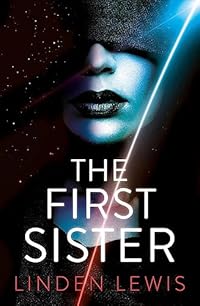
The First Sister by Linden A Lewis

Hodder and Stoughton, 2020, 344 p. Reviewed for ParSec 1.

Sisters are a kind of hybrid of priestess and handmaiden in service to the Goddess. Clad in grey robes, they act as confessors to the soldiers aboard Gean spaceships and are required to submit to their sexual demands without demur. They are literally voiceless, their ability to speak blocked on induction into the Sisterhood. They communicate with others by glance and, between themselves, with hand gestures. Only four sisters per ship are exempt from the sexual role; status as First, Second or Third Sister is denoted by wearing an armband. Adding to this faint echo of the sexual servitude in Margaret Atwood’s The Handmaid’s Tale is the title Aunt(ie), bestowed on that fourth sister, the woman who is the ship’s chief representative of the Goddess.

One of the book’s narrators is the (otherwise unnamed) First Sister of the Gean spaceship Juno, who had been disappointed when her previous captain’s promise to take her with him on his retirement was not fulfilled. She is now looked on with suspicion both by her fellow sisters and Aunt Marshae and has to build a relationship with the new captain, Saito Ren, the Heroine of Ceres, who lost an arm and a leg in the Gean takeover of that minor planet.

As a result of the Dead Century War human society has fractioned into three: the Gean, based upon Earth and Mars; the Icarii, who are settled on Venus and Mercury; and the Asters, gene altered, elongated, thin people who eke out a living from the asteroid belt. Expansion further out into the Solar System is prohibited by the Synthetics, combatant AIs who left for there after that conflict. The Gean and Icarii are in an ongoing state of war. The Gean, though, eschew technology as much as possible, with a particular revulsion to the Icarii use of neural implants and geneassistance. The Icarii’s power is founded on the properties of a substance called hermium, “specific to Mercury,” (whose name was presumably chosen by Lewis on the basis of the more or less magical properties she ascribes to it.)

A second strand is the first person viewpoint of Lito sol Lucius – a somewhat disgraced Icarii, in part blamed for the fall of Ceres. Interspersed with this and the First Sister’s story is a recorded message to Lito passed onto him from his former partner, Hiro. Lito and Hiro were a Rapier-Dagger pair, an Icarii military unit known as duellists. They came together at the Icarii military Academy. Their implants help them bind together telepathically, enhancing their fighting prowess. Lito is recalled from his ostracism to form a new Rapier-Dagger pair with Ofiera von Bain, a much older Academy graduate. Their mission is to infiltrate Ceres to kill both the Mother, head of the Gean Goddess cult, and Hiro, who they are told has turned traitor.

Echoes of other SF inevitably arise. Chapters are headed by extracts from important texts of the various cultures, there is a hint of Ann Leckie in the Gean military set-up, and a glorying in violence for its own sake. Lewis no doubt will argue otherwise but there is more than a fair share of gratuitously spilt blood and chopped heads here, prefaced by a gruesome space execution early on and the emphasis on mercurial blades and neural whips seems odd when their bearers are up against projectile weapons. This may have contributed to the fight/battle scenes being a touch unconvincing.

In a passage which perhaps has somewhat different connotations to a British reader than to others Lito at one point tells us of a superior, “I salute him with two fingers.” On the other hand, Lewis does later mention a two-fingered Icarii gesture of insult.

What at first seems a reflection of the author’s sensitivity via her identification in the book’s blurb as queer (and also a witch. Seriously?) has Hiro’s person always referred to by Lito using plural pronouns. There turns out to be a plot reason for this but when the reader is introduced to Lito’s memories of him Lito does not yet know that reason.

While the recorded message passages were a slightly heavy-handed means of info and back-story dumping Lewis has certainly plotted her story well. However, though conflict is necessary or the reader may not care enough to carry on, The First Sister, readable enough otherwise, leans too much on the violence. And the future of humanity as always at war with itself? Surely SF can do better than that.

Pedant’s corner:- “time interval later”/“within time interval” count, noticeable. Otherwise; “the spherical screen like a port window” (porthole window?) “a family who has” (which has,) Mars’ (Mars’s – which was used later,) “less people” (fewer people,) “I slip between two Aster crafts” (craft.) “The mechanics hiss as the airlock cycles” (The machinery repair workers hiss? ‘The mechanism hisses as the airlock cycles’,) “a pry bar” (a crowbar, or jemmy,) “metal parts for Gean crafts” (craft,) “in perigee to Venus” (perigee is a closest point to Earth, not to Venus; so, ‘perivenera’?) “since the first letter, Ren and I wrote together” (doesn’t need that comma,) smoothes (smooths.) “‘How deep of a hole did she dig?’” (Why that ‘of’?) “‘You’ve grown quite close with Captain Saito’” (quite close to Captain Saito.) On the back cover blurb; Lito val Lucius (sol Lucius.)

ParSec Again

The latest book I’ve received from online SF magazine ParSec is The Carnival of Ash by Tom Beckerlegge.

This is another author new to me, though he has had success as a children’s writer.

This is his first book aimed at an adult readership. Its content seems to lean towards fantasy.

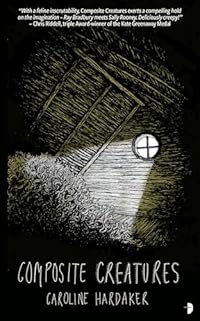
Composite Creatures by Caroline Hardaker

Angry Robot, 2021, 267 p. Reviewed for ParSec 1.

Science Fiction is a broad church, which is arguably at its best when it examines the impact of technology on humans and their relationships. Composite Creatures is such a novel with its speculative background sketched out early on. Among other creatures, birds have vanished – in her youth our narrator’s mother made a collection of feathers in memento. Pollution is rife, even garden soil and plants are contaminated. The NHS is more or less gone, signed up with a private institute to make up for lack of funding; apparently in response to an endemic disease known as the greying. (Reviewer’s note: that institute at present would have to have enormous pockets; but this NHS appears much reduced in scale and ambition.) Technology is being used to synthesise or simulate versions of natural organisms. There are also hints that human fertility has been compromised.

The story is narrated by Norah, a woman in her thirties. She has entered a relationship with Art, a somewhat older writer of forgettable crime novels, who has emigrated from the US to live with her. Theirs is a curiously distanced liaison, little or no passion is displayed, even after Art proposes to her; it is certainly not a conventional romantic relationship. Norah has been in love before, though. There are frequent mentions of Luke, an ex-boyfriend. Her friendships with Aubrey, Eleanor and Rosa are also often in her thoughts. In her office job at Stokers, Norah tells us she is efficient but keeps her head down. (This aspect of the novel was a touch unconvincing. The interpersonal dynamics shown seemed odd.)

Norah and Art have signed up to a mysterious clinic called Easton Grove for which they were subject to a thorough vetting process. Hardaker leaves the terms of their contract vague while implying they can be over-intrusive, but this may be a reflection of Norah’s hypersensitivity. However, the Grove seems to have wider influence in society, as an exchange with Norah’s boss indicates.

The couple’s reward arrives in a cardboard box; a creature like a baby but clearly not one. A “faceless bundle of grey fluff” which is fed on what Norah calls “tinned slush”. This is the Grove’s product, an ovum organi (whose exact function Hardaker leaves unconfirmed until late in the book, leaving the reviewer with a dilemma.) Their interactions with the new arrival, a female, rapidly take on the aspects of parenthood, though the creature is kept in their loft, and later given the run of the house.

Despite cautions against, Art and Norah name their charge Nut, and Norah in particular becomes very attached to her in a series of scenes which could almost have been a depiction of the feelings of a new mother towards her child.

Ova organi are an option available only to the wealthy – or to those who can just afford it, a category Norah and Art fall into but her friends do not. The ova are not entirely acceptable to wider society as a group of protesters against the Grove illustrates on one of the couple’s visits there. This, along with Norah’s increasing fixation with Nut and failure to keep up with the problems in her friends’ lives are two of the contributors which lead to the disintegration of Norah’s friendships and to her descent into self-centredness. Her focus on Nut is entirely comprehensible. Nut is flesh of Norah’s flesh after all – and of Art’s. That self-centredness is the driving force throughout. The ova are a technological solution to both the greying and to an aspect of the human condition to which the society depicted in Larry Niven’s stories of Gil the ARM Hamilton adopted a very different approach.

Novels which hitch themselves to the literary end of the SF genre, which focus on small stories as this one does, sometimes find themselves overlooked in favour of more glittering vistas. Composite Creatures is, though, very well written,* and psychologically believable. It also manages to avoid the pitfalls of excessive information dumping (until it gets a bit more open towards the end.) It’s certainly one for those who prefer SF driven by its characters.

*At one point the text mentions Science Fiction, not generally regarded as a good idea in an SF novel as it tends to break suspension of disbelief.

Pedant’s corner:- innumerable instances of ‘to not’ followed by the required verb rather than ‘not to’, also many uses of focussed or focussing rather then focused or focusing, “Mom or Luke say something new” (the ‘or’ makes it singular; ‘says’.) “The final piece of …. were a pair of socks” (the final piece … was a pair,) bannister (banister,) “along endless roads that lead to” (context and previous tense implies ‘led to’,) sprung (sprang,) sat (sitting,) a semi-colon where a comma would have sufficed (and even that wasn’t necessary,) echo-y (echoey?) gamble (gambol – an odd error, Hardaker had gambolling later in the book,) “the tickling of his fingers on the nape of my neck were far more vivid” (was far more vivid,) “a larger crowd … were crowded around” (was crowded around.) “one of the woman” (women.) “I pressed it back together and returned to the grave before carrying on walking” (no grave had been mentioned, ‘returned it to the ground’ makes more sense,) sneakers (trainers, please,) a missing comma before a piece of direct speech (more than once,) snuck (sneaked,) “the men’s room” (this is set in Britain, it’s ‘The Gent’s’,) outside of (outside, no ‘of’,) inside of (ditto, just ‘inside’,) fit (fitted,) Markus’ (Markus’s,) “estate agents’ office” (estate agent’s office,) “to diffuse the situation” (x2, defuse,) “his trousers hug loosely” (hung loosely.) “Either me or Eleanor was” (Either Eleanor or I was,) stood (standing,) “that I’d already drank too much” (drunk,) “‘It’s New Year’s’” (New Year; no apostrophe,) piece de resistance (pièce de resistance.) In the Acknowledgements; beˋing (being.)

free hit counter script