Archives » ParSec

ParSec 8

I believe ParSec’s issue 8 has now gone live:-

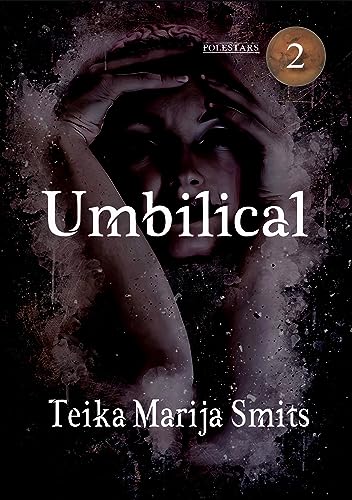
I’ve not yet delved into this issue but it ought to contain my reviews of Beethoven’s Assassins by Andrew Crumey, Chimera by Alice Thompson, and Umbilical by Teika Marija Smits.


Europa Deep

You may have noticed on my sidebar the book Europa Deep by Gary Gibson.

This is to be the latest of my reviews for ParSec online magazine.

I know Gary, at least to talk to at conventions. It’s been a long time since I did though. He now lives in Taipei. The book was mailed to me all the way from there.

Another for ParSec

It’s not appeared on my sidebar yet but I am at the moment working my way through the first collection of stories by Teika Marija Smits for a review to be published in ParSec.


The book is titled Umbilical and contains twenty-one stories, covering various speculative fiction genres, plus one poem.

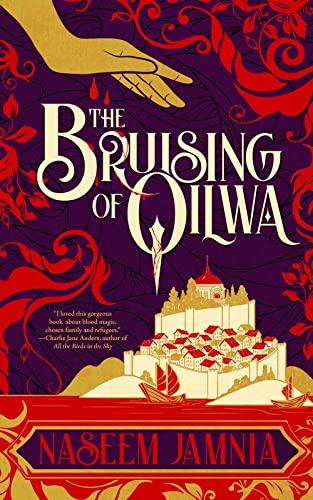
The Bruising of Qilwa by Naseem Jamnia

Tachyon, 2022, 177 p, plus 5 p Afterword and 4 p Acknowledgements.  $15.95. Reviewed for ParSec 5.

Qilwa is an island lately having become independent of the mainland Queendom of Dilmun after previously being conquered by Sassanid, which in its turn was taken over by Dilmun. A plague has been raging through Qilwa, blamed unofficially (but with nods and winks from the authorities) on an influx of refugees of Sassanian heritage from Dilmun, fleeing both from the depredations of the sky-borne Homa bird and the fear by Qilmunis of Sassanian blood magic. The flight has been such that during the novel the last Sassanian people that were left in Dilmun arrive in Qilwa.

Viewpoint character Firuz-e Jafari, a user of blood magic, has not been in Qilwa long and still cannot get used to the local failure to designate chosen pronouns on being introduced to someone. When meeting a local healer, Kofi Nadifa, a man who is also able to control breezes, he says, “I’m they-Firuz” and throughout the book is described by the pronouns they, them and themself. When Firuz rescues another Sassanian, she introduces herself to them as she-Afsoneh. We never see other characters, like Firuz’s brother Parviz, and his friend Ahmed, or indeed any Dilmunis, barring Kofi, introduced. Except for the occasional other pronouns such as zhe, zher and hu, usually used for incidental characters, those whom Firuz interacts with are designated either by name or the more traditional singular pronouns.

In Dilmun, Sassanians are definitely second-class citizens, kept more or less segregated. In this fantasy world, as in the real, colonialism exerts a dark shadow. Kofi tells Firuz, “It’s said when your people took ours over they made a pact with a dark god to gain powers over life,” a phrase which has echoes of the blood libel. Firuz’s family at first had to live in an area known as the Underdock before his work at Kofi’s clinic allows them to move to a slightly better neighbourhood and such is the fear in which blood magic is held that Firuz has to keep their abilities secret. They worry in particular about Afsoneh, who has an innate facility for blood magic but is totally untrained and thus a danger not only to anyone she might try to heal but to herself and her associates. Firuz agrees to train her and says, “‘Really all magic works on this principle, pulling energy from a source in order to manipulate it. But for us, for blood magic users, we have to pull from our own life force.’” Blood magic users are practiced in the science, those in training or without the control are adepts.

Some healing magic is acceptable in Dilmun, though. Environmental magic involves equivalent exchange (akin to the First Law of Thermodynamics,) and structural magic uses runes or words to channel energy.

When cases of blood-bruising begin to arise, brought to their clinic’s attention by a local undertaker showing them bodies strangely preserved after death, Firuz is at first baffled by the phenomenon but its possible ramifications for Sassanians in Qilmun after the only recently subsided plague are not lost on them. It takes a while for them to work out its possible cause, bone marrow increasing its output of blood cells to an unsustainable level. This faulty blood, leading to lack of clotting and subsequent bruising, its lack of oxygen carrying capacity giving unwarranted fatigue, is redolent of someone searching for blood that attacks illness and wipes it out without a trace by magical means instead of natural. Firuz’s suspicions initially fall on Afsoneh who is covertly attempting to carry out an alignment, a redistribution of tissue to other areas or a breakdown of tissue for the body to repurpose, on Parviz before Firuz prevails on her to stop. The true culprit for the altered blood is more surprising.

The background colouring to the story (the author is the child of Persians who emigrated to the US) is out of the ordinary for modern fantasy but not too unfamiliar historically. However, this is Jamnia’s first novel and sometimes that shows. Relationships tend to be sketched rather than fleshed out, the concept of the Homa bird is sorely underdeveloped and the climactic scene feels rushed. Then there is the use of the somewhat coy “muck” or “mud” as expletives. The prejudice in Qilwan society is mostly mentioned rather than shown and sits a little uneasily with the book’s other elements. In scenes where more than one person is present that usage of plural pronouns for Firuz is liable to be misread.

Twice it is emphasised that “Magic is mostly a working of the will.” Jamnia’s will is strong but perhaps their magic isn’t quite fully controlled as yet. Overall, though, The Bruising of Qilwa is an interesting read.

Pedant’s corner:- Afosneh (elsewhere Afsoneh.) “It annoyed Firuz to no end” (no, it did not annoy Firuz ‘for no purpose,’ it annoyed Firuz no end, ie it annoyed Firuz immensely, “the warm towel with the runes sewn into them” (sewn into it.) “Had he been in a chair, Ahmed would have likely sunk into it. As it were, he cradled his head in his hands.” (As it was, he cradled,) “the minutia of the shifts” (this read as plural, minutiae,) “on the governor’s behest” (at the governor’s behest,) sunk (sank.) “This would make the day to day of running of the clinic” (no need for the ‘of’.) “It was so nice someone around their age to talk with” (so nice to have someone,) sprung (sprang.) “a density separator” (a centrifuge to give it its proper name,) “a yellowish-clear layer” (implies a yellow liquid cannot be clear; it can: ‘a clear [pale?] yellow layer’,) “Afsoneh squirmed of reach” (out of reach.) In the Afterword; “the storming of the White House” (the Capitol,) “to use my background a scientist” (as a scientist,) “the people from whom my parents came from” (has one ‘from’ too many.)

Best of British Science Fiction 2021 Edited by Donna Scott  

NewCon Press, 2022, p. Reviewed for ParSec 5.
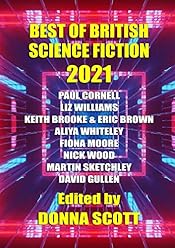
In her introduction to this collection of twenty-three stories taken from various sources, editor Donna Scott wonders about the shadow the Covid pandemic will cast over Science Fiction. Though few of the submissions to her had addressed it directly she sees its influence as being present in subtler ways – isolation being one of the themes. The book’s contents cover a relatively wide spectrum of SF tropes (the generation starship seems to be making a comeback, though time travel continues to be somewhat out of vogue.)

As to the stories themselves….

In ‘Distribution’ by Paul Cornell a local authority operative investigates a man who has divided his consciousness among parts of himself that he now keeps in tubes.

‘Stealthcare’ by Liz Williams focuses on an insurance assessor investigating possible fraud in a future where health is expensively monitored by interactive wrist band.

‘Down and Out Under the Tannhauser Gate’ by David Gullen centres on an old soldier eking out her existence by the interstellar gate where she was the only human survivor of the last battle and waiting for her chance to pass through to its imagined delights.

The superbly written ‘Me Two’ by Keith Brooke and Eric Brown is a poignant tale relating the connection, from first awareness(es) to death, of a consciousness switching daily between Danny Madison in London and Cristina Velásquez in Barcelona.

In Tim Major’s ‘The Andraiad,’ Martin is the andraiad replacement for a man who committed a violent crime, and is determined to be a better person than his predecessor.

The action of ‘Bloodbirds’ by Martin Sketchley occurs after the Qall have come, used humanity as humans had used other animals, and then gone again, leaving inside people cells which will form Qall embryos, emerge with little warning, and devastate their erstwhile host. Nikki is an Angel, part of the Vanguard who hunt down these surrogates. Then she meets a possible surrogate man who treats her kindly.

In ‘Going Home’ by Martin Westlake a Russian scientist is in effect conscripted to investigate mysterious fragments found in the area where Tunguska was struck by a meteorite              . Or was the devastation there caused by a conflict between angels?

Spookily atmospheric, ‘Okamoto’s Lens’ by A N Myers centres on the eponymous lens which acts a bit like Bob Shaw’s slow glass, only in reverse. It can capture images of the future.

Set in Leith, ‘Love in the Age of Operator Errors’ by Ryan Vance explores the illicit use of memory technology to access the experiences of the narrator’s lost boyfriend.

‘Stone of Sorrow’ by Peter Sutton combines two new technologies, an experimental system for regenerating farm soil and a top secret army transportation system in a story whose focus doesn’t stray from concern for its characters.

Bearing some tonal resemblances to Daniel Keyes’s Flowers for Algernon, ‘Henrietta’ by T H Dray features a retired plastic-eating artificial life-form which wants to see a sunrise.

The light-hearted ‘A History of Food Additives in 22nd Century Britain’ by Emma Levin does what its title promises. The entry for 2150 is especially sardonic.

‘The Trip’ by Michael Crouch has a professor and a newly qualified former student undertake an archaeological expedition on a new planet, where they make a mind-expanding discovery.

‘The Ghosts of Trees’ by Fiona Moore. A plant researcher working in the Nevada desert on plants suitable for use on Mars sees the ghosts of trees, specifically the trees in the footage of 1950s nuclear test explosions.

Russell Hemmell’s ‘The Opaque Mirror of Your Face’ is narrated by a faceless cyborg, part of a human spinal fluid harvesting team, who steals – down to the seventh dermal level – the face of a young woman to use as his own. Her revenge is not what you might expect.

Aliya Whiteley’s ‘More Sea Creatures to See’ features aliens who, unbeknownst to humans, are slowly replacing them in order to turn Earth into a theme park.

Remarkably effective at evoking memories for those of a certain age, ‘The End of All Exploring’ by Gary Couzens is a hymn both to all those unrecorded 1960s TV moments forever lost to the ether and to the man who comes back in time to record them.

David Cleden’s ‘How Does My Garden Grow?’ is set on a generation starship whose occupants are obsessed with keeping the recycling ratio as high as possible.

‘Girls’ Night Out’ by Teika Marija Smits relates an experience of “bottled” memories by hybrids who are used to do the unpleasant jobs necessary for wider society to function.

‘Bar Hopping for Astronauts’ by Leo X Robertson finds a former astronaut who has been locked into his space suit for twenty years having to come to terms with the modern world.

‘In Aeturnus’ by Phillip Irving sees a man trapped in a never-ending cycle of regeneration and disposal.

Emma Johanna Puranen’s ‘A Spark in a Flask’ is set in a moonbase abandoned to robot caretakers supervising a series of experiments set up to engender life. The protocols are not set to cater for the project’s success.

A tale about the survivor of an airlock accident having to overcome her fears, the elegantly allusively titled ‘A Pall of Moondust’ by Nick Wood references other SF stories set on the Moon as well as the Arthur C Clarke story its title echoes.

In summary, there is nothing remarkably new here but all are good examples of the genre, many illustrating what it is best suited to explore, the human condition under stress.

Pedant’s corner:- In the Introduction: Smits’ (Smits’s,)  Myers’ (Myers’s.) Otherwise; “its” (it’s,) “steps back down them with he sees Shan hasn’t followed” (when he sees Shan hasn’t,) WID (elsewhere WIS, for Wehlberg’s Inflammatory Syndrome,) missing start quotation marks. “‘She said she’d always has this one’” (always had this one.) ‘I thought about it. “some women too.”’ (either; no full stop but a comma; or; ‘Some women too’,) ‘Dumass” brigade’ (Dumas’s brigade,) ;the aliens” stillness’ (the aliens’ stillness,) no capital letters on a new piece of direct speech (x 2,) “you ‘ve done it” (you’ve done it,) “as they set of up the steps” (set off,) “I ‘ll come back” (I’ll come back,) “three Cytheran” (Cytherans,) Louis’ (x 3, Louis’s.) “The nine on the lower deck” (in the previous paragraph we are told there had been sixteen on the lower deck, nine on the upper,) unfocussed (unfocused,) whiskey (x 2. This is set in Birmingham [and not the one in Alabama]: whisky,then,) camelia (x 2, camellia,) Chris’ (Chris’s,) “leaving for her sisters’” (her sister’s.) “The receptionist clicks their tongue” (the receptionist had previously been described as a man; so; ‘clicks his tongue’,) “set him at odds to” (at odds with,) whiskey (in Leith it’s whisky,) “the civil war” (Civil War,) span (x 2, spun,) “porch swing” (for a story set in England a farm having a porch swing is unlikely.) “I acknowledge that the growing inefficiency of my mouth-parts, gut and legs necessitate precautionary measures” (the growing inefficiency ….. necessitates precautionary measures,) McVities’ (McVitie’s,) “meeting up with the one that got away after twenty years ago” (either ‘the one got away after twenty years’ or, ‘the one got away twenty years ago.) “‘That is what you we’re thinking’” (you were thinking,) a paragraph break in the middle of a sentence (x 2.) “The only thing I can seem to see in sharp focus are little bursts of light” (the only thing …. is little bursts.) “There are a mix of colours” (there is a mix,) “the cushioning effect of mycelial layers on the floor become more apparent” (the cushioning effect … becomes more apparent.) “Fungi can eat rock and absorb the mineral content into its own being” (fungi is a plural word; so; ‘into their own being’,) “eager to see what else lay beyond” (the rest of the paragraph is in present tense; ‘what lies beyond’,) “into the gaping maw of the passage entrance” (a maw is a stomach, not a mouth,) “neither of us were in a state” (neither of us was,) “Hangar is just passed the check point” (just past.) “Whatever ripe human muscles a human body owns is at risk” (ripe human muscles …. are at risk.) “‘Healthy for what I can see from a superficial reading’” (Healthy from what I can see,) “he began (rest is in present tense; begins,) “concentrated in listening to” (concentrated on,) “it has the excitement of the novelty” (of the novel,) “as he has done a while ago” (as he had done,) “or we careful avoid developing one” (carefully,) “I’m incapable to get rid of both” (it’s not ‘incapable to’ it’s ‘incapable of’; incapable of getting rid.) “I have to be contented in touching her lips” (contented with touching,) “for what it’s going to happen” (what is going to happen.) “‘Since the first time you’ve screwed me’” (the first time you screwed me,) Woolworth’s (Woolworths,) “<em>TV Time</em>” (<em>TV Times</em>; correctly titled lower down the same page,) “whom I met once I week” (once a week.) “I could day more” (say more?) “He turned to face m.” (to face me.) “I was furious at have been lied to” (at having been.) “I hurried down the stars” (stairs.) “‘I’m the one they’ve come from’” (they’ve come for,) “‘has involved us with us in this matter’” (no need for that ‘with us’,) “photograph if a bride and groom standing hand in hand” (of a bride and groom,) “the fading purple of chive flowers are hung with melancholy” (has something syntactically wrong about it. ‘The fading purple … is hung with melancholy’ is more grammatical but odd. ‘The fading purple chive flowers are hung with melancholy’ just about works,) smartglass’ (smartglass’s,) “open doorways loom dark like maws” (maws are stomachs, not mouths,) descendent (descendant,) “wide as a monster’s maw” (it’s a stomach, not a mouth.) “‘Do we need to titrate your medication and increase your dose?’” (titrate is not the correct verb here,) Baines’ (x 2, Baines’s,) knobkierie (Afrikaans spelling of knobkerrie.)
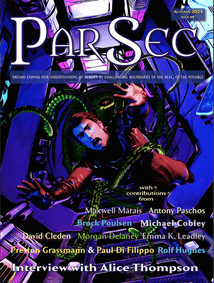
 

ParSec 7

It’s ParSec time again. The seventh edition of the online SF magazine is now available to purchase.

This issue contains my reviews of The Chinese Time Machine by Ian Watson and Cold Water by Dave Hutchinson.

Night, Rain, And Neon edited by Michael Cobley

A New Cyberpunk Anthology, NewCon Press, 2022, 315 p. Reviewed for ParSec 4.

Is it really nearly forty years since “the sky was the colour of television” as that famous opening line of William Gibson’s Neuromancer had it? For those of us old enough to have felt that particular jolt to the SF-verse it can be hard to remember those all-but pre-digital days. In his introduction to this anthology Michael Cobley reminds us that most of the visions of the cyberpunk pioneers have now become embedded in everyday life as he argues that the sub-genre has never been so relevant. This book is intended to address for the modern age the question cyberpunk always has; how does humanity adapt and change when its perceptions are retooled by technology? Do we accept becoming something else or try to remain stubbornly human? That last is something the best SF has always interrogated and illustrated. Cyberpunk’s edge is that it tends to do this at a more immediate, visceral level rather than a philosophical one.

Though there are few explicit homages here – Al Robertson references “a blank television, tuned to a dead channel,” Jon Courtenay Grimwood mentions the “sky above the street” (though in Neuromancer I recall it was “the sky above the port”) and has someone wearing mirrorshades – we have numerous paraphernalia or tropes generally associated with cyberpunk: neural jacks; implants; VR environments; scuzzy, run-down neighbourhoods; dismal weather – grey skies, rain: the sun never seems to shine in cyberpunk – and criminal activities. Society’s underbelly appears an enduring preoccupation. Many of these stories feature imbalances of power and/or the relative impunity of money. Some have high body counts, displaying an implicitly casual attitude to human life: in these particular cyberpunk futures life tends to the harsh and brutish and may be short. The stories are frequently told in the first person, present tense preferred, and typically conveyed in prose with brief, terse sentences. Many without a verb. One, Callum McSorley’s Forever in Scotland, where anti-ageing treatments (and therefore living forever) are banned, is written in Glaswegian and all the more effective for it.

So what can cyberpunk still offer us? Among other things; a virus gradually eating away a cyborg operative from toe to head but whose contract means he will be transferred to a digital existence to pay off the debt forever; five colourful superheroes called The Fianna designed to protect Ireland from The Threat, (a threat which seems to be people in boats;) AI driven buses crashing more often than they should and whose city’s systems blame everything but the buses, an impossibility leading to an investigation of their operator, QuickMind; a world where the rich can buy anything – even the use of another (poorer) person’s body – and one of them searches for the ultimate thrill, transfer into the mind of a top predator; brain implants, personalised in the mind as an entity called Ena, steering the narrator’s decisions, not all of which are intuitive; the ability to feel and cause remote sensation, six thousand miles apart; a hit man wondering if the game is worth the candle; a woman who’d been in a motor-cycle crash waking up to find herself with a brain implant giving her commands – with menaces; a VR addict who overdoses but is then hired by a VR entity who wants her to create new flavours digitally; an undercover agent trying to unionise AIs; a neo-Nazi rampant world where the good guys track one down to a VR dive house and ensure a condign punishment; a memory doctor allowing cycling through a series of altered memories to pick the most convenient, or believable; a contractor extracting a nine-year-old boy from a guarded convoy in what appears to be a kidnapping because the boy has been bred to usher in an AI to rule the world; AR personae being used to track down a murderer operating in the phase interstices of a series of spaceships plying the solar system; the facility for people’s consciousnesses to be temporarily transferred to proxy bodies – for a fee – permitting multiple opportunities to commit crime and escape the consequences, or pinning them on an innocent party, but raising the question as to how prison can be made to work under such circumstances.

None of the ideas is startlingly new and any of these tales could easily have been found in SF short story outlets over recent years. Which is only to say that cyberpunk is now firmly part of the SF writer’s toolbox, to be called upon as and when necessary.

The overall impression the book gives though is that it is not technology that is the enemy: it is other people; and what they are willing to do with and for that technology.

Pedant’s corner:- Except for the first page of a story odd numbered pages are without numbering until it kicks in at page 289. Otherwise; “All the monstrous growths …. branching of sub-tentacles of itself” (of themselves,) “where he’d been stood” (standing.) “Itsay laid back from the effort” (lay back,) “down to the staff stood around someone lying on a gurney” (standing around.) “‘Which one of us gets to live.’” (is a question so ought to have a question mark,) “reaches its crescendo “ (no; the crescendo reaches its climax,) “the The Threat” (has one ‘the’ too many?) “Rewiding Centre” (elsewhere, Rewilding,) “moments before they are aware of here” (aware of her,) “she had pretended to him …….that she were as robust as she’d ever been” (that she was as robust,) “the buses’ robotic voice” (the bus’s robotic voice,) “the buses’ story” (bus’s.) “The bus’ voice changed” (bus’s,) sprung (sprang,) curb (kerb,) bannister (x 2, banister,) staunchin (stanchin,) “pouring over” (poring over,) “in the class above one called us” (once called us,) “this many smells and strangers and squeezed into a tight, suffocating space” (all squeezed into.) “Neon it flickers across” (Neon light flickers,) “be apart of” (apart = separate, the context was “a part of” = ‘belonging to’. ‘Apart of’ appeared twice more when ‘a part of’ was the sense,) “there’s plenty of secrets” (there are plenty of secrets,) “but it’s not until the Lynx that I’d realised” (but it wasn’t until the Lynx that I realised,) “head over to large booth” (a large booth.) “The girl with terrible teeth we’d seen yesterday” (needs its syntax cleaning up,) “like putting your tongue a livewire” (on a live wire,) “the sniffily guy says” (x2, sniffly.) “If I walk away, I’d be an outcast” (it’s a prediction; so, ‘I’ll be an outcast’.) “The intensity of the heartbeats are stronger” (is stronger.) “I think I felt a finger” (rest of narration is present tense, ‘I think I feel’.) Ditto “My own body felt” (feels,) amoung (among.) “Some were already sobbing” (Some are.) “The masked groups scrambles away” (scramble away.) “The crowd roars their approval” (its approval.) “A series of firm, stony nods come from” (a series ….. comes from,) “The unbearably guilt” (unbearable,) “all with an invested interest” (the phrase is ‘vested interest’,) “laying down” (lying down.) “She could any-fucking-where” (She could be any-fucking-where,) “no license” (licence,) targetters (targeters.) “The headache couches in wait” (crouches makes more sense,) “lay down on the floor” (x 3; lie down,) “lay down” (again; lie down) “she can’t see what is says” (what it says,) “struggles to breath (breathe.) “‘I’m not going to lie you though’” (to lie to you,) “very still-human offal” (very human-still offal?) “other than they’re preferred pronouns” (their.) “The first SUV in the convoy was also its roof” (also on its roof,) “the Bofor’s” (Bofors,) needs-must (needs must,) “over head” (overhead,) “as lot calmer” (as a lot calmer,) “your parent’s security folks” (parents’,) scooedg (????) Shambles’ (Shambles’s,) “strafed across as tiny spot” (as a tiny spot.) “Bit Nico preferred the offensive” (‘But Nico preferred’ makes more sense.) “Murdere was expecting him” (Murder, or, Murderer.) “There was a silver scar across the back of each of his knuckles, and remembered what it was like” (and he remembered,) “more people that could reasonably be accounted for” (more people than could reasonably.) “Where they just circling the block” (Were they,) “closing against towards the ankles” (closing again,) “the all the possible outcomes” (one ‘the’ too many,) “‘you’ll always outbid by someone’” (you’ll always be outbid,) “couldn’t name to it” (couldn’t put a name to it,) “rode passed” (rode past.) “‘Better that I’d give most’” (‘Better than I’d give most’ makes more sense,) ithe (the,) “the ships holographic interface” (ship’s,) Praxiteles’ (Praxiteles’s.) “The others low murmuring becoming a howl” (others’.) “The glyphs was so beautifully complex” (the glyphs were,) Stobbs’ (several times, Stobbs’s,) Stobb’s (Stobbs’s,) an unneeded paragraph indent, “opened its maw wide and swallowed” (a maw is a stomach, not a mouth,) “artifact back into place” (my dictionary has artifact as a alternative spelling but artefact is more true to the word’s roots.) “‘I don’t think it’s that it’s a stretch to say’” (one ‘it’s’ too many,) fit (fitted,) H2O (H2O,) missing comma before direct speech, “they use clone for skin grafts” (use to clone for skin grafts,) “as ugly grin crept” (as an ugly grin.) “‘You’ll be surprised that you can concoct with stuff’” (what you can concoct,) “at the insect’s crawling underneath” (insects.) “He kissed her daughter” (his daughter,) SUV’s (SUVs,) “wanted to setup show” (set up shop.) “‘I could give a toss’” (couldn’t give a toss,) extraneous quotation marks, “Jean Paul” (elsewhere Jean-Paul,) missing quotation marks, “without getting whet” (??? The context did not imply ‘wet’,) “Where they alive or dead?” (Were they,) “promises to investment” (of investment,) “untouched by violence of decay” (violence or decay,) “handy work” (handiwork,) “the engine’s stays hot” (engine,) two sized too big” (two sizes too big,) “It was her sisters” (sister’s,) “but had not taste” (had no taste,) “several meters in every direction” (metres,) “knowing already that they find” (what they’d find.) “The first thing that stuck them” (struck them,) “pulled out small glass container” (a small glass container.) “She felt Jean-Paul silent horror” (Jean-Paul’s.) “He pointed at a finger in the corner” (‘at a figure’ makes more sense.) “It was about to get whet.” (????) “a years’ worth” (year’s worth,) “in the Bosses hand” (Boss’s hand.) “A dip attached to her arm” (a drip,) “dress gown” (dressing gown,) “her sisters’ eyes” (sister’s,) “like I was at the helm of ship” (of a ship,) “from whatever set of thoughts looking at” (thoughts she was looking at.) “The only thing I can control are my reactions” (The only thing I can control is my reactions,) a missing full stop at the end of a sentence, whinging (I prefer the spelling whingeing – without the ‘e,’ I, being Scots, would otherwise read this as rhyming with singing; compare ‘hinging’ [= hanging in Scots] with ‘hingeing’, British English does make this distinction between singing and singeing.)

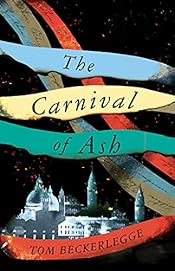
The Carnival of Ash by Tom Beckerlegge

Solaris, 2022, 600 p. Reviewed for ParSec 4.

“Welcome to the city of words” is the invitation spread across the front cover of the advanced reading copy of this interesting, characterful, ambitious, but flawed novel. Words indeed are what the reader experiences. What could be more appropriate for a book set in a city, Cadenza, full of libraries, run by poets, with a thriving Printing Quarter and where the word is respected if not quite universally revered? Yet it is perhaps too self-consciously wordy for its own good. It isn’t so much that the author hasn’t killed his darlings, more that the overall feel is of something overpolished, worked on too assiduously, words chosen a touch too particularly. Which is a ridiculous thing to be saying of a piece of writing, but there you are. Don’t let that put you off though. There is still plenty to savour in this blend of historical fiction with occasional intrusions of fantasy.

The book is composed of twelve sections of varying length the author has designated as Cantos, each of which has a descriptor on the Contents page similar to those short, pre-chapter, italicised précis found in Victorian novels. The book’s focus shifts from Canto to Canto, though some characters may appear incidentally in one or another, and for most of its length it seems more like a collection of short stories/novellas with little connection other than the city in which they are set before there comes a degree of synthesis towards the conclusion.

Cadenza lies (lay?) somewhere in the Italian peninsula, seeing itself as a rival to Venice (though that city could not care less,) the time is on the cusp of modernity (there are those printing presses) not long after that of the austere and censorious monk Savonarola whose sway in Florence some of the characters lived through. Cadenza’s leading citizen, or Artifex, has recently changed from Tommaso Cellini, who suffered an absurd accident that we later discover was no such thing and had a brutal, hidden side, to Cosimo Petrucci, widely regarded as ineffective. The latter is profoundly aware that the city is all but bankrupt and, to much disgruntlement, cancels the expensive Carnival of Wit which the city’s poets see as its embodiment.

Amongst those twelve Cantos we find a would-be poet whose first appearance in the city becomes a fiasco, an ink maid whose job it is to write missives for those who cannot do so for themselves, a poet whose latest vitriolic verse is made out to be targeted on the daughter of a powerful man, clandestine missives bearing an enigmatic message, a seeker-out of Aristotle’s lost library, a pair of poets engaged in a lifelong feud, a monk investigating the murder of a librarian who had a collection of forbidden books (an episode bearing extremely strong echoes of The Name of the Rose but not quite as intriguing or involved,) a group of would-be poets attempting to carry on a tradition of kidnapping, and a Count whose wife has locked herself up in a tower seeking help from an unusual quarter to persuade her to leave it.

Then, which changes everything, comes the plague, and a descent into chaos. The Canto describing a sojourn in the plague hospital is particularly stark. There are other more or less graphic scenes describing torture or conflict but in the main what we have is humanity in all its aspects, lustful, boastful, conniving, self-deceiving, tender, self-denying, violent, foolish and absurd.

It seems that this has been a labour of love for Beckerlegge, who has previously been better known for writing children’s books. This is emphatically not a book for children. There is too much scatology – and a measure of sexual content – for that to be true. He certainly knows how to put a scene together, though, even if his understandable investment in his concept occasionally overrides his facility.

Pedant’s corner:- On the Contents page; “MazzoniIn which” (Mazzoni In which.)
I read a proof copy. Some of these others may have been picked up and amended before the final printing; descendent (descendant,) Ucello (elsewhere Uccello,) staunch/ed (at least five times; stanch/ed,) Hyptia (elsewhere Hypatia,) “opened his mouth to object, then close it with a nod” (then closed it,) “wiping her mouth on the back of her mouth” (a neat trick; on the back of her hand,) “so obliging at hand” (obligingly a hand,) “inside of” (x 2, inside; no ‘of’,) unste ady (unsteady,) Guilio (elsewhere Giulio,) “thought further inevitable clashes inevitable,” (has one ‘inevitable’ too many,) “might taken as provocation” (might be taken,) Diamba (elsewhere Diambra,) vocal chords (they are cords, not chords,) maws (employed as if it means ‘mouth’; a maw is a stomach.) “Over the course of their acquaintance, Cosimo had” (the comma is unneccesary.) “He treated every word as though they were a personal gift from God himself” (every word as though it was [were] a gift,) “waiting to lend from the secreta for months” (waiting to borrow from the secreta,) “‘I would have thought you all people would understand’” (you of all people,) “knocking the both of them to the ground” (knocking both of them; no ‘the’,) “not Jacopo’s own , but” (‘own, but’,) “but the city had turned his back on him” (its back,) “the only thing left to tether him to the world were the shackles clamped around his limbs” (the only thing left … was the,) “gh l” (x 3, elsewhere ‘ghül’,) “strip it all clothing” (of all clothing,) “for s rathole or a crack so small” (for a rathole,) “he bid farewell” (he bade farewell,) “as books spilled out over to the floor” (either ‘out’ or ‘over’, not both.) “Stuck dumb with shock” (‘Struck dumb’ makes more sense,) Fabrizo (elsewhere Fabrizio,) “their crafts on the water” (the plural of craft – as in sailing – is craft,) “she came across sealed note” (a sealed note,) stood (standing,) “there was rumours that” (were; or ‘there was rumour that’.) “‘But is it not the plague of the flesh that has driven it to its knees’” (‘But it is not the plague ..’.) “A group … are” (A group … is,) “they lay down their slates” (they laid down their slates,) “catching one of his attackers and sending them tumbling backwards” (it was a woman; ‘sending her tumbling’,) sat (sitting, or, seated.) “‘You were with here when I saw her last’” (with her,) “hard for her breathe” (to breathe,) “as its connected” (as it connected.)

Recent Arrivals

The Annual BSFA Awards booklet came yesterday.

A couple of days before that The Chinese Time Machine, a collection of short fiction by Ian Watson, had come through the letter box. This is for review in ParSec.

Lots of reading to do then.

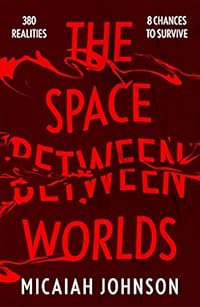
The Space Between Worlds by Micaiah Johnson

Hodder, 2022, 333 p. Reviewed for ParSec 4.

There are 380 parallel worlds which can be reached by Adam Bosch’s invention allowing travel between them. In all but eight of those worlds Caramenta’s doppelgänger is dead. That makes her valuable as only people with no counterpart in another world can traverse to it safely. As Cara puts it, that means trash people, poor black and brown people, since most wealthy scientists and the like are alive (and presumably, though this is not explicitly stated in the book, white.) Those other worlds are a resource tapped by Earth Zero – the only one with traversing technology. This is not recognisably our Earth and therefore nor are the other worlds Cara visits; but it could be descended from it. Civil wars occurred in its relatively recent history, as a result of which weapons capable of killing from a distance have been banned. The social organisation is very different, the environment harsh, the sun at its height all but deadly.

Bosch’s Eldridge Institute is in Wiley City, separated from Caramenta’s original home in the Rurals by mutual suspicion. In Ashtown, which Cara was desperate to escape, life is nasty and brutish and run by what is in effect a particularly cruel mafia style boss; or maybe his brother depending on the individual world. It’s the family business. Whichever Earth it is, these are men with whom Cara has a past. To ingratiate herself with him she had the name of one of them, Nik Nik, tattooed on her back. The comparatively cosy life in Wiley City is nevertheless still stratified – literally; the upper levels of Cara’s building are reserved for those with more standing in the Institute.

Traversers have built up a mythology where a Goddess called Nyame stalks the space between the worlds. Sometimes Cara can feel Nyame’s breath on her back as she shifts from one world to another and on the novel’s crucial traverse – to Earth 175 – she realises with horror the Goddess is crushing her bones. On 175, Cara’s dop, Nelline, is not dead. On 175, intrigued by that tattoo, its Nik Nik saves Cara’s life by putting her mangled body in a medical recovery pod. On 175, Cara begins to question all she knew about Earth Zero, especially when she meets Adam Bosch’s counterpart there.

And Cara has her own secrets. Her original name was Caralee, she is really from Earth 22 and had come across her doppelgänger from Earth Zero just after Caramenta died traversing from there, and, hearing controller Dell’s voice coming from her cuff giving the instructions to follow to get ‘back,’ Cara took the chance to replace her dop and escape her own Nik Nik’s violence. She has been living a lie ever since, treading a tightrope, all the while developing an overwhelming attraction to Dell, without knowing the crucial differences between herself and Caramenta. Only Caramenta’s (handily well kept) journal gave her any chance of pulling this deception off.

There is plenty more plot to be going on with, barely hinted at above, all mediated through Cara’s distinctive voice, self-questioning, thoughtful, loyal to those who treat her well but unforgiving to any who didn’t.

A scenario such as this might in lesser hands have produced nothing more than a pot-boiler but Johnson, while never neglecting the necessity for story, has taken the opportunity to treat with profound questions if you read closely. Questions about how personalities are formed; why we are who we are; what might have made us different; why we do what we do; not to mention highlighting the importance of close relationships.

In infinite universes there is a world somewhere in which you will like this book. Perhaps many worlds.

Pedant’s corner:- in the first chapter preamble; earth (Earth.) Otherwise; “releasing the heat from rising from the baked sand” (that first ‘from’ is redundant,) “on the worlds whose census list Nik Nik as emperor” (‘whose census lists’, or, ‘whose censuses list’.) “One less, I decide” (One fewer.) “‘Lay down’” (Lie down,) “inside of” (inside; no ‘of’, please) “pulling clothes out of the back of my closet that I haven’t worn in years” (syntax clanger. Why would someone wear a closet? – ‘pulling clothes that I haven’t worn in years out of the back of my closet.’)

free hit counter script