Only This Once Are You Immaculate by Blessing Musariri
Posted in My ParSec reviews, Reading Reviewed, Reviews published in ParSec, Science Fiction at 12:00 on 7 November 2022
Solaris, 2021, 432 p. Reviewed for ParSec 3.
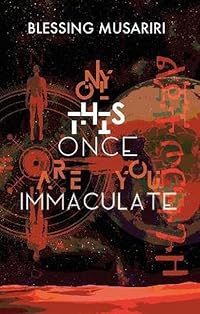
“Every traveller begins his journey in the Valley of Souls; the very first gift of new life. It is only this once he is Immaculate.” So we are told in the first chapter “The Beginning.” From then on narration is in four hands. Those of Azad, whose emergence from the Primary Cycle identified him as a spirit keeper, so therefore guardian to Immaculate travellers; of twins Aftab and Afya, Immaculate travellers at first inseparable and acting as one but later forced apart (they also have the ability to be so still they can avoid being seen;) and of their adopted brother Khaled, a Foundling, brought back to the valley through its single entrance/exit from a previous journey by the twins’ Uncle Azad.
Immaculate travellers are on their first journey, Foundlings’ journeys are renewed and redirected. There are other travellers – Intermediaries, Interconnectors, Meanderers, Sleepwalkers, Interruptors, Interlopers and Infiltrators – whose particular characteristics are enumerated in a kind of glossary. Part of the mythology of the background here involves the Uunu who know “the way of the Human, Being, Ancient Traveller. All Ancients are the guardians of the secrets of being, the last custodians of the pathway to the true Valley of Souls.”
Our narrators are on a quest, then, with Afya and Aftab having particular significance since they each carry hidden about their bodies a certain type of powerful stone.
In this scenario an Empire has fallen some time ago and the land is divided into Seven Territories over which various Generals rule, and squabble. It is through this landscape of potential conflict that Azad, Afya, Aftab and Khaled set out on their journey. The stones have importance as one of the Generals is keen to acquire them. On the travellers’ way they experience various hiccups, their trip on the ship the Nairobi Queen (which is captained by a woman called Wangui,) is hijacked by Kasim, the son of General Demissie, as a result of which the twins are separated, then they fall into the protection of perhaps the most interesting character, Zinhle, daughter of General Dingane, who is keen to impress on her father that, as leader of the Sons of Kalano, she is worthy of serving at his side, by way of winning the Donga torunament at Ishunka.
The fantastical adornments of all this are somewhat at odds with the main thrust of the narratives which are for the most part resolutely familiar in form, with the technology totally recognisable – motor vehicles, guns and ships are not described as in any way different from those of our present day. There is a prefatory map of the setting which appears to be the area taking in the Horn of Africa but barring one mention of the Gulf of Aden (and the name Nairobi Queen) the geography might as well be invented. The setting’s relationship to our time as readers is also undetermined; it could be the future, a completely different timeline but is more likely an outright fantasy world.
References to Bereko Mountain as the cradle of mankind, the navel of the world, might be a reflection of historical reality but the star ruby, whoever possesses which has the power not only to conjure up beings from other worlds but also the power to send them back; Infiltrators as mortal beings simply travelling at a different frequency, and so, as a result, difficult to see; the tree at Uunu guarding the entry to the vault of the Ancients’ power of Banishment, to which the Uunu, Custodians of the way, were granted the secrets and so managed to banish the Infiltrators once before; and that a second banishment will destroy all portals, all lie more in the fantastical sphere. Time itself is somewhat fluid; occasionally Azad harks back to a previous journey involving Hiro, Riitho and Anahita, of whom Kasim, Azad and Wangui are reincarnations (of a sort.)
Musariri’s approach is manifestly African, rightly making little or no concession to other literary traditions. Her background as a poet is often in evidence but her decision to structure the narrative in short chapters seen from four different viewpoints at times tends to hinder its flow. Her totally human characters are well drawn but those with fantastical attributes can suffer from that genre’s inherent tendency to lack of full roundness. As an overall vision, though, Only This Once You Are Immaculate is notable.
Pedant’s corner:- the text has many unusual placements of commas. Otherwise; Immaculate in the context of traveller is sometimes not capitalised, “Somewhere beyond that village begins the fortresses, the barbed wire..” (and many other objects of the verb; hence ‘begin’,) “in the hopes that” (in the hope that,) “outside of” (several times; ‘outside’.) None of those on board believe his words” (none … believes his words,) “you will have moulded yourself to bark and began to slip” (and begun to slip,) “‘What to do want with this man, brother?’” (‘What do you want with this man’) “method of hacking of a long slim offshoot” (method of hacking off a ..,) “making their way to and from” (to and fro,) “in the hopes of” (in the hope of,) “a metal grill” (grille,) “as I flit in an out” (in and out,) “and all is else is shades of darkness” (and all else is shades of.) “‘What is there?’ One of the Sons of Kalano asked’” (is one sentence; ‘What is there?’ one of the Sons of Kalano asked.’) There were at least two other instances of a capital letter in the middle of a sentence, or after a comma,) Rawha (elsewhere Rahwa,) “lead by” (led by,) “the Marauders fleets” (Marauders’,) a paragraph in a continuing speech not preceded by quote marks. “A short crop of curls frame her face” (a short crop … frames her face,) sunk (sank,) miniscule (minuscule.)
Tags: Blessing Musariri, Only This Once Are You Immaculate, ParSec, ParSec 3, Science Fiction
