Archives » ParSec

Umbilical by Teika Marija Smits

NewCon Press, 2023, 228 p.  Reviewed for ParSec 9.
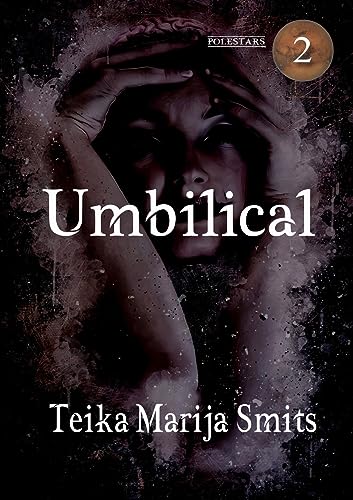
This is the author’s first collection of stories, twenty-one in all, plus one poem. Sixteen of them were culled from appearances in a variety of outlets over the past ten years, five are making their first appearance in print. The contents range in genre over SF, fantasy, myth and horror, with stories sometimes crossing over their borders.

In general, literature deals largely with the themes of love, sex and death. Science Fiction tends to be more restrictive (love for example tends to be bypassed and sex for the most part avoided) but its signature feature is in making its metaphors literal. (The outstanding example of that here is the title story, about the bond between a daughter and her mother.) Fantasy, myth and horror act more as warnings and as stripped-down guides to human relationships.

In the first few stories here the theme of death seems to be a connecting thread but this does not then extend to the collection as a whole.

The poem, Icarus Dreams, opens proceedings and partly sets the tone by inviting Icarus to heed his father and rewrite his story. Smits is more than adequately equipped to provide new shapes to old tales. To that end there are herein updated treatments riffing on the Blackbeard and Theseus stories, while the Baba Yaga of Russian folklore meets an AI.

But the author has further strings to her bow. Elsewhere, moles on the skin are a marker of long, perhaps immortal, life, and carry the threat of incarceration to unravel their genetic secrets. We meet an AI repairman whose encounter with his charge becomes reminiscent of 2001: A Space Odyssey. One story (not narrated by Dr Watson) features Sherlock Holmes, but only in a bystanding part as he asks his psychic investigator – and female – cousin to help him. We have tales where a psychological decline follows the break-up of a relationship which had settled into routine, the Green Man appears to rescue a ravaged future Britain, a woman inherits a bookshop with an unusual kind of ghost, AI/human hybrids question each other over their origins – and the nature of God. One story centres on the reliving of bottled memories. There is an African inspired SF/fantasy cross-over. A woman falls in love with her witness protection AI android bodyguard, another tells of the lengths she went to in an attempt to get pregnant, a brother and sister hatch a plot to rescue their twin siblings from VR addiction in a warehouse, a female painter who sells pictures under her brother’s name finds she cannot hide her expertise from J M W Turner (with whom she shares the same reverence for sunlight,) two people celebrate their involvement with the commercial start-up of nuclear fusion at Sellafield, a woman on the point of death remembers incidents from her life while subjectively traversing a fantastical purgatorial maze.

Their telling requires a comprehensive array of authorial registers and Smits handles them all well, with very few infelicities. She is a talent to watch.

Pedant’s corner:- Theseus’ (x 2, Theseus’s,) focussing (x 2, focusing,) a missing comma before a piece of direct speech,  Holmes’ (x 2, Holmes’s, which appeared later,) shrunk (shrank,) focussed (x 3, focused,) sunk (sank,) Geena Davis’ (Davis’s,) “legs akimbo” (I doubt it. It’s extremely difficult to put your feet on your hips,) “and laid down again” (lay down again,) data used as a singular noun (that would be datum, data is plural,) Jesus’ (Jesus’s,) “the settings on each gamer’s capsule isn’t” (the settings … aren’t,)  “‘it’s okay to chop down all the forests and poison the soil.’?” (has that question mark in the wrong place. It ought to be where the full stop is,) “him and Kel had looked to the stars” (he and Kel,) James’ (x 3, James’s; annoyingly employed a few pages later.) “A trail of soapy bubbles stream after his fleeing form” (a trail streams.) Plus points, though, for using maw correctly as a stomach.
 

Another Review Book

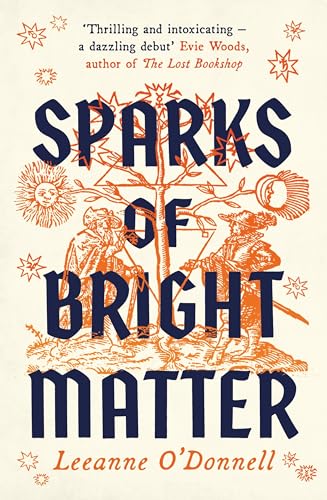
The latest book for my ParSec review count is Sparks of Bright Matter by Leeanne O’Donnell.

The author is new to me – it seems to be her first novel but she is apparently an award-winning radio documentarist and Irish mythology expert.

The blurb promises Georgian London, alchemy, lust, a Jacobite plot and a mysterious illustrated book.

Sounds right up my street.

Apart from the lust obviously.

The Phoenix Keeper

Another one for ParSec has arrived. (Editor Ian Whates is keeping me busy.)
The book is The Phoenix Keeper by S A MacLean. The author is another who is new to me.

According to the publisher’s accompanying blurb it’s “The Romantasy debut everyone’s talking about.” (Are they? I wasn’t. )

Then comes the line “an irresistible queer romantasy standalone set in a magical zoo.” (Irresistible? Don’t tempt me. I will make up my own mind, thank you.)

It also tells me MacLean is a fantasy romance author from sunny Southern California.


More for ParSec

The latest books I have received for review for online SF magazine ParSec arrived this week.

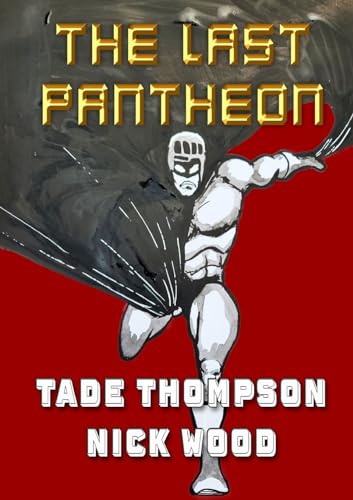
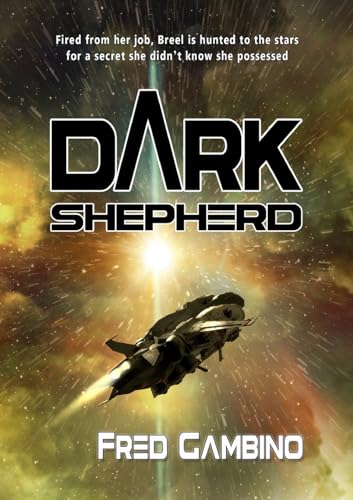
They are The Last Pantheon by Tade Thompson and Nick Wood and Dark Shepherd by Fred Gambino.

I have read books by Thompson and Wood as individuals but not in collaboration. Thompson is Nigerian and Wood South African. It therefore make sense that The Last Pantheon has African (super)heroes. The novel contains illustrations.

Fred Gambino is new to me.

I assume the reviews will appear in ParSec’s issue 11.

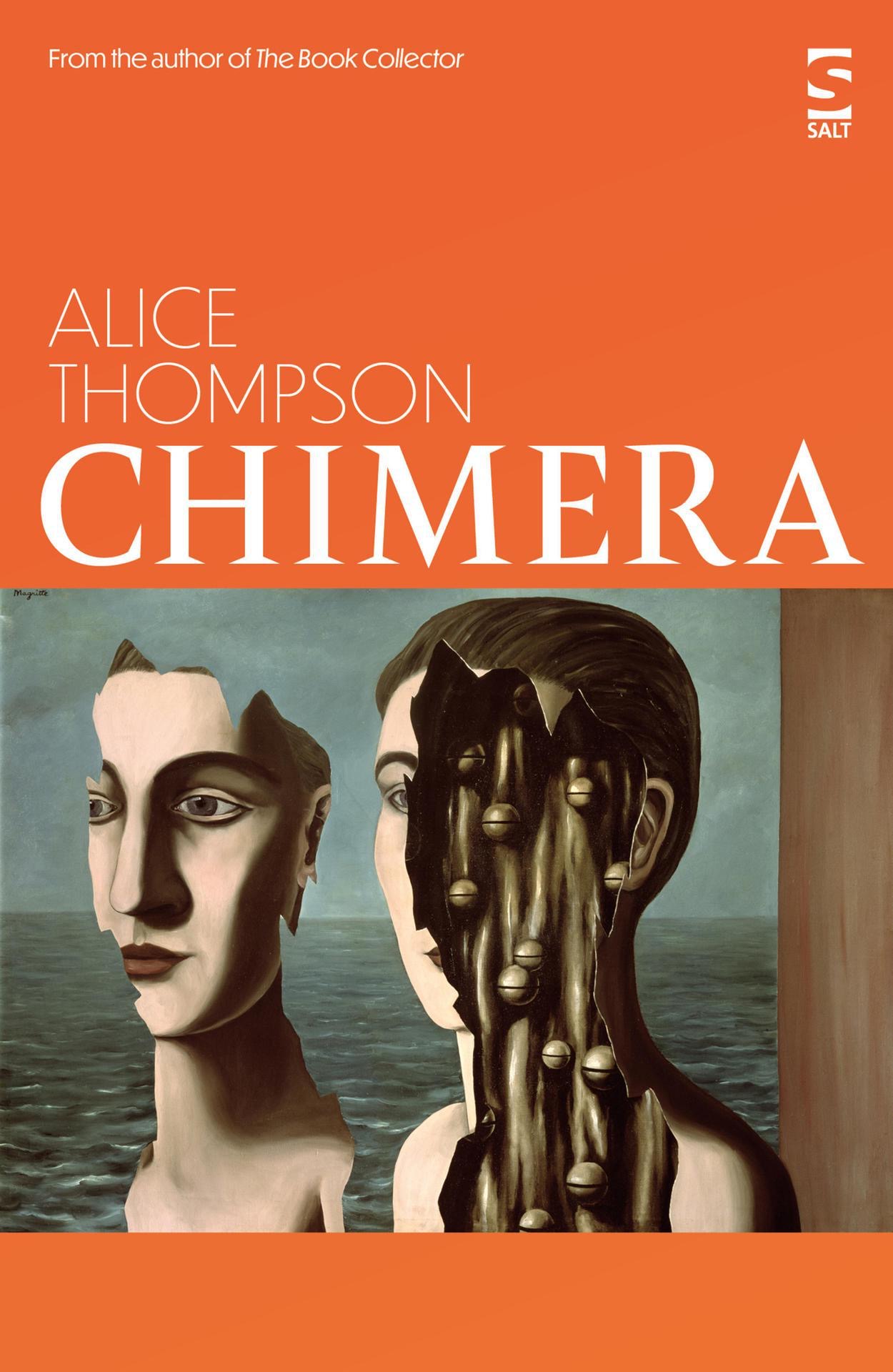
Chimera by Alice Thompson

Salt, 2023, 183 p.  Reviewed for ParSec 8.

Alice Thompson is a veteran of seven previous novels but as far as I’m aware none of them has been Science Fiction. Concerning as it does a voyage to another planet (or, strictly, to its moon) this book could hardly be described as anything else. Yet it is not a typical exemplar of modern SF. Unlike the brashness of the average space exploration story its tonal qualities are more reminiscent of Stanisław Lem’s Solaris or David Lindsay’s A Voyage to Arcturus. Its epigraph, perhaps the most famous quotation from The Tempest, suggests the trajectory that will follow.

A prologue sets up the body of the text as a tale of lost memory. Artemis was the sole human returnee of her crew from their trip to Oneiros on the spaceship Chimera in a search for bacteria that could break down carbon dioxide to obviate global warming. Two dryads, hybrids of computing powers and cloned human DNA provided by anonymous donors, came back with her. Though she has none of Oneiros she is now setting down as a novel, Chimera, the memories she has of the trip.

This odyssey from a beleaguered world where – apart from “the IT elite, the governing body called the elITe” (who do not allow their children access to computers or smart phones) – all humans seem to be in thrall to “widespread automation and the internet of things” and “virtual reality had destroyed downtime and daydreaming” while “in many ways all human progress, except for AI, had stagnated,” is an incongruous endeavour. The crew seems mismatched and detached. Artemis tells us that in space humans are not allowed to dream; it is too unsettling for their daily work. Though she got on the trip more or less by subterfuge and has a slightly unbalanced mental history she is in charge of the medication to ensure this. “Pills suppress rapid eye movement.” Dryads record everything they see and hear. In their ever-lurking presence they come across like HAL from 2001: A Space Odyssey before David Bowman pulled its plugs.

Adding to the distancing effect odd things happen on board. Though it is cruising faster than the speed of light jolts affect the ship’s smooth passage. A dryad alters the temperature controls for no good reason. A bacterium appears on a microscope slide as if out of nowhere. Artemis starts to hear ringing bells. One of the crew, Ivan, disappears.

The oddnesses do not stop there. On Oneiros itself they land miles away from their destination and have to trek across a snowscape to reach the base built for them by automated fabricators. Artemis discovers there had been a previous research ship to the moon, the Siren, but Mission Control, personified in an AI named Cressida, lost contact with the crew and pilot dryads returned the ship. She begins to see shadows.

On a novelistic level the writing here is perfectly acceptable, though the book has flaws. Thompson brings attention to her use of quotations via asterisks and footnotes. That may be all very well in academic tracts but in a novel it distracts from the narrative. Oneiros is a tad too programmatically named. At times the information dumping could have been better integrated but there are also indications of a lack of familiarity with SF as a genre or with scientific processes. Stars are visible through Chimera’s windows even though it’s travelling faster than light. (I doubt light could be seen if it’s moving slower than any potential observer.) Before their trek across Oneiros, the crew take oxygen pills. (Just how are these supposed to work?)

The novel’s central concerns are the relationship between humans and dryads and the nature of consciousness – which Ivan opines may be a fundamental property of matter. The crew’s fate and that of Artemis are bound up with the absence of dreams. How does their loss affect people, how does their lack impact on the dryads?

An Epilogue describes Artemis’s novel’s fate and may be commenting on Artemis’s reliability as a narrator.

Chimera is a solid, very readable piece of work but in drawing comparison to Lem and Lindsay is setting a high bar.

Pedant’s corner:- “She turned to the dryad.’ Why?’” (She turned to the dryad. ‘Why?) “Just logarithms and data” (this was about a dryad. ‘Just algorithms and data’ makes more sense,) bacteria (used as if its singular. Occasionally the proper singular ‘bacterium’ pops up,) focussed (focused.) “our brains our designed to look for connections” (Our brains are designed to.) “There was always had a book of poetry” (no need for the ‘had’,) two sentences couched as questions but lacking their question mark. “Cressida gave him a disarming smile” (gave her,) a missing quotation mark at the end of a piece of direct speech, “she could make out, through the blizzard, snow that covered the entire surface of the moon, with abnormally high mountains in the distance” (a blizzard tends to obscure anything more than a few metres away,) “minus 40 centigrade” (the official designation for that temperature scale is Celsius.) “‘Check for cuts. Frostbite can get in’” (Cold can get in [though it’s actually heat being lost] and then frostbite might develop.) “Their strength and stamina was formidable” (the ‘and’ makes this plural; ‘were formidable’,) “outside of it” (outside it.) “A empty wardrobe” (An empty.) “His brain was wired different” (differently.) Technicolour (I believe it was spelled Technicolor,) “like an idea struck the flat previous” (I haven’t a clue what this is supposed to mean,) “refraction of protons” (this was about light; refraction of photons, then,) “of this moon ?” (the space between moon and the ‘?’ was there to distribute the words in the line evenly but it looked odd.)

ParSec 9

ParSec 9 has been published and can be purchased here.
I have not yet received my contributor’s copy* but – unless I’ve lost track – this one ought to have my reviews of:

Europa Deep by Gary Gibson,

Creation Node by Stephen Baxter,

Mindbreaker by Kate Dylan

and My Brother’s Keeper by Tim Powers.

*Edited to add; now received, and I hadn’t lost track. (Except I hadn’t noted that I have a fifth review in this issue, of Umbilical, by Teika Marija Smits.)

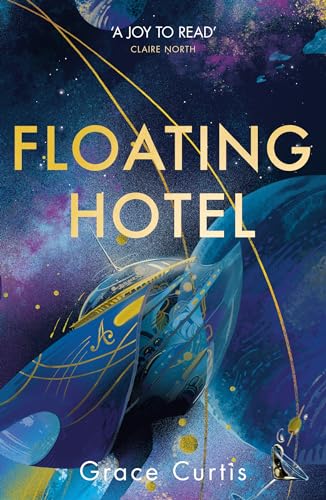
The Floating Hotel by Grace Curtis

The above titled book will be the latest of my reviews for ParSec.
I have not sampled any of Ms Curtis’s work before, though she has had a previous novel, Frontier, published.

The publishing blurb says “There will be more!!!”

Is that a threat or a promise?

Time will tell.

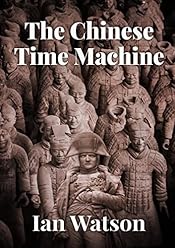
The Chinese Time Machine by Ian Watson 

NewCon Press, 2023, 269 p. Reviewed for ParSec 7.

This is the latest collection of stories from Ian Watson, who has been active in the SF field for over fifty years. These were all first published within the last seven.

We start with four stories under the rubric The Chinese Time Machine. Each describes an expedition into the byways of times past. Our travellers, David Mason and Rajit Sharma, set out from a basement lab in Oxford in 2050 on behalf of the Time Institute in Beijing in a Chinese dominated world whose kaleidoscopic and shifting background is elaborated over the four tales. It is obvious that Watson has had huge fun devising and writing these episodes exploring the paradoxes and confusions of timelines in tales where tenses have to be twisted in order to convey the contingencies of “times gone by yet to be.” They are also replete with allusions and jokes. In them there are echoes of John Brunner’s The Society of Time and Connie Willis’s Oxford Time Travel stories. Not the least of their pleasures is that the characters remain blissfully unaware of how their activities change history. Watson’s delight in word-play and allusion also permeates the rest of the collection.

In the 1st Trip: Brave New World by Oscar Wilde, our brave time adventurers, complete with wrist computers and translators worn as necklaces, pluck that author from France in 1897 so that, instead of dying in 1910, he can write his work that will change literature, Brave New World.

The 2nd Trip: The Kidnap of Fibonnaci is made in an attempt to stop that mathematician’s influence inflicting capitalism on the world and makes much of the fact that little is known of Fibonnaci’s life.

3rd Trip: The Emperor’s New Wallpaper is the longest story in the book. Mason and Sharma are accompanied to St Helena by Colonel Maggie Mo, ostensibly to replace the wallpaper made with arsenic dye said to have contributed to Napoleon’s early death so that he will survive for a time. Maggie has ulterior motives and takes them all, Napoleon included, back to the construction of the Terracotta Army as she wishes to establish a world-wide Chinese hegemony well before its time. The tale is somewhat sprawling and even strays to a Lakota Sioux – and Cheyenne – inhabited Mars (which they call Barsoom) before its resolution. Watson’s jocular narration here finds room to comment on the alliteration heavy prose style of these stories.

4th Trip: Sherlock Holmes and the Butterfly Effect (written with Cristina Macía) sees Mason and Sharma travel back to abduct Sherlock Holmes (who claims Dr Watson was an invention by Conan Doyle) so that the United Kingdom of Europe – headquartered in Brussels of course and this future China’s great rival – will not come about. They fail but persuade Maggie Mo to travel back to become Holmes’s chronicler.

The premise of Hot Gates (a literal translation of Thermopylae) is that a process called melting, which erases landscape features – and consequentially kills the people living there – is happening to disputed border regions. Our narrator is a vulcanologist surveying Jerusalem hoping to observe its destruction, which of course occurs – and during which he constructs a hypothesis to explain the phenomenon.

Monkey Business riffs on the monkeys typing Shakespeare trope. Watson makes the most of this chance to include multiple allusions to the bard’s work. The city of Scribe is where thirty-seven robot monkeys (which are more like baboons) are carrying out their task. From the outset it is clear that this world is artificial, or at least not ours. Mixed in with all this is a tale of a pilgrim to the city and a swain she meets on the way, giving the title monkey business added resonance.

When the Aliens Stop to Bottle is an invasion story. Octopus-like aliens calling themselves the Oktagon have appeared on Earth and nullified all the nuclear weapons launched at them. Narrator Jen is on an overcrowded train trying to get home when an alien enters the carriage and asks for her Eye-dentity before displaying an interest in philosophers.

Heinrich Himmler in the Barcelona Hallucination Cell has Himmler on a visit to Spain demand to see the hallucination cell which, to prevent sleep, has a tilted bench and bricks jutting from the floor plus “degenerate art” on its walls when he starts to hear voices from the future in his head. But are they communicating with the real Himmler or one from a different reality?

Clickbeetle is a story regarding an unusual punishment using that tiny insect placed into the ear as an irritant. Its irregular clicks are akin to tinnitus and compared to Chinese water torture (a torment said here to be apocryphal.) The story manages to range widely across the history of such tortures and of Dr Mengele’s experiments.

Journey to the Anomaly explores the differences among the crew of a ship sent out from a star clump containing various sentient races to said anomaly, a solar system whose planets’ orbits are arranged too regularly, in other words our sun’s. Its twenty-one pages contain a plethora of SF ideas.

The Birth of Venus features the coming to awareness of a set of posthuman AIs and their subsequent adventures. It speculates on a universe where Beryllium 8 isn’t unstable and carbon atoms could have formed earlier than they did in ours.

On its own, each one of the above stories is amusing, informative and thought-provoking. Read immediately after each other, with only slight pauses to reflect (as is required for review,) and their cumulative effect can be a touch intense. Take your time, though, and you’ll be fine.

The following did not appear in the published review.

Pedant’s corner:- In the Acknowledgements, The Emperor’s New Clothes (In the Contents and as the story title this was The Emperor’s New Wallpaper. On the contents page “About the Author” is given as starting at page 371 (it’s actually 271.) Otherwise; obsolete (obsolete,) Padddyfields (Paddyfields,) chilis (chillis,) “an annex” (an annexe,) conjouring (conjuring,) times (multiply,) “4 .25” (no space after the 4; ‘4.25’,) “deuxième bureau” (shouldn’t this be capitalised, “Deuxième Bureau”?) schooma’am (schoolma’am,) Sharman (x 1, Sharma,) halfs (as in half-pints of beer. I would have thought it should it be halves,) Surtees’ (Surtees’s,) Porteous’ (Porteous’s,) “as opposed to  surrendering to the Russians” (at Waterloo it was the Prussians who fought alongside Wellington. But this may be – is – an altered history,) “outside of” (x 2, no ‘of’, just outside.) “Clouds are whispy” (wispy.)  “Gracefully Maggie yields les jumelles just a sentry kneels, sights, and fires a crossbow” (seems to be missing either a few words or punctuation.) “A few more arrows follow suite from crossbows” (follow suit,) “the peasant army charge” (charges,) “to be scraped of its hull” (off,) teepees (tepees,) mathematical (mathematical,) mantlepiece (mantelpiece,) Wells’ (Wells’s,) “inside of” (x 2, just inside, no ‘of’,) Holmes’ (Holmes’s – which did appear earlier,) bacterias (bacteria is already plural; one of them is a bacterium,) “isn’t nice even it’s passably pretty” (even it it’s,) “rains never falls” (fall,) ne’re (ne’er.) “type thorough the hours of night” (through,) accommodate (accommodate,) tressle (usually trestle,) glitch/es (usually glitch/es,) “a chamelion’s tongue” (chameleon’s,) Eye-denity” (Eye-dentity,) “barely 5 mills long” (mills is not an abbreviation for millimetres; that is ‘mm’. I have heard people say ‘mils’ as in ‘10 mils’ but the abbreviation is ml, pronounced ‘mil’ however many there are,) “doubles in numbers” (doubles in number,) “voice with chords” (they may communicate musically but ‘cords’ is more likely,) CO2 (x 3, CO2,) “should not be taken refer to” (taken to refer to,) “two a. m. -ish” (two a.m. -ish,) collapsment (should this perhaps be spelled collapsement?) connexions (x 2. But elsewhere – correctly – connection,) “the imagery of … suggest” (the imagery …. suggests,) “none of these are” (none of these is,) dispensably” (dispensibly.)  Syncronisation (Synchronisation.)

Cécile Cristofari’s Elephants in Bloom

You may have noticed this book on my sidebar a few days ago.
It is the latest book I had for review from ParSec a collection of Cristofari’s short stories.

I have sampled her prose before from her contributions to Interzone.

I’m afraid that since I contracted Covid* in the intervening days my mind hasn’t been on constructing the review. I will get round to it though.

As to Covid, I think I’m recovering. It’s not been too bad (but I was fully vaccinated and boosted) though I experienced a strange mixture of flu and cold symptoms, the classic loss of smell and taste included, none of which were utterly debilitating. It’s left me a bit listless, though.

*Galling that I managed to avoid it for nearly four years till now and only caught it once shops and so on stopped providing sanitiser.

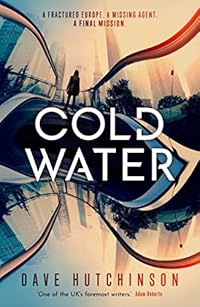
Cold Water by Dave Hutchinson

Solaris, 2022, 417 p.  Reviewed for ParSec 7.

This is set in the alternative future familiar from the author’s sequence of four previous books – each with Europe in its title – where, after the devastation of the Xian flu, the continent’s political structures have fractured into a patchwork of states and statelets. Main viewpoint character Carey Tews has been invited back from retirement by Les Coureurs des Bois, that secretive organisation which conveys packages (and sometimes people) across the multitude of borders now garlanding the continent, to look into the death, near Gliwice in Poland, of her fellow Coureur – and former lover – Maksim Petrauskas. Despite misgivings she agrees, but swiftly realises there are odd inconsistencies at the scene and among the supposed circumstances: patchy police notes, improbable timings, its sheer unlikelihood.

The book’s first few sections also contain scenes from two other viewpoints, Krista Lindmaa, a police officer in Tallinn, and Lenna, a journalist sacked for poor time-keeping and insufficient research. Both are introduced while enduring a power blackout in the city, an event which is a precursor to Lindmaa’s deceased father (an ex-cop) being implicated in police killings of ethnic Russians back in the day and its supposed cover-up. All but destitute, Lenna accepts the offer of a Mr Reinsalu to probe into the affair. While Krista has a part to play in the unfurling of the plot, Lenna’s appearances soon peter out.

The leveraging of the discontent of ethnic Russians in Estonia is elaborated on by Krista’s Uncle Stepan. “‘People are angry all the time. Not about any one thing, just this hot explosive core of anger waiting to be aimed at something. Doesn’t even matter what it is. All you have to do is point them at it and off they go,’” adding, “‘Sometimes it’s quite easy to convince even the most rational people that someone else is trying to take away something that’s theirs. Their money, their property, their rights.’” Russians, he says, know this and work on it. Disinformation is now about making people unsure what to believe. If all news is fake where does the truth lie?

Maksim was the person who was instrumental in recruiting Carey as a Coureur. About the state of Europe he opined, “‘Borders are primitive, mediaeval. They promote division and nationalism. They’re offensive frankly.’” Knowing him as she did even then, Carey replied, “‘It’s also a great business opportunity.’” Elements of Carey’s back story such as this soon lead the reader to suspect that the resourceful and slippery Maksim is not in fact dead and something deeper is going on.

Which there is – and that is over and above the additional complication in Hutchinson’s scenario of the existence of the Community, a separate pocket universe where Europe was settled in the 18th century by the English. The Community’s borders with Carey’s world are both nebulous and porous, and its government may be responsible for all sorts of mischief. Events soon briefly drag Carey and Krista into a third such world, Arcadia, situated in what we would call North America. Hutchinson’s resolutely down to earth style ensures this Science Fictional gloss on a story, which is (the procurement and use of an electronic device known as a cloth laptop notwithstanding) only peripherally SF, is treated matter-of-factly by his characters for whom it is merely part of life. The reading experience here is firmly that of the spy thriller, a contrast with Carey’s belief that, “Real life was always disappointing and complicated and shabby and not very exciting, and it constantly amazed her that people were surprised by that.”

Hutchinson is a very good writer indeed. His books are peopled with utterly believable characters and his plotting is intricate. Here, calls on Carey’s phone asking, “Who are you?” are subtly placed, as is the importance of Maksim’s admiration of Herman Melville’s Moby Dick.

That Cold Water is at its heart a spy thriller does not lessen any of that. Science Fiction is uniquely placed to explore all of space and time. Make that spaces and times.


The following did not appear in the published review.

“Time interval later” count; six or so.

Pedant’s corner:- “the only real variations Carey had ever noticed was a choice of heels” (variation.) “‘What,’ she said.” (it was a question, ‘“What?” she said’,) span (spun,) mediaeval (yay!) miniscule (x 2, minuscule.) “‘So far all we’ve done is stepped on the toes’” (all we’ve done is step on the toes,) aberation (aberration.)

free hit counter script