The Carnival of Ash by Tom Beckerlegge
Posted in My ParSec reviews, Reading Reviewed, Reviews published in ParSec at 12:00 on 13 April 2023
Solaris, 2022, 600 p. Reviewed for ParSec 4.
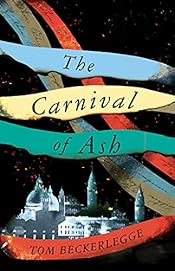
“Welcome to the city of words” is the invitation spread across the front cover of the advanced reading copy of this interesting, characterful, ambitious, but flawed novel. Words indeed are what the reader experiences. What could be more appropriate for a book set in a city, Cadenza, full of libraries, run by poets, with a thriving Printing Quarter and where the word is respected if not quite universally revered? Yet it is perhaps too self-consciously wordy for its own good. It isn’t so much that the author hasn’t killed his darlings, more that the overall feel is of something overpolished, worked on too assiduously, words chosen a touch too particularly. Which is a ridiculous thing to be saying of a piece of writing, but there you are. Don’t let that put you off though. There is still plenty to savour in this blend of historical fiction with occasional intrusions of fantasy.
The book is composed of twelve sections of varying length the author has designated as Cantos, each of which has a descriptor on the Contents page similar to those short, pre-chapter, italicised précis found in Victorian novels. The book’s focus shifts from Canto to Canto, though some characters may appear incidentally in one or another, and for most of its length it seems more like a collection of short stories/novellas with little connection other than the city in which they are set before there comes a degree of synthesis towards the conclusion.
Cadenza lies (lay?) somewhere in the Italian peninsula, seeing itself as a rival to Venice (though that city could not care less,) the time is on the cusp of modernity (there are those printing presses) not long after that of the austere and censorious monk Savonarola whose sway in Florence some of the characters lived through. Cadenza’s leading citizen, or Artifex, has recently changed from Tommaso Cellini, who suffered an absurd accident that we later discover was no such thing and had a brutal, hidden side, to Cosimo Petrucci, widely regarded as ineffective. The latter is profoundly aware that the city is all but bankrupt and, to much disgruntlement, cancels the expensive Carnival of Wit which the city’s poets see as its embodiment.
Amongst those twelve Cantos we find a would-be poet whose first appearance in the city becomes a fiasco, an ink maid whose job it is to write missives for those who cannot do so for themselves, a poet whose latest vitriolic verse is made out to be targeted on the daughter of a powerful man, clandestine missives bearing an enigmatic message, a seeker-out of Aristotle’s lost library, a pair of poets engaged in a lifelong feud, a monk investigating the murder of a librarian who had a collection of forbidden books (an episode bearing extremely strong echoes of The Name of the Rose but not quite as intriguing or involved,) a group of would-be poets attempting to carry on a tradition of kidnapping, and a Count whose wife has locked herself up in a tower seeking help from an unusual quarter to persuade her to leave it.
Then, which changes everything, comes the plague, and a descent into chaos. The Canto describing a sojourn in the plague hospital is particularly stark. There are other more or less graphic scenes describing torture or conflict but in the main what we have is humanity in all its aspects, lustful, boastful, conniving, self-deceiving, tender, self-denying, violent, foolish and absurd.
It seems that this has been a labour of love for Beckerlegge, who has previously been better known for writing children’s books. This is emphatically not a book for children. There is too much scatology – and a measure of sexual content – for that to be true. He certainly knows how to put a scene together, though, even if his understandable investment in his concept occasionally overrides his facility.
Pedant’s corner:- On the Contents page; “MazzoniIn which” (Mazzoni In which.)
I read a proof copy. Some of these others may have been picked up and amended before the final printing; descendent (descendant,) Ucello (elsewhere Uccello,) staunch/ed (at least five times; stanch/ed,) Hyptia (elsewhere Hypatia,) “opened his mouth to object, then close it with a nod” (then closed it,) “wiping her mouth on the back of her mouth” (a neat trick; on the back of her hand,) “so obliging at hand” (obligingly a hand,) “inside of” (x 2, inside; no ‘of’,) unste ady (unsteady,) Guilio (elsewhere Giulio,) “thought further inevitable clashes inevitable,” (has one ‘inevitable’ too many,) “might taken as provocation” (might be taken,) Diamba (elsewhere Diambra,) vocal chords (they are cords, not chords,) maws (employed as if it means ‘mouth’; a maw is a stomach.) “Over the course of their acquaintance, Cosimo had” (the comma is unneccesary.) “He treated every word as though they were a personal gift from God himself” (every word as though it was [were] a gift,) “waiting to lend from the secreta for months” (waiting to borrow from the secreta,) “‘I would have thought you all people would understand’” (you of all people,) “knocking the both of them to the ground” (knocking both of them; no ‘the’,) “not Jacopo’s own , but” (‘own, but’,) “but the city had turned his back on him” (its back,) “the only thing left to tether him to the world were the shackles clamped around his limbs” (the only thing left … was the,) “gh l” (x 3, elsewhere ‘ghül’,) “strip it all clothing” (of all clothing,) “for s rathole or a crack so small” (for a rathole,) “he bid farewell” (he bade farewell,) “as books spilled out over to the floor” (either ‘out’ or ‘over’, not both.) “Stuck dumb with shock” (‘Struck dumb’ makes more sense,) Fabrizo (elsewhere Fabrizio,) “their crafts on the water” (the plural of craft – as in sailing – is craft,) “she came across sealed note” (a sealed note,) stood (standing,) “there was rumours that” (were; or ‘there was rumour that’.) “‘But is it not the plague of the flesh that has driven it to its knees’” (‘But it is not the plague ..’.) “A group … are” (A group … is,) “they lay down their slates” (they laid down their slates,) “catching one of his attackers and sending them tumbling backwards” (it was a woman; ‘sending her tumbling’,) sat (sitting, or, seated.) “‘You were with here when I saw her last’” (with her,) “hard for her breathe” (to breathe,) “as its connected” (as it connected.)
Tags: ParSec, ParSec 4, The Carnival of Ash, Tom Beckerlegge
