Elephants in Bloom by Cécile Cristofari
Posted in Fantasy, My ParSec reviews, Reading Reviewed, Reviews published in ParSec, Science Fiction at 12:00 on 28 August 2024
NewCon Press, 2023, 239 p. Reviewed for ParSec 10.
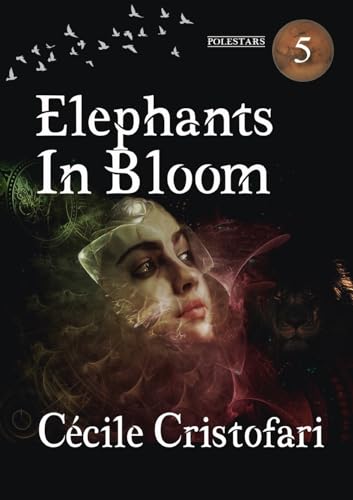 This is the author’s first collection of short stories. Ten of them appeared in a variety of publications over the past five years, eight are original to this book. Each is provided with an authorial afterword. Some of these mention Cristofari’s French background and the latitude she gains as a writer from having two languages to draw on. She casts her net wide, with settings ranging from prehistory through to the present day and beyond. A common thread running through them is ecological collapse and possible recovery from it, in perhaps a sign of recent events some feature characters living in the aftermath of a pandemic.
A few are set in France, two even in Québec. Most succeed well but The Fishery, where “fishing boats” scour the universe for usable materials while avoiding inhabited worlds, has a central metaphor which is unfortunately stretched beyond breaking point. All have a firm focus on the humans at their heart and the dilemmas which they face.
The scenarios vary widely: a woman lives in a house with a window which gives onto other worlds so providing a means of escape, a couple try to evade an ongoing apocalypse on an otherwise deserted island, an intrusive cat in a care home seems to be a feline angel of death, a girl in post-Great War France talks to her never born brother to honour her non-French origins, a dangerous encounter on a mountain road ends in various ways, a witch has an uneasy pact with a hangman, another woman, with the help of the Moon, flies to Pluto in a plastic bottle to find her son who set out to search for his dead grandmother, a research scientist in a kind of steampunk fascist dictatorship secretly works against the regime, two children put a cat into a quantum bag in a glorious excuse for the author to deploy numerous cat puns (the least of which is is it alive or dead, and in which world?) An alien reports back to her planet from World’s End in Tierra Del Fuego, a museum caretaker converses with the (long dead) exhibits after hours, three travellers bearing gifts for a newborn trudge through a post-apocalyptic Québec winter, a stone-age woman finds a home outside her birth group despite the disfigurement inflicted on her to prevent it, a woman meant for sacrifice is surprised to find herself in the goddess’s world, a witch and a space-faring knight come to an accommodation after the battle they fought destroyed the world. The end can come in three ways, by wind, by flood, and by someone singing “My Bloody Valentine”, a group of archaeologists investigating the interior of the god who fell to Earth on the local mountain find an unusual treasure.
With the single exception mentioned above Cristofari handles all of them very well.
The following did not appear in the published review:-
Pedant’s corner:- “outside of” (just outside, no ‘of’,) “knowing fully well” (the phrase is ‘knowing full well’,) “that forced me to quiet” (to stillness,) “a thick handful of filaments were already drying on the windowsill” (a thick handful … was already,) “sank behind underwater buffs” (bluffs?) “Madame Darmon sit up” (sits up,) “Gaspard withdraw his paw” (withdraws,) “between oaks trees” (oak trees.) “Door and windows were open everywhere” (Doors and windows,) “the brand news dreadnoughts” (brand new,) “I will not baulk at any sacrifice” (balk.) “None of us have.” (None of us has,) a missing end quote mark, “as soon as the oil had ran out” (had run out.) “They dragged me until the edge of the woods” (dragged me to the edge of the woods,) “terrified that the he would ride away” (no need for the ‘the’,) “in disgust of our marred faces” (in disgust at our marred faces,) “the moon waxed and waned nine more time” (nine more times,) “on all four” (all fours,) fit (fitted.) “Its flower-fruit were turning” (was turning,) “precious guinea fowls” (the plural of guinea fowl is ‘guinea fowl’,) “always easier than thriving for a real solution” (striving for?)
 Yesterday, Lake of Darkness, the latest novel from Adam Roberts, was handed over by our postman.
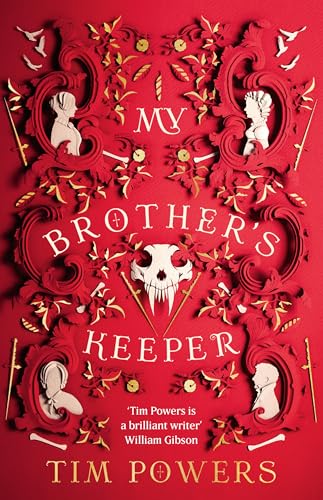 The Yorkshire Moors make an ideal setting for tales of the uncanny. A thin place. Remote, wild, desolate, atmospheric, and above all, wuthering. A world beyond the world. It is easy to imagine strange goings on, mysterious creatures, ghosts, hidden menace, inhabiting the landscape. But we don’t have to. The Brontë sisters (well, Emily) already did. And now, so too has Tim Powers in a story whose central focus is on the Brontë family and Emily’s dog, Keeper, but also incorporates the author’s usual injections of weird. In particular here we have boggarts, gytrashes, barguests, (the latter two being essentially the same thing,) werewolves, a temple on the moors to the Roman goddess Minerva, double-bladed knives called dioscuri, an ancient creature with latent potency buried inside Haworth Church under a slab with an Ogham inscription. Not to mention clandestine human organisations known as the Oblique and the Huberti.
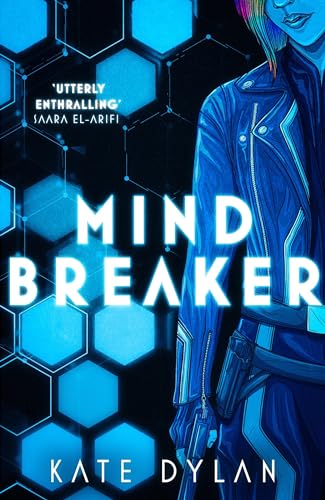 In the aftermath of a nuclear war Indra was brought up in the Order, a religious sect fanatically opposed to technology, whose members are marked out by a crescent moon branded on one cheek. Despite (or because of) this indoctrination she was fascinated by computers which led her to befriend Nyx, who calls her God Girl. One night they were caught in a radioactive storm and, because of her brand, refused shelter till it was too late, unless they had radical medical intervention. Her mother refused to countenance anything so ungodly as nanite repair therapy but her father okayed it, at the cost of rejection from the sect. Nyx was fine but Indra’s rare susceptibility to acute onsite nanite rejection meant the treatment did not work. The Glindell Corporation offered her a way out through Neural Transcendence, the process of uploading a human mind to an artificial drive, a MindDrive housed in a titanium shell.
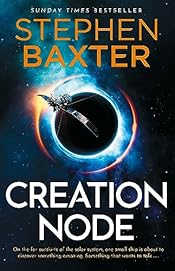 In 2255 humanity has recovered from the ravages of climate change on Earth and extended into the Solar System. Earth is dominant, with a stranglehold on the Lunar Consortium’s expansionary plans and its helium-3 extraction exports via control of the supply of nitrogen needed as a buffer gas. However, schemes are in hand for Earth to mine the gas giants for helium-3 to fuel a nuclear fusion engine which will cut journey times across the Solar System from decades to years. A third group called Conservers does not wish to deplete the Solar System’s resources but has sent out the Shadow, a ship powered by solar sails, to the Oort Cloud to investigate the possibility of Planet Nine orbiting there.
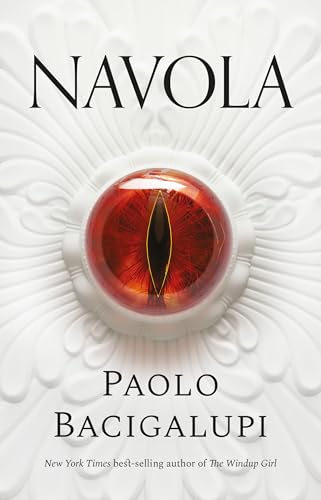 This time with Navola by Paolo Bacigalupi.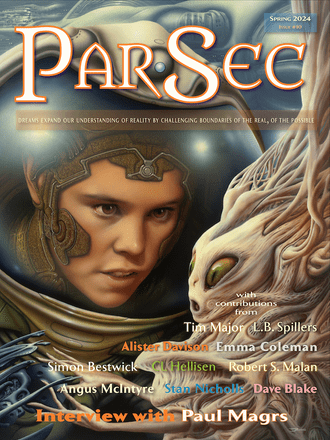
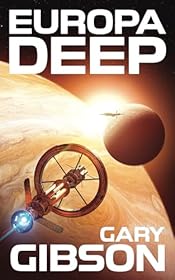 In the aftermath of an extremely virulent virus called the Whispers, which may or not have been man-made, optimised humans (Opts) such as Cassie White are widely held to have had something to do with it and subject to prejudice as a result. Somewhere around the same time there was also an AI war after which the Chinese People’s Republic was replaced by the New Chinese Republic (NCR.)