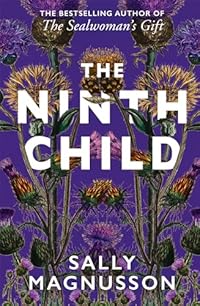
The Ninth Child by Sally Magnusson
Posted in Reading Reviewed, Scottish Fiction, Scottish Literature at 12:00 on 6 July 2021
Two Roads, 2020, 331 p, including 5 p Author’s Note and 1 p Acknowledgements.
At first this promises to be solely the story of Isabel Aird, married to a doctor, Alexander, who is disgusted by the conditions of the poor working class of 1856 Glasgow and wishes to alleviate them. To this end he is drawn to the position of physician to the construction works of the scheme designed to carry the pure waters of Loch Katrine in the Trossachs to the city in order to combat the ravages of cholera, an arduous project requiring tunnelling through extremely hard rock wth nothing but pickaxes, sweat and gunpowder, “the greatest engineering marvel since the construction of the aqueducts of Rome” – a system still in existence, whose flow is driven by gravity alone. The novel soon broadens out though into a wider account.
Isabel has suffered a multiplicity of miscarriages or still-births (the irony of her being married to a doctor is not lost on her) and at first is not keen on a move to the wilds but on her first visit to Loch Chon she is enchanted by the views and for all its deprivations becomes enthusiastic about living there.
Many of the chapters are related in third person from Isabel’s point of view but there are two first person contributions, one from the viewpoint of Robert Kirke, a kirk minister who disappeared into the world of faery in 1698 but has now returned with a commission from what in Gaelic are known as the sìthichean, and the other from Kirsty McEchern, the wife of a navvy working on the project, written as if it is the verbatim transcript of her memories as told to someone who for a long time remains unidentified. There are also curious interpolations from the life of Queen Victoria and Prince Albert, mostly in the form of letters from the Prince. (The Queen was famously entranced by the Trossachs – and Scotland in general – and did open the waterworks in 1859.)
Like many Scottish lochs Loch Chon has a legend of a supernatural denizen, in this case a black Dog who at times will rise from the surface to swallow human victims. This is one of the many tales of the sìthichean known to Kirsty, who, being an islander from Mull, is well versed in Gaelic superstition (or knowledge as she would have called it.) This legend is central to Kirke’s commission from the land of faery and to the novel’s denouement.
It is with this part of the book that I initially had least patience. Then I reflected that dealings with the supernatural – the Devil especially, but also faery – are a staple of Scottish literature. So too, exhibited here by Robert Kirke, is psychological duality. (In her Author’s Note Magnusson calls that a familiar trope. To my mind that enduring concern is something more profound than a trope; it is a deep reflection of the Scottish character – see the third and second last paragraphs in the link.)
A parallel between the lives of Isabel and Queen Victoria is that both had nine children. Well Victoria did, only Isabel’s ninth (the one of the book’s title) survived gestation and birth. The plot and the denouement both of course depend on this.
Magnusson writes really well, she expresses the ups and downs of the Airds’ marriage sensitively, captures superbly the voices, doubts and thoughts of both Kirke and Kirsty and her descriptions of the Trossachs landscape are evocative, while the necessary conveying of information about the construction works is never intrusive.
This is another example of the enduring fascination of the novel with love and death but unlike in Magnusson’s earlier The Sealwoman’s Gift sex is absent from the pages, though its consequences of course are not. The Ninth Child is not quite as accomplished as that previous novel but it is certainly good enough to be going on with.
(At the end of the book are appended eight “Reading Group Questions,” a practice I find patronising. Not reading groups themselves I hasten to add, rather the fact that they are held to need some sort of prompting to ask questions of a text.)
Pedant’s corner:- “‘as soon as another epidemic hoves into view’” (hove is the past tense (and it is in any case ‘hove’ not ‘hoves’,) so here it should be ‘heaves into view’,) “a Yorkshireman with exuberant facial hair by the name of Bateman” (his beard was called Bateman?) “he had sawed a couple of fingers off” (sawn,) Descartes’ (Descartes’s,) “‘the taste of those mean cruelties were back on my tongue’” (either ‘the tastes’, or ‘was back’,) a missing comma before a piece of direct speech (x 2,) Athole Highlanders (Atholl) powder your nose, (the phrase was in juse in the nineteenth century but I would have thought it an unlikely expression for a navvie’s wife though it was said many years after the events in the book and she had been in “polite” company in the interim,) maw (it’s not a mouth, it’s a stomach.) In the Reading group questions; “navvie’s wife” (navvy’s wife.)