Archives » Other fiction

Those Who Leave and Those Who Stay by Elena Ferrante

Book Three of The Neapolitan Novels. Middle Time.

Europa Editions, 2015, 411 p, including vii p Index of Characters and Notes on the Events of the Earlier Volumes. Translated from the Italian Storia di chi fugge e di di chi resta, (Edizioni E/O, 2013,) by Ann Goldstein.

This book carries on the tale of the life of Elena Greco, friend to Lila Cerullo, here following Elena into marriage and motherhood and illuminating Italian life in the late sixties/early seventies. Her husband is Pietro Airota, from a relatively well to do and influential family. The contrast between his background and hers, his atheism (which Elena shares) and her family’s traditionalism is illustrated when they visit Naples pre-marriage. On this visit, an acquaintance in Naples makes references to the dirty pages in her novel, whose publication came in the previous book, as being brave (but also true.) The novel itself, even the fact she left, would be enough to make her different but those pages mark her out, stamp her in the eyes of some of those she left behind as unworthy, tainted, all but a whore. Then a piece on industrial conditions in the sausage factory where Lila works is accepted by the newspaper L’Unità and brings her more attention/notoriety.

Married sex is a revelation for Elena. Though not a virgin, she had not had sex with her husband before the wedding and he is, to say the least, an unsympathetic lover. The birth of her first daughter, Adele, later pet-named Dede, brings the crushing responsibility of motherhood; the baby is unable to feed properly, her husband retreats into his work. Elena’s inability, and his reluctance, to cope requires the employment of a housekeeper/nanny. The novel Elena cobbles together in these circumstances is unpublishable, the lifeless articles she submits to L’Unità rejected. A second baby, another daughter, Elisa, is less trouble.

This was a turbulent time in Italy, with political violence referenced many times here. (As it also was in Europe; Rudi Dutschke and Daniel Cohn-Bendit are given a mention.) I did wonder how the political discussions and attitudes here (not to mention the atheism though that is more skated over) went down with Ferrante’s US readers as the left-wing leanings of most of Elena’s circle are fairly pronounced. Perhaps it is outdone by the feminism she comes to feel – both practical in her marriage situation and theoretical in the discussions she has with other women – especially in her writing, “no-one knew better than I did what it meant to make your own head masculine so that it would be accepted by the culture of men: I had done it, I was doing it,” which would certainly strike a chord.

Ferrrante’s Neapolitan Quartet has been widely discussed as a dissection of female friendship yet for many pages at the start of this instalment Lila is all but unmentioned. However, Elena is called to her side when Lila becomes ill (worn down by working at the sausage factory) and immediately goes to succour her and the blanks in Lila’s life in the interim are filled in. From then on, apart from a crucial incident where a decision by Lila reveals her in her complexity as almost unknowable, certainly unpredictable, they communicate mainly by telephone. Lila and Enzo, the man she lives with, teach themselves computing and begin to make a niche for themselves in the nascent computer industry. The dissolving margins which Lila once mentioned to Elena, when she feels people round her becoming insubstantial (and which may be the key to her personality) are here referred to only once.

As in the foregoing Neapolitan novels there is a density here of apparently lived experience, a proliferation of detail, a fecundity of (re)construction, a layering of a life apparently recollected. As if to comment on this Lila tells Elena after her confusion over that decision of Lila’s, “But when do people ever speak truthfully and when do things ever happen unexpectedly? You know better than I that it’s all a fraud and that one thing follows another and then another.”

The ambiguity of the friendship (of all friendships?) is addressed when Elena herself tells us at the book’s crux, “I had wanted to become something – here was the point – only because I was afraid that Lila would become someone and I would stay behind ….. I had to start again to become, but for myself, as an adult, outside of her.” The relevance of Nino Sarratore – with whom Elena has been besotted since her teenage years but who had an affair with Lila in Book Two – to this epiphany is not unravelled by the book’s ending which mercifully has less of the cliffhanger element the first two instalments had but which still leaves Elena’s life situation unresolved.

Pedant’s corner:- Marirosa (elsewhere always Mariarosa,) legitimatized (legitimised,) “and thought, She was once a pretty girl” (context suggests ‘and I thought, She was once a pretty girl’,) missing question marks at the end of sentences which are questions, “rather than aiming Stefano and his money” (aiming at Stefano.) “And at least Enzo in front of him, in the factory, women worn out by the work, by humiliations, by domestic obligations no less than Lila was.” (as a sentence that is missing something which would make it clear what it was meant to be saying,) “secretary of the union local” (in English ‘of the local union’ is more idiomatic,) “as if” three times in four lines, Vesuvio (x 2, usually ‘Vesuvius’,) waked (woken,) insured (ensured,) “men with drooping mustaches [sic] and a cloth cap on their head” (and cloth caps on their heads,) parallelopipeds (my dictionary categorises this variant spelling of parallelepipeds as ‘improper’.)
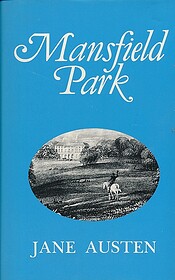
Mansfield Park by Jane Austen

Guild Publishing, 1981, 459 p. First published 1814.

 Mansfield Park cover

Well, this started out well enough: with one of those pithy Austenisms on page one, “But there certainly are not so many men of large fortune in the world, as there are pretty women to deserve them,” but I think it is safe to say that had Austen’s literary reputation rested on Mansfield Park alone it would not be so high as is usually asserted. The main man of large fortune here is Sir Thomas Bertram (owner of a plantation in Antigua) who married a Miss Maria Ward of Huntingdon. Her two sisters married less well, one to Rev Mr Norris, who then was able to secure the living in the gift of his brother-in-law and was therefore reasonably situated financially, but the other “disobliged” her family by marrying a Lieutenant of Marines without education, fortune or connections and so ensured a breach with her sisters.

The Rev Norris having died, his wife moved into Mansfield Park – and fancied herself as running the place. She took it into her head one day to relieve her poorer sister of the care of one of her children and, with the assent of Sir Thomas and Lady Bertram, Fanny Price came to stay at Mansfield Park. There she is treated very much as the poor relation, receiving her cousins’ cast-off toys, the room she is given to use having no fire laid, and treated as a dogsbody by Mrs Norris – though less so by Lady Bertram – a dogsbody who should nevertheless be grateful for her condition. Sir Thomas she finds scary and aloof. The only one of the family who treats her with any consideration is the younger Bertram son, Edmond. The older son, Tom, is a bit of a wastrel (as was the wont of older sons with the prospect of inheritance.) Mrs Norris is always complaining about Fanny’s habits and supposed deficiencies and similarly misguidedly sagacious-seeming about what is right and proper. We all know a Mrs Norris. The local clerical living has been taken over by a Rev Grant whose wife’s sister and brother, Henry and Mary Crawford, come to stay and so enter the social circle of Mansfield Park.

Sir Thomas’s fortunes go up and down and he is forced to make a voyage to Antigua. In his absence the Bertram children and their friends hit on the idea of putting on a play. There follow several utterly tedious chapters on which play should be chosen (one called Lovers’ Vows is eventually selected,) who should play whom, and what alterations to the house are required to stage it. Fanny is mostly a bystander in all this but agrees to help with rehearsals.

Okay, this all has a plot function since it illustrates Henry Crawford as not to be trusted – he uses his part to try to suborn Fanny’s elder female cousin, by now engaged to the wealthy (but dull) Mr Rushworth, away from her fiancé – and so forms Fanny’s opinion of him. At the same time she has become friends of a sort to Mary Crawford. In one of their conversations there appears another Austenism as Mary tells her, “there is not one in a hundred of either sex, who is not taken in when they marry …… it is, of all transactions, the one in which people expect most from others, and are least honest themselves.”

The play is destined never to be performed as Sir Thomas’s early return – and high disapproval – puts an end to it. Henry Crawford later sets his sights on Fanny, whose refusal of his proposal mystifies all and sundry. A return to her family in Portsmouth for a period of reflection is settled on and while she is there the later unfoldings of the plot take place, off-stage in London.

As a novel this has severe limitations. Fanny is not a very active protagonist, almost an absence in fact. She has to be self-effacing due to her station in life but as a result becomes all but invisible as a character. The omniscient third person narrator (who only twice interpolates an “I” into the text as a sort of commentary on what we are being told) more often relates events and characteristics rather than illustrating them. This may though be to attribute twenty-first century expectations of a novel on to one two hundred years old. The whole is of course as long-winded and circumlocutious as any other early nineteenth century novel but that cannot really be held against it.

From a modern perspective it is signal that the text directly mentions slavery only once, but that institution was of course the foundation of all that the denizens of houses like Mansfield Park, and their frivolous pursuits, depended on. It was not Austen’s main focus in any case, which as is customary were the vagaries of the marriage market and the gradations of social class. The sections set in Portsmouth do bring out the contrast between the hustle and bustle of life in more constrained circumstances and that in a supposedly sedate house like Mansfield Park.

Pedant’s corner:- Some Austenish spellings – everybody, everywhere, everything, anybody, nowhere, anywhere, background, akin, are all written as two words – staid (stayed,) stopt (stopped,) stampt (stamped,) chuse (choose, but ‘choose’ itself did appear once,) headach (headache; though ache itself was spelled in the usual manner, as was heart-ache, albeit with the hyphen,) buz (buzz,) cruize (cruise,) birth (berth,) or early nineteenth century usages, fulness (fullness,) intreat (entreat,) cloathe (clothe,) sunk (sank,) sprung (sprang,) shrunk (shrank,) etc. Otherwise; “the Miss Bertrams” (the Misses Bertram,) “the Miss Bertrams’” (the Misses Bertram’s,) “the Mr Bertrams (the Mrs Bertrams would be misconstrued; so ‘the Misters Bertram,’ or ‘the Messrs Bertram,’) “the two Miss Sneyds” (the two Misses Sneyd,) “the Miss Maddoxes” (the Misses Maddox.) “‘How many Miss Owens are there?’” (Misses Owen.) “Mrs Grant has has been” (only one ‘has’.) Mr Yates’ (Mr Yates’s,) Beachey Head (Beachy Head,) “a last look at the five or six determined couple” (couples,) some commas missing before pieces of direct speech. “‘- So many months acquaintance’” (months’ acquaintance,) “to stay dinner” (to stay to dinner,) similies (similes,) “by the bye” (later expressed as ‘by the by’, which I prefer anyway,) “‘I did not use to think’” (did not used to think,) “better that Maria” ( better than,) “heir apparents” (heirs apparent.)

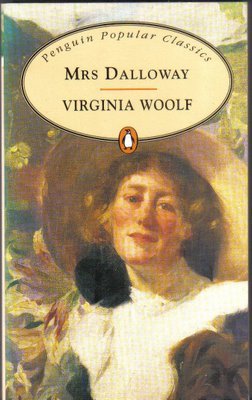
Mrs Dalloway by Virginia Woolf

Penguin, 1996, 211 p.

 Mrs Dalloway cover

This tells the events of one day leading up to the throwing of a party by the titular Mrs (Clarissa) Dalloway which may, or may not, be being attended by the Prime Minister. That title might lead you to believe that the book’s main focus will be Clarissa but it is not. It is written in the stream of consciousness style but that too is a misnomer as what we have here is really streams of consciousnesses since the narration flits from one character to another like a gadfly, rarely settling down for long. This is immensely irritating to begin with but in time, with familiarity, becomes less so.

As well as Mrs Dalloway we enter the thoughts of Peter Walsh, recently returned from India and a failed marriage but declaring himself to be in love for the first time, and Rezia and Septimus Smith, wife and husband. Walsh it seems had a thing for Clarissa in their youths, later musing he had been so in love with her then. (So what was that “first time” declaration all about?) Septimus has not recovered from his experiences in the Great War and his disturbed state has tragically not been recognised by various medical practitioners, nor by his wife.

I know Woolf has received praise for her writing and was an early user of stream of consciousness (a pioneer, indeed) but there is something detached about her style which I find difficult to engage with. My reaction to this book is the same as it was with To The Lighthouse.

This copy was loaned to us by a friend who has written in the margin that Woolf was trying to erase the narrator as a persona. On this evidence, replacing a narrator with many personas isn’t much of an improvement. I’ll not be in a hurry to read any more Woolf.

Pedant’s corner:- sprung (sprang, which was used later,) waggons (wagons,) Hatchards’ (either Hatchard’s or Hatchards’s,) Jorrocks’ (Jorrocks’s,) plaguy (plaguey?) a missing full stop, missing commas before pieces of direct speech (too numerous to count,) Kinloch Jones’s (this was a plural, hence Kinloch Joneses,) “They rose .And Richard” (They rose. And Richard”,) “Mrs Peters’ hat” (Mrs Peters’s,) campare (compare,) “did not use to rouge” (did not used to rouge.)

The Book of Fathers by Miklós Vámos

Abacus, 2009, 476 p. Translated from the Hungarian, Apák könyve, by Peter Sherwood

 The Book of Fathers cover

Tinged with a dash of magic realism and told episodically this is a chronicle of the first born sons of the Csillag family (later Sternovszky, later still Stern and then Csillag once more,) beginning with Kornél Csillag in 1705, who starts writing down his experiences in a notebook which his descendants refer to as the Book of Fathers and to which each makes his own additions in due time. More uncommonly, since Kornél took possession of a small globe which enclosed a watch, each of them – bar the penultimate Csillag, after the device has been discarded in a latrine – has access to the memories of his forebears and can seem preternaturally mature and knowledgeable. The title is a slight misnomer – the novel could be entitled “The Book of Sons” after all – as there is not just one notebook since the first becomes filled relatively quickly and others are purchased to continue the tradition.

Each descendant has his own chapter in The Book of Fathers we are reading, relating the significant events of the life of its subject, but too often we are told of them more than shown them. Sometimes too we see the same event from a different viewpoint in succeeding chapters – the father’s (sometimes the grandfather’s) and the son’s. It would be unkind to call the novel a family saga but it shares that enterprise’s lineaments. However, while the bulk of a chapter may be full of incident it sometimes seems as if Vámos lost interest in that particular life as there can be what seems an unseemly rush to its finish and the character is dispatched within a sentence or three.

All of life is here, though; along with those perennial concerns of the novel as a form – love, sex and death – but love is never a main focus here (and relationships between the generations are frequently strained) while there is no emphasis on sex. Death, though, is a necessary component of a book with this one’s premise. One of the family line converts to Judaism in order to marry (thereby upsetting both families involved) but the lives of his descendants allow Vámos to throw light on the status of middle-European Jewry as the years unfold. Then of course, as it approaches the mid-point of the twentieth century, the reader’s sense of foreboding heightens, but arbitrary deaths were no stranger earlier and occur later too.

That early convert is taught by Rabbi Ben Loew of Prague and expresses his confusion about Jewish teachings and his new co-religionists’ place in the world. “‘Everyone is a stranger in this world,’ said the Rabbi. ‘Above all the Jews. The pharaohs drove them from their ancient homeland,* they dispersed to all points of the compass. They are to this day not allowed to buy land in many places.’” Yet for most of the time the family members live lives undisturbed by prejudiced undercurrents, only subject to those political incidents endemic to any country’s history. As such the book is a kind of primer on Hungarian identity and the country’s struggle for independence.

The peculiar nature of the Csillag/Sternovszky/Stern/Csillag line is alluded to when one reflects, “He to whom is given the gift of seeing into the past does not choose what he sees.” As well as the past, some of them can see into the future – but only indistinctly, on occasion Delphically, often with tragical outcomes. A later thought that “whatever happens in this world it all ends in the crying of women” is of universal resonance.

The writing has a similar sensibility to that evident in Czech literature or from the former Yugoslavia: an exercise of imagination, a kind of heightened realism or exaggeration largely absent from Anglophone literature.

Pedant’s corner:- caftan (usually kaftan.) *It was the Romans, not the pharaohs, who were the dominant power when the Jewish diaspora began, “the Book of the Fathers” (usually written as ‘the Book of Fathers’, three times that extra ‘the’ is inserted,) “horses’ hoofs” (in my time they were always hooves,) extra points for ‘stanch’, “only his father’s and grandfather’s exact moment of birth was known to him” (…. moments of birth were known to him.) “‘In Budapest the best streets have had electric light since 1873’” (electricity first came to Humgary in 1884.) “The Csillag side of the family were not in the least happy with Ilse” (the … side …. was not in the least,) churns (churns,) sunk (sank,) “he had simply sawed a hole” (sawn a hole,) a missing comma before a piece of direct speech, “preserved on the black and white snapshots” (‘preserved in’ sounds more natural,) Csilla (Csillag,) “suspecting nought” (nought = the number 0; ‘suspecting naught’.)

Bookshelf Travelling for Insane Times – William Boyd

Another entry for the meme started by Judith and now collated by Katrina. The weekend comes around so fast.

This week I’m featuring books by William Boyd. His Wiki page describes him as a Scottish writer (but Fantastic Fiction has him as British. By parentage (and part of his education) he is Scottish but his writing is more akin to that from south of the border so I have always had a slight reservation. I do have his books shelved on my “Scottish” bookcase, though, but only after the “W”s and Kurt Wittig‘s critical work.

Books Written by William Boyd

Standouts here are The New Confessions, Brazzaville Beach, Any Human Heart, and the spoof biography Nat Tate, an American Artist.

Cold Winter in Bordeaux by Allan Massie

Quartet, 2014, 237 p.

 Cold Winter in Bordeaux cover

This is the third of Massie’s Bordeaux series, set in that city during World War 2. The first, Death in Bordeaux, I reviewed here, the second, Dark Summer in Bordeaux, here.

In this one Police Superintendent Jean Lannes is called in to investigate the death of Gabrielle Peniel whose body was found strangled and sordidly arranged. It looks like a crime of passion as in pre-war times – which Lannes would welcome as a relief from having to juggle French law with German oversight – but he senses something amiss. Peniel was a piano teacher to young girls and it is soon revealed she was a procuress for men who had such a taste.

In terms of the book’s thrust the murder is something of a red herring. Massie is really only using the crimes Lannes investigates as hooks to hang his series on. As Cold Winter in Bordeaux unfolds it is more obvious that he is illustrating the exigencies of living under occupation, the compromises that must be made, the care that has to be exercised. At one point he has Lannes reflect, “conversations all over France went round in circles, and said nothing.” In his home life Lannes’s wife Marguerite has withdrawn from him as she blames him for letting their younger son Alain go to join the Free French in London (where he has been found suitable to be recruited by the SOE and parachuted back into France,) his elder son Dominique is still employed by the Government in Vichy, his daughter Clothilde fallen in love with the Michel whom Lannes always thought unsuitable for her but she is unhappy that due to the influence of his cousin Sigi, Michel has joined the Legion of French volunteers against Bolshevism, so looks set for the Russian Front. However, news of the US landings in French North Africa, the possibility that they promise of a positive outcome to the war, gives a new charge to those longing for exactly that.

It may be a means to underline the claustrophobia of life under occupation but the circles in which the novel works itself out again feel too small, the connections between the characters and Lannes’s own life and problems too close. The last chapter mentions one François Mitterand as setting up a group of ex-POWs, probably for resistance purposes. This feels like too much of a wink to the reader with knowledge of subsequent French history.

It is though all very readable and well enough written. It is also a reminder that in bad times people may be forced to accede to acts they would in other circumstances shun.

Pedant’s corner:- In response to an allusion, Lannes says he’s never read Dickens and that, “My English novelists are Walter Scott and Stevenson.” Both were of course Scottish, not English, which Massie could not be unaware of, but would his protagonist Lannes be unaware? Surely not. I suppose, though, he could argue he was speaking of English language novelists. Otherwise; “when they had first met – at the time of …….., himself now dead, Lannes – had” (has that second hyphen misplaced: ‘when they had first met – at the time of …….., himself now dead – Lannes had’,) Michael (Michel,) Travaux Ruraux’ (Travaux Ruraux’s,) a missing end quote mark after a piece of dialogue, a missing comma before one (x 3,) “his copy book spotless” (copybook,) a missing full stop, “more than couple of hours a night” (more than a couple.) “He wore only a singlet despite the freezing weather and a pair of blue cotton trousers” (syntax, syntax; ‘He wore only a singlet despite a pair of blue cotton trousers?’ Put ‘Despite the freezing weather’ at the beginning of the sentence.)

Look At Me by Anita Brookner

Triad Panther, 1985, 193 p

 Look At Me  cover

The novel starts with the sentences, “Once a thing is known it can never be unknown. It can only be forgotten.” Narrator Frances Hinton works in a medical library. While she is laying out the progress of her life to the novel’s point of crisis she more than once alludes to something in her past she does not wish to remember (“the time of which I never speak”) but, annoyingly, we never actually find out what that was, though we can guess. She lives in the big, old house which belonged to her parents, with Nanny still in attendance, though Frances is completely independent. In her spare time she makes notes for a projected novel. Though not much should be made of this, Look At Me is not primarily a novel about someone writing a novel, it does give Brookner scope to make observations such as, “writing is the enemy of forgetfulness, of thoughtlessness. For the writer there is no oblivion. Only endless memory,” and, “For those who put pen to paper do so because they rarely trust their own voices.”

Through her work Frances falls into the orbit of Nick and Alix Fraser. Nick has an alluring aura, (“He struck one as a much-loved creature ….. The combination of his golden and indiscriminate affection and his hard if random gaze at the women around him made one feel that possibly, and potentially, he might favour one,”) and Alix has “come down in the world,” and scarcely forbears to let everyone know it. When discovering Frances’s parents are both dead they take to calling her Little Orphan Fanny – a description she dislikes.

Frances strikes up a friendship with mutual friend James, the details of which Alix is perennially asking Frances to divulge. This relationship is the core of the book. Frances tells us that, “The worst thing that a man can do to a woman is to make her feel unimportant.” James appears to do the opposite yet Frnces does not seem to appreciate that till it’s too late.

Apart from one aspect Brookner’s writing flows very smoothly and almost transparently though the whole is perhaps a trifle inconsequential. The problem is that use of “one” as an (im)personal pronoun. While seeking to illustrate generality, it in fact undermines it, serving instead to point to the book’s class imperviousness. That phrase quoted above, “possibly, and potentially, he might favour one,” is utterly jarring in its awkwardness. The affect is so detached as to be alien.

Pedant’s corner:- ambiance (I prefer the spelling ‘ambience’.)

After a Dead Dog by Colin Murray

Constable, 2007, 414 p

 After a Dead Dog cover

The author used to be an editor for Orbit and was in fact the person who bought my novel “A Son of the Rock” for publishing under that imprint. Unfortunately (for me) he left that post soon after and his replacement didn’t seem to take to my stuff. Ah well. Murray has since taken to writing himself and this was his first novel. By the evidence shown here his experiences of editing have not gone to waste.

There are, though, echoes/reminders throughout of the writing of Iain Banks, what with the setting in rural Scotland (here the Kintyre peninsula,) an ex-lover for whom the narrator still holds a torch (and who hasn’t quite got over him,) a family secret, a ‘big house’, a political connection and a crime – several crimes – to be unravelled. As in The Crow Road, which the text explicitly mentions, we start – Prologue excepted – with a funeral. The dialogue at times approaches the irreverence of the banter we meet in Banks but doesn’t quite have his zing and sparkle. The first person narrator, a more or less washed up poet turned TV scriptwriter, is even named Iain (Lewis,) though is for some reason often addressed by other characters as ‘Lewis, Iain.’

The funeral was that of Margaret Crawford, mother of Lewis’s first girl friend Carole (now Ferguson) whose relationship with him broke up shortly after the death of her father (attributed to suicide) more than a few years before. The Crawfords run a fish processing business in the town. At the funeral purvey Carole’s husband Duncan introduces Iain to a business associate from Dublin, Colm Kelly, and plies Iain with spiked drinks so that he will be arrested by the local bobbie for drink driving on his way home. Iain manages to avoid drinking them all, puzzling the copper, an old adversary from school, with his negative test. The plot then engages when Iain arrives home and finds a strange suitcase in his study. It contains money and packages with white powder in them. Wondering how, exactly, he would explain this circumstance to the police, he hides the suitcase. Shortly thereafter he finds Danny McGovern (who had earlier noticed a boat on the sea-loch making odd manoeuvres) dead in a caravan dragged from its usual position. Iain enlists the aid of his pal, crime reporter Dougie Henderson, to help him resolve his problem.

Iain’s narration is replete with allusion and more than the odd quotation – which will please the more highbrow reader – and we have enough degrees of skulduggery involving Kelly and New Labour politician and Scottish Executive Minister, Alan Baird to satisfy crime aficionados. Of Edinburgh Iain says it, “has a railway line where it ought to have a river, it’s not very nice to motorists and it’s always cold,” while its good people are positively icy. “If ever a city deserved a dyspeptic Duke it was Edinburgh.”

Murray spins a very good tale. Perhaps as a character Duncan is a bit underdrawn but Iain himself, Carole and Dougie are rounded personalities. The baddies are as baddies are, but then arguably that is as it should be. After a Dead Dog – an odd title but a quote from the Old Testament – is very readable stuff.

Pedant’s corner:- “‘Trick or treat?’” (while Murray correctly refers to the children coming round the doors at Hallowe’en as guisers, it is not usually the case – or wasn’t in my day – to ask this question. It was, however, expected that any child desiring largesse in the form of sweets or money from their hosts performed a party piece first as part of the implicit bargain involved,) Yeats’ (Yeats’s,) wifeys (usually spelled ‘wifies’.) “They were hewed from the same rock” (they were hewn,) “the Great Western Road, the Byres Road” (these well-known Glasgow thoroughfares don’t attract the definite article in local speech; they’re called Great Western Road and Byres Road,) “stamping ground” (isn’t the phrase ‘stomping ground’?) Stephane Grapelly (Grapelli,) “I felt like fool” (a fool,) Evans’ (Evans’s,) soccer (football!) “‘aren’t I?’” (said by Dougie Henderson. He’s Scottish, he would more likely say, ‘amn’t I?’)

According to Queeney by Beryl Bainbridge

Little, Brown, 2001, 250 p

 According to Queeney cover

Bainbridge is – or was – one of the stalwarts of English Fiction, but I had not read anything from her œuvre before this book. I gather her output is varied though, so I shall not take this as representative.

According to Queeney is topped and tailed by a Prologue and Epilogue describing respectively Samuel Johnson’s body’s removal from the house in which he died and his funeral, the sections in between being an account of his relationship with the Thrale family, one of whose daughters (given name, Harriet, like her mother) is the Queeney of the title.

The individual chapters deal with phases of Johnson’s life from a debilitating illness in 1765 to his eventual fading away and each is appended by a letter from the grown-up Queeney to Miss Laetitia Hawkins of Sion Row Tottenham, who is composing her memoirs which feature Johnson heavily, or, once, to novelist Fanny Burney (by now Madame D’Arblay) in Paris. Queeney’s mother and Johnson had both championed Burney’s writing. These letters provide Queeney’s own perspective on the events. (In one of them, incidentally, she mentions recently staying in Dumbartonshire.)

Johnson is irascible, opinionated and enamoured of Mrs Thrale, whose life is otherwise a constant round of pregnancies and dead children. Since this is an illustration of a more private part of Johnson’s life his biographer James Boswell makes only fleeting appearances in the book. We are also granted glimpses of the actor David Garrick.

Bainbridge’s prose is finely written but unfortunately too much of the proceedings are told, rather than shown. As a result the reader does not feel the emotions implied.

Pedant’s corner:- “was sat” (was seated, or, was sitting,) another “sat” (where ‘sitting’ would have been more appropriate,) “she was of no more interest to him that the stone urns set at frequent intervals along the way” (than the stone urns,) “nought but darkness lay ahead” (nought is the number, zero; ‘naught but darkness’.)

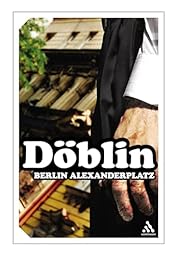
Berlin Alexanderplatz by Alfred Döblin

The story of Franz Biberkopf, Continuum, 2004, 381 p, plus ii p Foreword by Alexander Stephan and i p Contents. Translated from the German, Berlin Alexanderplatz, by Eugene Jolas

 Berlin Alexanderplatz  cover

Franz Biberkopf has just been released from Tegel jail after serving four years for the killing (manslaughter) of his partner Ida. This far from straightforwardly told novel tells his story – in nine books – over the next few years at the back end of the 1920s. These were of course troubled political times in Germany and some conversations involve “the Reds” and mention of swastikas but for the most part the political situation is kept in the background. The focus is on Biberkopf and his milieu, his acquaintance (it would not be accurate to describe him as a friend) Reinhold, their associations with various women and the demi-monde in general.

At first Biberkopf is determined to go straight and he manages to gain a living selling newspapers an din the meanwhile having relationships with several women (who tend to be Reinhold’s cast-offs.) Franz is settled with Meize, though, when his life unravels once more as he is hoodwinked into acting as lookout on a burglary. His irritation leads to Reinhold throwing him out of the getaway car into the gutter. His arm is damaged by a succeeding vehicle and he loses it.

The text is overloaded with repetition of phrases such as, “truly, ruly, roo,” “There is a mower: Death yclept,” “tararara taraboomdeay” and “drrumm, brrumm, drrumm.” There are, too, many digressions via Bible quotations, a multiplicity of rhymes, asides on how the novel is progressing, and relatings of everyday events in the wider world, including weather reports. Such things tend to a lack of clarity in the text, a situation not helped by dialogue being carried on from one character to another on the same line – albeit separated by quotation marks. As a mark of its times and of the prevailing attitudes there are also casual references to Jews as if those characters’ ethnicity was the only thing noteworthy about them.

Not only dialogue but also the prose is usually rendered in demotic mode. This is an attempt to represent the various viewpoint characters’ thoughts and as such is justified. However, the demotic employed by the translator was USian – “Say,” or “Gee,” at the start of a piece of dialogue, phrases or words like “back of it,” “boloney,” “dames.” As a result, the book didn’t feel at all German to me. Since experiencing another culture, even if at second hand, is one of the reasons for reading translated fiction this might be thought to be something of a failing. Jolas’s translation has been decried elsewhere.

The back cover blurb describes Berlin Alexanderplatz as one of the masterpieces of modern European literature – the first German novel to adopt James Joyce’s technique. I must admit to not having read any Joyce so do not know whether it was this aspect of the book, the translator’s choices, or the work itself which rendered reading it a bit of a chore. I don’t regret having read it though. Reading new authors, rarely turns out not to be worthwhile in some way.

Additional sensitivity warning: the book contains one use of the ‘n’ word.

Pedant’s corner:- Franze (I have no idea why, in asides, Biberkopf’s first name is sometimes spelled this way,) “work must being immediately” (begin,) Frankfort (either on-the-Rhine, or on-the-Oder, many times. The usual English spelling is Frankfurt,) newsvender (many times, newsvendor,) offuscation (obfuscation?) “let’s me stand there” (lets,) thind (think,) “you might of sat down” (okay it was in dialogue, but does German actually have this egregious mispronunciation? You might have sat down, or, you might’ve,) gayety (x 2, gaiety,) dumfounded (dumbfounded,) “has waked up” (woken up,) “I wouldn’t of started” (ditto as above,) “lay of the land” (lie of the land,) “layin’ around” (lyin’ around,) “he puts his hands over her mouth” (this was Franz. At this point he only has one arm, therefore only one hand,) Karle (Karl,) Mandelay (Mandalay,) “the gang … insist” (the gang … insists,) busses (buses.) interne (x 3, intern.)

free hit counter script