Posted in Art Deco, Bridges, Trips at 12:00 on 31 January 2018
Kyle of Lochalsh is a village situated at the mouth of Loch Alsh, ten or so miles from Dornie and Eilean Donan Castle.
It is perhaps most famous for being the terminus of the Kyle of Lochalsh Railway line, which nominally runs from Dingwall but the trains go on to Inverness.
Kyle of Lochalsh Railway Station:-

The Station is effectively on the pier. Handy for goods traffic:-

Part of railway line:-

Signal Box, Kyle of Lochalsh, taken from same bridge as above:-

The village is quite small but as I recall represented the big bad wider world of fleshpots and the like for the inhabitants of the Applecross peninsula in His Bloody Project
The most impressive building in Lochalsh is the Lochalsh Hotel which has minor Art Deco leanings:-

Only a mile (or less) away is the Skye Bridge. (No need now to take a boat – bonny or otherwise – over the sea to Skye.) Skye hills in background:-

In the village there is a memorial in the form of a defused mine:-

Mine memorial inscription:-

No Comments »
Posted in Dumbarton FC at 19:50 on 26 May 2016
I see from the club website that Sons have been included in the north area for the purposes of the new format of the League Cup (or Betfred Cup as it is officially known.)
Given that one of the major reasons for change was to have ties between sides more or less local to each other this decision seems utterly bizarre.
It is however a consequence of Sons relative success in that we have been included in the second layer of seeds due to finishing 8th in the second tier of the SPFL last season.
There is a possible nightmare scenario of trips to Dingwall or Inverness, Peterhead or Cove Rangers.
No Comments »
Posted in Architecture, Art Deco, Trips at 12:00 on 20 October 2015
This one’s in Church Street. New Start Highland:-

As I recall all these are in Academy Street.
Nickel and Dime, street frontage:-

Nickel and Dime, corner. Note the eyes have been poked out:-

Part of Farmfoods. Again poked out eyes:-

Craigdon Mountain Sports, corner. The upper windows on this don’t look bad. Could they still be original?:-

Craigdon Mountain Sports, Academy Street frontage. Built 1936. Good detailing:-

No Comments »
Posted in Architecture, Art Deco, Trips at 20:42 on 15 October 2015
While we were up north with the good lady’s blog friend Peggy we managed to take in Loch Ness and Inverness. Loch Ness is well photographed but not so much the Art Deco in Inverness.
The most striking Art Deco structure is probably the BT building which I first saw from the north end of Church Street:-

There was, though, a better view from the pedestrian suspension bridge across the River Ness:-

The first deco building I had spotted, however, was across from a supermarket car park.

There was a pub with deco styling in Baron Taylor’s Lane:-

This very dilapidated looking upper storey is at the north end of Academy Street:-

There is more to come from Academy Street later.
No Comments »
Posted in Chemistry, Other fiction, Reading Reviewed, Scottish Fiction at 12:00 on 16 August 2015
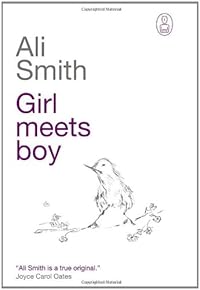
Canongate, 2007, 164 p.
Not borrowed from a threatened library but returned to one of them.
This is part of Canongate’s Myths series and is a retelling of one of Ovid’s Metamorphoses wherein Iphis (a name used for both sexes) was born a girl but on the gods’ advice is brought up by her mother as a boy as her father said they couldn’t afford a girl. As a young adult Iphis falls in love with and is set to marry Ianthe but has to appeal to the gods to resolve the dilemma of how to do this as a girl.
Told in five chapters titled “I,” “You,” “Us,” “Them,” and “All Together Now” Smith adapts this to a story of Anthea falling for Robin Goodman whom at first sight she thought, “He was the most beautiful boy I had ever seen,” rapidly amending this to, “She was the most beautiful boy I had ever seen.”
Mixed in with this is the story of Anthea’s sister, Imogen – at first shocked by Anthea’s relationship (Oh my god my sister is A GAY,) but later reconciled to it – and both their experiences of working for a rapacious company called Pure which sells bottled water. Office politics and the vacuousness of “creative” meetings are well skewered.
Many of the scenes take place in Inverness, Smith’s birthplace, but the book’s concerns are never parochial. Smith works in an account not only – in Imogen’s trip down south – of the Englishness of England but of the many ways in which women are disadvantaged in the workplace and life generally and also provides a more satisfactory resolution to the “problem” than would have been available to Ovid. As Robin (another name used for both sexes) tells Anthea, “It’s what we do with the myths we grow up with that matters.”
The book is typographically idiosyncratic in that the author’s name on the title page, the page headers (Smith’s name on even pages and the book’s title on the odd,) the names of the dedicatees and the authors of the epigraphs are rendered in a fetching pink and as in most of Smith’s books the right hand margin is unjustified but, in this case, not in a distracting way.
This may be a short novel but it is perfectly formed, the best by Smith I have read.
Pedant’s corner:- back and fore (maybe it is an Inverness thing;) and in the acknowledgements, H2O (H2O.) Here Smith also seems to find it noteworthy that ‘water is bent,’ but that isn’t news to a chemist.
No Comments »
Posted in Other fiction, Read Scotland 2014, Reading Reviewed at 12:00 on 16 August 2014
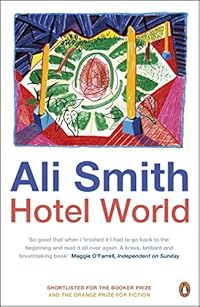
Penguin, 2002, 238 p.
I picked this up in a local library as I hadn’t read it. The author was born in Inverness and so counts for the Read Scotland Challenge; but see below.
Hotel World is not so much a novel as six novellas linked by the accidental death of Sara Wilby, a young woman worker in a hotel. She packed herself into the dumb waiter and its cables broke, plunging her to her death. The novellas each have titles relating to a verb tense; past, present historic, future conditional, perfect, future in the past, present. The first is narrated by the dead woman (after the death,) the second from the viewpoint of Else, a woman begging on the streets outside the hotel where the accident took place, the third is Lise’s, one of the hotel’s receptionists, whose mother is composing a poem cycle called ‘Hotel World,’ the fourth tells of the strange evening experienced by Penny, a later female guest, the fifth is an unpunctuated stream of consciousness of Clare, the dead girl’s sister, the paragraphs of which are connected by and – with the single exception of an I – all start with &, the sixth is an overview of what various minor characters observed earlier are doing in the present moment.
As in all of Smith’s novels which I have so far read the text’s right hand margin isn’t justified. This didn’t, though, seem so distracting in this volume.
The only hints of Scottishness here are the use of the word skirl, one mention each of the inscription on the rim of pound coins of the motto “nemo me impune lacessit” which was that of the Scottish monarchy (English pound coins have “Decus et tutamen” there,) of the “run-rig system of farming in Scottish History III,” and a town in the misty cold-bound Highlands. This is more than in subsequent Smith novels, though.
Several times Smith uses the archaic sounding phrase “back and fore,” where “back and forth” is perhaps more heard, we had pigmy instead of pygmy and foetid spelt in the USian manner as fetid.
I’m really not sure what to make of Smith. She can clearly write well, with insights into the human condition, but is it too much to ask for a plot?
No Comments »
Posted in Art Deco at 14:25 on 26 July 2010
Someone got to my blog by searching for “skottland art deco hotell” presumably because I’ve recently posted about the Balcomie Links Hotel or more likely the Beresford Hotel in Glasgow.
Anyway I looked at the google search page and found links to the Drumossie Hotel, Inverness.
A quick look through flickr turned up five photos which revealed part of it to be branded Inverness Conference & Banqueting Centre now. It’s undeniably Deco.


One of the flickr contributors complained that the local planning committee had vetoed new windows because they weren’t in keeping. The ones in the pictures don’t look original to me, though.
No Comments »