Archives » History

Scone Palace

Scone Palace isn’t actually a palace but an old house, near the village of Scone itself near Perth, Perth and Kinross.

The name palace derives from the site being that of an Abbey with its accompanying Abbot’s Palace.

The Palace’s grounds contain the ancient coronation site of the Kings of Scotland where the Stone of Destiny, also known as the Stone of Scone, was situated on Moot Hill.

Scone Palace from drive:-

Scone Palace from Drive

Closer view:-

Scone Palace

Old gates. These are not on the main drive but nevertheless a few years ago some delivery driver tried to get through them and knocked the central stones down. The arch has been well restored:-

Scone Palace Gates

Chapel on Moot Hill:-

Chapel on Moot Hill, Scone Palace

Chapel and Stone of Destiny, Moot Hill. You have to look really hard from this angle to see the Stone:-

Chapel and Stone of Destiny, Moot Hill, Scone Palace

Stone of Scone replica (or is it?) There have always been rumours that the stone Edward I of England removed to Westminster Abbey and on which the monarchs of England and, from 1701, the UK have been crowned was not the original:-

Stone of Destiny, Moot Hill, Scone Palace

Scone Palace is also renowned for its peacocks (and peahens):-

Peacocks, Scone Palace

They are reasonably tame and will eat out of your hand:-

Peacock Feeding, Scone Palace

Dundrennan Abbey, Dumfries and Galloway

Dundrennan Abbey was the place where Mary, Queen of Scots spent her last night in Scotland before fleeing over the Solway Firth to England, imprisonment and eventual execution. She didn’t sleep in the Abbey itself but in the commendator’s house in the west range.

Dundrennan Abbey from the car park:-

Dundrennan Abbey in Dumfries and Galloway

Dundrennan Abbey ruins from side:-

Dundrennan Abbey Ruins From Side

Walls and west range:-

Dundrennan Abbey, Walls

Arches:-

Dundrennan Abbey, Arches

More Arches, Dundrennan Abbey

Choir screen – now detached and situated in the west range:-

Dundrennan Abbey Choir Screen

Carved graveslab:-

Dundrennan Abbey, Carved Graveslab

Man on the Moon

The Moon landings were faked up on a Hollywood backlot, right?

What a load of utter tosh!

It astounds me that anyone would prefer to believe that something which would have had to be kept secret for so long by quite a large number of people (people moreover, cinema technicians etc, not truly invested in the “deceit”) would not have leaked by now. But it hasn’t leaked.

And why hasn’t it leaked?

Because it would need proof of such a conspiracy to fake.

And there is none.

And why the desire to deny the endeavour and the expertise which went in to the making of man’s greatest adventure, not to mention the sheer bravery of the men who made the voyages? Buzz Aldrin was quite right to take exception to the guy who accosted him, a guy who has not one thousandth of the guts and integrity. What is it about some folk that they cannnot rejoice in others’ achievements but must find some way to denigrate them?

And the Soviet Union did not claim that the US Moon landings did not happen – which as a propaganda coup they most certainly would have – because they knew perfectly well that they did. (Compare that to now, when Russia does claim that things that happened didn’t and things that didn’t, have. And so, too, does POTUS, T Ronald Dump.)

Besides, some of the experiments the astronauts placed on the Moon are still sending back data, even fifty years on.

So, raise a glass and drink a toast to a magnificent accomplishment, a demonstration of humans’ ability to perform amazing feats of focus, cooperation and enterprise.

It’s just a pity we gave up on that enterprise so soon.

Fife Pilgrim Way

A project to resurrect the mediæval Fife Pilgrim Way is now well in hand.

There were two main routes across the county (or kingdom as the locals still refer to it at times,) starting at Culross and North Queensferry and ending up at St Andrews.

The ancient route went through the nearest small town to Son of the Rock Acres, Markinch, the ancient capital of Fife.

There are some hopes the restored route(s) will bring modern day pilgrims (and other tourists) to the town.

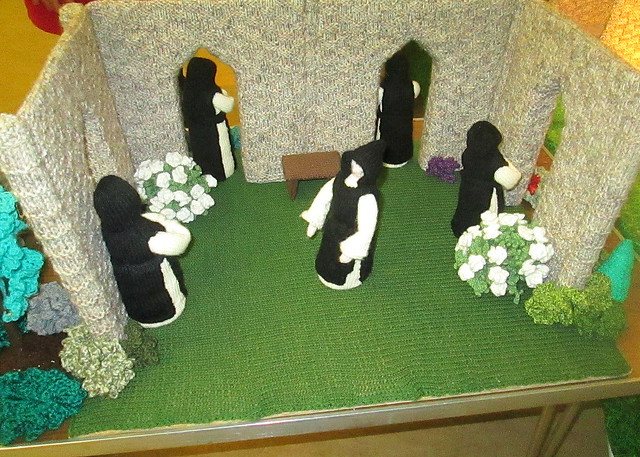
A year or so ago there was an information day about the Pilgrim Way at St Drostan’s church. On display were several representations of monastic and pilgrim life, rendered in knitwear.

Trees and pilgrims:-

Knitted Trees and Pilgrims

Church:-

Knitted Church

Monks:-

Knitted  Monks

Monks’ garden:-

Knitted Garden

Monastery vegetable patch:-

Knitted Vegetable Patch

Son of the Morning Star by Evan S Connell

General Custer and the Battle of the Little Bighorn.

Pavilion Books (Michael Joseph), 1985, 447 p.

Son of the Morning Star cover

This book does what it says on the (subtitle of the) tin. It is an account of the fatal (to Custer’s Seventh Cavalry troop) encounter at the Little Bighorn. I say encounter, as to describe an engagement involving so few combatants on the one side as a battle is stretching things a bit. Compared to those of the US Civil War in the previous decade and of the century following it was really only a firefight. Account is also misleading. Along with everyone else Connell does not really know exactly what happened. None of Custer’s troops survived, the Native Americans who fought them did not know till later it was Custer attacking their camps and their recollections are beset by translation difficulties and their custom of noticing those things which made sense to them rather than to historians from outwith their culture.

The narrative begins a little oddly, with a description of the engagement’s aftermath, specifically of Major Reno’s and Captain Benteen’s commands whom Custer had detached from his own to attempt a pincer movement. Here is a first indicator of the range of Connell’s project. He goes into details of both these officers’ lives – before and after the Little Bighorn – and when referred to gives us biographies of all the notable characters who had anything to do with the events of that day (and even of some of those who didn’t.) All interesting stuff, but leading to a certain lack of focus.

Custer’s misjudgement in attacking a force of whose size he was unaware was not a one-off. He had acted similarly in the Civil War, where his tendency to charge at anything without adequate reconnaissance and (not) think later became almost a trademark (and he got away with this against Indians at the Battle of the Washita, gaining his unearned reputation as an Indian fighter.) But then, what else is to be expected of a man who graduated twenty-fourth out of twenty four in his year at West Point, with the most demerits of any such student to that time? Indeed his rise in the ranks during the Civil War could be said to be without trace as none of the actions in which he was involved (not that they are explored in great detail in the text) indicated any intrinsic military ability. But they did catch the eye of his superiors.

In an interesting aside Connell states that any photographs said to be of Crazy Horse are most likely of someone else. He would apparently sit for paintings but felt a photograph would steal something from him and refused to have his picture taken. Also, one observer noted he lacked the usual high cheekbones of the North American Indian and had a pale skin colour. Connell does not suggest this but that seems to me to imply he could have been of white ancestry, though brought up as a Cheyenne.

There are no fewer than thirteen pages of bibliography – in smallish print – in this book (and only three for the index.)

So what makes Custer’s story endure? Why has so much been written about it? The Little Bighorn was not the greatest defeat suffered by US soldiers at the hands of Indians. So why is it remembered? The text quotes a Professor Rosenburg* as saying, “Custer meeting death at the Little Bighorn descends to some impalpable region of the American psyche.” This is perhaps the nub. The legend persists of a lone survivor – dog, or horse – and that at the climactic moment Custer “must have flowing locks”. He didn’t; his hair had been cut before the expedition set out – for practical reasons. And too, “Reaction throughout the country was no different in 1876 than it is today on receipt of similar news: shock, followed by disbelief, fury, and a slavering appetite for revenge.”

Then there are the numerous representations of the battle on canvas and, later, film, so that “Custer’s last stand remains an inviolate myth.” According to Walt Whitman, there is “nothing in the books like” John Mulvany’s painting of the battle, “nothing in Homer, nothing in Shakespeare; more grim and sublime than either, all native, all our own, and all a fact.”

And all for what? Canada had no Indian problem – mainly due to the fact that the Canadian government kept its word. It wasn’t the Indians who broke treaties. Custer’s fate was sealed as soon as the presence of gold was confirmed in the Black Hills of Dakota. Nothing could then have stopped the influx of prospectors and the inevitable protection they demanded from the US government in the name of progress.

But even then it could perhaps have been avoided. Feather Earring in 1919 told General H L Scott, “‘If Custer had come up and talked with us, we had all agreed we would have surrendered and gone with him,’ if he had approached diplomatically the Indians would have gone back to the reservation. General Scott observed that such a method of dealing with the hostiles had not occurred to anybody.”

Pedant’s corner:- *Is this the Bruce A Rosenberg of the bibliography, author of Custer and the Epic of Defeat? Otherwise; Sturgis’ (Sturgis’s: the possessives of all names in the text ending in “s” are rendered similarly,) teepees (tepees,) diety (deity,) Macawber (Micawber,) idyls (idylls,) witnesss (witness,) Congressional stationary (stationery,) as to “knobby days”, and “whiffenpoof” I can’t find a definition.

Battlefield Monument, Langside, Glasgow

The monument, now in the middle of a roundabout, was designed by one of the good lady’s collateral ancestors, Alexander Skirving, and commemorates the Battle of Langside, site of the last defeat in Scotland of Mary Queen of Scots, and is somewhat at odds with its modern surroundings.

From east:-

Battlefield Monument from East

From south:-

Battlefield Monument from South

From west:-

Battlefield Monument From West

Battlefield Monument plaque:-

Battlefield Monument Plaque

Planter at monument’s foot:-

Battlefield Monument Planter

A Piece of Rocketry History

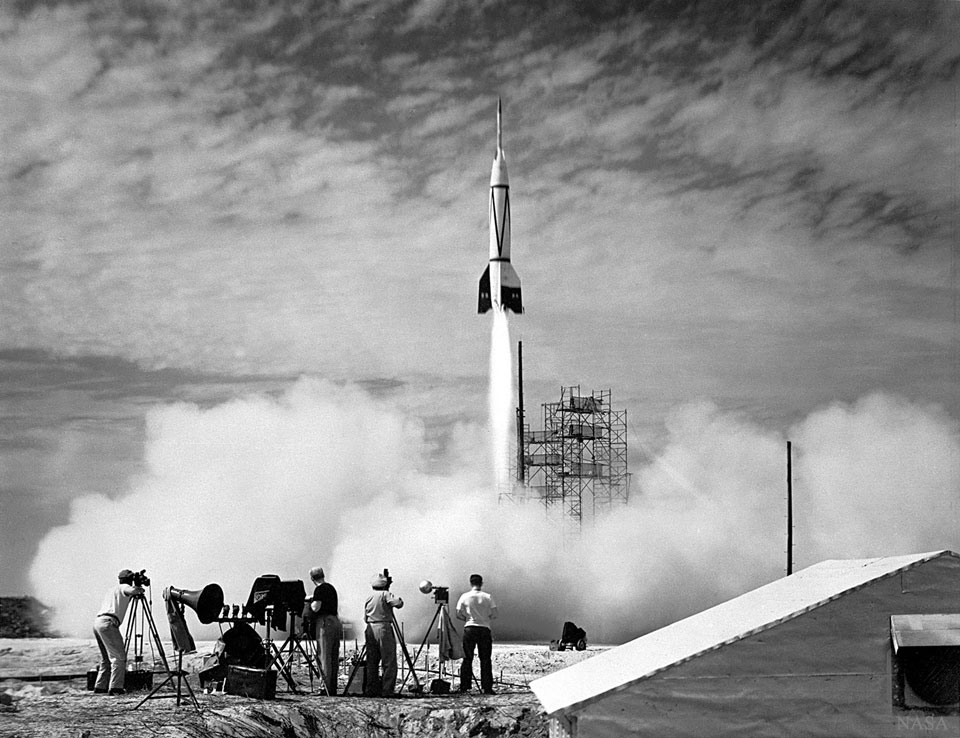
What a piece of nostalgia this is. This is a what a space rocket ought to look like – and in all those 1950s SF story illustrations always did. (It’s a pity it’s based on a V-2, though.)

From Astronomy Picture of the Day for 1/10/2018, the first ever rocket launch from Cape Canaveral.

First Launch from Cape Canaveral

Rochdale Co-operation

Rochdale is the home of the modern Co-operative Movement, through the Rochdale Society of Equitable Pioneers

The original site of their first shop, in Toad Lane, is now a museum:-

Co-operative Museum, Rochdale

Side view with Co-op Tea painted on the brick:-

Rochdale Co-op

The museum extends into the modern building you can see on the left in the first photo.

Just up Toad Lane are two shopfronts which are Victorian in appearance with lovely stained glass:-

Old Shop Windows, Rochdale

More Old Shop Windows, Rochdale

On the other side of the entrance to Toad Lane is a memorial to the Kobe earthquake, which, from its inscription, seems to have something to do with the Co-operative movement:-

Kobe Earthquake Memorial, Rochdale

Buildings in Rochdale

Apart from the Town Hall there are several fine buildings in Rochdale town centre, a few of them banks or former banks.

Royal Bank of Scotland, RBS:-

Royal Bank of Scotland, Rochdale

This has “bank” inscribed in the stone above the door but is somewhat anonymous now:-

Old Bank Building, Rochdale

Lloyd’s Bank (the rounded building):-

Lloyd's Bank, Rochdale

If you look closely at the above picture you can see a blue plaque. It was once the Union Flag Inn. In 1745 a confrontation between the Jacobite forces of Bonnie Prince Charlie and the town authorities took place here:-

Union Flag Inn as was, Rochdale

Beside Lloyd’s Bank is the very modern Beales and behind and above both a building with faded writing on the brick. “Rochdale (something I can’t make out; equitable?) Pioneer Society (something I can’t make out.)” The Co-operative movement started in Rochdale (see later post):-

Above Beales and Lloyd's Bank, Rochdale

This building has a fine cupola:-

Cupola'd Building Rochdale Town Centre

Càrn Liath Broch (ii)

The broch’s entrance:-

Carn Liath Broch

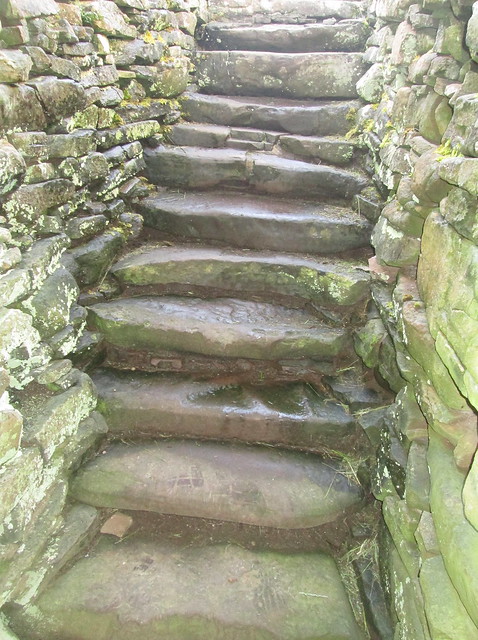
The broch had bronze age modcons. Stairs:-

Carn Liath Broch stairs

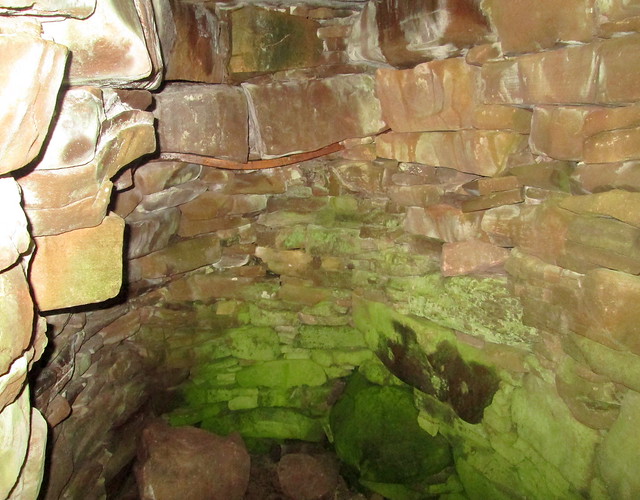
An internal chamber:-

Càrn Liath Broch, Internal Chamber

View towards Golspie and Dunrobin Castle:-

Towards Golspie and Dunrobin Castle

The towers of Dunrobin Castle peek above the trees to the left here and on the hill is the statue of the infamous Duke of Sutherland:-

Golspie and Dunrobin Castle

free hit counter script