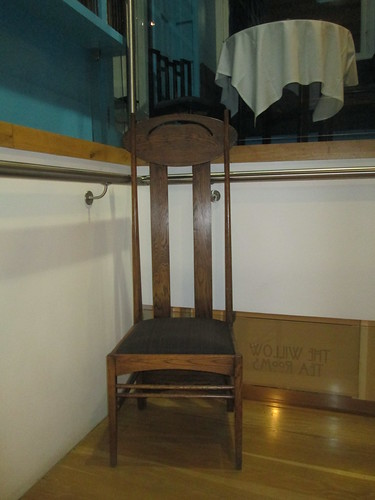
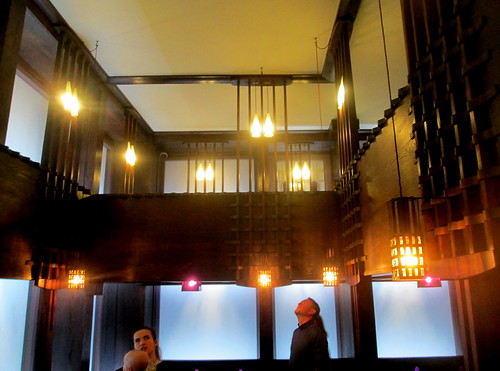
Willow Tea Rooms, Sauchiehall Street, Glasgow (ii)
Posted in Architecture, Art, Glasgow at 12:00 on 25 February 2025
Posted in Architecture, Art, Glasgow at 12:00 on 23 February 2025
These Charles Rennie Mackintosh designed tea rooms – for the famous Miss Cranston – were privately refurbished in the past few years but are now in the care of the National Trust for Scotland and seem to go by the name Mackintosh at the Willow, but that’s also the title of the affiliated gift shop next door.
We visited them because we hadn’t been there before but also to have lunch; which was excellent.
Sauchiehall Street was having work done on it at the time:-
In the photo above you can make out the circular design fronting the windows. This is a close-up:-
The Tea Rooms’ street sign:-
Internal lighting gantry:-
Wall frieze and partition wall below:-
These window curtains help diners escape scrutiny from outside:-
Posted in Architecture, Art Deco, Empire Exhibition, Scotland, 1938, History at 12:00 on 2 December 2024
I haven’t done one of these posts featuring postcards from the Empire Exhibition 1938 in a while. The tower was officially known as The Tower of Empire but was dubbed Tait’s Tower after its architect.
A colourised photo of The North Cascade and Tower by Night at the Empire Exhibition 1938:-
Black and White Photo Postcard, North Cascade and Tower:-
A Fountain and Tait’s Tower, Empire Exhibition 1938, with Palace of Engineering:-
Posted in Art Deco at 20:30 on 6 October 2024
Glasgow’s St Enoch Square 1955.
I don’t remember ever seeing the rotunda to the right side of this picture.

(Photo from Britannnia Daily’s facebook.)
Posted in Glasgow, Read Scotland 2014, Scottish Fiction at 12:00 on 12 July 2023
Black &White, 1993, 208 p. In Wax Fruit. First published 1947.
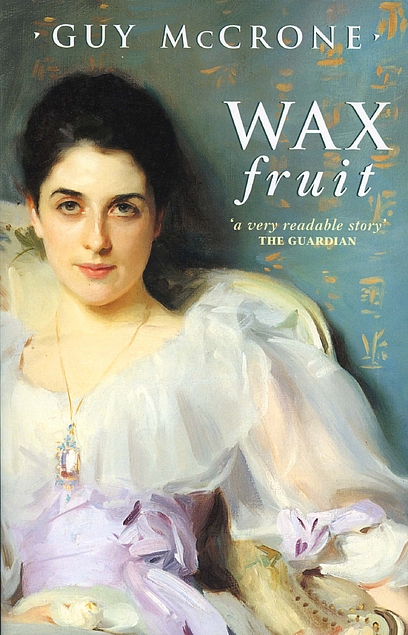
Wax Fruit is a trilogy of novels set in the Glasgow of the late nineteenth century. Antimacassar City is the first in the sequence.
We are dealing with the saga of the Moorhouse family, originating from an Ayrshire farm in the mid-1800s, though the setting is mainly Glasgow in the 1870s. The youngest Moorhouse, Phœbe, is the result of her father’s second marriage, to a Highland woman, and the book’s first scene describes the night she was orphaned by an accident. Phœbe is portrayed as a restrained, self-possessed girl and, later, young woman. Her older (half)-brother Mungo is the only one of the family left at the farm, the others have moved to Glasgow and are going up in the world. Her brother Arthur’s wife Bel determines to take her in, even though she is expecting their first child.
Phœbe takes a sisterly interest in the child, Arthur, when he is born. A few years later a maid, taking a shortcut home from a visit to his grandmother, loses him in a slum area when distracted by her sister’s presence there. On her own initiative and though still a child Phoebe sets out to find him, braving the shocking – and frightening – conditions of the overcrowded slums, and earns Bel’s everlasting gratitude for his rescue. McCrone’s attitude to the slum dwellers, couched through the middle-class values of the upwardly mobile Moorhouses, is disparaging and dismissive. They are depicted as depraved and dissolute; there is, it seems, nothing to redeem them.
The rest of the book deals mainly with Bel’s attempts to persuade her husband to move out of the city centre to the more salubrious West End and Mungo’s surprising attractiveness to Miss Ruanthorpe of Duntrafford, the local Big House in Ayrshire.
Henry Hayburn, tongue-tied except when enthusing about steam engines and engineering and a friend of another of Phœbe’s brothers, develops on sight a yearning for her. She is less enthusiastic but his family’s exposure to ruin in the collapse of the City Bank of Glasgow brings out her protective side.
The prose here is efficient but fails to spark. Elements of this are a bit like the works of Margaret Thompson Davis (though of course McCrone was published much earlier) but Davis’s attitude to the poor was more empathetic. But she was portraying the honourable poor.
As a cursory representation of Glasgow (a certain echelon of Glasgow) in the mid-Victorian age this is a good enough primer. Literature, though, it is not.
I still have two instalments to go. Maybe it will improve.
Pedant’s corner:- “Gilmour Hill”, “Kelvin Bridge” (1870s designations? now Gilmourhill and Kelvinbridge,) “‘you’ll can move out to the West’” (‘you’ll move out to the West’ or ‘you can move out to the West’,) missing commas before pieces of direct speech. “‘What way, can she not stay at the farm?’” (no need for that comma, it’s not two phrases,) “begging at he door” (at the door.) “Had she been unhappy here she was?” (where she was.) “Sophia as only too prompt” (was only too prompt,) missing quote marks around one piece of speech, “she turned way” (turned away,) “a coil of barbed wire lying rusty and hidden” (Barbed wire was only invented in 1873. There would hardly have been time for it to have been used on an Ayrshire estate and left to rust.)
Posted in Empire Exhibition, Scotland, 1938, Exhibitions, Glasgow at 12:00 on 11 January 2023
Despite its (for the time) Hi-Tech modernistic architecture, the Empire Exhibition, Scotland, 1938, was home to a very traditional type of building, that of the turf-roofed dwellings of the clachans of Highland Scotland. I featured a postcard contrasting the new with the old – the Tower of Empire overlooking Highland village cottages – here.
Clachan is Gaelic for a small settlement. A previous such village had been one of the hits of the Scottish National Exhibition held in Kelvingrove Park, Glasgow, in 1911 and the population of Glasgow was keen to see such an exhibit revived.
Three of Brian Gerald’s art-drawn postcards of the 1938 Exhibition focused solely on the Clachan. As well as cottages the Clachan featured a ruined castle, a loch, with a lovely stone bridge over a burn running into it, and the occasional bagpiper strolling about:-
One of the cottages did double duty as the Exhibition’s Post Office:-
Posted in Art Deco, Empire Exhibition, Scotland, 1938, Glasgow at 12:00 on 26 October 2022
I haven’t posted any of these for quite some time.
So here are three views of the North Cascade and Tower at the Empire Exhibition, Scotland, 1938, held in Glasgow’s Bellahouston Park.
First one of Brain Gerald’s art-drawn postcards:-
This is a very similar view but is a colourised photograph:-
This one, also a colourised photograph, omits the fountain:-
Posted in 1980s, Live It Up, Music at 12:00 on 17 July 2020
I mentioned before that I saw Tom Robinson play live before he came to wider prominence. He was in a band called Café Society and they were supporting somebody or other at the Apollo in Glasgow.
This is one from Tom’s post-Tom Robinson Band output.
Here’s (a very young looking!) Tom miming to War Baby on Top of the Pops in 1983.
Tom Robinson: War Baby
Posted in Architecture, Glasgow at 12:00 on 23 March 2020
One of Charles Rennie Mackintosh‘s designs for Miss Cranston’s Tea Rooms.
I featured the exterior and lower tea room with one photograph of the Chinese Room here.
Mackintosh chair halfway up stair to Chinese Room:-
View of Chinese Room from stairs:-
Alcove above stairs:-
View from above stairs:-
View back to stairs:-
Mackintosh print, tea-room tables, menu and chairs:-
Demi-lune chair opposite till:-
Not the Chinese Room:-
Posted in Art, Dundee, Glasgow at 12:00 on 18 February 2020
This Oak Room was designed by Charles Rennie Mackintosh for Miss Cranston’s Tea Rooms, Ingram Street, Glasgow.
After those tea rooms closed for business the room was for many years stored by Glasgow Corporation and then Glasgow Museums.
The construction of the V&A Dundee provided a space for the rooms to be on show to the public once more.