Archives » France

Honfleur, Normandy, France

The final stop on our cruise trip last year was the fishing village of Honfleur in Normandy, France; across the River Seine from Le Havre.

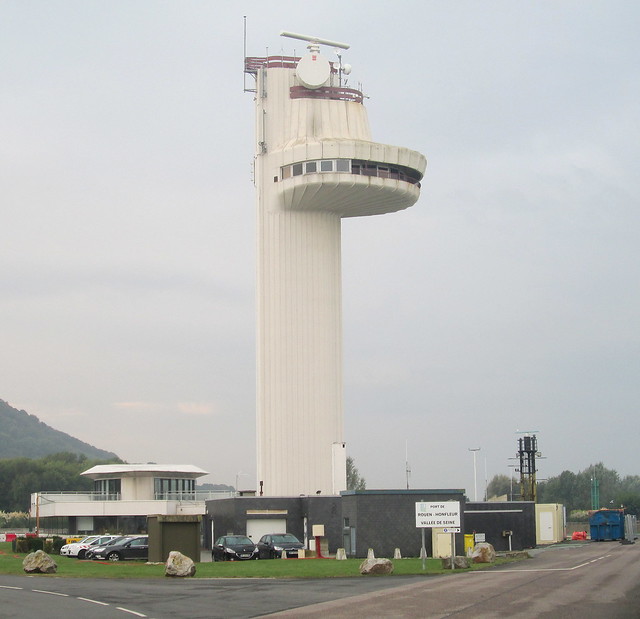
This is a panorama from the ship’s berth on the River Seine.Honfleur and Port Tower from Ship's Berth

At the extreme right above is one of those modern buildings we seemed to encounter at nearly every port. View from dock:-

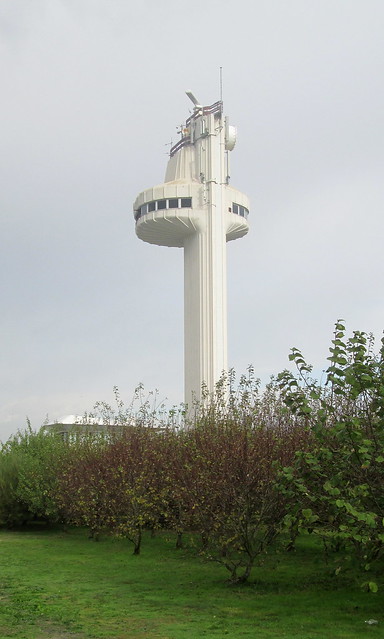
Port Tower, Honfleur

View from town side of tower:-

Honfleur, Port Tower from Town Side

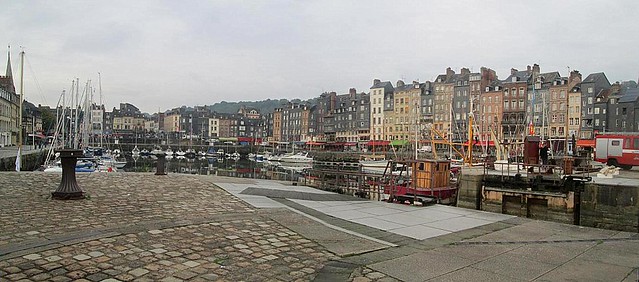
Honfleur itself is a delightful village in the old style. Panorama of harbour from the direction of the River Seine:-

Honfleur Harbour

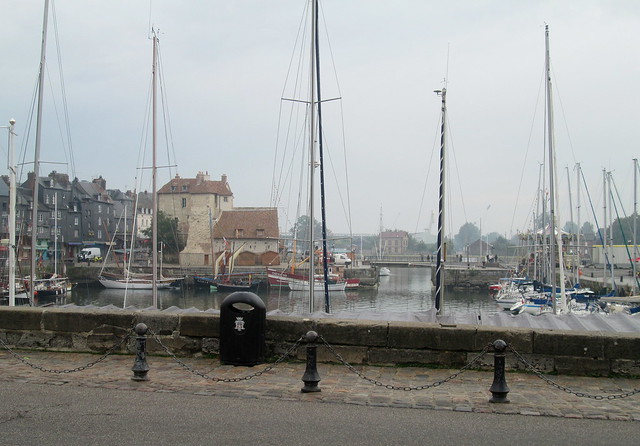
Honfleur harbour from the town:-
Honfleur Harbour From the Town

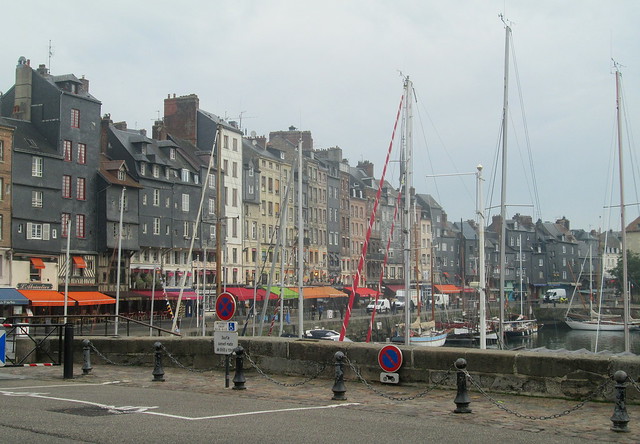
Harbour buildings:-
Honfleur Harbour, Buildings

Honfleur Harbourside

Lorient’s Art Deco Crown; Chambre de Commerce

This fine Art Deco building in Lorient, Brittany, France was just across a bridge over the inlet of the river, Le Scorff, from the modern Art Deco in the previous post.

Chambre de Commerce de Lorient et du Morbihan:-

Lorient Chaber of Commerce

Close-up of pediment:-
Lorient Chamber of Commerce Pediment

Doorway:-
Lorient Chamber of Commerce Doorway

Corner view:-
Lorient Chamber of Commerce, Corner View

Side view upper detail:-
Lorient Chember of Commerce Side View Upper Detail

View from side street:-
Lorient Chamber of Commerce, Extension?

The nearer doorway in the photo above has Tribunal de Commerce in the stone at the upper level:-
Lorient, Tribunal de Commerce

Lorient, France

Our first cruise stop was in Lorient, Brittany, France. Almost the first thing we saw after making our way out of the port was this piece of Modern Art Deco:-

Modern Art Deco, Lorient

The style continued a bit further along:-

More Modern Deco, Lorient

The same group of buildings from across an inlet of the river, Le Scorff, just beyond where the Black Watch was moored:-

Deco 3

The spire of this church kept catching my eye. It was ages before I found the street it was in. Eglise Notre Dame de Victorie St Louis, rebuilt 1953-5 after bomb damage during the war:-

Eglise Notre Dame de Victorie St Louis

Doorway:-
Doorway, Eglise Notre Dame de Victorie St Louis, Lorient

The Body Shop:-
Deco Style, Lorient

There is a slight Art Deco look, especially the porthole windows in the annexy bit, to this building at Lorient harbour, which from its appearance may date from the Second World War:-

Art Deco? Lorient Harbour

Portugal 0-0 France (1-0 aet)

Euro 2016, Final, Stade de France, 10/7/16.

So. It wasn’t to be Germanic hegemony after all.

Neither was it to be French triumph.

Like a lot of the knockout matches this was a spectacularly dull game but it suggested one thing to me. Portugal are a better team without Cristiano Ronaldo in it than with him. I felt much the same about Liverpool in the latter stages of Steven Gerrard’s time with them. It seemed to me the rest of the Liverpool players were looking too much to Gerrard, giving way to him or allowing him to have the ball when they were in better positions to do something with it. So too with Ronaldo and Portugal. Throughout the tournament (though perhaps not the 3-3 draw with Hungary which I missed as I was watching the Iceland-Austria game) there was something about the way they played with him on the pitch that rendered them less effective as an attacking force. His hogging of all the free kicks with no fruitful result whatsoever was almost laughable. Okay, he did score that header against Wales and scuffed the assist for Nani’s toe-poke in that game but otherwise there was little end product and he seemed to get in the way at times. With him not available others stepped up to the plate – particularly Eder who I doubt would have made it onto the pitch if Ronaldo hadn’t been injured.

Football. It’s a funny old game.

Exit. (England 1-2 Iceland)

Euro 2016, Round of 16, Stade de Nice, 27/6/16.

It’s hard not to think that there’s some sort of karma about this result. After England voting to leave the EU (loosely referred to as Europe) its football team has just departed Europe unwillingly.

The commentator on ITV called it a humiliation and also used the word embarrassment. The unspoken assumption (though it was all but articulated) was that England should always be beating Iceland.

Well; to anyone who had watched Iceland’s group games this was no surprise. Iceland are supremely well organised, the players know what they’re supposed to be doing and play for the team and each other. They drew with Portugal and group winners Hungary and then beat Austria, well fancied before the tournament began. If that wasn’t sufficient warning as to what to expect what would be? Using words such as embarrassment and humiliation is extremely disrespectful to a group of players who work their socks off and have no little ability. I expect France will also find it hard to break them down in the next round.

Iceland know their limitations and strengths, and play to them; as a team. The same was true of Italy earlier in what was a magnificent team performance against Spain.

In this respect it is also hard to resist the temptation to remark that English football commentators have an inflated idea of the worth of their country’s footballers based on club performances. Just reflect, not one of those players is good enough to play for an overseas team. They appear effective at club level only because they are surrounded by foreign players who make them look good. And the clubs of the league they play in have not made too much of a splash in the so-called Champions League of late. (OK, Liverpool made the final of the Europa League this season but that was mostly due to foreigners, manager included.)

England’s most penetrative player tonight was an 18 year old who was only brought on to the pitch when it was far too late and has in any case not yet had the enthusiasm and any latent talent knocked out of him by unwarranted expectation.

Mr Irresponsible’s Greatest Folly

Mr Irresponsible, aka Call me Dave, otherwise known as the Prime Minister of the UK, David Cameron Esquire, has a lot of idiocies to his name. But surely the largest of these is his utterly obtuse decision to give in to the bullying of his Conservative cohorts and the threat of UKIP to his voting base by first promising and then granting them a referendum on the UK’s membership of the European Union.

Instead of lancing the boil (he warned his party not to continue to bang on about Europe) his indulgence of their obsession has now unleashed a tide of xenophobia and intolerance, egged on by those who knowingly encourage a false belief that the troubles experienced by various communities up and down the UK are as a result of external forces (the EU,) so-called lack of control (again the EU) or immigrants (supposedly the EU but there are more migrants into the UK from outwith the EU than from inside it – and many Britons living and working in the countries of the EU) rather than the banking crash and the policies his Government has followed ever since its election in 2010. (I know its first five years were in coalition but really it was a Conservative Government in all but name.)

This tide has been growing for years – stoked up by spurious newspaper stories of EU “impositions” and “red tape” and the simplicities of people who claim that the country’s problems have one solution – and has now taken the form of a vicious and intemperate “Vote Leave” campaign which has peddled all sorts of what may be politely called inaccuracies but are in fact downright lies and often strayed close to, if not over, the border of racism.

I know the “Remain” campaign has also given apocalyptic warnings of the consequences of a leave vote, but it has not been whipping up fear of others, nor blatantly arousing expectations which will not (cannot) be fulfilled. Against whom will the anger the “Leave” campaigners have stoked be directed when things do not get better? (Either “in” or “out”, ditching austerity is not on their or David Cameron’s agenda.)

Had I been in any doubt about which way I would vote in Thursday’s referendum the “Vote Leave” television broadcast claiming that the £350 million pounds a week of the UK’s contribution to the EU budget (a large part of which promptly gets sent back anyway) would – in a leave future – be spent on the NHS instead would have made my mind up. These guys have no intention of spending money on the NHS; they want rid of it. They want to privatise everything that moves (and everything that doesn’t.) The worse thing, though, was the highlighting of five Balkan countries said to be on the point of entry into the EU (none of which actually are any time soon) plus Turkey: Turkey! which has been moving ever further away from meeting accession criteria under its present government) and then a series of arrows, leaping, Dad’s Army style, over to Britain. As if every inhabitant of those countries would immediately up sticks and come to the UK as soon as they were given the opportunity. Some may, most will not.

Then there was “Vote Leave”‘s pamphlet – delivered by post – which handily showed Turkey as having borders with Syria and Iraq. Are Syria and Iraq applying for EU membership? I don’t think so. What possible purpose can their inclusion on this map have? (Except to stoke up fears of people from there coming through Turkey – and riding the arrows to Britain.) Well, they’re doing that anyway, as “Leave” well knows and plays on. Yet in their circumstances so would I – and so would every leave campaigner.

The circumstances under which this vote is taking place, the Eurozone under strain, a refugee crisis, a war on Europe’s margins (two if you include Turkey in Europe which geographically part of it is,) render its timing more than unfortunate. It is potentially disastrous.

I really fear that a leave vote will see other countries (but emphatically not those who border Russia) seek to leave the EU. These may even include France if the Front National wins power.

In that case there will certainly be unresolved tensions between France and Germany – and we know where that has led in the past.

What the leave campaigners don’t seem to have grasped, or have deliberately ignored, is that the EU was set up (as the European Coal and Steel Community, then the Common Market) precisely so that France and Germany would never go to war again. That is emphatically in the UK’s national interest, and may be at risk. The writer of this letter to the Guardian knows what is at stake.

Whatever the result on Thursday the passions this referendum seems to have inflamed, at least in England – there has been almost no sign of it taking place at all in the way of posters and window stickers round where I live – will not be stilled easily.

The Holocaust and the State

There was an interesting article in the Guardian of 16/9/15 where Timothy Snyder argued that the conditions necessary for the Holocaust of Jews (and others, but mainly Jews) by the Nazis to take place have largely been misunderstood.

Snyder sees it as crucial that in the areas where most killings occurred, principally in the lands of pre-war Poland, the Baltic States and what had been Soviet Belarus and Ukraine, the apparatus of the state was no longer functioning – had indeed been deliberately destroyed. This was the necessary precondition for the activities of the Einsatzgruppen and the SS to be so unconstrained.

Though Snyder’s focus is on Eastern Europe I found myself thinking that in Western Europe too the absence of state institutions was a factor contributing to whether or not transportations to the killing zones of those whom the Nazis saw as undesirables came about. In Denmark, where the king remained and most institutions stayed intact (at least until 1943,) most of the Jews escaped or survived. By contrast in the Netherlands, whose monarch went into exile in Britain, and in France, where the Third Republic collapsed and Vichy was a puppet, deportations were much easier and in some cases even facilitated.

We have seen the consequences of the absence of the state relatively recently in Afghanistan – the Taliban would not have come to power there if not for the chaos engendered by, first, the Soviet presence and then its retreat (effectively driven out by a mujahideen aided and abetted via US and Western support) – in the disarray of Libya and now in Iraq and Syria where ISIS/ISIL/Daesh would not have had the opportunity to grow as quickly or at all if there had not been the vacuum created by the destruction of the Iraqi state and the failure to replace it.

Contrary to what some libertarians appear to think it seems the state really is a force for good.

Postscript:- While looking over the above it also occurred to me that the killing fields in Cambodia, while a consequence of Pol Pot’s take-over, were also due to state collapse, in this case that of the pre-revolutionary government. I suppose too that La Terreur in revolutionary France and the turmoil in the former Russian Empire after the Bolshevik coup are examples of what happens when state organisation suffers disruption. To avoid chaos a polity requires not people with guns but checks and balances; plus a functional judicial system capable of holding those in power to account.

And Now I’m Back

I’ve been in Holland.

Well, strictly speaking, since it was on the borders of the Friesland and Groningen provinces, make that The Netherlands.

The good lady’s eldest brother lives there. We had been supposed to visit for years but life got in the way.

We needed to renew our passports first. I sent the applications away late in July. Despite all the talk on the news about delays we got the new ones inside a week. (As I remember it was four days.) Maybe the Glasgow Passport office is more efficient than down south.

So another country visited. Apart from the constituent parts of the UK (though I only just made it into Wales) I’ve been to Sweden (Stockholm,) the Soviet Union (Leningrad as was) and Denmark (Copenhagen) on a school cruise when I was at Primary School, Portugal (the Azores, Madeira, Lisbon) and Spain (Vigo) on a Secondary School cruise, and as an adult to Germany (near Stuttgart) and France twice (Normandy for the D-Day beaches and Picardy for World War I battlefields.)

Since the good lady didn’t fancy being on a RoRo ferry overnight we drove down to Harwich (with an overnight stop) and the same on the way back. I’m knackered.

The Great War Anniversary

One hundred years ago today, at midnight Central European Time, the event that shaped the twentieth century came into being. Or at least the British Empire’s participation in it began.

Germany had invaded Belgium that morning so we were a bit late. (A squad of Germans had invaded Belgium the previous evening but had jumped the gun – so to speak – not getting the delaying telegram in time and were recalled. They were soon back though.)

Yet those were not the first shots. Hostilities had started seven days earlier on 28th July when Austro-Hungarian troops opened fire on Serbia in response to the true first shots – the ones fired by Gavrilo Princip and which killed Archduke Franz Ferdinand of Austria and his wife Sophie but even those had their roots in the welter of national entanglements which plague the Balkans even yet.

Those entanglements were mirrored in the system of alliances that dictated that Germany had to attempt to defeat France first before swinging round to take on Russia and so necessitated a march through neutral Luxembourg and Belgium.

Ironies abounded. Without attacking Belgium, Germany might have avoided war with Britain and so the holding up of the German armies by the BEF at Mons and later the Allies at the battle of the Marne might not have succeeded and so gained Germany the victory in the west it desired. Russia managed to invade eastern Germany earlier than the Germans had anticipated and troops were hurriedly withdrawn fron the Western Front to face the threat which I believe was actually defeated at the Battles of Tannenberg and the Masurian Lakes before these reinforcements could get there.

The Great War is remembered for the bloody stalemate of the trenches yet in these first encounters when it was still a war of movement daily casualties were enormous – especially for the French – much higher than in most later battles; though the Somme has a grim reputation in Britain.

I heard a woman on BBC Radio 2’s Pause for Thought this morning say she refused to call it the Great War “as there was nothing great about it.” Wrong meaning of great I’m afraid.

Flodden

Today is the 500th anniversary of the most disastrous encounter between the forces of Scotland and England in history. (Bigger even than the 9-3 reverse at Wembley only 50 years ago. But that was a mere football match.)

On the 9th Sep 1513 14,000 men died on a battlefield in Northumbria. 10,000 of those were Scots – including most of the Scottish nobility and even the King, James IV, himself, the last British king to die in battle. The Battle of Flodden Field was at one and the same time the biggest clash of arms between the two countries plus it was the last mediæval and first modern battle on British soil. Never again was the longbow to be a major weapon, never before had artillery been employed.

My memories of reading about this were that it was an unnecessary tragedy as James had only invaded Northumbria as a sop to the Auld Alliance between Scotland and France. England’s king, Henry VIII had gone to war with France and Louis XII had appealed to the Scots king. One of the peculiarities of this situation is that James’s wife was Henry’s sister, Margaret. She had apparently asked him merely to “break a lance” to honour his obligations. I doubt that she thought he would not return.

Reading the BBC History magazine a couple of weeks ago it turns out that Henry VIII’s father, Henry VII, aware of his tenuous right to the English throne had foregone the English claim to Scotland and signed the Treaty of Perpetual Peace. Henry VIII had no such inhibitions – or else was eager to bolster his own position – and had recently reasserted England’s overlordship over Scotland. James, then, in effect, had no option but to stand up to Henry.

His initial efforts were successful, taking three castles in short order. He then set up a strong fortified position on Flodden Hill and awaited the English forces. The English commander, Thomas Howard, Earl of Surrey, apparently accepted battle on James’s chosen ground. However, being out of favour with Henry, he was desperate for a victory and instead of attacking at Flodden Hill, he made a flanking manœuvre, interposing his army between the Scots and the border. James was furious at this unchivalric behaviour and had to make a quick redeployment to Branxton Hill instead. Perhaps it was this anger that led to his lack of judgement in the battle. Wikipedia has the details of this dispute over the proposed battleground slightly differently.
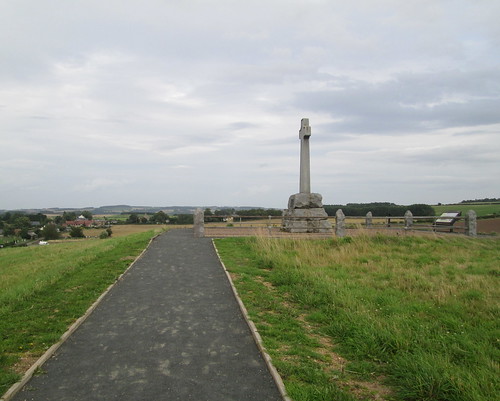
Flodden Memorial from path
Flodden Memorial from path.

Flodden Memorial

The plaque reads, “Flodden 1513. To the Brave of Both Nations.”

The Scots artillery was heavier but more cumbersome and so less effective but at the beginning of the battle the Scots left completely overran the English right (if only!) and retired from the battlefield expecting the rest of the army to achieve overall victory. In the centre, however, things did not go so well. From their position on Branxton Hill the Scots could not see the boggy ground in the declivity between the lines.
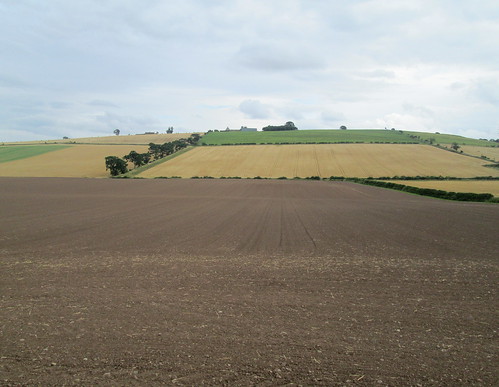
Flodden Memorial. View to Branxton Hill

Flodden Memorial. View to Branxton Hill. From English start line.
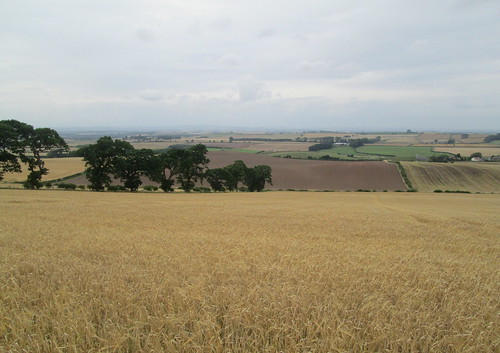
Flodden Memorial from Scottish line

Flodden Memorial from Scottish line. Memorial is just left of centre here.
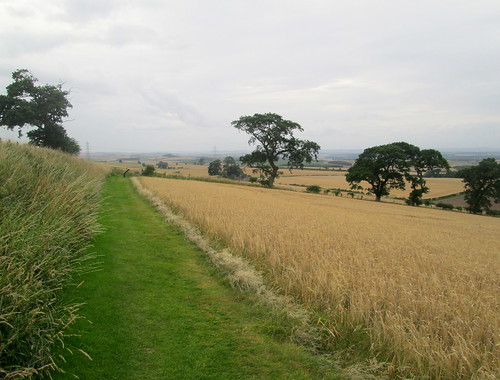
The Scottish Start Line at Flodden
The Scottish start line at Flodden.

The Scots infantry, armed with long pikes, whose efficiency had been proved in European battles, soon lost the essential formation necessary for success as they slipped and slid on the uncertain footing. The pikes also could not be anchored securely due to the underground conditions so were useless defensively. The English infantry, armed with much shorter billhooks, waded in to bloody effect. Dead bodies and blood soon made the conditions even worse.
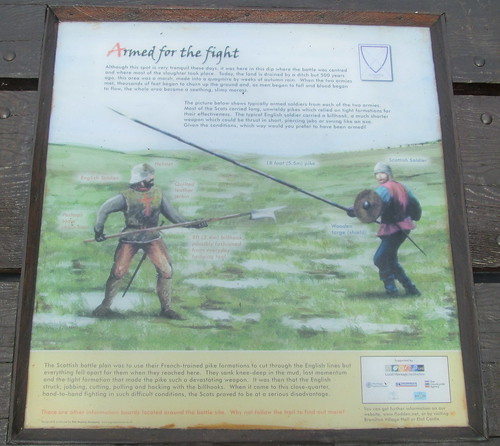
Flodden Information Board

To their credit, as one of the information boards on the Battlefield Trail says, the Scots did not cut and run, but bravely fought on.

The memorial, built in 1910, is inscribed to the brave of both nations. I have been told the only other battle memorial to acknowledge both armies is at Quebec but cannot confirm this.

There is an information centre – in a red telephone booth – in Branxton village. It claims to be the smallest information centre in the world.
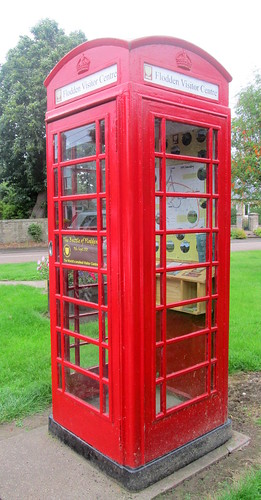
Flodden Information  Centre

James had been making his court and kingdom one of the most cultured in Europe, and Scots into a major European language. That process came to an abrupt end on his death.

The result of the battle at Flodden, the subsequent decline of Scotland’s influence, is probably the main reason why this post is being written in English rather than Scots.

The irony is that, despite the result of the battle, it was not Henry VIII’s descendants that would unify the crowns of Scotland and England and be monarchs of the UK but rather James’s, through his marriage to Margaret, their son James V and granddaughter Mary Queen of Scots, down to her son James VI and I.

The disaster is said to have inspired the traditional Scottish lament for the fallen, Floo’ers o’ the Forest,” sung here as The Flowers o’ the Forest by Isla St Clair.
free hit counter script