Archives » France

Argentina 2-2 France (3-3 aet, 4-2 on penalties)

FIFA World Cup, Final, Lusail Stadium, Doha, 18/12/22.

This certainly provided drama – but not until late in the second half.

In the first and most of the second France were pedestrian wheteher due to suffering from a virus or not, but more likely because Argentina were at them from the start. France barely had a kick in the first half. Then again Argentina were playing not only for themselves and their country but also for Lionel Messi.

Argentina’s penalty looked like one to me, Dembele clipped Di Maria not once but twice. Messi despatched it with ease.

The second goal was a thing of beauty. Messi’s pass to Alvarez delightful and Mac Allister sweeping on to supply Di Maria who scored with what football commentators sometimes call aplomb. The withdrawal of Di Maria changed the game a bit and Argentina began to look like they thought they’d won it.

Then came the real turning point, Otamendi’s failure to hit the ball into row Z leading to a clear penalty. Kylian Mbappe was not going to miss.
France now had their tails up and when Mbappe knocked down the cross a minute later, his marker failed to track him and Mbappe’s finish was brilliant.

Then Messi seemed to have won it for Argentina all over again after another sweeping move cut France open before we had the third penalty of the game and a hat-trick for Mbappe.

Loads of incident but all the tension packed into the last forty minutes of the contest, up to then Argentina were strolling it.

But that shows how a goal can change a game. This would most likely have fizzled out but for Otamendi’s mistake.

The result means no-one can now deny Messi’s footballing stature. He has won everything he could in the game and emulated Diego Maradona as a World Cup winner.

Will we ever see his like again?

Kirriemuir War Memorial

Kirriemuir’s War Memorial is right at the top end of Kirriemuir Cemetery. It takes the form of a kilted Scottish soldier with raised rifle surmounting a square stone, elaborately capped block with columns at its corners containing WW1 names resting on a larger plinth with inscriptions all set on a stepped base.

Kirriemuir War Memorial

The base is inscribed with the word “France.” The dedication reads, “This monument is raised to perpetuate the memory of the youth and manhood of the parish of Kirriemuir who fell in the service of their king and country in the Great War. It stands a tribute of homage to the fallen and an abiding inspiration to posterity. ‘Their name liveth for evermore.'” The panel holds names for the Great War:-

Base and Dedication of Kirriemuir War Memorial

Each side of the memorial contains Great War names and that of an area of conflict, Mesopotamia, Gallipoli and Belgium:-

Great War Names on Kirriemuir War Memorial

Kirriemuir War Memorial, Great War Names

In front of the older memorial is a further granite plinth commemorating the dead of World War 2 with the dedication, “To perpetuate the memory of those who gave their lives in the World War 1939 – 1945” and names from the Black Watch, the Royal Navy, the RAF and the Hong Kong Volunteer Defence Force:-

Second World War Memorial and Dedication, Kirriemuir

On one side of the plinth are commemorated soldiers of the Gordon Highlanders, King’s Own Scottish Borderers, Royal Scots and Royal Engineers:-

World War 2 Names, Kirriemuir War Memorial

On the other the Royal Army Corps, Royal Army Medical Corps, Royal Army Ordnance Corps, Scots Guards, Seaforths and Royal Corps of Signals:-

Kirriemuir Second World War Memorial

Nearby is a War memorial bench:-

War Memorial Bench, Kirriemuir

Farewell then, EU

So today was the last day the UK was part of the EU’s close trading arrangements and its single market.

My parents’ and grandparents’ generations had much more to endure it’s true – what with World Wars to contend with.

But it was the fact of those World Wars that made the EU, whatever its faults, such a worthwhile institution.

In the UK the myths surrounding those wars – especially the second one which has been mischaracterised almost ever since in these islands as a solely British victory with “us” “standing alone” (as if the contribution of Empire/Colonial forces and crucially Indian Army personnel to the North African campaign in particular – but also more widely – did not occur, with the USSR in Europe and the US in the Pacific seemingly mere bystanders) – are pervasive and pernicious. With the Great War such a perception may be less off-kilter. While it is true that the presence of US forces in 1918 made a difference it was by and large the British (Empire) Army which from the middle of 1917 carried the onus of first, not losing, and second, going on in 1918 to win final victory and in the process the biggest series of successive victories the British Army has ever had.

1939 marked the third war between France and Germany in 70 years (a woman in a Northern French village saw Prussian/German troops march past her house and occupy the place for the third time in her life) and there were many invasions of German territory by France in the centuries before. If some cooperative trading institution so as to minimise potential areas of disagreeement had not been set up post-1945 who is to say that conflict between them might not have arisen again? Some say it was NATO that preserved the peace in Europe in the years since then (but France, remember, was for some time not a NATO member.) In any case NATO’s expansion eastwards since the USSR dissolved, far from being a peaceful endeavour has been a standing provocation to that state’s main successor, Russia.

Tonight at 23:00 GMT, 0:00 CET, marked the last time when free movement of people and goods to Europe from the UK was possible (at least since before the requirement for passports came into being.) Some (little Englanders in the main) might rejoice at what they are pleased to call freedom, which actually has instead seen the biggest extension of powers to the UK government to bypass Parliamentary scrutiny and act summarily since 150 years or so before the UK even came into existence; ie over 560 years ago.

It’s a very sad day.

So farewell then EU.

Or, better, au revoir and auf wiedersehen, because I hope to be with you again soon.

2022 World Cup Qualifying

Gosh, it comes round again.

The draw for the European qualification round for the 2022 World Cup (to be held in Qatar) was made today.

Scotland’s fate could have been worse I suppose – we managed to avoid holders France, world ranked no 1 Belgium and also Spain, England, Germany, Italy and Portugal, nemeses in previous qualification campaigns, but Denmark, Austria and Israel (yet again drawn in a group with Scotland) are no mugs; and I always get the fear over games against countries like the Faroe Islands and Moldova.

Our last two games were 1-0 defeats too let’s not forget, but I’ll give the team a pass on those as they were hungover (in the nicest sense I hasten to add) from managing to reach the Euro finals.

Paired War Graves, Overleigh Cemetery, Chester

For more general views of Overleigh Cemetery, see here.

It’s unusual in the UK for two soldiers to be commemorated on the one headstone. (It is much more common in the battlefield War Cemeteries in Belgium and France.)

There were two such paired burials in Overleigh though.

Gunner W Jones, Royal Garrison Artillery, 5/11/1918, aged 35 and Driver A Wildman, Royal Field Artillery, 6/11/1918:-

War Graves, Overleigh Cemetery, Chester

Private R Jones, Cheshire Regiment, 19/10/1915, aged 21, and Private C H McLaren, Cheshire Regiment, 12/10/1915, aged 43:-

War Graves, Overleigh Cemetery, Chester

Private A Waterfall, West Yorkshire Regiment, 26/7/1916, and Private E T Morris, Cheshire Regiment, 22/5/1916:-

Overleigh Cemetery, Chester, War Graves

Private J Williams, Royal Welch Fusiliers, 15/6/1921, aged 29, and Private F Dale, Manchester Regiment, 16/1/1921.

Chester, Overleigh Cemetery, War Graves

Bombardier C Pearce, Royal Field Artillery, 13/7/1920, aged 32, and, in background, F Williams, The King’s Liverpool Regiment, 2/6/1920, aged 20:-

War Graves, Overleigh Cemetery, Chester

Brechin War Memorial

After all those visits to Brechin to see the mighty Sons of the Rock play away against Brechin City last year in August in preparation for yet another visit I finally looked up where Brechin’s War Memorial is located. It turned out it’s very near the football ground in a pleasant park area.

It’s an impressive sandstone column:-

Brechin War Memorial

Side view:-

Brechin War Memorial From Side

World War 2 Dedication. “To the glory of God and in grateful remembrance of those who gave their lives in the Second World War 1939 – 1945.” Below the names, “Greater love hath no man than this.”

World War 2 Dedication, Brechin War Memorial

Great War Dedication, “To the undying memory of the men of the City and Parish of Brechin who gave their lives in the Great War 1914 – 1919. Their name liveth for evermore,” and names Ada – Cla:-

Brechin War Memorial Great War Dedication

Great War names Cob – Hod:-

WW1 Names, Brechin War Memorial 8

Great War names Hoo-Pai:-

Great War Names Brechin War Memorial

Great War names Pet – You:-

Brechin War Memorial Great War Names

Other Conflicts; Kenya, Northern Ireland, Korea, Malaya. Plus additional names for France 1916, Burma 1945, and Mediterranean 1942:-

Brechin War Memorial, Other Conflicts

50th Northumbrian Division Memorial, Oxford Road, Wieltje, Belgium

50th Northumbrian Division Memorial, Wieltje, Belgium

Close-up. The Dedication reads, “to the enduring memory of all ranks of the 50th Northumbrian Division who fell in the Great War 1914 – 1918 and in memory of their comrades of the same division who gave their lives in the war of 1939 – 1945 for the liberation of France, Belgium and Holland.” On the lowest plinth, “Pro Patria.”

50th Northumbrian Division Memorial Close-up

Side inscription, “The Ayrshire Yeomanry; the Yorkshire Hussars; 1st, 2nd, 3rd, 4th, Northumbrian Brigade, RFA; Northumbrian Amminition Column; Northumbrian Divisional Engineers, RE; 50th Divisional Train, RASC; 1st, 2nd, 3rd, Northumbrian Field Ambulance, RAMC; Northumbrian Division CCS; Northumbrian Vet Section, RAVC; RAOC.”

Inscription 50th Northumbrian Division Memorial, Wieltje, Belgium

Other side inscription, “149th Infantry Brigade: 4th, 5th, 6th, 7th Northumberland Fusiliers; 5th Border Regiment.
150th Infantry Brigade; 4th East Yorks; 4th, 5th Yorkshire Regiment Green Howards; 5th Durham Light Infantry.
151st Infantry Brigade: 6th, 7th, 8th, 9th Durham Light Infantry; 5th Loyal North Lancs Regiment.”

50th Northumbrian Division Memorial Inscriptions

Memorial Information Board:-

50th Northumbrian Division Memorial Information Board

The view from the 50th Northumbrian Division Memorial is now so peaceful:-

View From 50th Northumbrian Division Memorial

So much so alpacas were ruminating by the memorial:-

Alpacas by 50th Northumbrian Division Memorial

Rochdale Town Hall, Stained Glass

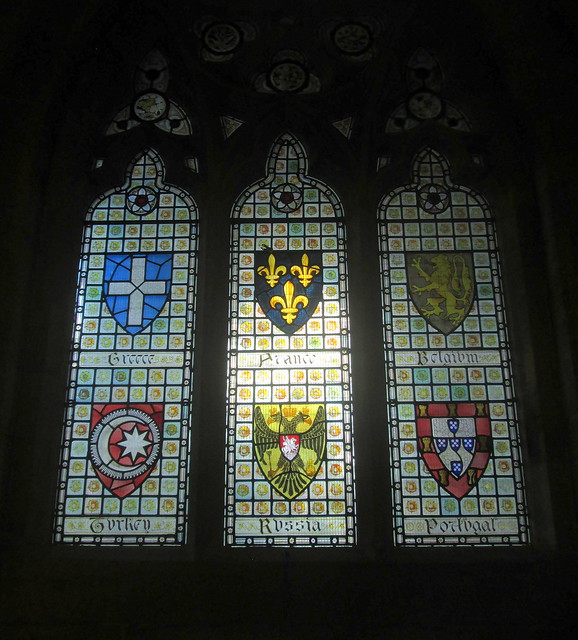
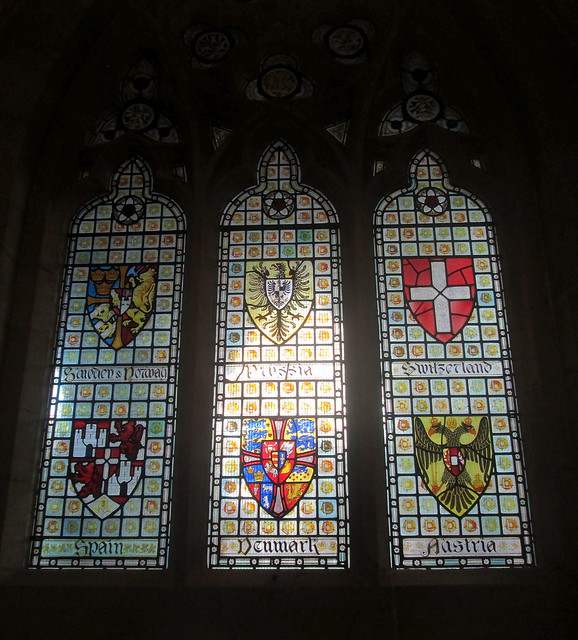
One of the striking features of Rochdale Town Hall’s interior is the stained glass windows many of which feature portraits of the Kings and Queens of England.

The windows flanking the entrance though have stained glass representations of the coats of arms of European countries, here Greece, France, Belgium, Turkey, Russia and Portugal:-

Rochdale Town Hall, Stained Glass Windows 1

The other such window betrays the building’s age. Coats of arms for Sweden & Norway, Prussia, Switzerland, Spain, Denmark and Austria. Note Sweden & Norway, as was (they separated in 1905) and Prussia which, subsumed the rest of Germany in 1871.

Stained Glass Window, Rochdale Town Hall

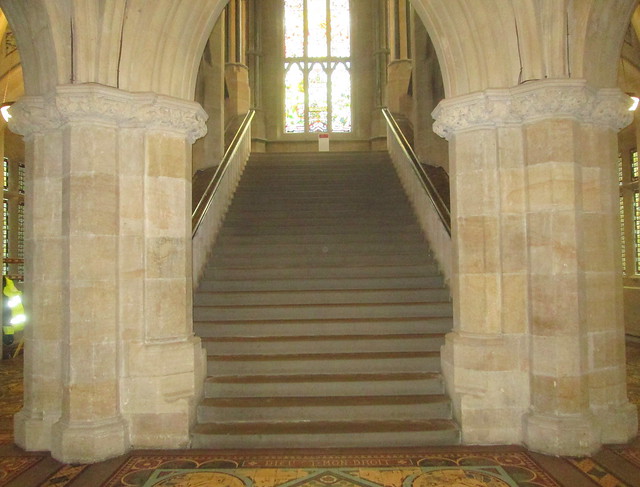
Grand staircase:-

Rochdale Town Hall Staircase

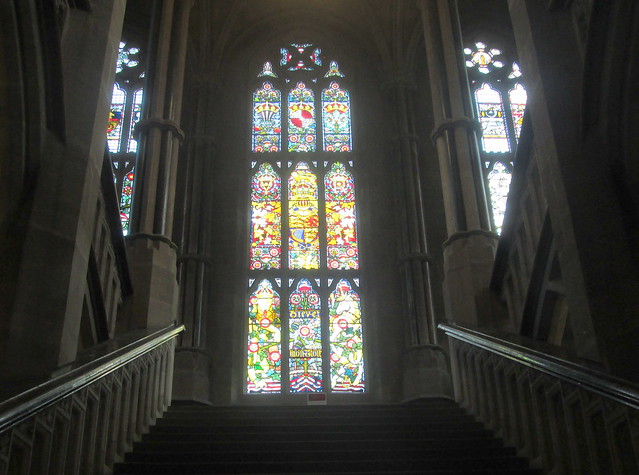
This is a closer view showing the stained glass window on the half-landing to greater effect.

Rochdale Town Hall, Stained Glass

Berriedale and Braemore War Memorial

This memorial is situated just off the A 9 at Berriedale (almost at the lowest point of the Berriedale Braes, a particularly hair-raising descent to and ascent from a river valley containing the Berriedale Water and the Langwell Water.)

The main aspect of the memorial faces north:-

Berriedale War Memorial

The photograph below shows the World War 2 dedication. Names on left here are for the Great War, those killed or died of wounds and – unusually – those wounded. The smaller list on right names World War 2 dead and the memorial’s architects are named at the bottom:-

Berriedale War Memorial Showing World War 2 Dedication

The memorial from the west. In another unusual touch the names on this side of the memorial are of those who served in the Great War (and presumably survived it):-

Dunbeath and Berriedale War Memorial from West

From west to north to east the pillar is surmountd by the words “Their Name Liveth Evermore” with the theatres of war Palestine, Salonika, France, Belgium, Egypt and Gallipoli, engraved towards the base.

Dedication. “Honor et Gloria. To commemorate the patriotism of the men of Berriedale and Braemore who fought on land and sea some of them giving their lives for their king and country during the Great War 1914-1918 and in thankfulness to God for the victory their valour helped to win”:-

Berriedale War Memorial Dedication

Honfleur

Honfleur is in many ways a quaint old town. I liked the contrast with this old (and, to me, Spanish looking) building at the corner of the harbour and the yellow motor bike:-

Old Building, Honfleur

We found this fantastic iron gate (one of a pair obviously) at a side alley:-

Ornate Iron Gates, Honfleur, Normandy, France

The side alley:-
Side Alley, Honfleur

A typical narrow street:-

Typical Narrow Street, Honfleur

But there were some open spaces:-

Tree-lined Square, Honfleur

And it wouldn’t have been complete without a touch of old France. A Clochemerle style outside toilet. (The grey hut behind is an inside toilet):-

toilets

free hit counter script