Archives » Fife

Open the Door by Catherine Carswell

Canongate, 1996, 431 p + xii p introduction by John Carswell. Borrowed from a threatened library.

On the spine plus the front and back covers the title is written as above but the title page and other mentions have it as Open the Door! (as did a Virago reprint I saw yesterday in a charity shop.) One of the 100 best Scottish Books.
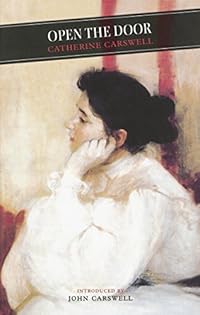
 Open the Door! cover

Joanna Bannerman has had a strict religious upbringing in Glasgow. Her father dies on an evangelising trip to the US, but didn’t really love anyone. “Better than his curbed enjoyment of his wife’s virginal freshness” was his love of public speaking: hence his ministry. Joanna’s mother, Juley, might have had a religious vocation – so much so that had she been a Roman Catholic she would have entered an order; “But to her the Church of Rome was the Scarlet Woman.” And there it is again; that stab of religious intolerance that blighted Scotland for so long and, partly, still does. However, Joanna’s life is a long attempt to throw off this background. Not that the novel focuses too much on religion, it’s more concerned about her wish to shake off restrictions (to open the door to living) and her relationships with the men in her life, Ben Ranken, Mario Rasponi, Lawrence Urquhart, Louis Pepper, whom she strings along, or is strung by, in one manner or another. The first she enters into an engagement with then breaks it off, the second she marries but he dies not long after they move (in his case, back) to Italy, the third is an intermittent presence, the fourth is a much older married man with whom she has a years long affair.

In Italy Mario also restricts her, not wishing her to appear in public where “she carried on her the lovely bloom which comes to some women when they are first possessed.” But she does notice a sunken door in a wall which she is told admitted a lover to the house of the Renaissance courtesan “La Porziuncula”. Mario’s death in a crash on a motorcycle of his own construction is something of a release. Her return to Glasgow to live with her mother is only relieved by her meeting with Pepper. Her mother’s friend Eve Gedge is described thus, “Barren of life herself, her deepest passion was to balk and defeat the entering of others into life.” I’m sure we’ve all met one of them.

On seeing her sister Georgie with her son Joanna thinks, “Their mother had done this for them, and her mother for her, and all with the same eager and touching confidence in the next generation. And what was to come of it? Nothing! Nothing because it was based on a lie..…… No! If the children, born and unborn were to be served fairly, one must utter clearly and fearlessly one’s own word of truth in one’s own lifetime.” She feels that, “‘evil’ (in the Christian sense of the word) quite as much as ‘good’ had made her alive ….. had made her an individual,” and her thought, “She remembered the words – ‘In sin did my mother conceive me,’ Why not – “In sin did my father beget me’?” shows that feminism is by no means a recent conception.

Mainly due to her affair with Pepper Joanna seems to drift through life. This gives the novel for most of its length the trajectory of a tragedy but Carswell seems to resile from this for the dénouement. Perhaps this was because, as her son John’s introduction reveals, a large part of the book is autobiographical in origin. Already less than overwhelmed by the novel – among other things it is overlong and too full of introspections – I must confess I was all the more disappointed by this (as usual I left the introduction till after I had read the book) as, while of course an author’s life experiences will feed into the work produced, it is better to rely on imagination to create something completely fictional in order to address deep truth. Towards the end there is a strange passage about the attractions of Fife towns. “Cupar, Falkland, Auchtermuchty, Strathmiglo! Such promising names as they had!”

I’m glad I read this and I suspect it was more of a ground-breaker when it was first published in 1920 but for me there were too many longueurs.

Pedant’s corner:- in the blurb page; annulment (annullment,) Observerand (space is missing,) Boccocio (Boccaccio,) Hugh Macdiarmid (Hugh MacDiarmid.)
In the main text:- first pain them was past (has a four character gap between pain and them,) Asias’s Millions (Asia’s Millions,) an end quote mark where none had been opened, sewed up (sewn up,) or his Easter Holiday (for,) thig (thigh,) students were too shy speak (the s and t of students are underprinted with t and o respectively and the word “to” is missing,) an opened pair of quote marks where no speech followed, pigmy (pygmy,) showed (shown, x 2,) “o return home” (to return home,) ay one (anyone,) beams o the guttering candle (the space between “o” and “the” suggests “of” was meant,) forment (foment,) missing quote marks at the beginning of a piece of dialogue at a chapter’s start, a missing full stop, to day (today,) eveybody’s (everybody’s.)
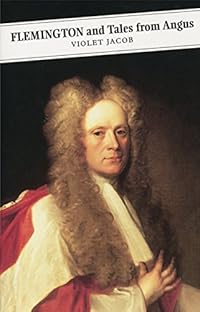
Tales from Angus by Violet Jacob

In Flemington and Tales from Angus, Canongate 2013, 269 p; including 9 p Introduction, 1 p Acknowledgements, 9 p Notes and 6 p Glossary.

 Flemington and Tales from Angus cover

Jacob was born into the Kennedy-Erskine family of the House of Dun near Montrose (and published the family history The Lairds of Dun in 1931. In the memorable stories of Tales From Angus her sympathy with, and compassion for, those born with fewer advantages, her intimacy with and love for the landscape of Angus, shine through. The summaries below do not capture her facility nor her powers of description. Again, the book’s introduction mentions some of the salient points in the stories. Read that afterwards.

Thievie. An old skinflint would do anything rather than hand over his life savings – even to his daughter.
The Disgracefulness of Auntie Thomson. On the arrival in town of a well-dressed stranger the daughter of an upright but proud couple (to flaunt their wealth they take a carriage to a further away Kirk rather than attend the one backing onto their land) turns down her suitor on the grounds his guardian, his Auntie Thomson – is too coarse. The twist here is obvious long before the end but enjoyable just the same.
The Debatable Land. An orphaned young woman taken in as a servant by a woman the attentions of whose son she finds abhorrent finds refuge with a traveller.
The Fiddler. A beautifully constructed tale of a woman haunted by her aid to one of the rebels hunted after Culloden and the fiddler who is the only other person in the know.
A Middle-Aged Drama. A widower takes on a housekeeper and gradually comes to appreciate her. But she has a secret.
Annie Cargill. A man visits his godfather’s house and is spooked by a grave in the adjacent cemetery. A fairly straightforward, but admirably written, ghost story.
The Watch-Tower. A shepherd shelters for the night in a watchtower and finds there an old acquaintance whom he perceives to be the notorious sheep-stealer recently escaped from a nearby jail. Others are on the hunt.
The Figurehead. The mate of the brig “William and Joann” is struck by the resemblance of a girl he sees on a stairhead in Montrose to his ship’s figurehead and starts to court her.
Euphemia. A young lass organises women to bring in a harvest on a Sunday when the men refuse supposedly for Sabbatarian reasons but really for the money.
The Overthrow of Adam Pitcaithley. The son of a farmer strikes up a friendship with a travelling lad but ignores him when in his Sunday finery. Not a wise move.
The Lum Hat. The manuscript of this story – of which a few pages were missing – was found in Jacob’s papers and first published in 1982, many years after her death. The missing pages do not affect the story’s thrust. Christina Mill has led a sheltered life in the house of her father (whose favourite ‘chimney pot’ hat provides the story’s title.) Her disastrous marriage to Baird, a sea captain, and thankfully swift widowhood when his ship founders, leads her to cling to the familiar.
The Fifty-Eight Wild Swans. A man all but bed-ridden with arthritis is struck by a desire to view the many swans newly arrived on a loch just out of sight from his house.
The Yellow Dog. A tale mostly at second hand as the story of the yellow dog, which may or may not be a ghost, is related by one of three men in a smiddy.
Anderson. The boy of the title rescues a kitten from the gaggle of boys about to take great pleasure in drowning it.

Among Jacob’s bons mots are, “No woman, no matter of what age, can be quite cold to the charm of a new garment.” “Hard-working men do not analyse one another much; they either do or do not accept one another, and that is all.” “He was one of the many old men in Scotland who always allude to death as a joke.” She also writes, “Scottish people are addicted, perhaps more than any other, to nicknames,” and repeats the same sentiment elsewhere. Is that a particularly Scottish trait? Her acute observation is particularly evident in The Lum Hat. “In a small town a stranger in church is a godsend.” The cook objects to Christina’s help because of “her passionate belief that the gentry should keep the pose thrust on them by God.” “The stars in their courses fought for Baird, as they do for most thrusters.” “…men married their wives for convenience mainly, and were lucky if they got any attraction thrown in.”

I note that throughout Jacob employs the word “wean” for a child. Hitherto I had thought this a predominantly West Coast usage. On the East coast “bairn” had seemed to me to be exclusive. (It certainly is in Fife – and in The Sunday Post.) Perhaps its use stops just north of Dundee.

Pedant’s corner:- chrysophrase (chrysoprase,) standing in the white patch that then moon had laid, tried is used in the text where treid (the Scots for tread) appears in the glossary.

Rust Never Sleeps

About a month ago we went for a walk along the beach at Lower Largo in Fife. Old railway sleepers held together by well-rusted iron struts form a barrier to help shore up the … err.. shore.

There is the semblance of a face on the second sleeper from right here.

The texture of the rusted supports was interesting.

In this one the iron has almost reverted back to ore. It looks very like samples of haematite I have seen.

Leslie, Fife

I’ve posted previously about the sad demolition of Leslie’s Art Deco Cinema.

There are still some thirties-style buildings around, though.

This is the former Co-op. It’s not really bent; this is a stitch of two photos to get it all in.

This is what the two separate photos looked like:-

The marble round the centre door would have looked impressive in its day but it’s a bit tired now.

The former cafe on the corner here has more than a hint of Deco in the rounded element and the detailing above the door.

This isn’t deco but the columns either side of the windows prefigure the style. It’s opposite the Green and is the Old Parish Church Hall:-

Serendipitous Answer

One of the exasperating – or (occasionally) amusing – aspects of being a member of the teaching profession is the unexpected answer.

Some of these become less unexpected as time goes by. I lost count early on in my career of the number of times I read of a “bouncin” burner in a pupil’s responses. This is of course due to how Fife kids pronounce “bouncing” – and to the way Scots say Bunsen with an “oo” sound as in the original German rather than the “uh” English folk use.

Often a written answer can be baffling (where on Earth did they get that from?) but on extremely rare occasions one of these slightly wayward attempts is startling or even utterly brilliant in a surreal kind of way. I had one of these last year as an answer to the test question, “What name is given to someone who is dependent on alcohol or drugs?”

I can write about this now as the relevant course and question is no longer part of the Scottish curriculum.

The response of this particular pupil was misspelled compared to the marking scheme’s wording (but that was obviously what she intended and so I had to give her the mark – not that what she actually wrote could be said to be wrong in itself, as it is in many ways a totally accurate description.)

So what was this unintentionally magnificent reply to the question, “What name is given to someone who is dependent on alcohol or drugs?”

“a dick.”

Largo War Memorial

Largo War Memorial

The memorial is set by the A915 on the road from Leven up the Fife coast to Crail (or across Fife to St Andrews) just out of Lower Largo before the road turns up to Upper Largo. The memorial obelisk is inscribed with the words, “To the Glorious Memory of the Men of Largo Parish who fell in the Great War,” and also bears the names of the First World War dead. The plaques on the wall behind give the names for the Second World War.

Below is a wider view showing more of the wall, which bears the dates 1939 and 1945, one at each end.

Largo War Memorial

Fife’s Art Deco Heritage 10 (ii): Leven Again

When I pass through Leven I usually don’t go via the town itself but use the A915 which only goes through the upper part. Last time though I went via the A955 and consequently viewed not only the War Memorial but also two Art Deco style buildings.

The larger of these is in Durie Street, just off the town centre, and once housed a Co-operative store, built in 1937.

Former Co-operative Building, Leven, Fife from East

The stepping on the roofline, the “brows,” the windows, the horizontals and verticals, and the slight protrusion of the vertical windows flanking the centre ones are all deco features.

This is the upper frontage:-
Former Co-operative Building, Leven, Fife

And here’s a close-up on the frieze above the central windows:-

Detail on Former Co-op Building, Leven, Fife

The trianguloid protrusions flanking the centre portion look like this:-

Window Detail, Former Co-operative Building, Leven

Further out from the town centre on Scoonie road is the Agenda pub.
Agenda, Leven

This one shows the deco detailing:-
Art Deco Detailing on Agenda

Leven (Scoonie Parish) War Memorial

The Fife town of Leven lies in Scoonie Parish. It is the dead of Scoonie Parish which the memorial commemorates.

The main memorial is an obelisk set in well kept surroundings and carries names of WW1 dead. The wall behind commemorates WW2.

Leven (Scoonie Parish) War Memorial 1

Leven (Scoonie Parish) War Memorial 2

Leven (Scoonie Parish) Memorial Wall

Fife'€™s Art Deco Heritage 11: Methil

Methil is one of those post-industrial towns which now litter Scotland. There is still some shipbuilding/oil related work going on there but, like most of Fife, Methil is somewhat down on its luck.

It does have Art Deco though. This building is on Wellesley Road. The red paint is the main deco feature as the eyes have been poked out.

Budget Micro, Methil, Frontage

Budget Micro, Methil, Side

Just along from it there is this pub on a corner, now looking for a new owner, which has deco detailing to the roofline.

Bayview Bar, Methil, Fife

Culross War Memorial

One of the places we visited last summer was the small village of Culross in the west of Fife (almost as far west as possible in Fife.)

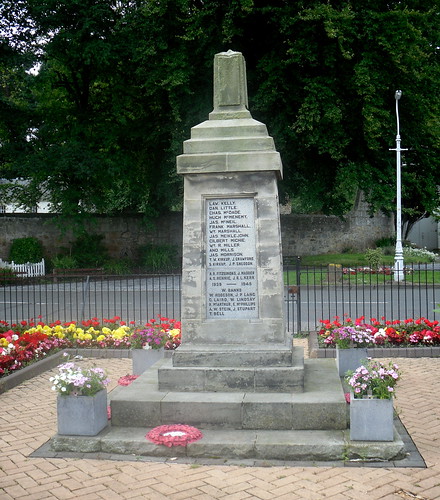
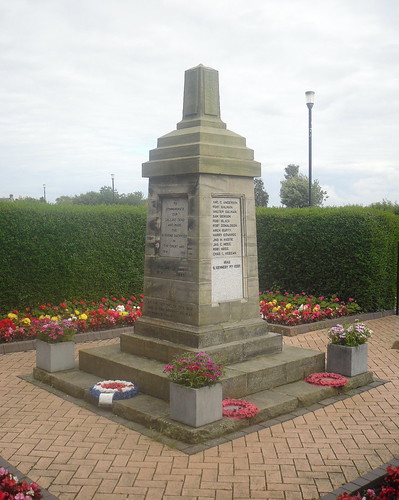
The War Memorial is set in a small memorial garden hard by the car park at the west end of the village almost as close to the river Forth as you can get. The lower names here are for the dead of World War 2. The other names are for World War 1.

Culross War Memorial

The lowest name here is for a soldier who died in Iraq in 2007.

Culross War Memorial

free hit counter script