Archives » Edinburgh

More Grayson Perry

Grayson Perry’s Smash Hits Show at the Scottish National Gallery, Edinburgh, got a rather sniffy and somewhat off the point review in the Guardian.

Yes, it’s about Englishness, even a very Grayson Perry kind of Englishness, but why should an exhibition about Englishness not take place in Edinburgh? Especially in the middle of an International Festival.

In any case it could be argued that Englishness has had more effect on Scotland than any other influence (except perhaps Calvinism) and is therefore an entirely appropriate subject for contemplation in the Scottish capital.

One of the most intriguing exhibits at the Exhibition was a model of a ship, titled The Tomb of the Unknown Craftsman. (I’m always a sucker for ship models.) Perry’s explanation of the piece is here.

The Tomb of the Unknown Craftsman, Grayson Perry

Grayson Perry's Temple for Everyone

Another piece, Temple for Everyone, reminded me of the story of Hansel and Gretel. See Perry’s explanation here.

Temple for Everyone by Grayson Perry

Grayson Perry's Temple for Everyone

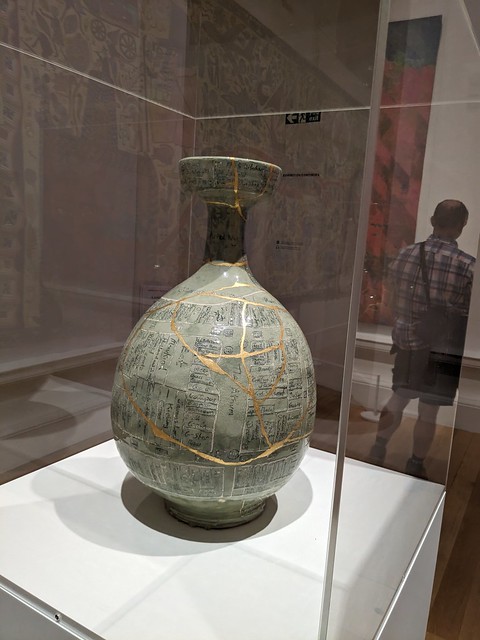
I was more taken with this kintsugi piece than I was with Perry’s undamaged vases. Kintsugi* is the Japanese Art of smashing an object – especially a piece of pottery and then gluing it back tgether and highlighting the joins with gold:-

Kintsugi Vase by Grayson Perry

This plate, Two Old Guys Wearing Checked Skirts, like a lot of pieces at the exhibition, (far too many in fact) features Perry’s childhood teddy bear Alan Measles and is a sort of homage to the late Queen Elizabeth:-

Two Old Guys Wearing Checked Skirts, Grayson Perry

This piece of pot, English Wanker, just about speaks for itself:-

English Wanker by Grayson Perry

*Edited to add: I have since found out that the Japanese frown on deliberately breaking something to reform it. Kintsugi is more properly the highlighting of imperfections – the repair of broken pottery lending itself to this.

Grayson Perry Exhibition, Edinburgh

A couple of weeks ago myself and the good lady went to the Grayson Perry Exhibition at the National Gallery in Edinburgh. It’s called Smash Hits.

I wasn’t expecting much as what I’ve seen of his work on television didn’t inspire me. However we are Friends of the National Galleries and that has various benefits – among them a discount in their cafés  (the one in Modern Two is excellent) and free entry to exhibitions such as this. (I would not have paid the entrance fee of £19.)

I had known Perry made his name as a potter and has an alter ego as Claire whom I find tiresome in the extreme.

I was, though, pleasantly surprised to see in the first gallery two sculptures which to me had a Japanese look.

Our Father and Our Mother. Clicking on the links should take you to my photos of the blurb accompanying each:-

Our Father by Grayson Perry

Our Mother by Grayson Perry

The next gallery had a series of tapestries collectively titled The Vanity of Small Differences and based on Hogarth’s Rake’s Progress but updated for the Twenty-First century:-

The Vanity of Small Differences, Birth

The Vanity of Small Differences Grayson Perry

Note the cafetiere and “literature” mugs in the second one above. Apparently these are emblems of being middle class. I admit to using a cafetiere. I don’t have literature mugs though.

The background in the last one seemed to me to sum up life in Britain in latter years:-

Grayson Perry, The Vanity of Small Differences

Another huge tapestry illustrated Perry’s lack of originality. It’s titled Morris, Gainsborough, Turner, Riley:-
Morris Gainsborough Turner Riley

His “Battle of Britain” ended up as a conscious channelling of Paul Nash. It’s quite effective though:-

Battle of Britain Tapestry by Grayson Perry

Lachie Stewart Exhibition, Maid of the Loch

Vale of Leven lad Lachie Stewart won a gold medal in the 10,000 metres at the first Edinburgh Commonwealth Games in 1970.  Over the years since he has built a succession of ship models. Some of these were on display on the Maid of the Loch when we visited last September.

Exhibition poster:-

Lachie Stewart

Lachie on the track:-

Lachie Stewart Memorabilia

Lachie’s ship models posters:-

Lachie Stewart Exhibition Poster, Maid of the Loch

Lachie Stewart Information

Lachie (centre) in conversation:-

Lachie Stewart (Centre)

Random Photos Taken in Edinburgh

Roof Detail of new W Hotel, in St James Quarter, Edinburgh. For obvious reasons the building has become known as the Turd:-

A Coil on a Roof

Thistle sculpture on Market Street – just along from the City Arts Centre:-

Thistle Sculpture

Art Deco style flats on Colinton Road:-

Art Deco Style Flats, Edinburgh

Art Deco Flats, Colinton Road, Edinburgh

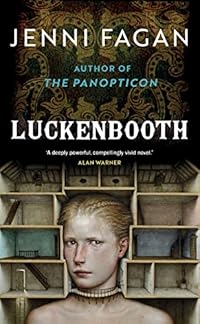
Luckenbooth by Jenni Fagan

Heinemann, 2021, 344 p.

The book examines the history of No 10 Luckenbooth Close, Edinburgh, via various of its inhabitants through the years; Jessie Macrae who lived in flat 1F1 in 1910, Flora in 2F2 in 1929, Levi in 3F3 in 1939, Ivy Proudfoot in 4F4 in 1944, Agnes Campbell in 5F5 in 1956, William Burroughs in 6F6 in 1963, Bee in 7F7 in 1977, Ivor in 8F8 in 1989, Dot in 9F9 in 1999.

Written with many short sentences, sometimes only two words long, weirdness is a characteristic from the off. Jessie is the recently deceased Devil’s daughter, sold by him to the house’s owner, Mr Udnam, to be a surrogate mother for the child his wife cannot have. On her father’s death, Jessie started to grow buds on her head and eventually sports a magnificent pair of horns – not to mention cloven hooves. This aspect of the novel is another illustration of the Scottish literary tradition of meetings with the Devil but here with an unusual twist.

Jessie’s presence haunts the house for the rest of the book – as does that of Elise, Udnam’s wife, and her five sisters, all of whom he has had killed, along with the child. Despite this Udnam is on the outside an upright citizen, rewarded by the city for his contributions to civic life.

The book is structured in three Parts. Its nine viewpoint characters each get three non-sequential chapters to him- or herself within the relevant Part of the book.

It is also a potted history of Edinburgh. Levi (a black man from the US) writes to his friend Leo, “There are two cities in Edinburgh. There is one above ground and one below, one in the centre and another on the outskirts … the Edinburgh that is presented to tourists. Then the other one, which is considered to be the real Edinburgh, to the people who live here ….. All fur coat and nae knickers,” that last a phrase the postman taught him. He adds, “ideology is sold to us as a fixed thing that everything is based upon … but they are all just based on ideas. And those ideas were created so people could find a way to control billions of other people … a way to profit, a way to order society, a way to warehouse humans,” and, “there are no different races of humans; there are only humans and we are all made from stardust every single one of us,” plus reflecting on religion, “there is no god wants murder in their name. Not a single one. Humans made that up to compensate for our own bloodlust, to sanctify it, to make it holy,” and society, “men with money pay poor men to hold guns up to other poor men or women to keep all of us in line.”

Feminist Ivy Proudfoot, who seems to believe she has been recruited to do undercover work in Occupied France, asks, “Why is it that young men who kill are heroes but a young woman who has the urge to do so is reviled?”

The William Burroughs in flat 6F6 in the 1960s is the writer; cut-ups litter his floor. He tells his Scottish lover that we are programmed by language and calls himself a word traveller, commenting on the relationship between writer and reader and what they conjure up between them. His aside about his lover’s attitude to the English, “You blame everything on them,” receives the reply, “They’ve a lot to answer for.”

Bee’s menace-dripping confrontation in 1977 with a group of Chinese gangsters is beautifully written.

The building is at one point described as a psychic vampire, it drinks human essence. Its dark secrets are revealed when it falls apart – consumed by decay and the tap, tap, tap of the death-watch beetle – on Hogmanay1999.

Luckenbooth (the word has two meanings: a lockable stall or workshop – there used to be a row of these standing opposite St Giles Cathedral in Edinburgh’s High Street – and it is also a type of brooch) is not a novel for the faint-hearted but all the characters have the stuff of life. And death. A sticky blend of horror (tipping over at times into grand guignol,) heightened realism and social history, it is likely to remain long in the memory.

Pedant’s corner:- the state of being recumbent is always rendered in the text by the words ‘lay’ or ‘lays’ (it should be ‘lie’ or ‘lies’,) “a hand jive” (in 1933?) “numbers 0 through 9” (0 to 9, please,) sat (sitting, or seated,) a character mentions tights in the context of women’s legwear (in 1944?) “Each of the girls’ heads swivel toward him” (Each … swivels.) “‘She had outdrank everyone’” (outdrunk,) “he is put in the recovery position” (in 1944?) hoofs (in my youth this plural was always ‘hooves’,) “‘Hurricane’ by Neil Young” (it was Bob Dylan I believe.) “A swarm of …. flash by” (a swarm … flashes by,) sneakers (USian, in 1977 in Scotland they would have been called training shoes,) ammonic (ammoniac,) a reference to running electrical appliances to “run the figures down” to fool the meter reader (surely that ought to be ‘run the figures up’?) “My Little Ponyies” (My Little Ponies,) “with their smug pus’s” (pus’s as in plural of pus – ie a face. Pusses is obviously wrong; puses doesn’t look right either. We’ll have to go with pus’s then.) Knifes (Knives.)

Art Deco Style Window, Modern Two, Edinburgh

This window is in the gents’ toilet at Modern Two (Scottish National Gallery of Modern Art). I love its geometric style.

Window, Art Deco Style Modern Two, Edinburgh

Slipping Into History

When I discovered the late Queen’s cortege would be passing within twelve or so miles of my home on its way from Balmoral to Edinburgh I thought this is a bit of history (before her no monarch had died in Scotland since the father of Mary Queen of Scots) so we might as well go and see it. Something to tell the grandkid(s.) It would be the closest I’ll ever get to a reigning sovereign after all.

At first we tried to stand behind a crash barrier by the M 90 near Milnathort, Perth and Kinross, but a policewoman moved us on so we ended up on a motorway bridge. It wasn’t a good vantage point.

I did get a reasonable shot of the cortege approaching (the West Lomond Hill is in the background):-

The Queen's Cortege

However the close up I tried to get was too blurry. (The hearse was travelling at speed.)

I hurried to the other side of the bridge to snap this, which ended up very badly focused.

The Late Queen's Cortege

The convoy was actually quite large. This shows its tail end:-

Tail of Queen's Cortege

It struck me when I downloaded it off the camera that it was fairly appropriate, though, as she was by that time gone. Elizabeth Alexandra Mary Windsor slipping inexorably into history (at 70 miles an hour.)

Old College and War Memorial, Edinburgh

The Talbot Rice Gallery (see posts here and here) is housed in part of the Old College, Edinburgh.

On the way out I happened upon a War Memorial to the former alumni of Old College, set into the wall behind its entrance facade

Old College:-

Old College, Edinburgh

From side. War Memorial wreaths behind:-

Old College, Edinburgh From Side

I could not get the whole of the memorial into one photo. Nor indeed two. Both of those below are stitches of two.

War Memorial Wall 1914-1918 names. Dedicated “MCMXIV To the glorious memory of the alumni of this University who fell in the Great War MCMXIX.”:-

Old College, Edinburgh War Memorial 1914-1918 Wall

World War 2 names. Stones to side inscribed 1939 and 1945:-

Old College, Edinburgh World War 2 Memorial

William Morris Exhibition, Dovecot Studios, Edinburgh, February 2021

Also in February we went to a William Morris Exhibition at Dovecot Studios, Edinburgh. The exhibition is now over.

William Morris was one of the leading proponents of the Arts and Crafts Movement. His wallpaper patterns covered many a Victorian wall and have been fashionable on and off ever since.

Wallpaper Patterns:-

Wallpaper Pattern by William Morris

William Morris Pattern

William Morris Pattern from Printing Block

William Morris Patterns

Three William Morris Patterns

Three More William Morris Patterns

Three Patterns by William Morris

Patterns, William Morris

William Morris Wallpaper Pattern

A printing block:-

William Morris Printing Block

Textiles:-

William Morris Textiles

William Morris textiles

Circles, Talbot Rice Gallery

Several of the exhibits at the Talbot Rice Gallery, Edinburgh, when we visited in February featured circles of different sorts, mostly of natural origin, but some not:-

Circles 1, Talbot Rice Gallery, Edinburgh

Thios one has a depiction of Copernicus’s heliocentric solar system in the book at the centre:-

Circles 2, Talbot Rice Gallery, Edinburgh

This was on the wall. It looks like the trace of an eccentically orbiting comet or something of that kind:-

Polished Stone 1, Talbot Rice Gallery

Liesegang Rings. I confess I had only heard of Liesegang Rings in a chemical context before this but I now know they occur geologically too, as evidenced below:-

Liesegang Rings, Talbot Rice Gallery

free hit counter script