Archives » Dumbarton

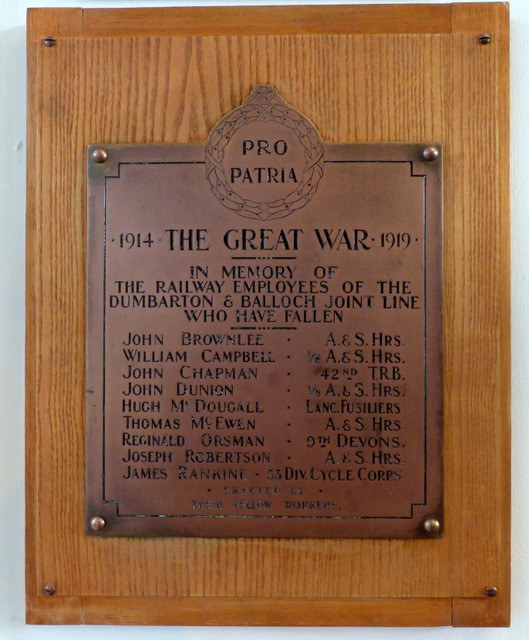
War Memorial at Dumbarton Central Station

The plaque at Dumbarton Central railway station commemorating the employees of the Dumbarton and Balloch Joint line who were killed during the Great War.

Photo 6x4 WWI Roll of Honour at Dumbarton Central railway station In the c2017 - Picture 1 of 1

There also used to be a Great War Memorial plaque at Dumbarton East Station but since the station buildings were demolished some while back I have no idea what happened to it.


The Dumbuck Hotel

I featured Dumbuck Hill a few posts ago. The hotel named after it – usually refrred to simply as “The Dumbuck” was for a long time the premier location in Dumbarton for functions such as wedding receptions and funeral teas.

Sadly the hotel fell into disuse and suffered a fire last year.

When we visited in Augst 2024 the former hotel was in the process of demolition. Another part of my childhood and adolescence gone.

Hotel being demolished:-

Ruins of Dumbuck Hotel, Dumbarton

Hotel ruins, Dumbuck Hill in background:-

Dumbauck Hotel Ruins

View from hotel’s rear (over a high fence, hence the poor focus):-

Dumbuck Hotel Ruins From Over Wall at Back

Dumbuck Hill

Dumbuck Hill, known simply as Dumbuck, is a prominent landmark in Dumbarton, lying at the eastern end of the Long Crags (Lang Craigs) part of the Kilpatrick Hills, which flank the town to the northeast.

When I was young the hill looked quite different from how it does now. It was extensively quarried as I was growing up and now has more the appearance of a decayed tooth when seen from the town.

Dumbuck Hill from old railway line. (LMS? I couldn’t find a clear map of the old rail system. It was scrapped in the Beeching cuts, though the other line through the town [LNER?] was retained.)

Dumbuck Hill Closer View

Dumbuck from immediately below.

Dumbuck Hill from Below

Closer view:-

Dumbuck Hill Zoom View

Bowling War Memorial

Bowling is a village two miles east of Dumbarton on the A 814 road. It’s probably best known as being the western end of the Forth and Clyde Canal.

Its War Memorial is a stone Celtic Cross on a rough-hewn stone plinth lying at the edge of a small park to the north of the A 814:-

Bowling War Memorial

Name Plaques, War Memorial, Bowling


Dumbarton Buildings (and a Bit More)

Minor Art Deco style, Wallace Street, Dumbarton:-

Minor Art Deco Style, Wallace Street, Dumbarton

I can’t ever have walked down Wallace Street before as I don’t remember seeing this building until this visit in April.

Doorway detail:-

Art Deco , Doorway Detail, Wallace Street, Dumbarton

I had seen this one many times: the former Co-op on the corner of Greenhead and Glasgow Roads. The date above the lintel is 1922, a bit early for true deco:-

Art Deco Style Former Coop, Dumbarton

We also took a stroll along the quay in the town and spotted this children’s slide (chute) in the shape of an elephant, with a wooden play elephant behind. An elephant appears on the crest of the town and of the mighty Sons, Dumbarton FC. It’s a nice nod to that heritage to have these play objects reflect it:-

Dumbarton, A Children's Slide (Chute) in the Shape of an Elephant


War Memorial, Dumbarton Castle

The entrance to Dumbarton Castle is up a flight of stairs which has a left turn on the way up. On the wall facing you as you turn is this War Memorial dedicated to the officers and men of the 9th Battalion (Dunbartonshire,) Princess Louise’s Argyll and Sutherland Higlanders:-

War Memorial at Dumbarton Castle


The Rock in the Snow

This photo appeared on the DFC website on Christmas Eve. I don’t know when it was taken as it doesn’t often snow in Dumbarton, it being on the confluence of two rivers, but it looks lovely.

The Disorderly Knights by Dorothy Dunnett

Cassell, 1966, 513 p.

Being the continuing adventures of Francis Crawford of Lymond, Comte de Sévigny, following on from The Game of Kings and Queen’s Play. We start here with a small incident in the ongoing border skirmishes with English forces before Lymond sets out for Malta, the seat of the Order of the Knights of St John, currently under the corrupt leadership of Grand Master Juan de Homedès. A Turkish fleet is bearing down on the island and Lymond is accompanying a mission to warn of its approach. It is there he meets the fair and pious Sir Graham Reid Malett (known as Gabriel.)

After witnessing the fall of Gozo they engineer a message giving false information to the Turks so that their fleet sets out for Tripoli instead of attacking Malta. A small group of Knights travels there to help its defence. Lymond’s former lover Oonagh O’Dwyer, whom he previously persuaded away from would-be Irish King Cormac O’Connor, has taken up with Galatian de Césel, Governor of Gozo, but when the island is lost she falls into the hands of the Turks. It turns out she is pregnant with Lymond’s son, eventually named Khaireddin, but for most of the book he is unaware of this.

The attempts to prevent the Turks capturing Tripoli eventually failing Lymond is joined by Malett in his efforts to form and train a private army partly to police the perennial feuds in the Scottish Borders but also to make money as mercenaries.

In the meantime Malett’s young and visually captivating sister, Joleta, has been sent by him to Lymond’s mother for safe keeping. Her attitude to men, who have always it seems deferred to her beauty, is summed up her reaction to Lymond’s articulation of his feelings for her, “‘But you can’t dislike me!’” In this scene Lymond seems to act at odds with the gentlemanly demeanour we might expect of a novel’s hero. But we later find his reasons are sound.

Notably (to me anyway) the pivotal moment in the book takes place in a hostelry in Dumbarton.

Twists and turns, betrayals and unfortunate choices abound and there are several loose ends (presumably to be taken up in the three later instalments of the Lymond Chronicles.)

It all jogs along eventfully enough but there is something about Dunnett’s writing here that jars with me. Too many viewpoint jumps perhaps, too little transparency.

Pedant’s corner:- helments (helmets,) unhung (unhanged,) “nursed rom” (nursed from.) “‘Unless your  fortify’”  (‘Unless you fortify’,) pomegranite (pomegranate,) “which soaked hides at might need protect” (context suggests ‘hides it might need’,) “the knights vulnerability” (the knights’ vulnerability,) disks (discs,) demonaic (demoniac,) hiccoughing (hiccupping,) cameraderie (camaraderie,) “a oecumenical” (‘an oecumenical’, and the latter is usually, now, spelled ‘ecumenical’,) Sandilands’ (Sandilands’s,) “every man, woman and child for which the company were responsible” (for which the company was responsible,) connexion (connection,) “had reached a screaming crescendo” (had crescendoed to a screaming climax,) pollarchy (first known use of this word was in the 1850s, not in mediæval Scotland.)
John Frost Bridge, Arnhem

John Frostbrug in Dutch, this is the famous bridge too far, except it’s a replacement for the original Rhine Bridge fought over in the Second World War during Operation Market Garden. It’s somewhere in The Netherlands I’ve always wanted to visit.

John Frost Bridge, Arnhem

Arnhem, John Frost Bridge

I must say the River Rhine looks not very wide here – not as wide as the Clyde at Dumbarton certainly. Still an obstacle to an army though:-

John Frost Bridge and River Rhine, Arnhem

Eastern guard post. Slight Deco styling.  I assume this is original:-

John Frost Bridge East Guard Post, North Side

Western guard post. Note groove up the middle of steps, for wheeling bicycles up and down.:-

John Frost Bridge West Guard Post, North Side

Reverse view of bridge:-

Reverse View, John Frost Bridge, Arnhem


John Frost Bridge over River Rhine

Roadway:-

John Frost Bridge, Roadway

Commemorative plaque with inscription to John Frost by roadway on north side of bridge:-

John Frost Bridge Memorial Inscription


Stirling Albion 0-0 Dumbarton (agg 1-2)

SPFL Tier Three 3 Play-off, Semi-Final, second leg, Forthbank Stadium, 11/5/24.

Like water torture. This was indeed a long 90+ minutes.

Albion looked a side lacking in confidence, not surprising when you slide into a relegation play-off spot.

In the first half they only threatened our goal once, after a bit of ping-pong in the box following a corner. Jay Hogarth saved the first effort but when the rebound was played across goal their attacker air-kicked a sitter.

We ought to have scored when a great move culminated with Div Wilson going for the near post but just shaving it into the side net. (Just for a moment it seemed he had scored.)

In the second half Albion came out to throw everything at it even going to three at the back. As a result our midfield was overrun at times but Jay Hogarth never really had a save to make. One shot did hit the post but that was it.

We had a few counter-attacking forays but tended to overcarry the ball when a pass was on (Kalvin Orsi and Finlay Gray I’m looking at you) or else players strayed offside so we never put the tie to bed. (Curiously, the linesmen flagged at the earliest opportunity, something which is very rare these days.) Michael Ruth was again superb up front but never got the clear chance his hold-up and general play deserved.

The final whistle was more of a relief than anything else even though Stirling never looked like scoring.

So it’s on to the Rock on Tuesday evening for the first leg of the Play-off Final against The Spartans then to Ainslie Park (of ill memory but also great memory) on Friday.


free hit counter script