Posted in Bridges, Trips at 12:00 on 27 September 2021
Barnard Castle is a market town in Teesdale, County Durham. It lies beside the River Tees over which there were at least two bridges.
One of these is a relatively narrow traffic-light controlled bridge which lies just below the ruins of the mediæval castle (of which more later.)


The second I got to by walking along a path by the riverside. Its purpose is more obscure:-

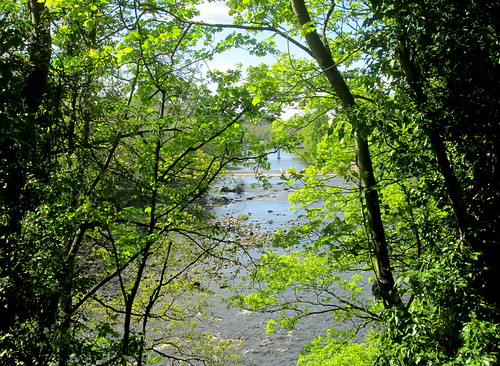
On the way up to it we passed this weir:-

Weir and second bridge through trees:-
No Comments »
Posted in Trips, War Memorials at 12:00 on 25 September 2021
Stanhope’s War Memorial is a stone cross above a square plinth. It stands in the grounds of St Thomas Church but is visible from the street:-
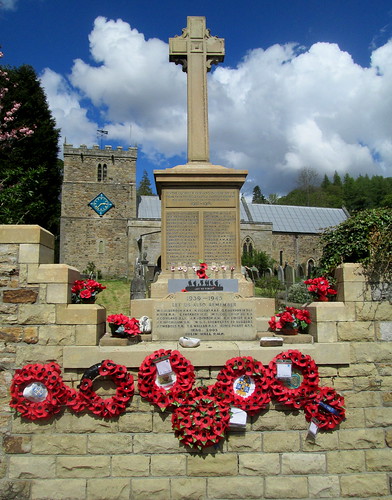
Dedication and names. “To the glory of God and in memory of those from the ecclesiastical parish of Stanhope who gave their lives in the Great War 1914 – 1919.”
“1939 – 1945. Let us also remember.”

No Comments »
Posted in Architecture, Art Deco at 17:30 on 22 September 2021
Stanhope is a village in County Durham, England.
The Bonny Moorhen has some deco touches: horizontals, verticals, flat roof, rounded corner:-

Its side aspect also shows off a stepped roofline:-

No Comments »
Posted in Trips, War Graves at 12:00 on 18 September 2021
Wolsingham is a small town in Weardale, County Durham.
The local building material looks to have been a lovely stone, similar to Cotsworld stone but a bit darker.
These terraced houses were quite olde-worlde

St Mary’s and St Stephen’s church stood back up a side street off the road through the town:-

There were two war graves in the churchyard.
Leading aircraftman F Langdale, Royal Canadian Air Force, 27/4/1943, aged 24:-

Private J H Jackson, Royal Army Medical Corps, 13/9/1920, aged 43:-

No Comments »
Posted in Trips, War Memorials at 12:00 on 15 September 2021
Lanchester is a small village in County Durham. We visited there because it features in a Book of British Villages which we have.
Its War Memorial is in the form of a wall on the village green:-

Closer view:-

There was a Great War 100th anniversary vintage memorial bench nearby:-

No Comments »
Posted in Architecture, Art Deco at 12:00 on 8 September 2021
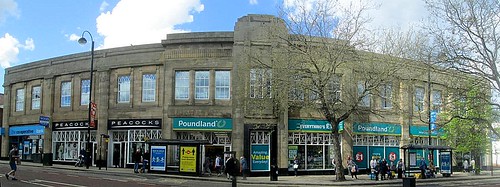
This one was too long for me to be able to fit into one photo. It still houses the Co-operative Bank, but also when we visited a Peacock’s and a Poundland.

Central portion detail. Rule of three in the windows plus other Deco hallmarks:-

Stitch of two photos to get whole building in:-
No Comments »
Posted in Art Deco, Trips at 12:00 on 6 September 2021
On our trip to England’s north-east earlier this year we decided to make a stop in Chester-le-Street, County Durham.
When I pulled to a stop in the car park I’d chosen, right in front of me was an Art Deco building, which turned out to be the Post Office, built in 1936.
It’s one of those brick Art Deco buildings. Note the horizontals, verticals, canopy, rounded corner, flat roof:-

This angle shows the rounded corner better:-

Crown and ER 1936 (Edward VIII) logo detail on columnar window, round ended canopy:-

No Comments »
Posted in Sculpture, Trips at 20:30 on 6 July 2020
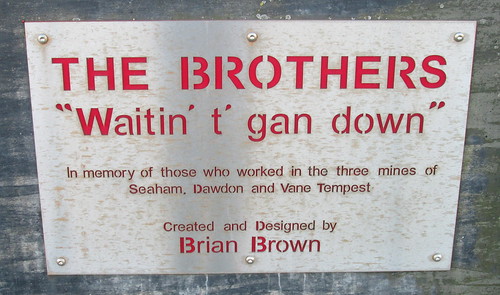
Seaham, County Durham, used to be a coal-mining town. There were three pits in the area, Seaham, Dawdon and Vane Tempest.
The Miner’s Memorial is on the main road through the town:-

Reverse view:-

Information Plaque:-
No Comments »
Posted in Trips, War Memorials at 12:00 on 6 July 2020
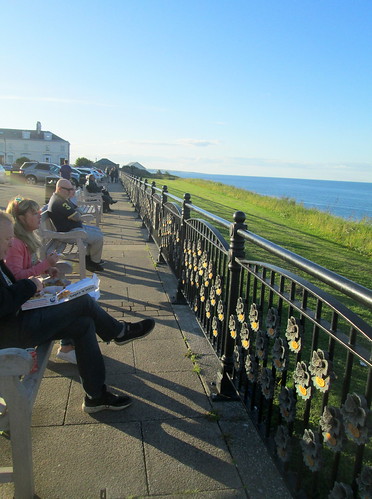
Between Terrace Green (hence, Tommy, and Seaham War Memorial) and the sea there is a fence on which Seaham’s Great War dead are commemorated.
One panel bears the first line of the poem In Flanders Fields.

Poppies on the fence bear soldier’s names and regiment. (Seaham harbour beyond.)

A typical panel:-

Looking north:-
No Comments »
Posted in Trips, War Memorials at 20:30 on 5 July 2020
Clustered round Seaham’s War Memorial on Terrace Green are three benches commemorating those who served in the World Wars:-


Close by the War Memorial is this box for the laying of crosses and poppies in remembrance:-

Seaham was once a mining village. A fourth bench rerpresents scenes from mining life. It has struck me that this may be in memory of the Bevin Boys, men conscripted during World War 2, not into the armed forces but to mine coal. Some of these also died during their service but they are not usually commemorated on war memorials. To my mind they ought to be.

No Comments »
