Posted in Trips at 23:04 on 19 May 2017
Bruges (Brugge) in West Flanders in Belgium is a lovely small city with great buildings.
We entered it through Smedenpoort, a gatehouse built over what looked like may once have been a moat:-

Smedenpoort from the city side of the gate:-

View to right from bridge seen above:-

View to left:-

The streets into the centre were festooned with banners. I couldn’t quite make out what they were displaying:-

No Comments »
Posted in English Football Grounds, Modern Architecture, Trips at 21:31 on 16 May 2017
For our trip to Belgium and the Netherlands we took the ferry from Hull across to Zeebrugge.
At Hull we got onto the ship, examined the cabin, no room to have a cat never mind swing one, then went up on deck.
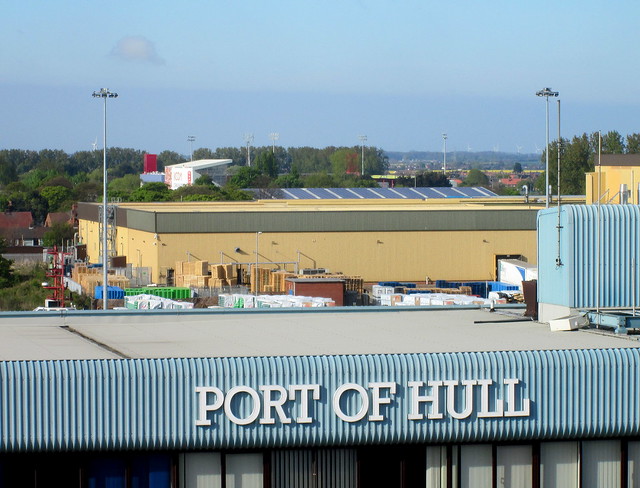
Hull was surprisingly green but with some industry too.
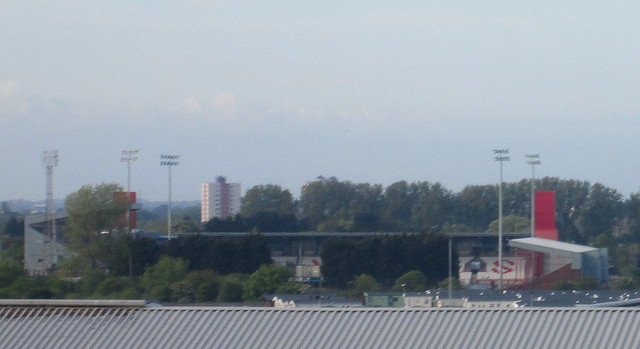
Over the dockside rooftops I spotted what I thought might be a football ground with what appeared to be the word KCom on a stand. Was it the KCom stadium, the home of Hull City AFC (and Hull FC, one of the city’s two big Rugby League clubs) I wondered? But it looked too small.
It turns out that it was KCom I had spotted but it was KCom Craven Park, the home of the other Rugby League club, Hull Kingston Rovers.
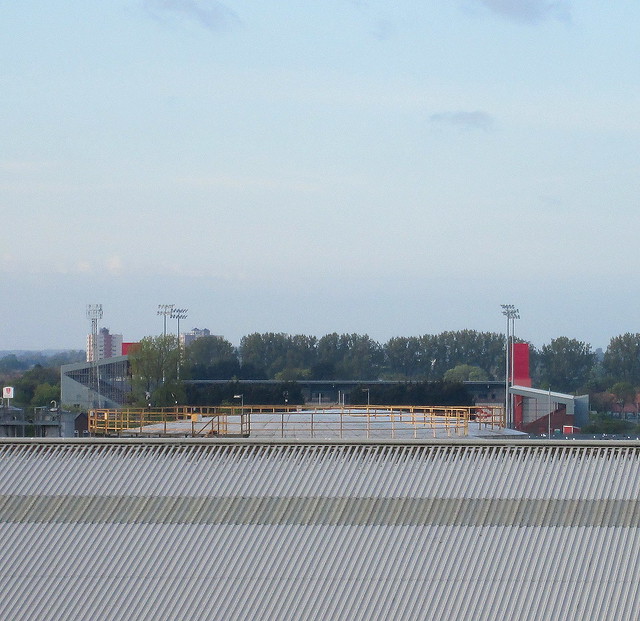
In this zoom shot the end S of “Rovers” can be seen on the far stand’s seats.
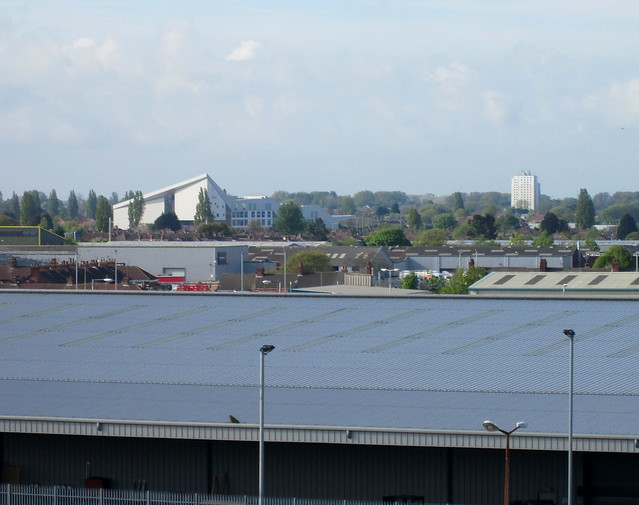
Some modern architecture in Hull:-
No Comments »
Posted in Architecture, History, Museums, Trips, War Memorials at 12:00 on 9 November 2016
With the possible exception of Saint Martin’s Cathedral, the Cloth Hall (Lakenhalle) is the most imposing building in the city of Ypres (Ieper) in Flanders, Belgium. (The cathedral’s spire can be seen to the rear.)
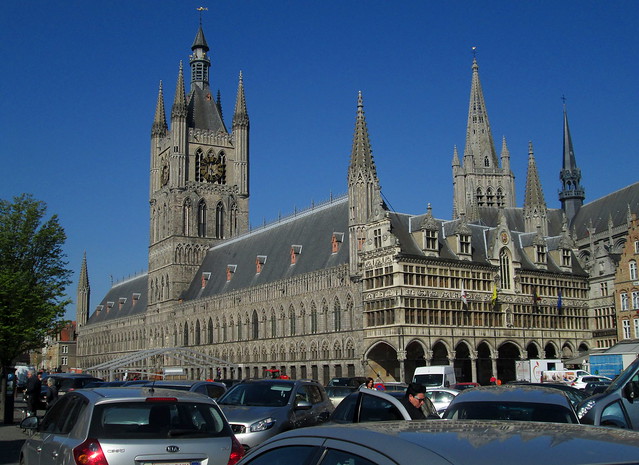
The mediæval Cloth Hall was all but totally destroyed by shelling during the Great War but lovingly restored in the years after.
There is now a lovely fountain in the paving at the front of the Hall.

Flanking one of the doors to the Cloth Hall are two memorials. This one is to the French soldiers who died in defence of Ypres during the Great War:-

And this commemorates the liberation of Ypres by Polish troops in 1944:-

The Cloth Hall now houses In Flanders Fields Museum, formerly the Ypres Salient Memorial Museum:-

No Comments »
Posted in War Graves, War Memorials at 12:00 on 19 July 2016
Just outside the town of Langemark (formerly Langemarck) in the municipality of Langemark-Poelkapelle, West Flanders, Belgium, lies a German War Cemetery which contains the bodies of more than 44,000 soldiers including the German air ace Werner Voss and two British soldiers who died in 1918. Many of the smaller German war cemeteries in this part of Belgium were consolidated into larger ones such as Langemark in the 1950s.
Langemarck village (as it was then) was the site of the first German gas attack in April 1915.
Stone by Langemark War Cemetery entrance. The five crosses design is the motif of the Volksbund Deutsche Kriegsgräberfürsorge, the German war graves commission:-

Langemark War Cemetery Entrance:-

Volksbund plaque inside entrance building:-

This basalt cross is at the cemetery’s corner by the path from the car park to the entrance. Blockhouses can be seen in the cemetery’s interior:-

Blockhouses and graves from cemetery exterior:-

On a series of basalt blocks in the area just behind the cemetery’s entrance are engraved the names of those known soldiers who are buried in the mass grave here, known as the Comrade’s Grave (Kameraden Grab.) The plaque on this first one commemorates British Privates A Carlisle, Loyal North Lancs Regiment and L H Lockley, Seaforth Highlanders:-
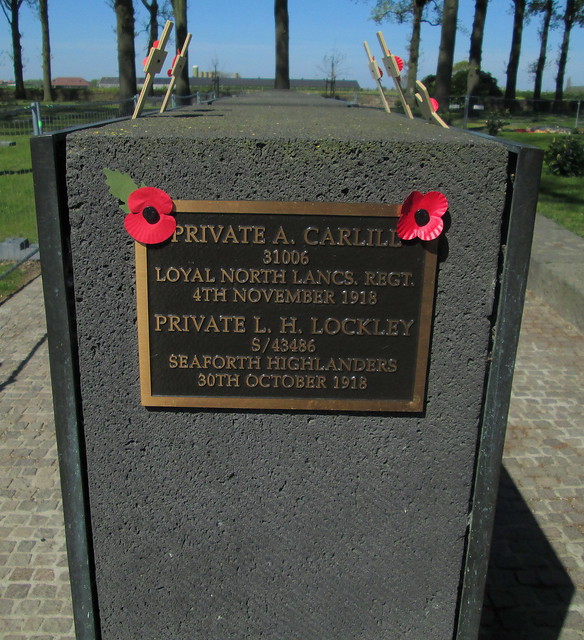
Names of some of the known soldiers in the Kameraden Grab. There are 68 bronze panels of these names:-

Langemark War Cemetery, Statues. When we visited this grouping was set behind the entrance building though previously it had been moved from there to the cemetery’s rear boundary. It was designed by Emil Krieger who gained his inspiration from a photograph of mourning German soldiers taken in 1918:-

No Comments »
Posted in War Graves, War Memorials at 12:00 on 5 July 2016
The cemetery is in numbers of burials now the largest Commonwealth war cemetery in the world. It is located 9 km north-east of Ypres (Ieper) town centre, on the Tynecotstraat, a road leading from the Zonnebeekseweg. Its name derives from the nickname (Tyne Cottage) given to a German blockhouse by the Northumberland Fusiliers.
11,962 Commonwealth servicemen of the First World War are buried or commemorated in Tyne Cot Cemetery. 8,374 are unidentified. In addition there are four German dead only one of whose identities is known.
Entrance:-
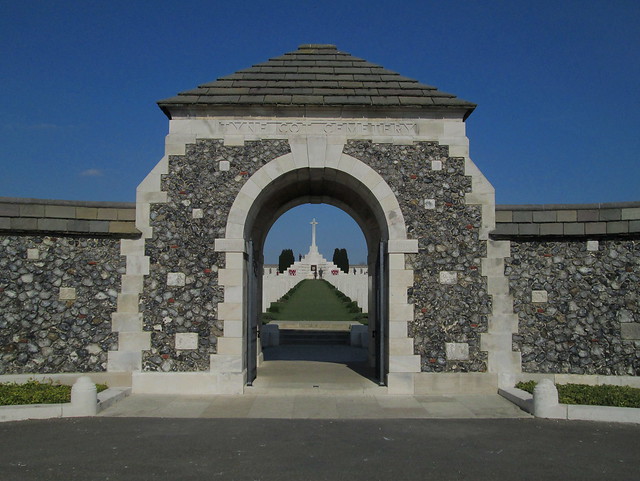
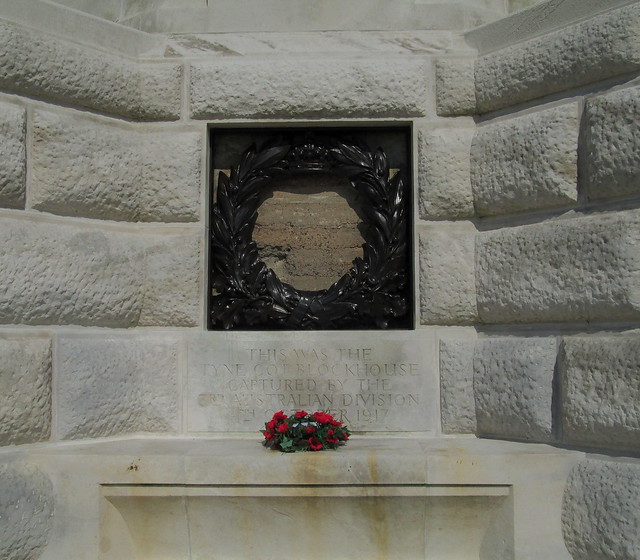
It was said to be the idea of King George V, who visited the cemetery in 1922, to erect the cross above the remains of a German pill box at the centre of the cemetery, a remnant of which was left uncovered by the white stone (centre here):-
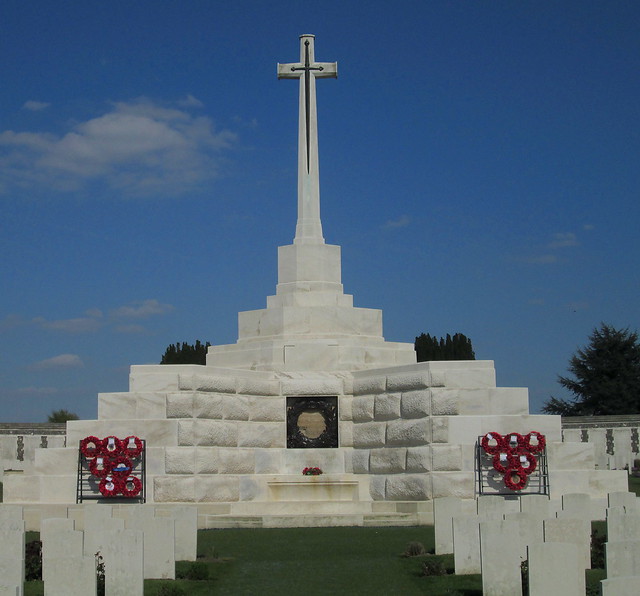
Remnant of pillbox. The inscription reads, “This was the Tyne Cot Blockhouse captured by the Australian Division 4th October 1917:-
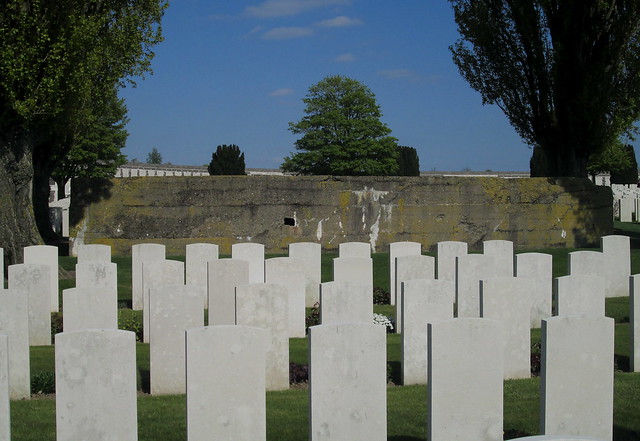
A further blockhouse incorporated into the cemetery is surrounded by graves:-
Central area:-
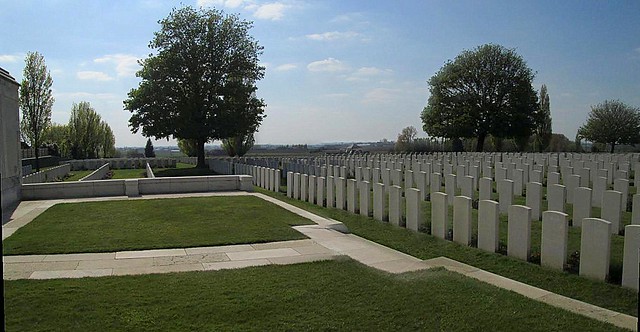
Cemetery from North-west corner:-
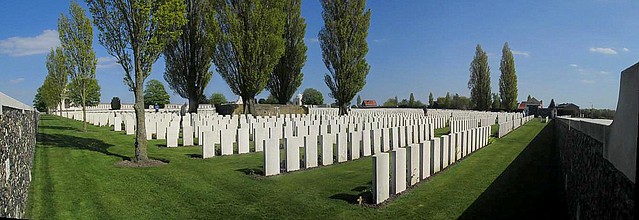
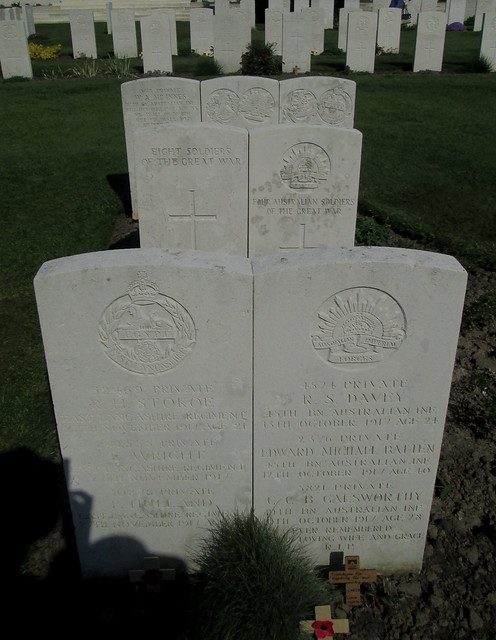
Graves containing the remains of several men:-
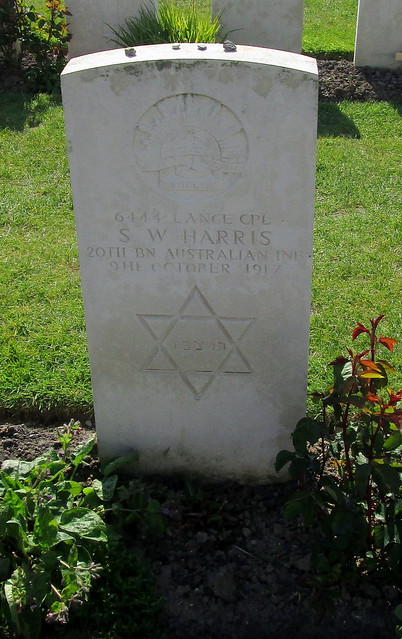
A Jewish grave. It is unusual for a Commonwealth War Grave stone to indicate a religion:-
No Comments »
Posted in Trips, War Graves, War Memorials at 19:55 on 15 May 2016
My most recent posts have been rather focused on photographs. This is because I’ve been away. Myself and the good lady have been in The Netherlands again and this time also in Belgium.
We drove down through England (and back up again) to and from the ferry and through the Netherlands and Belgium top to bottom and back. I’m a bit knackered.
But…… I have seen Ypres (nowadays spelled Ieper) and the Menin Gate where we witnessed the nightly Last Post. We walked along the Menin Road, a place I had only ever read about or seen in photographs in a shell shattered state, passing Hellfire Corner on the way.
The hotel we stayed in was right beside the Hooghe Crater and across the Menin Road from the Hooge Crater Commonwealth War Cemetery (note the British spelling.) Right by the hotel there was an open air Great War Museum which encompassed the crater and some trench remnants. The Front Line straddled that part of the Menin Road from 1915-1917. Hooghe was where the first use of flame throwers in a concerted action took place when the Germans made an attack on July 30th 1915. The trenches were apparently only 4.5 metres (4.9 yards) apart there. The flamethrower’s maximum range was 18 metres (20 yards.)
Strange to think I slept only a few more metres away from the spot. It’s all so peaceful there now but reminders of that war are everywhere as the area is covered in War Cemeteries and Memorial sites – too many for us to visit them all.
No Comments »
Posted in Events dear boy. Events at 19:47 on 29 November 2015
No not Judi.
They were hyping it as the World Cup of tennis – and Great Britain won it for the first time in 79 years this afternoon.
Well I say Great Britain….
I don’t wish to minimise the efforts and input of team coach Leon Smith and the other players who contributed to elevating GB to the highest level of team tennis but in reality this was a triumph for a small town in Scotland (Dunblane beats the world!) – and more especially for one family.
I know some would say the very best players apart from one A. Murray had sat this year out and that it was only Belgium who stood in the way today but Belgium had made it to the final and had home advantage. Anyway as the old football cliché has it you can only beat what’s in front of you.
Really though, a win for the first time in 79 years speaks for itself.
Arguably the lioness’s share of the glory belongs to one woman, Judy Murray. Dame Judy, anyone?
No Comments »
Posted in BBC, History, Radio 2 at 23:00 on 4 August 2014
One hundred years ago today, at midnight Central European Time, the event that shaped the twentieth century came into being. Or at least the British Empire’s participation in it began.
Germany had invaded Belgium that morning so we were a bit late. (A squad of Germans had invaded Belgium the previous evening but had jumped the gun – so to speak – not getting the delaying telegram in time and were recalled. They were soon back though.)
Yet those were not the first shots. Hostilities had started seven days earlier on 28th July when Austro-Hungarian troops opened fire on Serbia in response to the true first shots – the ones fired by Gavrilo Princip and which killed Archduke Franz Ferdinand of Austria and his wife Sophie but even those had their roots in the welter of national entanglements which plague the Balkans even yet.
Those entanglements were mirrored in the system of alliances that dictated that Germany had to attempt to defeat France first before swinging round to take on Russia and so necessitated a march through neutral Luxembourg and Belgium.
Ironies abounded. Without attacking Belgium, Germany might have avoided war with Britain and so the holding up of the German armies by the BEF at Mons and later the Allies at the battle of the Marne might not have succeeded and so gained Germany the victory in the west it desired. Russia managed to invade eastern Germany earlier than the Germans had anticipated and troops were hurriedly withdrawn fron the Western Front to face the threat which I believe was actually defeated at the Battles of Tannenberg and the Masurian Lakes before these reinforcements could get there.
The Great War is remembered for the bloody stalemate of the trenches yet in these first encounters when it was still a war of movement daily casualties were enormous – especially for the French – much higher than in most later battles; though the Somme has a grim reputation in Britain.
I heard a woman on BBC Radio 2’s Pause for Thought this morning say she refused to call it the Great War “as there was nothing great about it.” Wrong meaning of great I’m afraid.
No Comments »
Posted in Scotland, World Cup at 21:58 on 7 September 2013
FIFA World Cup Qualifier: Europe, Group A, Hampden Park, 6/9/13.
Nobody really expected Scotland to get a result out of this and so it transpired.
I only saw the highlights and it looked as if Belgium did not have to reach top gear. Even so, Scotland did well to restrict them to as few attempts on goal as they got.
Belgium are an impressive side. Whether they are impressive enough to go all the way in Brazil next year is another matter.
Bottom of the group again. With only two games left we really need a win on Tuesday in Macedonia to have any hope of avoiding that spot at the end of the qualifiers.
No Comments »
Posted in Scotland at 22:00 on 7 February 2013
International Friendly, Pittodrie Stadium, 6/2/13
I suppose we should be grateful for small mercies. A win’s a win after all – and those were difficult to come by under Craig Levein.
The highlights didn’t look very exciting and a poor pitch didn’t help. The goal came from a set piece – which is how we’ll have to hope to score against the likes of Belgium and Croatia – and Allan McGregor saved the jerseys at one point.
Gordon Strachan’s mood music is brighter than Levein’s, he’ll most likely play in a more attacking style. The players might take heart from it.
It was only Estonia (no mugs, but also no great football power) but a clean sheet is always welcome.
We also have a few players in England’s top level, not something that could be said for a while.
It’s still going to be an uphill struggle to get a decent draw in the next European Championship.
No Comments »
