Archives » Andrew Crumey

The Secret Knowledge by Andrew Crumey

Dedalus, 2013, 234 p.

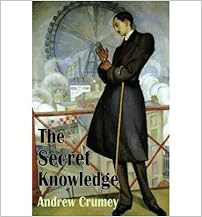
The Secret Knowledge cover

In The Secret Knowledge Andrew Crumey has done something out of the ordinary. He has illustrated a corollary of the Schrödinger’s cat scenario – the possibility of multiple worlds – in a piece of fiction written in realistic terms. His characters discuss the possibilities but in the text it is never really spelled out that different scenes take place in different worlds. We must infer it from the narrative. Utilising the concepts of quantum physics in a literary form has always been one of Crumey’s concerns, though, and here he also returns to another of his familiar themes, music.

The chapters alternate between the historical and the present day starting in Paris in 1913 where composer Pierre Klauer has just completed a piano piece (entitled Le Savoir Secret, hence – in part – our novel’s title,) has also just proposed to his girlfriend Yvette but kills himself (off-stage) moments later. In our time, Paige, a student of piano, has just been assigned the tutelage of part-time concert performer David Conroy after giving up a course in English because she loves music more. Conroy gives to her to play a manuscript that has just come into his possession. A manuscript written by an unknown French composer and entitled The Secret Knowledge.

We then go back to 1919 just prior to the “Battle of George Square” in Glasgow where a newly arrived young French man befriends socialist John Quinn outside an Engineering Works. The Frenchman stirs up a meeting and is of course named Pierre Klauer. So. Did Klauer actually die in 1913, or not? (According to one Schrödinger outcome it can be both – or neither.) There follows a narrative which skips between the doings of Conroy and Paige, Yvette (who marries Klauer’s friend Louis Carreau,) to 1924 where Theodor Adorno meets a man who introduces himself as Klauer, Spain in 1940 where Carreau – who had stolen Klauer’s manuscript for Yvette – has an encounter with the philosopher Walter Benjamin who then kills himself in the belief he will be returned to France and the Nazis, and 1941 where Adorno meets Hannah Arendt. During these the same scene may be returned to but is shown to be subtly different.

But as Conroy says, “Art is always inconsistent,” and, “Truth is not something we discover consciously; it discovers us.” He also muses on his disappeared wife, “It’s only when they surprise you that you find out your ignorance. We expect continuity, not paradox.” About a part of Le Savoir Secret he feels, “this section is the dream of how things might otherwise have been, a path denied.”

In a passage which could be all about the writer’s art we have, “‘A performer knows all about the tricks of persuasion. Yes, the game was rigged, you were always meant to lose, but go on, take a card, see what you get.’” One of the characters conceives a future project, “a book of fragments, epigrammatic, or even surreal in character, apparent irrelevancies serving to create new, unintended meaning,” a book which, presumably, Crumey intended us to be reading in The Secret Knowledge.

Other notable pieces of dialogue include, “Lenin has” (succeeded) “in Russia. Make everyone think it’s a popular revolution when really it’s a coup: that’s genius.” Mention is made too of Louis Auguste Blanqui and the Mechanical Turk – which has seemed to crop up a lot recently in the books I have read.

Not the simplest of narratives then but immensely readable just the same. The actual secret of Klauer’s manuscript is not quite the tremendous revelation we might have hoped for though. Crumey here hasn’t quite achieved the heights he did in previous novels but The Secret Knowledge is still a remarkable rendering of quantum physics in the form of an accessible piece of fiction.

Pedant’s corner:- “he no longer tours, or records” (nor records,) Louis’ (Louis’s,) “the roll of a dice” (one of them is a die.) “The family she saw are gliding over the top” (the family is gliding.) Crumey is a serial offender here – “the family were” (the family was,) “around its upper balcony stand a crowd” (stands a crowd,) “a young couple huddle in one corner” (a couple huddles.)
Read Scotland 2014 Overview

Twelve months gone and 29 books “Scottish” books read. (Or 30 if The Member and The Radical count as two; then again perhaps only 27 if A Scots Quair is treated as a single book.) That’s 2½ per month, give or take. And, if you discount the exceptions already mentioned, not a repeat author in the list.

2 were non-fiction; 4 outright SF/Fantasy; 18 were written by men (20 if the trilogy is separated) and 9 by women. (That gender disparity is lessened by 50% if you consider only authors still alive in 2014, though.)

I’m pleased to have caught up with John Galt and have already bought two more of his novels, delighted to have read A Scots Quair at last, made acquaintance with William Graham, Neil M Gunn, Carole Johnstone, Jackie Kay, Agnes Owens, Muriel Spark and Alan Spence and refound Naomi Mitchison. My main discovery, though, was Andrew Greig whose That Summer is the best book by a writer new to me (Scottish or not) since I first encountered Andrew Crumey.

My review of Kate Atkinson’s Life After Life is still to appear. See later this week, or even tomorrow.

There is apparently a Read Scotland Challenge 2015. I don’t think I’ll make 29 this year. I’ve got a lot of other reading to catch up on.

2014 in Books Read

The ones that stick in my mind most – for whatever reason – are:-

Signs of Life by M John Harrison
Mr Mee by Andrew Crumey
Be My Enemy by Ian McDonald
The Deadman’s Pedal by Alan Warner
A Scots Quair by Lewis Grassic Gibbon – but in especial Sunset Song
The Moon King by Neil Williamson
The Dogs and the Wolves by Irène Némirovsky
The Last of the Vostyachs by Diego Marani
HHhH by Laurent Binet
That Summer by Andrew Greig
Roadside Picnic by Arkady and Boris Strugatsky
My Name is Red by Orhan Pamuk
Way to Go by Alan Spence

Four SF/Fantasy novels, six Scottish ones (eight if the trilogy is separated) and no less than five translated works.

Mr Mee by Andrew Crumey

Picador, 2000, 344 p.

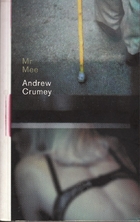
Mr Mee cover

Mr Mee bears several Crumey hallmarks; explanations of concepts from Physics (and, in this case, probability) in literary form, characters from the 18th century, ruminations on literature and philosophy. The narrative is triple stranded: that of Mr Mee himself, in the form of the eighty six year old’s letters to an old friend; the adventures of two Frenchmen, “the Gossips,” Ferrand and Minard, who meet Jean-Jacques Rousseau and precipitate his flight from France; and the meanderings of academic Dr Petrie whose main research interest is those same two Frenchmen. The epilogue introduces a fourth narrator who once installed a Théâtrophone in the bedridden Marcel Proust’s apartment. It casts further light on the preceding stories and has the potential to alter the reader’s perceptions of them, though is perhaps a little too eager to drop in literary allusions.

The unworldly Mr Mee, stuck in his ways and almost drowning in a sea of books, is prompted by his housekeeper, Mrs B, to discover that the worlds of literature and philosophy are available through the less space consuming medium of the PC and the internet. What he finds there intrigues him – and shocks Mrs B into leaving abruptly. His old fashioned attitudes to modern life and his misunderstandings are a source of light humour (“those nice folk at Dixons,” the joys of live video links – a bus stop in Aberdeen and a naked girl reading a book which is of course Dr Petrie’s on Ferrand and Minard, the “sensational and sentimental” fare that passes for Scottish literature in a modern bookshop) unusual in Crumey’s work. His encounter with practical and capable life scientist student Catriona leads the unmarried (and sexual ingénu) Mr Mee to new experiences.

Ferrand and Minard are copyists, whose latest project regarding a new understanding of how the world works is stolen from their flat and whose downstairs neighbour has been murdered. Fearing the blame for the killing they flee to Montmorency, come under the protection of a Bishop Bertier and end up living next door to Rousseau who is said to think the world would be a much better place without books.

Dr Petrie has been captivated by the sexual possibilities involved in his tutoring of a mature (twenty four year old) student called Louisa and imagines his disease symptoms are a reflection of his attraction to her. He believes Ferrand and Minard to have been invented by Rousseau whose Confessions he says are as much a fiction as was the novel Émile.

The text contains a lot of literary reference; not just to Rousseau and Proust but to mechanical poetry and the pitfalls of attributing what happens in a novel to autobiography, (“a person called ‘I’ who is not necessarily oneself.”) Other aperçus include, “the moment in which we live, like the self we inhabit, is the one we are least equipped to understand,” “when faced with an unfamiliar situation, we play the part as best we can; and our scripts come to us from many places,” the contention that “all men write for sex,” and the observation that “out of character” simply means unexpectedly. (Compare Allan Massie.)

Mr Mee is a kind of companion piece to D’Alembert’s Principle; some of that books preoccupations reappear – we hear again of D’Alembert and Diderot and their Encyclopédie – and there is a sly reference to the contents of Crumey’s earlier book Pƒitz. Dr Petrie tells Louisa that “Rousseau’s novel, like Proust’s, is intimately concerned with the nature of writing.” So, too, is Crumey’s, an engagement with what a novel is, or can be, the uses to which fiction can be put and an examination of the ways in which texts can be interpreted. While the book can be read solely for the stories contained within it these other aspects for me add value, elevate it beyond the level of just a novel but, curiously in such a well-crafted literary piece of work, we twice had “chord” for “cord,” even if I was also grateful to be introduced to the useful word “anacoluthon” (lack of syntactical agreement of the latter part of a sentence with the former.)

I had some misgivings about the way Mr Mee’s relationship with Catriona develops. She is depicted as being in control throughout (indeed she is by far the more knowing of the two, about modern life as well as in a sexual sense) but still. However, yet again Crumey has written an intriguing novel, well worth anyone’s attention.

Projected New Year Reading

Happy New Year everyone.

As I mentioned before the good lady suggested I should take part in her blog friend Peggy Ann’s Read Scotland Challenge. This post is about what I intend to read. (Whether I will actually get around to it all is another matter. There is the small matter of a review for Interzone to be got out of the way as a first priority and other reading to be done.)

When it came up I looked on this project partly as a chance to catch up on Scottish classics I have so far missed. In the frame then is Lewis Grassic Gibbon’s A Scots Quair trilogy – I have read most of his œuvre but not this, his most well-known work. The televison series made of it in the 1970s has been in my memory for a long time, though. I also have his Persian Dawns, Egyptian Nights in my tbr pile and a collection of shorter pieces under the title Smeddum many of which I have already read. I have not managed to source his The Calends of Cairo and doubtless if I did it would be horribly expensive.

Another Scottish classic I haven’t read is J MacDougall Hay’s Gillespie, which lies on my desk as I write this but, according to Alasdair Gray, has the “worst first chapter that ever introduced a novel worth reading.” I consider myself warned.

If I can get hold of a copy then John Galt’s The Member and the Radical will go on the list.

As far as modern stuff is concerned there are multiple novels by Christopher Brookmyre and Allan Massie on my shelves and as yet unread, two by Alan Warner, Andrew Crumey’s Mr Mee and James Robertson’s latest The Professor of Truth.

Plenty to be going on with.

We’ll see how it goes.

Goodbye 2012

I don’t usually do end of year round-ups – mostly because most folk write theirs before Christmas and that offends my sensibilities. The year ends on 31st Dec, not before.
Whatever, I looked through all the fiction books I read this year and found twelve that stood out. In order of reading they were:-

PfITZ by Andrew Crumey
Zoo City by Lauren Beukes
The Master and Margarita by Mikhail Bulgakov
The Song of Achilles by Madeline Miller
The Kings of Eternity by Eric Brown
the Tiger’s Wife by Téa Obreht
And The Land Lay Still by James Robertson
The Museum of Innocence by Orhan Pamuk
Redemption in Indigo by Karen Lord
New Model Army by Adam Roberts
Galileo’s Dream by Kim Stanley Robinson
D’Alembert’s Principle by Andrew Crumey

That’s four by women and eight by men, which is a pretty high strike rate for the distaff side compared to my fiction reading as a whole, 12:45 – is that shockingly low or a reflection of publishing? Four were SF, eight not; though that ratio alters if you count the fantastical – the Lord, the Obreht, the Bulgakov, and the Crumeys which feature stories from a city made up within one of the two. Only the Robertson and the Pamuk lie wholly within the realm of the naturalistic.

I don’t propose to rank the twelve in any way.

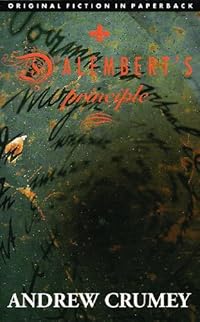
D’Alembert’s Principle by Andrew Crumey

Memory, Reason and Imagination. Dedalus, 1996, 203p.

How to describe this extraordinary book? At one extreme it’s a triptych, at the other it’s three totally different narratives shoe-horned between one set of covers. The first, D’Alembert’s Principle, mixes the confessional with traditional third person and the epistolary to tell the story of Jean le Rond D’Alembert, a mathematician who studied the laws of motion and, along with Diderot, edited the Encyclopédie. The second is a Vernesque fantasy, The Cosmography of Magnus Ferguson, a work with echoes in its feel of David Lindsay’s A Voyage to Arcturus. The third is called Tales from Rreinnstadt and features the character Pfitz from Crumey’s previous novel of that title.

Three different tales, the first a beautiful evocation of D’Alembert’s life and love and whose three types of narration shouldn’€t work in combination yet somehow do regardless, the second the conjunction of an imaginary travelogue through the then known (18th century) planets of the Solar System and the story of a man who seems to inhabit a sequel to a tale he has been reading about someone with his own name, the third a series of stories within stories within stories told by a character invented by the narrator of another book entirely (a book moreover which exists entirely outwith the covers of the one being read,) all reflecting on each other and on the nature of existence. Not for nothing is the sub-title of the overall D’Alembert’s Principle, Memory, Reason and Imagination. Yet reading it is never a chore, nor difficult. The prose flows as smoothly as anyone could wish.

Crumey manages in his fiction to use scientific concepts as metaphors without these seeming forced and to illustrate quantum mechanical ideas about the nature of reality in novelistic form, expressing them entirely naturally. (Or is it just that, as a scientist myself, these seem unexceptional?)

D’Alembert’s Principle is 203 pages of virtuosity and skill. The Introduction by John Clute – which, in case of spoilers, I took care not to read till after the novel itself – describes it as astonishing. Well, only if you have not read other novels by Crumey. This is the fifth of his novels I have read and they are, without exception, excellent.

The Accidental by Ali Smith

Penguin, 2007, 306p

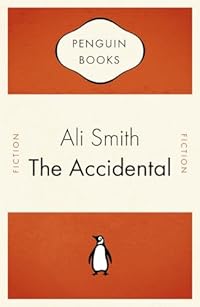
The Accidental cover

Reasonably successful writer Eve Smart, her philandering lecturer husband Michael and their family are renting a house in Norfolk when they are intruded upon by a female stranger called Amber, who proceeds to inveigle her way into their home, befriend Eve’s twelve year old daughter Astrid and seduce her teenage son Magnus.

The novel is split into three sections, The Beginning, The Middle and The End in all of which each family member has a narrative strand. Astrid’s narration is initially irritating as she has a habit of using ie (or even id est) in circumstances which do not warrant it. Thankfully, she – or Smith as the author – grows out of this by The End. Each section is preceded, and hence followed, by a framing narrative in the first person from Amber’s viewpoint. (This does not illumine Amber’s behaviour overmuch.) The unravelling of the Smart family’s life under Amber’s influence is the meat of the book.

There are several infelicities. Not only are a couple of characters unsympathetic but the changes of viewpoint initially jar and for a long time the lack of justification in the text irritated me. The ragged right hand margin was too much of a distraction. By The End, though, the characters (apart from Amber) are more established and these concerns fade.

I noticed that the “cloud” on my Library Thing tags this novel as Scottish Fiction. (According to the book’s blurb Smith was born in Inverness in 1962 but now lives in Cambridge.) Fantastic Fiction also designates her as Scottish. There is nothing identifiably Scottish about The Accidental, though; not its setting, its themes, its dialogue nor its vocabulary. Mind you, the same could be said about Allan Massie’s The Sins of the Father or Andrew Crumey’s Music, In a Foreign Language both of which I read recently. Interestingly enough, Library Thing has those two books tagged as Scottish Literature.

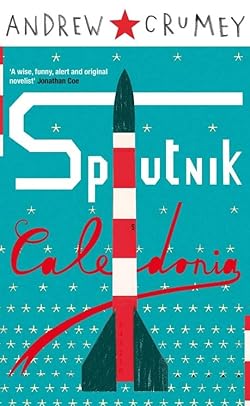
Sputnik Caledonia by Andrew Crumey

Picador, 2008. 553 p.

In the first part of the novel a shy boy called Robbie Coyle is growing up in a village called Kenzie in 1960s Scotland with the ambition of going into space. Since his father is an ardent socialist and anti-American Robbie therefore wants to be a cosmonaut. A frequent attender at his local library, he devours knowledge about the Soviet Union and discovers that “Russian is a language where some letters are written back to front and others are completely made up.” Quotes such as this display Crumey’s excellent ability to inhabit the world of a pre-adolescent. As he matures he starts to hear a voice in his head. The section ends with that voice saying, “I guess we’re not in Kenzie any more.”

The story then flips into a scenario of a Soviet-style Britain where a young adult Robert Coyle has been recruited into a space project to reach, before the wicked capitalists do so, what is possibly a black hole travelling through the solar system. The secret “Installation” where Robert is in training is suitably grim, the illustrations of the many compromises people have to make in such a society convincing, though whether dissidents could flourish there is another question. Perhaps this exists in the same British Democratic Republic which featured in the author’s Mobius Dick.

This central section could be considered an Altered History novel where the Jonbar Hinge lies in whether or not a man named Deuchar died while trying to rescue twins from drowning many years before the time the action is set. Yet its juxtaposition with the preceding and following parts, set in the “real” world, argues against this. And Crumey’s treatment of his subject matter does not have the feel of SF. The Soviet section can be read to be implicitly a figment of Robbie’s imagination. The subtlety of the point of divergence also marks this out from SF treatments of Altered Worlds. While Crumey pushes credibility a little by having characters in the central section behave and speak, or have the same names as, those in the book-end segments he does certainly avoid the trap into which Philip Roth fell in The Plot Against America of restoring the altered world to normal by the end.

The coda, a (present day?) exploration of the situation of Robbie’s ageing parents and a young boy who meets a mysterious stranger on a mission (which he is unwilling to explain) provides counterpoint and a resolution of sorts.

Sputnik Caledonia is excellently written and engaging, with convincing characters, but not quite as full of verve as Mobius Dick. I will look out for more Crumey, though.

Mobius Dick by Andrew Crumey

Picador, 2004, 312p

This book was not marketed as Science Fiction but in any straightforward reading of the term would be so, as it is fiction about Science, specifically quantum mechanics and wave functions. Science Fiction as understood, though, is not generally thought of in this light but rather as extrapolative. However, Mobius Dick fits the bill in this sense also, as its background involves a set of experiments to produce a vacuum array which can generate energies in excess of 1000 Eka-electronvolts which could lead to wave functions not collapsing on being observed and the end of the world as we know it. Fear not if you know nothing about the behaviour of subatomic particles, the necessary details are lucidly set out by Crumey in the appropriate places. (Or did I just find it lucid because I had encountered most of these ideas already? Studied them, even, when a student.)

The narrative is multi-stranded, beginning with an enigmatic text message to a physicist, John Ringer, reminding him of a lost love. Another strand is set in a hospital where patients are being treated for Anomalous Memory Disorder, AMD, a condition in which they appear to have false memories. A third contains extracts from a book by a certain “Heinrich Behring” but which is copyrighted “the British Democratic Republic 1954” and which focuses on Erwin Schrödinger. An Altered History too, then.

It is, as well, a consciously literary endeavour featuring in addition to the above; Bettina von Arnim, the composer Schuman and a letter from an unsuccessful Herman Melville to Nathaniel Hawthorne. No surprise it’s not marketed as Science Fiction. The John Ringer sections are Ballardian in tone and when he ventures into rural Scotland also have a tint of the testament of Gideon Mack, which I reviewed recently.

Crumey never pushes the connections between the sections. We are left to ourselves to infer that AMD is a manifestation of superimposed quantum states and the many worlds of uncollapsed wave functions. The characters, on opening doors etc, by and large treat any incursions into or from other worlds as if they are hallucinations, which interpretation is also entirely adequate.

The afterword, also by “Heinrich Behring,” like the sections featuring Schrödinger and Schumann, is written from the perspective of a world where Goebbels replaced Hitler, Britain was invaded but after liberation became a socialist/communist state and neither Melville nor Thomas Mann achieved critical acclaim. “Behring” depicts Schrödinger – who never amounted to much in this altered history – finding his famous (in our world) equation HΨ = EΨ in the scribblings of a madwoman.

What makes Mobius Dick ineluctably Science Fiction (whether it is labelled as such or not) is this looking in at our world, where a woman can become Britain’s PM, an actor President of the US and the many worlds theory is taken seriously, and finding it absurd.

But to label the book at all is to do it an injustice. It hums with ideas and wit, and not a few literary puns.

I haven’t been so impressed by an author new to me for a long time.

free hit counter script