Archives » Science Fiction

Shoreline of Infinity 11½: Edinburgh International Science Festival 2018

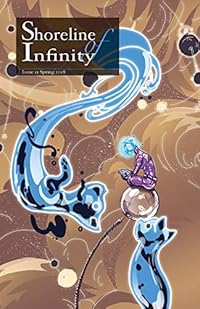
Shoreline of Infinity 11½ cover

In “Pull up a Log” editor Noel Chidwick puts the case for SF as a way to fulfil the question, “Can Science Fiction save us?” posed as the title of the spoken word Event Horizon the magazine was invited by the International Science Festival to put on in connection with the festival.

Some of the contents have appeared in previous issues. Charlie: A Projecting Prestidigitator by Megan Neumann and the poem The Morlock’s Arms by Ken McLeod appeared in Shoreline of Infinity (SoI) 2, We Have Magnetic Trees by Iain Maloney, Pigeon by Guy Stewart and the poem South by Marge Simon in SoI 3, Goodnight New York, New York by Victoria Zevlin and the poem Starscape by J S Watts in SoI 6, Message in a Bottle by Davyne DeSye in SoI 7, the poem Spring Offensive by Colin McGuire in SoI 8, while The Sky is Alive by Michael F Russell, The Last Days of the Lotus Eaters by Leigh Harlen and the poem the evening after by Peter Roberts in SoI 9.

We start with the poem Can Sci-Fi Save Us? by Jane Yolen and then the fiction kicks off with A Cure for Homesickness by Anne Charnock in which a contract employee ponders whether to extend her time.
Winter in the Vivarium1 by Tim Major is set in a future ice age. Ice statues suddenly start to appear outside the Vivarium for the rich and privileged whose upkeep is seen to by viewpoint character, the much less privileged Byron.
Charlie’s Ant2 by Adrian Tchaikovsky is about the dispute between Central Control and the ants of Charlie field over how maintain a farm’s production of grain. (Unbeknownst to both, the human society they were set up to service has broken down.)
In Candlemaker Row3 by Jane Alexander an unspecified disaster has hit Edinburgh. Our narrator is a woman who once lived there, now employed to verify its digital reconstruction – especially its aromas.
The titular Mémé of Juliana Rew’s story is one of the few survivors of her age group left after a flu epidemic wiped out older people. She becomes venerated and an influencer.
Monoliths4 by Paul McAuley looks to have been inspired by 2001: A Space Odyssey and the phenomenon of crop circles. Set in the author’s Quiet War universe three conspirators contrive to build a monolith on the far side of the Moon. When touched it will activate a radio signal beamed at the galaxy’s centre. Thirty-six years later more such unattributed monoliths begin to spring up all over the Solar System.
In A Distant Honk by Holly Schofield, a research biologist is tracking the behaviour and habitat of the wild clown population, which is dying out.
The Day it all Ended5 by Charlie Jane Anders shows a worker for a producer of useless but made highly desirable items deciding to tell his boss where to stuff it all only to find that was what the company had been waiting for to put into effect its real plan.
The narrator of Last of the Guerilla Gardeners6 by David L Clements is exactly that. Big agribusiness corporations have taken over seed distribution with only a dedicated few guerrilla gardeners left to scatter wild seed about. And there has been a crackdown on them. This story does for plants what Number Ten Q Street did for food.
This is followed by the poem: Now a Ragged Breeze by Jane Yolen.
Then in “Working the High Steel”7 by Jennifer R Povey, Malisse is a female Mohawk used to being told to get back to the reservation. But she is a construction worker, on a kind of space elevator. The finished project is being tested when one of the transit pods hits a problem. She goes out to try to fix it. After all, “‘Mohawks don’t fall.’”
The Rest is Speculation8 by Eric Brown is set over two million years in the future when representatives of all the sentient species which have populated Earth are brought to witness the planet’s last moments. The story nods to James Blish’s Surface Tension.

Pedant’s corner:- 1“Bryan dropped down from gantry” (from the gantry,) “the ha-ha that obstructed views of the town” (obscured is more usual,) jerry-rig (jury-rig.) 2Despite the author being British we have fit as a past tense (fitted,) “sufficient to even take the ants aback” (since this was about the ants’ attitudes this should be ‘sufficient to take even the ants aback,’) “I have had to considerable increase” (considerably.) 3“the skin team are working on it” (strictly ‘the skin team is working on it’,) “the Nor” Loch” (x2, Nor’ requires only an inverted comma, not an end quotation mark.) “Architects drawings” (strictly, Architects’.) “His team have been running behind” (his team has been.) 4 “ratio of 1:4:9, the square of the first three integers” (the squares of the first three.) 5ne280ws (???) CO2 (CO2, x 3,) a missing comma before a piece of direct speech. 6lept (leapt,) unlisenced (unlicenced,) gardner (gardener.) 7two odd line breaks on page 147, “a 140-pound woman could not hold a 230- pound man” (either both, or neither, should have a space after the 140 or 230,) “ I don’t really see she could have stayed on when the passenger pod after it started moving’” (no ‘when’ required,) “‘when the pod is stationery’” (stationary.) 8“this lacunae in our memories” (lacunae is plural. Either ‘these lacunae’ or, ‘this lacuna’. The first would make more sense,) eyes-stalks (eye-stalks – unless the stocks had more than one eye each,) “‘And they?’ I Kamis asked?” (The ‘I’ is redundant.) “Time interval later” count; 2.

Interzone 281

 Beneath the World, A Sea cover
Interzone 281 cover

Lying on my doormat – among a whole load of other stuff – after I got back from holiday was the latest issue of Interzone, 281 by number.

I had thought that my review of The City in the Middle of the Night by Charlie Jane Anders was due in this one but it’s not there. I assume it will now appear in issue 282.

Also on my doormat (delivered via TTA Press) was Chris Beckett’s latest novel Beneath the World, A Sea. I suppose my review of that one will also appear in issue 282.

Summerland by Hannu Rajaniemi

Gollancz, 2018, 328 p.

I had scheduled this post to appear when I was away but for some reason only the title appeared. I’ve now binned that one. Here’s the full version.

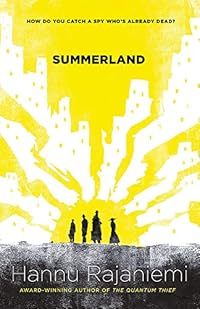
 Summerland cover

Rajaniemi’s first few novels were fairly dense narratives where not much concession by way of information dumping was made to the reader who in consequence was forced to do a bit of work in following their stories. As an approach this had its merits, as the rich, layered depths revealed themselves slowly and made for a more enriching read. By contrast Summerland has a more common narrative structure with no corresponding demands on the reader beyond suspension of disbelief. Given its timeline it could be classified as an Altered History but the milieu it depicts is really not one for which that description could fully apply being more sui generis.

Sometime towards the turn of the nineteenth and twentieth centuries radio experiments led to contact with the world of the dead. Now a whole system of communications – via ectophone and ectomail – exists between the realms, the Queen rules from what is called Summerland, the Great War was won with the aid of ghastly apparitions like the ectotank, but still a kind of cold war exists between Great Britain and the USSR. Transition between the realms (ie death) is mediated via Tickets which provide a destination for a departed soul. Without a Ticket a dead person is subject to Fading as their soul evaporates away. This will also happen even to those who had a Ticket unless sufficient suffusions of a substance known as vim occur.

The book is set over several months in late 1938 and January 1939. There is no Nazi threat but renegade from the USSR and its own Summerland god engine, Iosef Dzhugashvili, is fomenting trouble in Spain.

Rachel White is an operative of the British security services entrusted with the protection of a Soviet defector. After telling her of the existence of a mole called Peter Bloom, he blows his brains out. Her report of this revelation to her superior is greeted with dismissal, her gender being seen as making her an obvious target for an attempt to foment suspicion and distrust. Bloom, is, however, known to be close to the Prime Minister, Herbert Blanco West (whose mere name is enough to trigger associations in the reader even before we learn of his past as a draper’s apprentice who had dreams of Martian invasions and invisible men.) Similarly Rajaniemi has a bit of fun in slotting in the likes of Guy Burgess, Kim Philby and Anthony Blunt as minor characters in his tale.

The plot then consists of the usual kind of spy story albeit complicated with interferences from the spirit realm whose denizens can take over bodies in the “live” world on a kind of hire basis but also monitor the emotions of the undead, thus making it difficult to lie to them. The tale is however – unusually for a spy story – told from the viewpoint of the spy, Bloom, as well as the would-be spycatcher, Rachel.

The existence in the realm of the dead of shadowy entities called Cullers who will leap on any detected activity in the zone and pounce to ensure its inhabitants will Fade is not made much of in Summerland whose text is mainly Earth-bound and taken up with White’s efforts to prove Bloom is a spy. There is slightly more to Rajaniemi’s story than this but its appeal lies in the idea of a parallel world of the dead and its ability to interact with the ‘real’ world rather than the plot it contains.

Pedant’s corner:- I read an advanced reading copy so many of these may have been changed for final publication. “could really use a person of your calibre” (the British English for this is ‘could really do with’,) “desk a parking lot for memos” (again, ‘parking lot’ is not British English,) “lay low” (lie low,) “none of the security measures were enough” (none … was enough,) “there were a number of small glass vials” (there was a number,) “ we have a bloody mess in our hands” (on our hands,) a missing full stop at a sentence end (x2,) “she lunched with the junior staff with the canteen” (in the canteen,) “more spare time in my hands” (on my hands,) a missing start quotation mark, ”she managed slur the words” (to slur,) “in the in the” (one ‘in the’ too many,) prime minister (x2, Prime Minister,) “reached a crescendo” (a crescendo is a process, not a culmination; ‘reached a climax’, Crookes’ (Crookes’s,) “gift of gab” (gift of the gab,) “‘the benefit of doubt’” (the benefit of the doubt,) “I could use a little flattery’” (I could do with a little flattery,) “‘I just I can’t help you’” (an ‘I’ too many,) “a fearsome, feathered hat” (doesn’t need that comma,) “‘Say, do you see….’” (No English Oxford student would start a question with ‘Say’. ‘I say’, perhaps, but not ‘Say’,) “Peter let go of the drainpipe caught the roof’s edge” (and caught,) “‘you do this it a lot’” (no need for the ‘it’,) “folded his lanky frame into his bench in with great difficulty” (no ‘in’ required,) a missing end quotation mark, “the groans of the old coach” (‘the old couch’ makes more sense,) “times ten” (multiplied by ten,) “‘what are you going ty do next.’” (Is a question so needs a question mark rather than a full stop,) Djugashvili (x3, elsewhere Dzhugashvili,) “Leading up her bar exam” (up to her bar exam,) “‘setting up a meet’” (a meeting,) Symonds’ (Symonds’s,) “rode in their wake of as they pushed their way” (‘in their wake as they pushed’,) dove (dived. Please,) “‘I could, in fact, use some advice’” (I could, in fact, do with some advice,) Rache (elsewhere always Rachel,) “the men’s room” (the gents,) maw (it’s a stomach, not a mouth,) “the car’s hood” (the car’s bonnet,) “on a chair in cell” (in a cell.)

The Great Chain of Unbeing by Andrew Crumey

Dedalus, 2019, 335 p. Reviewed for Interzone 275, May-Jun 2018.

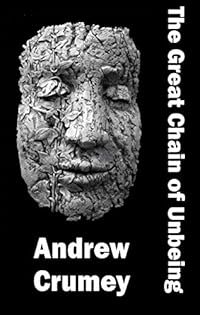
 The Great Chain of Unbeing cover

In his previous eight novels Crumey has constructed a strange niche for himself from his considerations of music, parallel worlds, imagined universes, the rendering of scientific concepts thought to be abstruse into accessible fictional form, all peopled with credible characters experiencing real human dilemmas. He is not beyond literary playfulness. Here we start with “The Unbeginning”, finish with “The Unending” and “The Introduction” comes as part three.

His latest novel is unconventional even in Crumey’s terms. It’s presented as a series of tales, which at first sight appear to have only the most tenuous of links between them (if any at all) yet on closer examination yield foreshadowings and echoes, subtle resonances – both with themselves and the rest of his oeuvre. We have a scene from the life of a man genetically blind due to his father’s exposure to H-bomb tests, a tale of mistaken identity on the international conference scene, an imagined interview, the thoughts of a lecturer undergoing a CT scan, how silk worms came to Europe, a man suspecting his wife of an affair, a fragment from a life of Beethoven, a young woman visiting her father on a Greek island after an abortion, the consciousness of a concert pianist who comes on like a hit man, the spying activities around the military secret that was early FM radio, a postman’s reminiscences, a lecture given by an insect, the story of The Burrows (a vast tunnelling project the length and breadth of Scotland) and the underground habitat which results, the invention of the word-camera which captures a scene and renders it in text, a woman bumping into someone she thought was dead (so reversing the previous collapse of her wave function,) a philosophical discussion of a Moslowski-Carlson machine to replicate Earth light years away, extracts from a truly awful SF novel inhabiting just that universe, a metaphor about the dangers of seeking fire.

They’re all beautifully written, pitch perfect to the milieux portrayed but also interspersed with a sly humour. “‘Bradley’s a real philosopher, incidentally, by which I mean a dead one,’” and in The Burrows section, “Some international medical authorities insisted that being starved of sunlight would cause long-term health problems but the Scots had been managing like that for centuries and it hadn’t done them any harm,” with ice-cream having a surprisingly prominent presence.

The text comments on itself, “A conventional novel or story collection is a sequence of parts in some predetermined order. We could of course read them any way we like,” and provides “layers of fiction”. Characters note variously a tendency to inconsistency, that imitation is the most fundamental human impulse, “‘We describe everything in terms of its similarity or difference compared to something else.’” That things aren’t what they seem or are described as being different to what they are. There are thoughts on a “past that wasn’t there,” “spurious influences”, “the night she didn’t have, with him instead of Matt. There is only now, she thought. Nothing else has any existence.” The five-second thrill of a life that never happened. The territory between being and non-being. One character says, “‘what neither of us can imagine is a universe without space and time,’” yet elsewhere we have, “‘Time is an appearance not a reality.’”

Despite “the interconnections by which the world is made a coherent whole,” even the most straightforward mainstream passages are saturated with subtle indeterminacies which it would be easy to overlook. Statements like, “‘You concentrate on that object…. visualise it as clearly as you can. Until it becomes no longer itself,’” or, “‘Alfredo Galli wanted to create a matrix of compositional elements through which numerous paths could be conceived, each a possible book with its own multiplicity of readings,’” and “History is an infinite superposition,” but “‘The universe is a circle…. A great chain of living and dying, giving and taking. Every moment is a link.’” “‘There is only one not many. No Difference, only Alike.’” Yet, “all literary style is really a kind of selection, a form of negation,” and “any path through the matrix of narrative possibilities should be a story not only scandalously disjointed but also inherently inconsistent: an appearance betraying its own unreality.”

What we have here is perhaps a literary expression of sonata form – “in the development the tunes get mixed up,” but with something to be discovered between the tones yet nevertheless totally accomplished.

The following did not appear in the published review.

Pedant’s corner:- jack-in-the-boxes (just sounds odd to me. But what is a more sensible plural? Jacks-in-the-box? Jacks-in-boxes? Jacks-in-the-boxes?) “The audience were applauding” (the audience was,) “All the burden of his father’s ambitions were lifted” (the burden was lifted,) liquified (liquefied; liquefy was used earlier,) “Ten Downing Street” (usually 10 Downing Street,) “the way his generation speak” (speaks,) Guttenberg (Gutenberg,) “umbilical chord” (that’s a cord,) “Marks and Spencers” (Marks and Spencer’s,) midgie (there is no such thing; it’s a midge,) CO2 (CO2,) a missing quotation mark at the end of a piece of direct speech.

Fifty-One by Chris Barnham

Filles Vertes Publishing, 2018, 317 p. Reviewed for Interzone 275, May-Jun 2018.

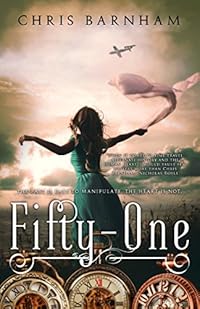
 Fifty-One cover

This novel is centred on the explosion of a V-1 Flying Bomb in Lewisham, London, in 1944 where fifty-one people were killed, hence the book’s title. It also features time travel in a way which has unavoidably noticeable echoes of Connie Willis’s “Oxford” series of tales but is in some respects better plotted and certainly not so prone to the narrative deferral to which Willis seems so wedded. Do not be put off by the book’s cover, which admittedly does have a doodlebug on it, but otherwise conveys a misleading impression of the contents. There is an element of romance here and it drives part of the plot but it is by no means the narrative’s main concern.

In the early 2020s experiments at CERN led by one Axel Darnell showed certain particles to be travelling back in time. Soon (too soon?) this discovery was extended into sending back animals then humans and the OffTime organisation was set up not only to explore the past for historical knowledge but also to monitor and amend any changes in the timeline.

There are two main settings, London in 2040 where the offices of OffTime are located and the same city during the 1940s war years. A prologue set in Koblenz in 1954 does rather give the game away about where we might be headed and we return there for the epilogue.

In the main story Jacob Wesson and his partner (in the romantic sense) Hannah Benedict are part of an OffTime team sent to 1941 to thwart an assassination attempt on Churchill. From the off there are odd aspects to this venture, including why it is even necessary, and of course things do not go smoothly. Jacob’s retrieval to 2040 in the middle of an air-raid is interrupted by a mysterious voice. Instead he jumps to 1943. While in 1941 Jacob (literally) bumped into one Amy Jenkins – about whose life we had been told in a previous chapter – then disturbed her wedding preparations. In implementing the “lost retrieval” protocol he meets up again with Amy (widowed in the same air-raid which disrupted the retrieval), and eventually despairing of being brought back to his own time allows himself to form an attraction to her. When contact is finally made Jacob has no option but to return to 2040, leaving Amy behind. But she follows him to the pick-up point and is projected into her future – against the supposed laws of time travel. Jacob and his team are faced with the dilemma of what to do with her and more importantly, what else have they not been told?

If you examine this in any detail it all vanishes in smoke of course. Any alteration of past events scenario is necessarily prone to that, however – unless it restores the time we know. There are certain pointers, though, that the past into which the team is sent is not our past (the “real” past?) and the 2040 shown here always seems contingent.

There are some problematic aspects to the narrative. Barnham has a tendency to tell the reader things rather than show them. The information dumping is not well integrated into the text and at times too crude. There is a bagginess to the prose, a tendency to repetition of things we already know. The necessity to make a time jump naked in order to avoid temporarily debilitating nausea was also a bit of hand-waving overkill. The dynamics of the relationship between Jacob and Hannah are underplayed and, for a supposed grand passion, that between Jacob and Amy is too restrained.

This is a US publication and so accommodations must be made but putting transatlantic speech patterns* into the mouths of 1940s Londoners can only jar with the British reader. Particularly egregious was the substitution of “Mum” by “Mom” in the wording of a famous wartime poster which consequently totally fails to embody the pun necessary for its effect. And that’s a pity as it immediately hauls said reader out of the story.

For all that, fans of a good time travel romp will enjoy this. The plotting is clever (if transparent, so that the twist in the tail came as not entirely a surprise.) Were Barnham to be more confident in his ability – and in the reader’s – eliminate repetition, tighten up on info-dumping and expand on characterisations sometimes too closely linked to plot necessities, his creations would breathe more freely.

The following did not appear in the published review.
Pedant’s corner:- *eg “‘we can go help them’” (go and help them,) “‘will go find’” (go and find.) “Be Like Dad, Keep Mom” (“Keep Mom” makes absolutely no sense. Unlike “keep mum”, which means “don’t say anything”.) “to get back with the program” (not a phraseology appropriate to a 1940s Londoner.)
Otherwise; “probably” appeared twice within the space of one line, “‘Keep out of sight and be ready to get into position right on the dot?’” (isn’t a question so needs no question mark,) “Code One” (really? Nothing more original for an emergency signal?) “The Heinkel bombers” (just “the Heinkels”, bombers is unnecessary,) “and what was doing there” (what was he doing there.) “‘But I finally I have some news’” (drop one of those “I”s ), “or tables, to be precise since she’d pushed” (the comma is misplaced “or tables to be precise, since she’d pushed”.) Jenkins’ (Jenkins’s,) “Amy had never seen a color (sic) photograph” (but coloured cinema films surely?) “the shops on this side of the Thames were closed for the weekend” (for Sunday maybe, but not the whole weekend,) practice (I thought the USian was always practise,) “get ahold” (get a hold,) “within a few days they’d break out and advance south towards Paris” (the D-Day breakout took longer than a few days after D-Day and Paris was east of the landing area, perhaps an indication of this not being “our” past.)

Shoreline of Infinity 11: Spring 2018

The New Curiosity Shop, 134 p.

All-women issue published on International Women’s Day.

 Shoreline of Infinity 11 cover

In Pull up a Log,a Guest Editors Pippa Goldschmidt, Caroline Grebell and Monica Burns note that some potential contributors to this special issue did not want to be cordoned off in such a way, bemoaning the general lack of submissions to SF markets by women writers, but rejoice in the many good submissions received – too many for this one edition, and lament the passing of Ursula Le Guin to whom they dedicate the issue.

Unusually we start with a poem, Speculative Fiction by Katherine McMahon. Later on the non-fiction has S J McGeachy’s “Frankenstein: the Nuts and Bolts of Genre Mash-up”b wherein the essayist feels Mary Shelley’s greatest achievement wasn’t so much the invention of a new genre but in ignoring the constraints of a previous one where in effect women didn’t matter. “Confessions of a Science Fiction She-nerd” by Jonatha Kottler tells us how the author got into SF, there is an interview with Lisanne Normann conducted by Caroline Grebell, “Noise and Sparks: Beyond the Mountains” by Ruth E J Booth finds the author disappointed in the Wonder Woman film’s failure to resonate with her personally while recognising it did with others, and arguing for more diverse stories on the mainstream. Reviews has only books by female authors all reviewed by women. Marija Smitsc finds Helen Segdwick’s The Growing Season slightly flawed, Eris Youngd looks at Lidia Yulnavitch’s Book of Joan,e Shelly Bryant’s collection Launch Pad lacks dynamism made up for by ambition according to Georgina Murray,f Samantha Dolang appreciates N K Jemisin’s The Fifth Season and Lucy Powellh calls The Long Way to a Small Angry Planet by Becky Chambers a tour de force. To that last I can only say, “What?” Multiversei has six poems by three poets, Catherine Edmunds, Paige Smith and Katie Fanthorpe.
As to the fiction:
A Slow Unfurling of Truth1 by Aliette de Bodard is a human tale of betrayal, filial duty and redemption wound round a memory encoding device in a colonially exploited setting.
In Write ME2 by Emily Bowles women’s bodies are being adapted to service the preservation of language in order to maintain male privilege and power.
Heading for the Border3 by Karen Heuler is set in a post-apocalyptic world invaded by aliens who bombed a nuclear reactor. Two women scratch a living selling cosmetics from the back of a truck to help improve the survivors’ morale.
Lith Amenti’s Sacrifice for a Broken Sky4 has a father about to sacrifice his daughter to placate what appears to be a black hole tearing at the fabric of the world. It isn’t, quite, and the story’s resolution doesn’t fit with its beginning.
In Do No Harm5 by Anna Ibbotson the reward for coming in the top two in an online virtual reality cancer eradicating game is to treat patients in the real world. The top guy is very casual about the process.
#No Bad Vibes6 by Katy Lemon is narrated via alien edited audio transcripts of and commentary on posts by an internet influencer. The aliens are using her to promote their message. Misunderstandings are mutual.
Sim Bajwa’s HR Confidential7 is a set of recorded exchanges between an employee and Human Resources along with their accompanying memos. The employee’s complaints relate to an overbearing line manager and the company’s subsequent efforts to improve productivity.
In Pearls That Were His Eyes8 by Jen Downes, a soldier conscripted due to bankruptcy is injured in an attack but the ocean into which he falls, apparently to his death, is riddled with downed military medical bots.

Pedant’s corner:- two of the responses to Caroline Grebell’s Twitter requests, ‘Why do you read SciFi?’ ‘Your favourite female SciFi author?’ are printed twice – and I hate the contraction SciFi. It’s SF. a“there are a plethora of voices” (a plethora is singular, so ‘there is a plethora of voices’.) bH G Wells’ (Wells’s.) c“the brief mention to epigenetics” (mention of.) d‘geocatacysm’ (later in the review it’s ‘geocataclysm’,) ethe book’s cover – illustrated on the page – has The Book of Joan. f“For all intents and purposes” (is this USian? It’s ‘to all intents and purposes’,) sat (sitting,) “out with” (outwith.) gpalette (palate.) hChambers’ (Chambers’s,) Jenks’ (Jenks’s,) Chambers’ (this one wasn’t a possessive, so, Chambers.) iIn the author information; Edmunds’ (Edmunds’s,) “where she feel most at home” (feels.)
1“the back of their hands” (strictly that should be backs,) [“We should “] (that second quote mark is inverted in the text – an opening mark rather than a closing one – no doubt due to the character space between itself and ‘should’,) “Too young for everything that had might have happened off-world to him” (either ‘had’ or ‘might have’, not both,) “had insisted to come” (is not an English construction, ‘had insisted on coming’ is,) “she’d return the capital with one more authentication” (return to the capital,) “the man who pretended himself Simalli Fargeau” (again isn’t an English construction, ‘presented himself as’ or ‘pretended to be’.) 2written in USian, “a few strings savaged from a piano” (salvaged? Though, given the story’s premise savaged makes sense,) spit (the past tense is ‘spat’. I don’t care how USians say or spell it, it just is,) sprung (sprang.) “I on the other had simply gave him back one word at a time” (on the other hand.) 3Written in USian, Ikea (IKEA.) 4Written in USian, “Before, he thought before that he had prepared” (one ‘before’ too many I’d have thought,) “Hedda holds very last of her treasures” (holds the very last.) 5James’ (James’s,) “‘for hells sake’” (hell’s.) 6“individual specie traits” (‘specie’ means ‘in kind’ and hence ‘coins’. It is not the singular of species.) 7“‘For fucks suck’” (suck? And it should be fuck’s.) 8“this damn’ battle” (I fail to see the necessity of the apostrophe.)

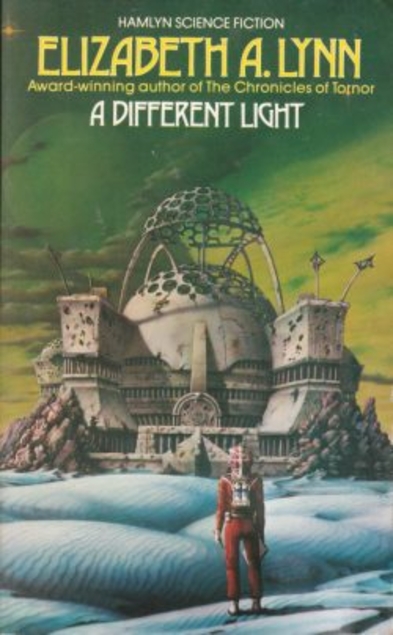
A Different Light by Elizabeth A Lynn

Hamlyn, 1983, 173 p

A Different Light cover

Lynn is one of those 70s-80s writers who published more fantasy than SF and as a consequence kind of passed me by. A Different Light is certainly SF rather than Fantasy, though.
Its main viewpoint character, Jimson Anneca, is an artist with incurable cancer, controllable unless he goes off-world. He is frustrated by this restriction. Given the chance to travel to the off-chart world of Demea to retrieve some Masks for a client, he accepts. Once there he and his companions finds this supposedly uninhabited planet has occupants who object to removal of their culturally significant Masks which turn out to be some sort of mind amplifier. Thereafter the story morphs into a tale about telepathy. A Different Light is pretty run of the mill fare even for its time and shows its age when talking about tapes for recording and playback of brain states.

Pedant’s corner:- “Now, does he know what he’s talking about? wondered Jimson” (has a question mark in the middle of a sentence; not only is it in the middle of a sentence it is arguably unnecessary,) “a gravity of two gees” (a gravity of two g,) “the rainbow changing of the ship before it jumped was like watching a real rainbow” (eh?) Nexus’ (Nexus’s, x2.) “‘The dust is debris that once were stars,’” (debris that once was stars.) “Her skill insured that” (ensured; is ‘insured’ used in this context USian?)

BSFA Awards for 2018

This year’s awards (for works published last year have been announced.)

Best Novel: Gareth L Powell for Embers of War

Best Shorter Fiction: Ian McDonald for Time Was

Best Non-Fiction: Aliette de Bodard for “On motherhood and erasure: people-shaped holes, hollow characters and the illusion of impossible adventures.”

Best Artwork: Likhain for “In the Vanishers’ Palace: Dragon I and II.”

The novel winner wasn’t my choice.

BSFA Awards Booklet 2018

BSFA, 2019, 104 p.

BSFA Award Booklet for 2018

It would appear from the nominations for shorter fiction appearing in this year’s booklet that the SF short story is dead. Barring the last in the booklet none of the shortlisted stories is printed in its entirety. The others are all extracts from longer pieces of fiction.
Nina Allan’s The Gift of Angels: an introduction1 is narrated by a Science Fiction writer, whose mother was the first person on Mars but whose fate remains unknown, and tells what appears to be his life story. The tale riffs on and critiques the films La Jetée and Twelve Monkeys. Allan has a beautiful writing touch. I did want to find the longer version to finish it. The story, though, refers to Harry Potter and Game of Thrones as famous. I doubt these will be quite such cultural touchstones in the fifty years or so time when this is set as they are now.
I read The Purpose of the Dodo is to be Extinct by Malcolm Devlin in Interzone 275, where it was first published. I reviewed the issue it appeared in here.
The Land of Somewhere Safe3 by Hal Duncan is one of the author’s Scruffians stories. Here we have a wonderfully linguistically inventive tale (Dunstravaigin Castle is a brilliant coinage) involving wartime evacuees to Skye and a Nazi spy.
The magnificent Time Was by Ian McDonald I reviewed here.
Exit Strategy (The Murderbot Diaries Vol 4)5 by Martha Wells is narrated by a murder bot apparently lured to a planet by an organisation that has sequestered its boss. The story suffers from being told to us rather than shown and did not grab me in the slightest.
Phosphorus6 by Liz Williams is set on Mars and the planet Winterstrike. One of its viewpoint characters is dead. However, the extract is not really long enough to judge whether its balance is askew or not nor to evaluate the story properly.
Kingfisher7 by Marian Womack is set in a future where wildlife is all but vanished and human births a rarity yet libraries seem to abound. Our protagonist is saddled with a useless tool of a husband, an abiding sense of failure and a fascination with birds. There is a hint of a writerly sensibility lurking underneath the prose but the story is riddled with a ridiculous number of errata.

The non-fiction nominees section contains two of Nina Allan’s “Time Pieces”a columns from Interzone, ditto for Ruth E J Booth’s Shoreline of Infinity essays published as “Noise and Sparks”, Liz Bourke has five of her “Sleeps with Monsters”b columns for Tor.com, Aliette de Bodard writes “On Motherhood and Erasure”c from the blog “Intellectus Speculativus” and there is an extract from Adam Roberts’s “Publishing and the Science Fiction Canon: The Case of Scientific Romance”d.

Pedant’s corner:- 1“A sinister band of scientists prey off” (a band preys off,) “sprung up” (sprang up,) “the museum has replacedtheir stash” (its stash,) “a cetain child .. finds themselves” (a child finds itself.) 3puntied in (punted?) argylle socks (argyle,) liptick (lipstick seems intended but liptick may be one of Duncan’s neologisms.) 5GrayCris’ (GrayCris’s.) 6governess’ (governess’s,) mistress’ (mistress’s,) “The scatter of hovels erected at the tip of the Tail were the last to fall behind..” (The scatter … was the last.) 7 “each bar offered their personal take” (each bar offered its personal take,) statues becomes statue several lines later, “a prevalent Sun descended” (a prominent Sun?) “it was frightening how comforting was to fall back into” (how comforting it was to.) “The library would pay for my librarianship degree on the sole condition that I came back to work for them for three or four years” (to work for it, or, to work there,) “climbing up thopusands of miles up in the air” (one ‘up’ too many,) a ‘seem’ where ‘seemed’ fits the other tenses in the sentence, “and they would let themselves been touched” (be touched,) “Jonas was better at cooking at me” (than me,) “scribbled in old pieces of reclaimed paper” (scribbled on,) “in a strangely elaborated [dream]” (elaborate.) “I looked a Jonas” (at Jonas.) “I fell a moment of void” (I felt.) “I had never knew whsat to do with it” (I had never known, or, I never knew,) although there were not fluff” (although they were not fluff,) “but they seem to accumulate” (seemed,) “when I notice a stain” (noticed,) “too look inside” (to look,) “the dinning room” (dining room,) “what they where for” (were for.) “Whener I don’t remember what it means to be sad I took it out and look at those pages” (either ‘remembered’, and ‘looked’, or, ‘take’,) “minus zero” (that would be zero, then,) “magazines cut-outs” (magazine cut-outs,) “I had tided them up” (tidied,) “plastics bags” (plastic bags.) “They were not native to the local fauna” (‘They were not native’, or, ‘they were not local fauna’,) “so effectively they had contaminated the environment” (so effectively had they contaminated the environment.)
a“are startling out of step” (startlingly.) b“I’m going to look at take two books together” (either ‘look at’ or ‘take’ not both, automatons (automata,) “Neither of them resolve anything” (neither of them resolves anything,) “[X]’s .. pregnancy …. and her feelings … is central to the narrative” (there’s an ‘and’ in there; that makes for a plural verb subject, so, ‘are central’.) “The poets are most affect by” (affected by.) c“are littered with the death of mothers” (deaths.) d“is comic-satiric impossible voyage” (is a comic-satiric impossible voyage,) “triple-decker length SF form this era” (from, I think,) “the content of which were published” (was published.)

Gene Wolfe

And they keep coming. (I suppose, really, that should be going.)

Yesterday, via George R R Martin’s Not a Blog, I learned of the death of Gene Wolfe.

I have been an admirer of his work ever since his novel The Shadow of the Torturer, the first of his sequence set in Urth, with the overall title The Book of the New Sun.

This was followed by Soldier of the Mist set in ancient times, whose hero, Latro, can not remember things from one day to the next, and two more books with the same protagonist.

Two other series, The Book of the Long Sun and The Book of the Short Sun, appeared in the 1990s and early 2000s along with two books related to each other The Wizard and The Knight.

Many stand alone novels were published before, during and after these series books.

I have 24 of Wolfe’s books, 20 novels and 4 collections of his shorter work, but have not yet read them all. (So many books to read, so little time.)

Ursula Le Guin was a great admirer of Wolfe’s writing, calling him “our Melville”, (our in the context of the SF and Fantasy field.)

The last of his novels to be published, A Borrowed Man, 2015, I had the privilege of reviewing for Interzone. I had the impression that was to be the first in another series of books, which sadly are now probably lost for ever.

I’ve got those unread ones to look forward to though.

Gene Rodman Wolfe: 7/5/1931 – April 14/4/2019. So it goes.

free hit counter script