Archives » Science Fiction

Shoreline of Infinity 10: Winter 2017/18

The New Curiosity Shop, 132 p

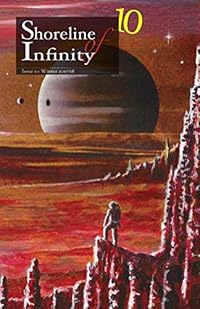
 Shoreline of Infinity 10 cover

In Pull up a Log Editor-in-Chief Noel Chidwick rightly notes the achievement of the magazine reaching its tenth edition. There are Judge’s Reports by Eric Brown and Pippa Goldsmith on Shoreline’s flash fiction competition followed by a celebration of The Worthy Winners and shortlisteesb. Three of these stories appear in this edition (see *.) Tales From the Beachcomber riffs on the human fascination with powers of ten via the life and works of Arthur C Clarke, there’s an interview with Helen Sedgwick by Pippa Goldschmidtc, in Noise and Sparks: The Company of Bears, Ruth E J Booth lauds the interactions and memories convention going brings, the tolerance it fosters. Reviewsd considers Ada Palmer’s Too Like the Lightning, the Jonathan Strahan edited Infinity Wars, Kim Stanley Robinson’s New York 2140, The Death and Life of Schneider Wrack by Nate Crowley, 2084 edited by George Sandison, and The Clockwork Dynasty: A Novel by Daniel H Wilson. Multiverse has poems by Rachel Plummer, Jo-Ella Sarich and Rosemary Badcoe. Parabolic Puzzlese challenges the reader to identify twelve SF writers from their photographs and very brief information about them.

Little Freedoms by Ephiny Gale1 is set in a closed room where some sort of endurance test of nine characters is taking place with various tasks to be undertaken – such as not touching, not speaking, not breathing. The winner gains freedom (from an unspecified but clearly onerous existence.) The others are restored to their former state.
Sweet Compulsion by Chris Bailey is told to us rather than shown and overall feels more like a sketch of a story than the complete article. Riddled with quotations from Paradise Lost it features a world in which people’s thoughts are etched onto others’ skins.
In Junk Medicine2 by Die Booth plastic ownership is outlawed but there are still people willing to pay over the odds for items made from it. This story does for plastic what Number Ten Q Street did for real food.
ATU334 The Wise*3 by Marija Smits is a future tale of Baba Yaga and an importuner, the titular ATU334.
If Thine Eyes Offend Thee4 by Daniel Rosen is narrated by Elsa whose ambition was always to be a mermaid. We see the lengths of body reconstruction and skulduggery she will go to to win the Miss Cosmos competition.
Pauline and the Bahnians*5 by S K Farrell is set on a demilitarised outpost turned into a – possibly illegal – smallholding. Its weapons are still there though.
The narrator of The Apple Bee6 by K E McPhee is marooned on an island on a mostly water planet, with no communication with the rest of humanity and only potatoes, apples and corn as a food supply.
Don’t Speak; Don’t Listen7 by Serena Johe explores the ramifications of an implant that prevents the speaker insulting or denigrating anyone.
A Choice for the Golden Age* by Matthew Castle was the overall winner of the flash fiction competition. It’s set on a generation starship which rotates its crew (and holds its genetic cargo permanently) in suspended animation.

Pedant’s corner:- aIn the cover artist’s (Dave Alexander) information paragraph; “His biggest claim to fame were the two front covers he painted for DC Thomson’s Starblazer series” (His biggest claim to fame was the two front covers.) b“As economical a tone-poem … it’s” (As economical as a tone-poem.) cnot mentioned on the contents page. d“if the government get wind of him” (gets,) “while others featuring AIs and a couple are” (the rest of the verb forms in this sentence are indicative so ‘feature’,) “take several different aspects … and extrapolated them” (extrapolate them,) “how will it effect you” (affect was meant,) Watts’ (Watts’s,) a missing full stop at the end of a review, bail out (bail-out,) counsellors (as I remember the book it was councillors,) Eric Morecombe (Morecambe,) political dissension (dissent I would think.) “Although, some readers have taken issue with” (no comma after ‘although’,) as though there maybe” (as though there may be,) “into this under ground world” (underground.) e“The winning team …. were amply rewarded” (The winning team was amply rewarded.)
1“a couple of pair of trousers” (a couple of pairs of trousers.) 2whinging (whingeing,) there’s a missing full stop, “Carbonari’s” (earlier it was Carboneri’s.) 3Written in USian. 4Written in USian – though curiously we have manoeuvre instead of maneuver – there is a full stop instead of a comma at the end of piece of direct speech embedded in a longer sentence. “Scales in every spectrum of the rainbow” (suggests the author doesn’t know what spectrum means.) “I let her wheel me all the way back to my room and offered me another drag of her vaporiser” (offer.) “Auroras antennae flickered” (Aurora’s.) “The voice rumbles like through the water in a sticky molasses bass.” (The only way I can make sense of this sentence is if the ‘like’ is redundant.) 5“(what is a Bahnian, please?).” (doesn’t need the full stop.) 6“Quite early on he’d abandoned the neatly organised rows and began planting” (begun is more grammatical,) we have ‘gotten’ and ‘maneuvered’ (the author is Aussie which wil possibly explain these.) 7“someone shined a light” (shone. It’s shone a light.)

BSFA Awards Booklet 2019

BSFA Awards Booklet for 2019

This year’s booklet arrived this morning.

It contains all the short fiction and non-fiction nominees for the BSFA Awards for works published in 2018 and the artworks nominated for the relevant award.

On perusing it I found the closing date for electronic voting is today so I had a lot of reading to pack in this afternoon.

I have been expecting the booklet’s arrival since the turn of the month and was getting worried it would not be forthcoming in time.

Eastercon, which I will not be attending this year, where the final awards will be announced, is of course this Sunday coming.

Interzone 279 (Nov-Dec, 2018)

TTA Press

Interzone 279 cover

Sean McMullen’s guest Editoriala argues real life has not, quite, caught up with Science Fiction. Andy Hedgcock’s Future Interruptedb riffs on the drawbacks of repetition and sequels in art while noting the originality of recent radio works by Stephen Bacziewicz and Anita Sullivan. Aliya Whiteley’s Climbing Stories ponders the writer’s relationship with and duty towards morality via her life experiences with role-playing games. In Book Zone Andy Hedgecockc comes round to Anthomy Burgess’s Puma despite the author’s disparagement of SF, Ian Hunterd appreciates Suzannah Evans’s poetry collection Near Future, Duncan Lawie finds reacquainting himself with Dave Hutchinson’s Fractured Europe series in Europe at Dawn a warm, comforting experience, Juliet McKenna says Our Child of the Stars by Stephen Cox is whooly fresh and intensely gripping, Barbara Melville is charmed by the reprint of Starfield edited by Duncan Lunan, Stephen Theaker’s initial reservations about The Sky Woman by J D Moyer are overcome by the story’s development into a “solid three-star book”, while Ian Sales finds Derek Kunsken’s The Quantum Magician naggingly familiar.
As to the fiction:-
In The Backstitched Heart of Katharine Wright1 by Alison Wilgus, Katharine, the sister of Orville and Wilbur Wright, is able to unravel time and retsitch it to prevent Orville’s early deaths.
The Fukinaga Special Chip Job2 by Tim Chagawa has its narrator travelling to all the world’s floating cities seeking out the mythical crisps of the title.
This Buddhafield Is Not Your Buddhafield3 by William Squirrell is printed sideways and tells the tale of a cleaner on a structure in the clouds of Uranus, a structure whose owner never lives there.
For the Wicked Only Weeds Will Grow4 by G V Anderson is set on a kind of interplanetary hospice called Requis. A curmudgeonly Terran tests the narrator’s soothing powers. The story displays an idiosyncratic approach to personal pronouns, use of which seems to depend on species but is inconsistent.
In Seven Stops Along the Graffiti Road by David Cleden survivors of an unspecified catastrophe wend their way along a road bedecked with graffiti – all of it encouraging. The road however becones strange at night, when they are all safely off to the side at way-stations.
Terminalia by Sean McMullen5 is a cod-Edwardian piece of fiction about cardiac resuscitation, a mechanical lady and the elimination of ghosts. The story is good but its execution feels more than a bit rushed.

Pedant’s corner:- adiscrete adultery (discreet that would be.) bidentify (identity makes more sense,) “there are a different set of irritations” (there is a different set.) cdisks (discs, please.) dEvans’ (Evans’s,)
1Written in USian, “[she] lays on her bed” (lies,) 2Written in USian; the story refers to a seal eating a penguin in the Arctic. (Well, I suppose the penguin might have escaped from a Norwegian zoo, otherwise tha’s one hell of a journey it took,) nautilus’ (nautilus’s.) 3Simplicius Simplicissmus (Simplicius Simplicissimus,) “Her mother’s anxiety at this abundance are compressed on the pages” (either ‘anxieties’ or ‘is compressed’.) 4sanatoria is used throughout as a singular noun, lieftenant (lieutenant,) maw (it’s on a plant. Plants do not have stomachs.) 5the contents page says Seam McMullen. “Quite possibly none of them were” (none of them was,) a photo (I doubt Edwardians used this contraction,) “I have a suite questions” (a suite of questions,) “a household electricity socket” (in 1905? Unlikely but just about possible,) “‘Word will be discretely put about’” (discreetly.)

Vonda N McIntyre

I was sad to read today of the death of Vonda N McIntyre.

She first came to my attention with the short story Of Mist, and Grass, and Sand – a Nebula Award winner in 1974 and which formed the first part of her later novel Dreamsnake which won the Hugo and Nebula for best novel in 1979. The story was unusual in that its protagonist was a healer rather than a fighter. It was immediately obvious McIntyre’s writing was up there with the best the genre had to offer.

Looking at my records I find I have six of her books (including one short story collection.) One of the novels, The Entropy Effect, was in the Star Trek franchise, and much better written than it probably needed to be.

I reviewed her 1986 novel Superluminal here.

In all she won three Nebulas and that Hugo.

She may not have been prolific as a writer and not so prominent latterly as she was at the turn of the 1970s/80s but she is undoubtedly one of the most noteworthy SF authors of the late twentieth century.

Vonda Neel McIntyre: 28/8/1948 – 1/4/2019. So it goes.

BSFA Award Novel List

I’ve now read three of the short-listed novels for this year’s BSFA Award.

I can’t say I’ve been too struck on any of them.

Gareth L Powell’s Embers of War did not appear to be anything out of the ordinary.

My thoughts on Before Mars by Emma Newman are here.

Dave Hutchinson’s Europe at Dawn was beautifully written but is the fourth in his Fractured Europe sequence and did not add substantially to the world(s) he has created.

I’ll not be reading the Yoon Ha Lee. I found his Nine Fox Gambit was not very good and put me off his fiction for life.

That leaves Tade Thompson’s Rosewater for which I probably don’t now have the time to resource or read. I gather also there is some doubt as to its eligibility as it was published on the Kindle in 2017 rather than 2018.

My reading of the short fiction has not progressed since the short list was announced (see first link in this post.) The usual BSFA booklet containing the stories has not yet arrived. I live in hope. In any case I doubt anything else will be better than Ian McDonald’s Time Was.

Europe at Dawn by Dave Hutchinson

Solaris, 2018, 358 p.

The third of this year’s BSFA Award nominees for best novel that I have read.

 Europe at Dawn cover

This is a pleasing enough conclusion to Hutchinson’s Fractured Europe sequence. We meet once again old friends Rudi and Rupert. Some loose ends are tied up. As usual Hutchinon’s prose goes down smoothly even if it contains the occasional barb such as, “Friends. Always there when they need you.” We make new acquaintances like Alice, a minor diplomat in the Scottish Embassy in Tallinn, to whom is brought the supposed head of St Magnus martyr, Kirkwall, which embroils her in various machinations involving Les Coureurs des Bois and its adversaries, and Ben, a refugee from Africa, stuck for a time on an Aegean island whose fellow refugee occupants are sustained by a rotating system of aid from southern European countries as a barrier to onward travel. The text explicitly references Tinker, Tailor, Soldier, Spy, an acknowledgement of Hutchinson’s debt to the cold war thriller. We also have the return of Professor Mundt, plus the Whitton-Whytes (responsible for all this byways into other-world stuff) and finally encounter the book of instructions as to how to map new landscapes over old. The story features not only Europe and the Community but also the Realm and there is the possible involvement in all these shenanigans of Americans who were maybe responsible for the Realm. (Boo; hiss.)

Europe in Autumn has been described as the first great Brexit novel (despite having been published before the 2016 referendum) but in among the delight of reading Hutchinson’s prose there’s a sense of despair that this Europe is more or less where we may be heading, though probably without a shadowy parallel world as an extra menace. Apropos of which we also have this observation, “For a certain type of English person, the Community was a wet-dream of Return, a place where tricky concepts like ethnic diversity and political correctness and sexual equality had never taken root, and gay rights were a misty fantasy. By any number of modern standards, it was an awful place, and that was probably why so many of the English wanted to move there.” Now there’s a nail hit firmly on its head.

However, a house described as, “deniable neutral ground, a place where the real business of the world could take place, far from the public eye,” maybe panders too much to the conspiracy adherents amongst us. But it does sit well within what is still essentially a spy novel.

Hutchinson is good. Reading this was a delight even if overall the book seemed more like a collection of loosely connected short stories than a novel per se. His is a world (two worlds?) so wonderfully imagined and described that it is something of a wrench not to be able to go back to it again to explore it more fully.

Pedant’s Corner:- “The sponsor themselves never showed up … .they’d” (himself … he’d… would be more grammatical,) homeopathy (homoeopathy, please – or even homœopathy,) “the actual food drop usually didn’t place until the day after” (usually didn’t take place until,) “She pronounced it” (Holyrood) “like ‘Hollywood’.” (Holyrood is pronounced like Hollywood,) “on face value” (it’s usually ‘at’ face value.) “‘Pour decourageur les autres’” (decourager,) “‘The Pozna thing?’” (Poznan, would that be?) Magnus’ (Magnus’s,) “came and went for time to time” (from time to time,) “an unsuccessful run for the Assembly” (Scotland doesn’t – and won’t – have an Assembly, but a Parliament.) “The Directorate had weighed up them up” (one too many ‘up’s,) “a rather battered old books of timetables” (book,) “there were a number of things” (there was a number.) “‘This is never going to be over, is it.’ said Rupert” (technically contains a question and so requires a question mark,) “the gallery were the only people” (couples a singular noun with a plural verb,) “off of” (just ‘off’, no ‘of’ required.)

Paris Adrift by E J Swift

Solaris, 2018, 379 p. Reviewed for Interzone 274, Mar-Apr 2018.

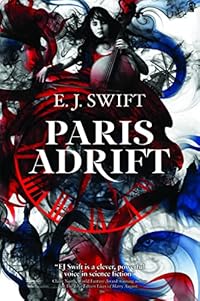
Paris Adrift cover

Time travel is one of Science Fiction’s most venerable tropes but in more recent times has taken something of a back seat to other aspects of the genre. In Paris Adrift, E J Swift has adopted an oblique approach to the topic, gaily skipping over any problems with the ethics of non-intervention and avoidance of the grandfather paradox. She does not make anything of, still less explain, the mechanics of the process (which arguably puts us in fantasy territory,) it is simply an integral part of the story she has to tell.

Hallie, an English geology student estranged from her family, is on a gap year in Paris trying to sort her life out. She takes a waiting job at Millie’s, a bar near the Moulin Rouge. Millie’s is a nexus for the strange. Fellow employee Gabriela finds she is always somehow prevented from leaving Paris while Hallie has odd encounters with birds that talk to her, an apparent doppelganger, and customers, while also experiencing odd sensations both in the keg room and in Paris’s catacombs. She still finds space for a relationship with fellow waiter Léon, and Swift charts superbly the overwhelming intensity of a burgeoning love affair.

The narration is almost exclusively from Hallie’s viewpoint, in that pressing present tense which can seem like a default in so much modern SF. Occasional mentions of geological terms underline Hallie’s background.

The incursions of the weird might perhaps have been more unexpected had we not already read a prologue chapter introducing us to the chronometrist, a person seemingly able to take control of other’s bodies at will but whose essence is fading, and to the concept of anomalies and their incumbents. Hallie soon finds out the keg room is a time portal and her future has been mapped out by the Way of Janus.

Her first experience of timefaring takes her to 1875 where she seems to adapt to her new situation remarkably quickly and is befriended by the Millie who will one day found the bar. She also meets the architect designing the Sacré-Coeur. Partly due to Hallie’s interference that building will no longer be erected. In its stead will arise the Moulin Vert which becomes a significant location in the rest of the book (plus inspiration for a political movement) and technically makes the novel an alternative history. However, other aspects of our modern world and its history are unaffected, there are mentions of Whatsapp, plus the Bataclan, Stade de France and Nice attacks.

The anomaly’s next flare sends Hallie to 1942 and a suitably claustrophobic encounter with would-be cellist Rachel Clouarte. Hallie dodges German soldiers and the curfew to reunite Cluarte with her cello and aid her escape in order to ensure her career in music will prevail, so that she will not marry and produce (eventually) the descendant who will contribute to a catastrophic war in the future. This 1942 Paris is lightly affected by the occupation, street life continuing gaily as normal, though of course the deportations from which Clouarte is to be saved proceed apace. I did wonder why Hallie’s intervention in the Clouarte family tree had to be quite so early but of course it does give Swift the opportunity to depict Paris in wartime and up the danger quotient.

Another flare takes Hallie to 2042 and a terribly plausible fascist Paris (complete with Metro station called LePen) and the seeds of the situation which the Way of Janus seeks to avert. Other timefaring trips are mentioned but not gone into in detail.

The 1942 and 2042 excursions lend the novel aspects of a thriller yet there are other scenes which bring to mind Angela Carter’s Nights at the Circus and the work of Tim Powers. Throughout, Swift’s portrayal of her characters is assured. These are people we can believe in even if one of them is prey to the logical fallacy that because the Earth is remarkably suited to humans it is a sign of something miraculous rather than the unfolding of impersonal forces which merely allowed us to arise.

Paris Adrift deals with the heavy theme of totalitarianism and the threat of the far right but never loses sight of the smaller people who live through interesting times. While Léon and Hallie are pivotal to the resolution of the plot (and History itself) its emotional focus, though sometimes sidelined, is on their relationship.

Like a lot of SF this suggests life is hard and pain impossible to avoid but unlike most recent SF it proffers hope along with the sacrifice. Never mind it being good SF/Fantasy, this is a good novel.

The following did not appear in the published review.
Pedant’s corner:- “the night team begin to trickle in” (the night team begins to trickle in,) “the group want shots” (wants,) “a stream of people flow inside,” (a stream flows,) “the confines of the locker room lends an air” (the confines lend an air,) “a travelling company were performing” (a company was performing,) “the shape of the walls change, become smooth and rounded” (the shape changes, becomes smooth,) “Her age and appearance has altered once again” (have altered,) “the floor team are doing the rounds” (the team is doing the rounds.) “None of these people have an anomaly. None are bound to this place” (none has, none is.) “Only a small proportion of the catacombs are maintained for visitors.” (Only a small proportion is maintained,) “as the assault team go through their final checks” (as the team goes through its final checks.) Yet despite all these examples of such failures of agreement of subject and verb Swift obviously knows what’s what as we had the correct “a rickety set of steps leads up to”,) “till I am stood right next to him” (it wasn’t a passive activity, so standing”,) “sat on the gravestones” (sitting,) gotten (in a narrative otherwise so British in tone this USianism jars,) “since she bid me farewell” (bade me farewell,) “preempting the touch that will follow” (the context implied savouring rather than pre-empting,) Dušanka calls Hallie “‘my petit chou.’” She responds, “‘And I’m not a pastry.’” (That response would be to “my petit choux” – chou is a cabbage and “petit chou” a term of endearment. Hallie’s French isn’t supposed to be good but surely she would not confuse the two?) “is sat” (is sitting,) “another woman is stood at the window” (is standing,) dove (USian; the British past tense of dive is dived,) “sat sipping” (sitting sipping,) “glasses pile up on either side” (context implies both sides,) inside of (USian, it’s just inside, no “of”,) descendent (descendant,) focusses (focuses,) syllabi (I prefer syllabuses, though I concede syllabi is a correct Latin plural,) “you’ll be never be happy” (that first “be” is redundant, “‘How can I do that.’” (That is a question so requires a question mark, not a full stop.)

Interzone 278 (Nov-Dec, 2018)

TTA Press

Interzone 278 cover

Tim Lees takes the guest Editorial where he ponders truth and realism in fiction and welcomes more inclusiveness – more truths – in SF. Andy Hedgecock’s Future Interrupteda wonders about the preponderance of negative perceptions of crowds in SF – and more generally – compared to their positive potential. Aliya Whiteley fills the gap left by Nina Alan’s columnistic departure in Climbing Storiesb, arguing that SF tales have no set structure like romances or horror stories do. Instead SF steals from everywhere. In Book Zonec Tade Thompson laments the failure of The Evolution of African Fantasy and Science Fiction edited by Francesca Barbini to treat African Sf&F on its own terms rather than Western ones, Daniel Carpenter says Aliya Whiteley’s The Loosening Skin will haunt the reader long after it is read (and also interviews the author,) John Howard appreciates Gary Westfahl’s reappraisal of Arthur C Clarke in the latest Modern Masters of Science Fiction series, Val Nolan discusses Christopher Priest’s “September 11th” novel An American Story, Duncan Lunan finds The Song my Enemies Sing by James Reich enjoyable hard work – up to a point – and considers carefully E M Brown’s Buying Time, I characterise Death’s End, the culmination of Cixin Liu’s Remembrance of Earth’s Past trilogy, as a bracing intellectual tour-de-force but emotionally unsatisfying, Andy Hedgecock finds Adam Roberts’s By the Pricking of her Thumb too self-indulgent, Stephen Theaker says Unholy Land by Lavie Tidhar is quite terrific – a corker – and Hazards of Time Travel by Joyce Carol Oates to be heavy-handed satire but arguably what this moment needs.

As to the fiction:-
Soldier’s Things1 by Tim Lees tells of a soldier invalided out from an ongoing conflict journey back home only to find nothing familiar, his memory untrustworthy – about anything.
In Doomed Youth2 by Fiona Moore an infestation of giant ants occurred sometime in the 1950s with intermittent rises and falls in their population ever since. The story is supposedly narrated by a Chinese American called Kara Chong in a chatty style that didn’t sit well with the content. The background of a world elsewhere falling apart has led to distrust of foreigners.
The Path to War3 by Louise Hughes sees a storyteller whose audience finds her lacking take a mountain path between two newly-warring countries (after a litany of wars) rather than the coast road in the wake of the army.
In Heart of an Awl4 by Eliza Ruslander an AI that was a car is bequeathed its owner’s body after his death. It and his widow go on a road trip.
Zero Day5 by Sheldon J Pacotti is the story of an off-duty cyber soldier who meets a girl on a bus. Tracking her later online he misses the big cyber attack.
The SF premise of Birnam Platoon by Natalia Thoeodoridou is much the same as that of Green Troops by William King, ie the development of soldiers capable of photosynthesising by themselves. This lot take their mission of promoting world peace seriously though. The story is framed via the post-war trial of one of their commanders for war crimes.

Pedant’s corner:- aZamyati’s (Zamyatin’s.) b“in the same way that there are” (in the same way that they are,) Roberts’ (Roberts’s.) cMaurits’ (Maurits’s,) “And it’s becoming clear is that” (and what’s becoming clear is that,) Roberts’ (Roberts’s,) 1fit (fitted,) 2“I made a final effort” (“I finally made an effort” makes more sense,) “someone beating a tympani” (tympani is plural, one of them is a tympanum.) 3snuck (sneaked,) “stood like marketplace crowds” (standing like marketplace crowds.) 4Written in USian, “she pulls up the hand break” (hand brake.) 5Written in USian, “and diffuse the situation” (defuse.)

Before Mars by Emma Newman

Gollancz, 2018, 345 p.

This is the second of this year’s BSFA Award nominees for best novel that I have read.

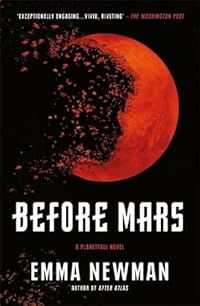
 Before Mars cover

Anna Kubrin, child of free-thinking parents, is woken from the mersive (a recording of a memory played on a chip internal to the brain and that manifests as all but real) she’s been accessing towards the end of her trip from Earth to Mars. She’s been engaged by GaborCorp as a geologist but her primary task is to produce paintings of the Red Planet for the Corp’s chief, Stefan Gabor. She experiences the usual disorientation those reaching Mars undergo but seems to recover quickly.

What, though, is she to make of the note – clearly painted by herself – that she finds down the back of the bed in her quarters, warning her to beware station psychiatrist Arnolfi, or the fact that her wedding ring now has no engraving on it, the strange but familiar attraction she immediately feels to fellow base member Dr Elvan, and the lack of response to her comments in messages home – not to mention the human footprint she finds beside a Martian crater that is supposedly unexplored?

Is this immersion psychosis? Paranoia? Or a sign of something deeply wrong at the base?

Anna’s confusion is heightened by her ongoing guilt at the fact she didn’t feel the connection to her child, Mia, that is accepted as the societal norm and by fearing she has inherited the madness of her father whose actions almost killed Anna’s mother many years ago.

Through Anna’s use of mersives, and other snippets of information dumping, we find the book is set in a post-democracy era that nevertheless doesn’t seem to have got beyond the profit motive since it is ruled by gov-corps (some benefiting from the use of indentured labour) and where ordinary people struggle for access to good housing.

The implanted chips all but compulsory for employees in this world – and certainly so for those on the Mars base – enable communication with the base’s operating AI, verbally, visually or via virtual keyboard and can act as a kind of internal mobile phone for non-verbal information transfer with others. These future humans also have retinal cameras which enable the recordings from which mersives are made.

Newman’s invented expletive – JeeMuh – strikes a jarring note, possibly as it seems to lack an origin. This chimes with the tantalisingly opaque nature of the novel’s background. Events which were clearly important and have consequences for the characters are alluded to or referenced but not entirely explained. This is apparently the third in a series of books of which I have not read the previous two and so these things may be more obvious to those who have. Before Mars does stand alone, though, and can be read with no difficulty.

On this evidence Newman is capable enough as a writer but can tend to the long-winded and repetitious. Award-worthy, though? I’ll reserve judgement on that.

Pedant’s corner:- Despite the narrator (and author) being from Britain – albeit a future Britain – we have many USian usages and spellings – though we have one ‘arse’ used to mean ‘bollocks.’ “‘I’m at high risk for that’” (high risk of that,) black currant (blackcurrant,) “for all intents and purposes” (the phrase is ‘to all intents and purposes’,) commas missing before quotations and sometimes, but not consistently, at their ends, “the latter only in Charlie’s case” (syntactically that would be better as ‘only the latter in Charlie’s case’,) “that I’d strived for” (striven, please.) “‘There are a handful’” (there is a handful,) “obligated to” (obliged to,) “‘I wrack my brain’” (rack my brain, wrack is a seaweed,) “none of the remaining dots correspond with the location of the mast” (none …. corresponds,) epicenter (it was a centre, not an epicentre,) “‘the images from one of the drones was missing’” (okay, it was in dialogue but it should still be “were missing”,) “lay of the land” (again, in dialogue, but it’s “lie of the land”.) “‘None of you are permitted to be here’” (again in dialogue, but by an AI. You’d think they’d programme them with correct grammar, wouldn’t you? “None of you is permitted to be here.”)

Interzone 280 Has Arrived

Interzone 280 cover
The Orphanage of Gods cover

On the doormat this morning: Interzone 280.

This one contains – among all the other goodies – my review of The Orphanage of Gods by Helena Coggan.

My review of The City in the Middle of the Night by Charlie Jane Anders, due in issue 281, has been despatched.

free hit counter script