Posted in Architecture, Art Deco, Trips at 12:00 on 20 July 2023
On our trip to Ayrshire in October we stayed overnight in Ayr. I found plenty to photograph including the Art Deco Gaiety Theatre. The attached building (Stagedoor) is also Deco in style:-

Photo of Gaiety showing stepped roofline, streamlining, canopy:-

Gaiety’s entrance column:-

Stagedoor from side:-

No Comments »
Posted in Art Deco, Shipping, Trips at 12:00 on 13 May 2023
The Maid of the Loch is a paddle steamer which was the last largish vessel to cruise up and down Loch Lomond. It was apparently the last paddle steamer to be built in Britain, at the Glasgow shipyard of A & J Inglis.
For a while it had been tied up at a pier in Balloch at the foot of the Loch and trading as a floating restaurant.
Latterly it has been under refurbishment.
Last September various buildings and organisations in the West Dunbartonshire area held an open day. We took the opportunity to visit.


Access to the interior was by a somewhat precarious metal stairway. The inside was of course far from pristine due to the refurbishments. Some of the original fittings were still in evidence, though.
Ship’s Bell:-

Art Deco style clock in saloon:-

There was a model in lego:-

And what I assume was an older model. However, I remember her colour as being totally white back in the day:-

One of the traditions of a cruise on the loch (or indeed “Doon the Watter” – see first paragraph in link) was a visit to “see the engines.” (The inverted commas are because some male passengers used this phrase as an excuse to go to a ship’s bar.)
Engines:-


I always find these ships’ engines fascinating especally when they are in motion and powering a ship.
One of the internal exhibits was the decoration of one of the ship’s paddle boxes:-

3 Comments »
Posted in Art Deco, Modern Architecture at 12:00 on 17 April 2023
Insch is a village in Aberdeenshire. We visited it during our trip north in August.
This shop with strong horizontals and verticals has a deco look. Its eyes have been poked out though.

No Comments »
Posted in Architecture, Art Deco, Trips at 15:00 on 15 March 2023
Aboyne is a village in Aberdeenshire.
This shop built in the Art Deco style (albeit in granite which doesn’t actually sit well with Deco I feel) wasn’t a surprise to me. I’d seen it on a TV news report from Aboyne a few months earlier. Most of the rest of the village architecture is standard Scottish rural stuff.
Horizontals and verticals, rule of three in the embellishments above the windows and door:-

No Comments »
Posted in Empire Exhibition, Scotland, 1938, Exhibitions, Glasgow at 12:00 on 11 January 2023
Despite its (for the time) Hi-Tech modernistic architecture, the Empire Exhibition, Scotland, 1938, was home to a very traditional type of building, that of the turf-roofed dwellings of the clachans of Highland Scotland. I featured a postcard contrasting the new with the old – the Tower of Empire overlooking Highland village cottages – here.
Clachan is Gaelic for a small settlement. A previous such village had been one of the hits of the Scottish National Exhibition held in Kelvingrove Park, Glasgow, in 1911 and the population of Glasgow was keen to see such an exhibit revived.
Three of Brian Gerald’s art-drawn postcards of the 1938 Exhibition focused solely on the Clachan. As well as cottages the Clachan featured a ruined castle, a loch, with a lovely stone bridge over a burn running into it, and the occasional bagpiper strolling about:-


One of the cottages did double duty as the Exhibition’s Post Office:-

No Comments »
Posted in Art Deco, Empire Exhibition, Scotland, 1938, Exhibitions at 12:00 on 7 January 2023
Another postcard of the Empire Exhibition, Scotland 1938. The Cascade and Lake on Dominions Avenue, art drawn by Brian Gerald:-

No Comments »
Posted in Architecture, Art Deco, Edinburgh, Sculpture at 12:00 on 29 November 2022
Roof Detail of new W Hotel, in St James Quarter, Edinburgh. For obvious reasons the building has become known as the Turd:-

Thistle sculpture on Market Street – just along from the City Arts Centre:-

Art Deco style flats on Colinton Road:-


No Comments »
Posted in Architecture, Art Deco, Dundee at 20:30 on 13 November 2022
I was so sad to see on the TV news last nighty that Willison House in Dundee – subject of my post Dundee Art Deco Heritage 4 – aka Robertson’s Furniture Store and a listed building, has been ravaged by a fire that was apparently set deliberately.
It seems the damage is so severe that demolition will be the only recourse.
My only consolation is that I saw and photographed – it before it became too much of an eyesore.
I show it again as it was in happier times.

No Comments »
Posted in Art Deco, Empire Exhibition, Scotland, 1938, Glasgow at 12:00 on 26 October 2022
I haven’t posted any of these for quite some time.
So here are three views of the North Cascade and Tower at the Empire Exhibition, Scotland, 1938, held in Glasgow’s Bellahouston Park.
First one of Brain Gerald’s art-drawn postcards:-

This is a very similar view but is a colourised photograph:-

This one, also a colourised photograph, omits the fountain:-

No Comments »
Posted in Architecture, Art Deco, Trips, Woolworths at 12:00 on 12 October 2022
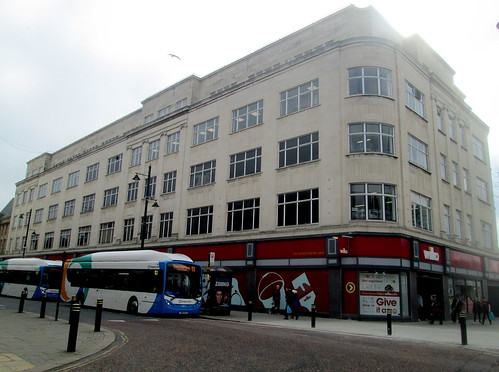
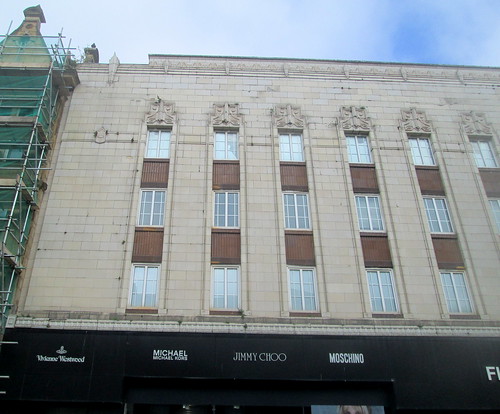
We were back in Sunderland in April and I took the opportunity to get some better photos of the Art Deco buildings I featured here and here in 2021.
Wilko’s:-
Marks & Spencer:-


Old Woolworths:-


No Comments »
