Art Deco Style Window, Modern Two, Edinburgh
Posted in Architecture, Art Deco at 22:23 on 28 September 2022
This window is in the gents’ toilet at Modern Two (Scottish National Gallery of Modern Art). I love its geometric style.

Posted in Architecture, Art Deco at 22:23 on 28 September 2022
This window is in the gents’ toilet at Modern Two (Scottish National Gallery of Modern Art). I love its geometric style.
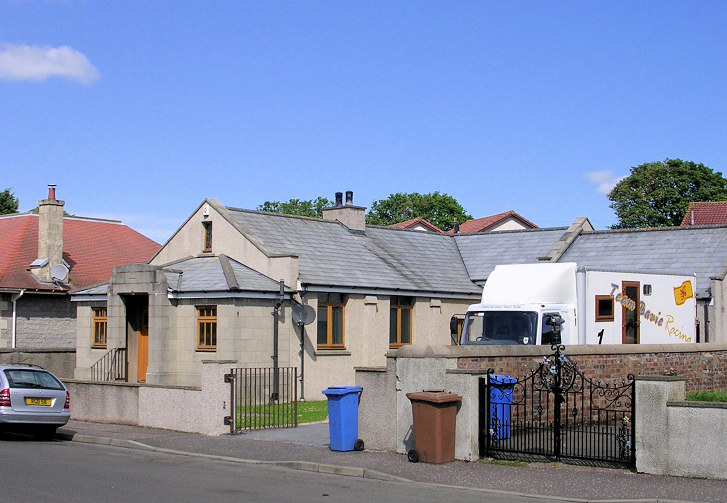
Posted in Architecture, Art Deco, Edinburgh at 20:30 on 4 August 2022
Edinburgh Art Deco Style – flat roof, cream render – as seen from car park of Modern Two, Edinburgh.
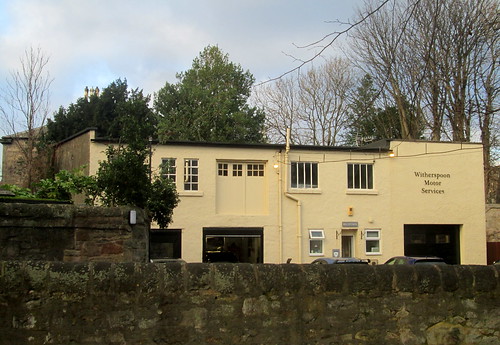

Posted in Architecture, Art Deco at 12:00 on 4 August 2022
In George Street, Markinch, is this former church building now a private house. It may have been a United Free Church.
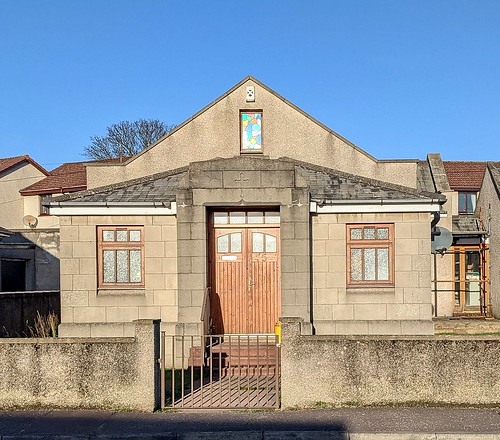
There’s rule of three in the (replaced) windows and 1930s style in the doors but the cross above the doors and the style of the portico both suggest deco.
There’s another photo of it on the web.
Posted in Architecture, Art Deco at 20:00 on 26 July 2022
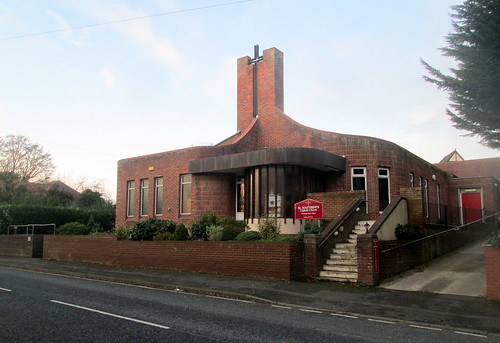
Ponteland is a largish village in Northumberland, just northwest of Newcastle upon Tyne.
Beside the A 696 road into the town from the northwest lies an Art Deco style church building, St Michael’s Catholic Church.
Curved wall, rule of three in nearer windows, styling of cross:-

Curved exterior, canopy and roof line, styling of cross:-
Posted in Empire Exhibition, Scotland, 1938, Exhibitions, Reading Reviewed, Scottish Fiction at 12:00 on 29 March 2022
B&W, 2000, 237 p.

This is a sequel to Davis’s novel The Clydesiders, though it might as well not have been. The actual plot here does not require it. It could as easily have been anybody’s daughter who fled the house after her grandfather died in front of her when she had frozen at his fit and not fetched his medicine. As it is, Davis more or less uses it as a thread to tie this one to the first book in her trilogy.
Wincey (Winsome) is that much-loved daughter of Virginia and Richard Cartwright, whom everyone sees as close to her grandfather. Wincey knows his darker side though. When he takes that fatal fit she watches immobile as he dies, before fleeing off and taking the first tram she sees. She ends up crying on a street in Springburn where Florence Gourlay befriends her and takes her home – as an orphan otherwise destined for the workhouse. In a sense Wincey strikes lucky. The Gourlays – father Erchie, mother Teresa, eldest sister Charlotte, twins Euphemia and Bridget and Granny, Erchie’s mother, who gets all the best lines – are a friendly loving family and treat Wincey as one of their own.
It is the thirties though, and times are hard with Erchie unemployed. Salvation comes with the family’s sewing activities spearheaded by Charlotte but which, with Wincey’s help and Erchie’s knack for mending machines, is built up over the years into a successful business. Flies in the ointment are employee Malcy making up to Charlotte with an eye to the main chance and Wincey’s total aversion to men. She is cold even to Erchie, who has given her no reason to be. Very occasional chapters deal with the loss Virginia and Richard feel at Wincey’s disappearance, the strains it places on their marriage and their ongoing friendship with Virginia’s first husband James Mathieson, bound as they are by their socialist principles.
All this takes place in the shadow of the 1930s, the growth of Nazism in Germany and the shadow of forthcoming war. One bright spark is the Empire Exhibition of 1938 held in Glasgow’s Bellahouston Park, the mention of which in the book’s blurb enticed me to buy it in the first place. Literally bright; the night time illuminations were famously spectacular. Though Davis has clearly researched it (she may even have attended the event,) the scenes at the Exhibition itself are a little cursory. Then again a lot of the book is. Relationships are sketched out, developments telescoped, the treatment rushed, the information dumping and drawing of background somewhat crude. Sometimes conversations are too obviously designed to provide the reader with explanations. Though probably true to life as it was then the female characters seem much too eager for Wincey to be married off given she’s still in her mid-to-late teens.
Davis has been described as Glasgow’s Catherine Cookson. I’ve not read any Cookson. And I won’t in the future.
Pedant’s corner:- Davis uses the term ‘abusing’ of Wincey’s grandfather’s treatment of her. That’s an anachronistic word for what was more likely known in the 1930s as molesting or interfering with.
Otherwise; “of the abdication King Edward VIII” (abdication of King Edward,) “‘Any digestives,’ Granny asked” (a question mark, not a comma, after ‘digestives’,) “hokey kokey” (hokey cokey,) an end quotation mark in the middle of a piece of direct speech. “‘For years they’ve been these camps’” (there’ve been,) a missing comma before a piece of direct speech. “‘Did she do along with this story’” (go along.) “‘Hiding’ yer heid in the sand’” (Hiding, [or, Hidin’] yer heid.) “‘An aw wis right’” (An ah wis right,) “‘When’s she ever been a blether,” Granny wanted to know’” (a question mark, not a comma, after blether) “along side” (alongside,) “the Atlantic restaurant” (it’s a proper noun, so Atlantic Restaurant,) “‘You really do believe there’s going to a war, then’” (going to be a war.)
Posted in Art Deco, Empire Exhibition, Scotland, 1938 at 12:00 on 23 March 2022
Brilliant coloured postcards of the South Cascade and Tower by Night at the Empire Exhibition, Scotland, 1938. The A697 code number on the left hand one tells me it is an Art Drawn card by Brian Gerald. The more muted one on the right is to all intents and purposes identical though it is missing the UnionJack on the Tower’s flgapole. Despite its different code number it was also produced by the same postcard company, Valentine’s. I suppose it may have faded over time but on the other hand it may have been printed this way. My copy of it claims to be a real photograph.


Stunning stuff, whatever.
The Tower of Empire (Tait’s Tower) was certainly impressive. More so at night, judging by these.
Posted in Architecture, Art Deco, Trips at 12:00 on 6 March 2022
This is apparently the room the Queen Mother used when she visited her childhood home at Glamis Castle as a young married woman. It is kept as it was in those days:-
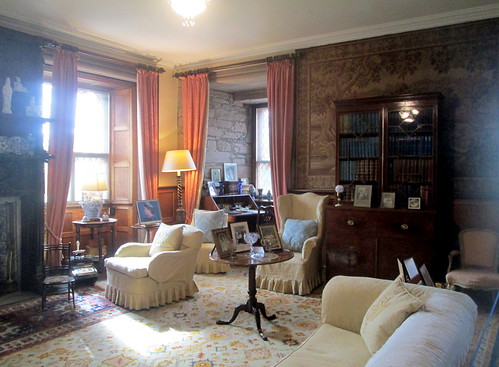
Fireplace and chairs used by the Princesses Elizabeth and Margaret Rose:-

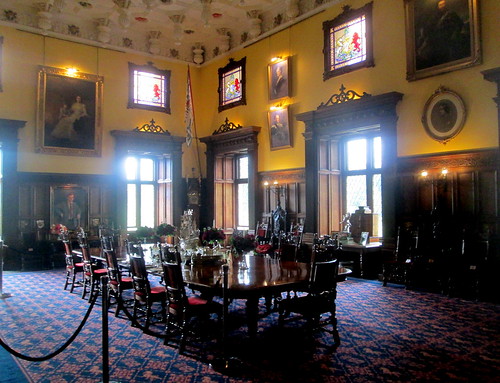
Dining Room, note armorial stained glass:-
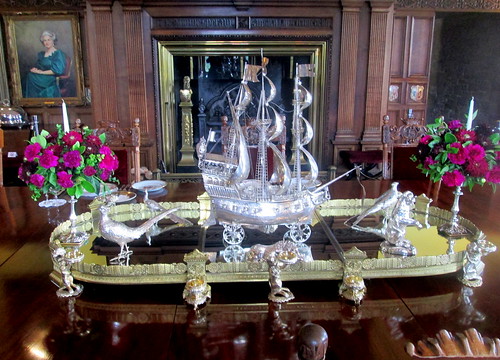
Dining Room centrepiece:-
Cupboard in Dining Room:-

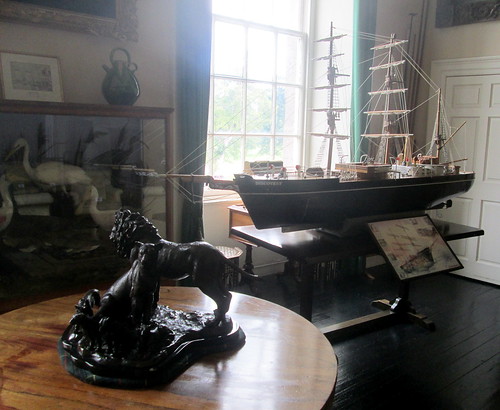
Model of RRS Discovery the original of which can now be found in Dundee:-
Drawing Room. The large painting is by Jacob De Wet:-

Drawing Room fireplace:-

Note again small chairs as used by the Princesses:-

Fireplace in Billiard Room:-

Lovely Art Deco cot used by Queen Elizabeth II when she was a child. And a nice rocking horse:-

Posted in Art Deco, Empire Exhibition, Scotland, 1938 at 12:00 on 24 February 2022
Another Brian Gerald Art-drawn postcard from the Empire Exhibition Scotland 1938. Pavilions for South Africa, New Zealand, Australia and Canada on left with Palace of Engineering at far end:-

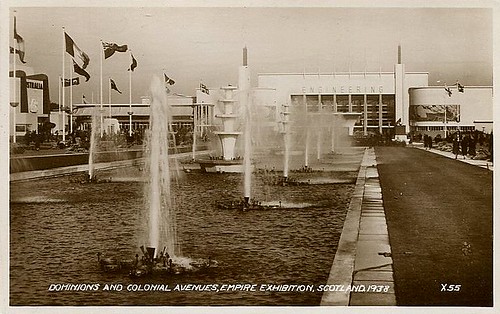
Valentine’s sepia postcard of the Dominions and Colonial Avenues at the Empire Exhibition Scotland 1938 featuring fountains, Australian Pavilion and Palace of Engineering:-
Reverse view. Another Valentine’s postcard. Australia and Canada Pavilions to near right, Palace of Industries at far end:-

Valentine’s sepia postcard of Canada Pavilion plus Palace of Engineering at far end. Tower of Empire in background left:-

Posted in Art Deco, Empire Exhibition, Scotland, 1938 at 20:30 on 21 February 2022
I haven’t posted one of these for a long while now.
A Brian Gerald art-drawn postcard of buildings and floral displays at the Empire Exhibition Scotland, held in Bellahouston Park, Glasgow. Palace of Engineering to right, Garden Club in centre, below Tait’s Tower:-

Posted in Architecture, Art, Art Deco, Dumbarton, Exhibitions at 12:00 on 17 February 2022
The Queen’s Gallery lies over the road from the Scottish Parliament, Holyrood, and close by Holyrood Palace. It has recently been refurbished and styled with a blonde wood.
Art Deco style lamp in niche by entrance to the Queen’s Gallery:-

Lower part of stairwell:-

Upper part of stairwell:-

Stair guard rail:-

Ceiling + Light:-

At the time we visited there was an exhibition of paintings illustrating the lives of Queen Victoria and Prince Albert.
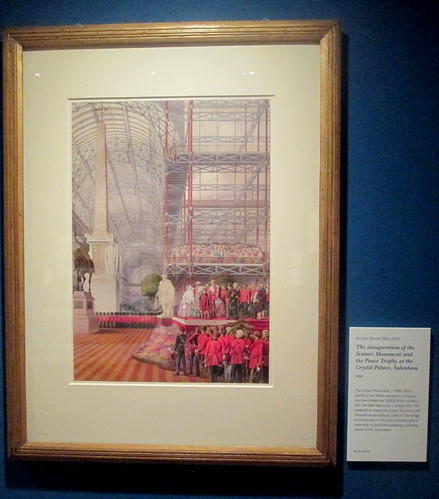
Painting of Scutari Monument at Great Exhibition. (The Great Exhibition is one of my interests so I had to photograph this):-
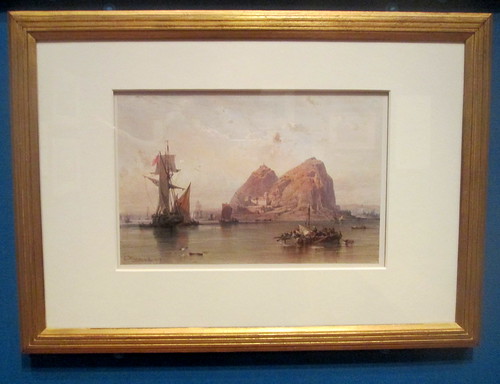
Similarly this painting by Edouard Hildebrandt of Dumbarton Rock and Castle was a must:-
Information card re painting above:-