State Rooms, Traquair House
Posted in Trips at 12:00 on 24 September 2026
Drawing room:-


The dining room is situated in one of the new wings of the house:-


The old laundry has been preserved:-

Posted in Trips at 12:00 on 24 September 2026
Drawing room:-
The dining room is situated in one of the new wings of the house:-
The old laundry has been preserved:-
Posted in Trips at 13:00 on 23 September 2026
Pottery:-

There are two rooms in Traquair House used as libraries. First:-

Second:-


In an upper room there is this diploma given to the house owner Sir John Stewart by Charles I:-

The above lies in a cabinet below a mural:-

Description of mural:-

Further along the upper floor is a bedroom:-

One part of an old painted ceiling has been kept exposed:-

View of maze from house:-

Posted in Reading Reviewed, Scottish Fiction at 14:00 on 22 September 2026
Canongate, 2026, 316 p.
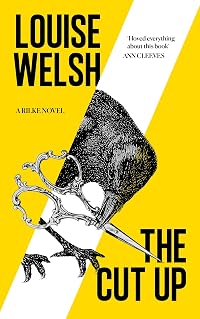
A third outing for Welsh’s Rilke, auctioneer at Bowery Auctions in Glasgow – and sometime private investigator. On page 1 – no messing here – he discovers a body on the auction rooms’ back premises. This is Mandy Manderson, a Bowery Auctions client, killed with a hatpin pushed through his eye; a hatpin which Rose Bowery, the auction rooms’ owner, had been brandishing before television cameras as a potential murder weapon only hours earlier. To protect Rose, whom he knows is not a killer, Rilke removes the hatpin, cleans it up and restores it to the auction lot before calling the police.
Rilke thereafter is treading a fine line between the SIO, Inspector Murchison, son of a well-known judge, and crime boss Ray (Razzle Dazzle) Diamond, who has taken displeasure at Rilke’s childhood pal Les, recently out of jail, but wants Rilke to find the killer since Manderson had been on his payroll.
Throw in Rilke’s homosexuality, dodgy cop Thurso Scanlon (Les’s nemesis and also on Rilke’s case,) a connection to Gallowhall, a former boys’ home with a bad reputation, and the pot is well stirred.
This is the usual accomplished offering from Welsh, with rounded characters, a cast of suspects, the sense of Glasgow as a city, a well-placed hint of the perpetrator and some red herrings to follow up.
Pedant’s corner:- “A table of actors …. were engaged in” (the subject of the verb here isn’t actually actors but table; ‘a table of …. was engaged in’,) “Jetpacks’ ribs” (Jetpacks’ several times; Jetpacks’s.) “A selection of sandwiches and shop-bought cakes were sweating beneath clingfilm” (a selection … was sweating,) “Mary, Queen of Scots’ final walk” (Scots’s,) “Tam Shepherds Trick Shop” (Shepherd’s, surely?) sat (x 2, sitting,) Panetella (x 3, that type of cigar is a Panatella, panatela or panetela.)
Posted in Bridges, Trips at 15:00 on 21 September 2026
River Tweed at Coldstream:-

From same vantage point but looking towards the bridge at the border with England:-

I have featured Coldstream War Memorial before, a cenotaph inset into a wall, but this is a better photo:-

This time I took a close-up of the dedications and names:-

Posted in Dumbarton FC at 16:30 on 20 September 2026
SPFL Tier 4, The Rock, 19/09/26.
Football is a funny game. On the face of it this was a comprehensive win, yet at no time during it did it feel that way. Yes we scored early, a fine move down the right with Robbie Cleary and Mikey Doyle exchanging passes before Doyle crossed for Deryn Lang to get in front of his defender and smash the ball in. But the BBC statistics show we had only 31% possession over the whole game.
Mind you new loan keeper Mason Munn barely had a save to make, certainly not from a threatening shot. It has to be said he looked assured enough, a contrast to Harry Broun who has now left the club again after only rejoining a couple of weeks ago.
The formation was strange again, selection bingo once more at work. The choice of fielding Leighton McIntosh in midfield seemed odd but someone on Pie and Bovril opined he had been given a man marking job. Another returnee, Tom Lang, helped to shore up the defence. While Spartans moved the ball about – and looked as if they had played together before – they seemed to lack penetration.
We did little of attacking note in the first half after we scored and thoughts of last week’s second half capitulation against Stranraer were never far away.
The second goal changed things and, like two weeks ago against Elgin, there was an air of freakishness about it, Robbie Cleary’s corner bouncing off a defender and going in off the post. The players celebrated it big style.
I thought to myself, though, how on Earth are we winning this 2-0? Apart from the goals their keeper hadn’t a save to make. It was that kind of game.
Spartans had to come at us a bit more after that and despite our last two substitutions smacking of a defensive mindset we managed up the park a few times. Josiah Sowa, who had come on midway through the half, showed just how good he can be at exploiting space when he cut in from the left and pinged a beauty in for no 3 in stoppage time.
We’re now joint second bottom, or alternatively, joint sixth and only two points off the promotion play-off spots. No chickens being counted here though. I think the players won this despite the manager, not because of him.
Posted in Scottish Football Grounds, Trips at 12:00 on 19 September 2026
Home of Coldstream FC.
Unsurprisingly they play in Coldstream, the first village/town in Scotland when travelling over the border from England via the A 698.
The club was a founder member of the East of Scotland League in 1923 and is now that league’s longest serving member, playing in its First Division (its second tier, after the Premier,) the 7th tier of Scottish football. It has long been eligible to play in the Scottish Cup.
Home Park lies at the edge of the town’s park, also called Home Park, the play area of which is to the left here:-
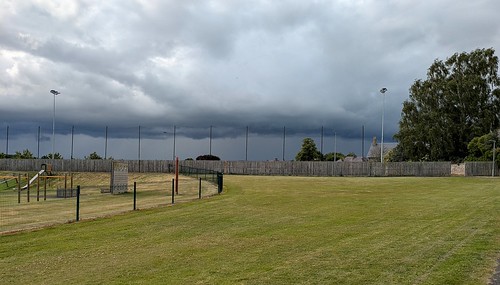
South end of the football ground:-

Looking north. The path beside the pitch (right) is a public footpath which has to be closed off for matches to be played.

Posted in 1990s, Music, Something Changed at 12:00 on 18 September 2026
MacColl’s first “hit” of the 90s. It only reached no 82 though. Lyrically it’s coming from a similar place to her first hit, There’s a Guy Works Down the Chip Shop Swears He’s Elvis. This one isn’t at all “rock”y, though, and has a Country feel.
Kirsty MacColl: Don’t Come the Cowboy With Me Sonny Jim
Posted in History, Trips at 12:00 on 17 September 2026
Bells to summon servants, Traquair House:-

A harpsichord:-

Ground floor room:-

Cradle used for James VI (James I of England):-

Bed of Mary, Queen of Scots:-

Relics of Mary, Queen of Scots:-

Posted in Architecture, Trips at 12:00 on 16 September 2026
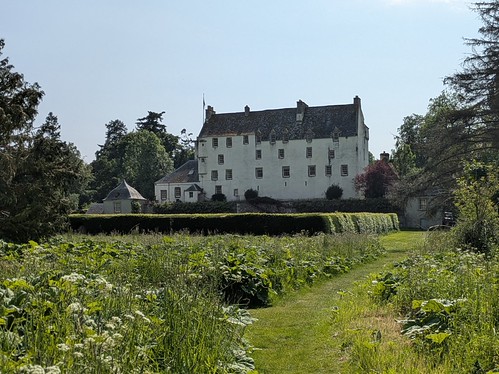
Traquair House is Scotland’s oldest continuously inhabited house.
House from distance:-

Closer view. there are “new” wings to either side:-

Right side new wing:-

Left side new wing:-

A drawing of Traquair House in earlier days is on one of its internal walls:-

Rear of house, hedged maze in middle ground:-
Posted in Other fiction, Reading Reviewed at 12:00 on 15 September 2026
Penguin, 2024, 249 p. Translated from the Japanese お探し物は図書室まで (O-sagashi mono wa toshoshitsu made, literally “Please go to the library for what you are looking for,”) POPLAR Publishing Company, 2020, by Alison Watts. Illustrations by Rohan Easson.

This book’s title is surely designed to appeal to book lovers. Yet, in a sense, it must be preaching to the converted. Book lovers will all have used libraries and, crucially, already read books and thus need no encouragement to pick one up.
There are five stories within, all with a similar trajectory. Each of the lead characters has a reason to visit the Hatori Community House situated by a local school and gets drawn to its library where the librarian, Sayuri Komachi, recommends books to them and at the same time proffers a gift of a felted toy from the many she spends her time making.
The viewpoint characters are:-
Tomaka, a sales assistant in womenswear at Eden, a Department Store.
Ryo, who works in accounts for a furniture manufacturer but yearns to start an antiques business.
Natsumi, a former magazine editor moved sideways to a less fulfilling role on having had a child.
Hiroya, a thirty-year-old NEET who has neglected his talent for drawing.
Masao, recently retired and feeling a lack of direction.
Unfortunately, this all involves a lot of repetition of information as each character relates the details of their first visit to the Community House in very similar terms. There are also some instances of the relaying of characters’ internal thoughts or reactions which are rendered far too colloquially thus breaking readers’ suspension of disbelief.
There is discussion of the content of the borrowed books (in one case it’s not borrowed, since it’s too heavy to carry far, but rather consulted,) publishing details of which are appended in the Bibliography.
Special pleading for the utility of reading occurs when one of the narrators tells us “Books belong to everybody: the creators, the sellers and the readers.” Similarly, Ms Komachi says to another, “Readers make their own personal connections to words, irrespective of the writer’s intentions, and each reader gains something unique.”
It’s all very easy to read and undemanding but somehow feels inconsequential.
Pedant’s corner:- Uses British spellings but has the occasional USianism – sidewalk, sneakers, schoolyard, some schoolchildren are said to be in third or fourth grade. Otherwise; “inside in my stockings” (either ‘in my stockings’ or ‘inside my stockings’,) “I did use to talk with him” (did used to.)
