Archives » Scotland

Preferred Lies by Andrew Greig

A Journey to the Heart of Scottish Golf. Weidenfeld and Nicolson, 2006, 289 p, including i p Acknowledgements and Thanks and ii p Contents.
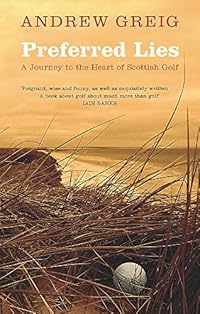
This project was undertaken after Greig’s surgery for a serious condition involving pressure on his brain, surgery from which recovery was by no means guaranteed. Thankfully his brain and other functions remained unscathed but it prompted a look back on his life and the golfing experiences of his youth. His father had introduced him and his two brothers to the game when they lived in Anstruther and he had become proficient enough to be asked to represent his county in youth tournaments but he drifted away from the game quite early.

The book is divided into eighteen sections (naturally) each reflecting an outing to a particular course or courses and each with its own addendum musing on the nature of life and golf, especially as related to Scotland and the Scots. All are tinged with Greig’s customary humaneness.

The courses range from South Ronaldsay, whose greenkeeping is entrusted to the local sheep – a feature which leads to its own all but unique hazards which the sheep leave behind them – to Anstruther, St Andrews, Bathgate, North Berwick, Gigha and even Iona, among others.

Greig says about his Dad and his golfing cronies, “They share a very Scottish sense that good fortune must come with a penalty.”

An attitude which has rubbed off. After being congratulated on a good shot by a woman called Joan (who came from the US) Greig replied, “‘It doesn’t happen often,’” only to be asked ‘Have you never heard of positive thinking?’

“‘Sure,’ I laughed. ‘In Scotland we call it kidding yourself!’

‘I call it unhelpful pessimism.’

‘We call it realism.’”

Of that quintessentially Scottish weather phenomenon he elaborates, “Dreich is our word for it. Our climate has made the word necessary, and its persistent, clinging gloom accounts for a lot of the Scottish mindset.”

Apropos his round at Bathgate – a much spruced up course from the one Greig remembered and a development he does not quite approve – he quotes playing partner Alastair McLeish, “‘Aye, Scottish Protestants,’ Al remarked after struggling himself in the opening holes. ‘We’re perfectly able to torture ourselves without any assistance.’”

The course on Gigha invoked in Greig thoughts which are an enduring theme of Scottish literature, a sense of important things lost. “The sorrow and loss are part of the beauty, but that doesn’t make them good. One of the reasons I’ve never lived in the West, despite it being part of what I must call my soul, is it’s too damn sad.”

In the end golf can be seen – like most sports – as some sort of metaphor for life. “Mostly golf is about self-inflicted suffering, self-knowledge and hard-won (precious because hard-won) joy. Who but the Scots could evolve a game that offers such opportunities for humiliation and failure, and no-one but oneself to blame for it? And such transcendent moments?”

Pedant’s corner:- “but there no witnesses” (but there were no witnesses,) “the unspoken immanence of death wasn’t terrifying” (immanence does make a kind of sense; but imminence seems more to the point,) “boys and girls getting up to good in the open privacy of the this coastal strip” (of this coastal strip.) “Princes Sreet Gardens” (Princes |Street Gardens,) “before dying in Iona” (on Iona,) “Forres’ first tee” (Forres’s.) “”I wiled away my last Dollar hours” (whiled away,) “more like one those summer evenings” (one of those summer evenings.)
John Robertson

Much underrated Scottish footballer, and Nottingham Forest legend, John Robertson died on Christmas Day.

He was never the most athletic looking of men (which probably led to that underrating) but he was described by Brian Clough, the manager who got the most out of him, as “the Picasso of our game” and by his Nottingham Forest teammate John McGovern as “having more ability than Ryan Giggs.” Forest coach Jimmy Gordon rated him as “a better player than Tom Finney and Stanley Matthews.”

He is one of the few Scotsmen to win two European Cups, providing the assist for the winning goal in his first in 1979 and scoring the winner himself in the second a year later.

He also scored a winner for Scotland against England at Wembley. In 1981: Scotland have only won once there since.

John Neilson Robertson: 20/1/1953 – 25/12/2025. So it goes.

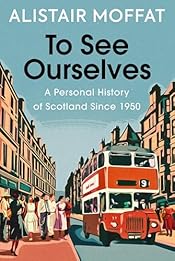
To See Ourselves by Alistair Moffat 

A Personal History of Scotland Since 1950. Viking, 2025, 270 p, including  3 p Foreword, 16 p Index, 2 p Further Reading and 1 p Acknowledgements.

As the title suggests this is a History of Scotland over the past 75 years as seen through the author’s eyes. He was brought up in Kelso, firstly in what he says people dismissively called a prefab, then a council house, in a time before the rise of supermarkets, when the food was local, without a hint of air miles, and goods were dispensed from larger containers into smaller carriable ones by the shop assistant (in my experience this was usually a man.) At the time most houses did not have a fridge – never mind a freezer – so food was consumed more or less on the day it was bought, necessitating many visits to the shops each week. Moffat waxes most nostalgic about the milk from the local farmer, rich and creamy or richer and creamier – no skimmed milk back then – but that food products from the Empire were unremarked on, taken as read, as was Imperial paraphernalia such as the label on Camp Coffee bottles. He also remembers, as do I, that Christmas was a working day in Scotland until very late in the 1950s.

His father was of the generation that knew its place and still suffered from deference to the landed classes (the Duke of Roxburghe’s Floors Castle lies just outside Kelso.) When Moffat’s elder sister performed well enough in school to get to University her dad at first was against it but his wife prevailed on him so off the sister went and in due course Moffat followed. Corporal punishment by the tawse was an everyday feature of Scottish schools at that point and Moffat outlines the circumstances that led to its abandonment.

The mid-1960s expansion of university places and the provision of grants made working class attendance at University eminently affordable for Moffat’s contemporaries and he laments the present system whereby, notwithstanding the provision for tuition fees, Scottish students now rack up huge debts while gaining a degree. He is also of the opinion that student life ought to be about more than educational attainment rather than narrowed down to academic performance.

The coming of television altered daily life as did the advent of The Beatles, the sexual revolution, and the Abortion Bill sponsored by Moffat’s local MP, David Steel.

Agriculture too has changed, the coming of the little grey Fergie tractor with its device for transferring power to farm implements hastening the demise of the horse and the jobs that they necessitated, grooming, smithing etc.

The decline of church-going has been precipitate (apparently now attendance at Catholic services outstrips the Church of Scotland, a fact which would have astonished those formidable eighteenth and nineteenth century adherents of the Scottish Reformation.) He touches on the religious divide which still mars life in Scotland. Apparently in staunchly Protestant Larkhall the lowest traffic light of a set was smashed on a routine basis, ASDA was even discouraged from opening there due to its green livery.

Newspaper readership was once much higher in Scotland than in the rest of the UK, the Saturday evening ‘pinks’ a feature, and Sundays were dominated by the Sunday Post, adorned by its pullout “Fun Section” – The Broons, Oor Wullie and all, and its border editions covered rugby extensively.

Moffat tells us that the Sunday Post was a true newspaper, with broad coverage of foreign news. “Couthy, borderline obsessive about Scottish sports reporting and constantly upholding what might be seen as the values of the Kirk – the Sunday Post was all of those things. But parochial it was not.” He then adds the killer line, “The paper even covered events in England.”

He remarks on the liberation of the licensing laws – which has not led to the deterioration of behaviour its critics feared and predicted but, he says, to a more measured approach to alcohol consumption – and laments the decline in amateur sport.

He notes the transformation of women’s place in society, and the highlighting of domestic abuse which had once tended to be considered a private matter but is now treated more seriously.

His final chapter is titled Permacrisis and deals with the upheavals, political and otherwise, which the world has seen over the past decade.

As a summary of the Scots experience in the past seventy years To See Ourselves is an excellent primer.

Pedant’s corner:-  Wilfred Brambell (Wilfrid Brambell,) the Glasgow Evening Times’ editorial  (Glasgow Evening Times’s,) “Robbins’ expansion” (Robbins’s,) the Hawkins’ house ( Hawkins’s,) the Flower Pot Men (the Flowerpot Men,) I Love Lucy is implied to have been aired on STV (I remember it as being on the BBC,) “Captain W E John’s Biggles” (Captain W E Johns’s,) “each Autumn Scottish schoolchildren were allowed off school for the ‘tattie holidays’” (not in all Scotland, certainly schools in Dumbarton didn’t have that break, though an October week or two is now, I think, standard across Scotland,) spikey (spiky,) “more liberal that in England or Wales” (more liberal than,) “the orchestra reached a crescendo” (crescendos are not reached; they build,) “the Lionesses won the European Champions Cup” (actually the European Women’s Championship; the Champions Cup is for clubs,)  “a Scottish businesswomen” (businesswoman,) “Liz Truss’ childish petulance” (Truss’s – as it was on the next page,) “seem not be episodes” (seem not to be episodes,) “Nana Hawkins’ house” (Hawkins’s.)


Scotland 0-3 Greece

UEFA Nations League Play-off, Hampden Park, 23/3/25.

After a sterling performance in Piraeus on Thursday Scotland came down to earth with a bump at Hampden in the second leg.

They never looked like matching Greece’s commitment or cohesion. In the end 0-3 rather flattered us.

I fear for the World Cup qualification campaign now. Only the group winners qualify directly – and on this evidence that may well be Greece. It looks like Scotland may have to finish above either Denmark or Portugal (whichever loses their Nations League quarter-final is in our group) even to get a play-off place.

So two relegations in two days for teams close to my heart.

Football is a cruel mistress.


Ron Yeats

Former Liverpool and Scotland footballer Ron Yeats has died.

His arrival at the club, along with Ian St John, was credited by the legendary Bill Shankly as being the turning point to propel Liverpool to the top of the English game in the 1960s. Prior to their signings Liverpool had been jogging along as a middling Second Division club. So impressed was Shankly by Yeats that he immediately made him captain. Promotion followed straightaway, then two Championships sandwiched Liverpool’s first ever FA Cup win. Such was his stature that he was nicknamed “The Colossus”.

Given all that it now seems surprising that Yeats was only ever capped by Scotland twice.

Ronald (Ron) Yeats: 15/11/1937 – 6/9/2024. So it goes.

Tom Nairn

I only discovered yesterday that Tom Nairn, the Scottish historian who came up with the memorable phrase that “Scotland will be free when the last minister is strangled by the last copy of the Sunday Post,” has died.

He is most famous for his critique of the British state which he dubbed Ukania for its monarchical resemblance to a Ruritanian archetype, anatomised in his book The Break-Up of Britain.

An advocate of Scottish independence, his Republicanism and Marxism, though neither Trotsykist nor Stalinist – his sojourn in Italy led him to lean towards Gramsci – probably did not help his career.

Thomas Cunningham (Tom) Nairn: 2/6/1932 – 21/1/2023. So it goes.

North Cascade and Tower, Empire Exhibition, Scotland, 1938

I haven’t posted any of these for quite some time.

So here are three views of the North Cascade and Tower at the Empire Exhibition, Scotland, 1938, held in Glasgow’s Bellahouston Park.

First one of Brain Gerald’s art-drawn postcards:-

View of Empire Exhibition, Scotland, 1938

This is a very similar view but is a colourised photograph:-

North Cascade and Tower by Night, Empire Exhibition 1938

This one, also a colourised photograph, omits the fountain:-

Different View, North Cascade and Tower by Night, Empire Exhibition 1938

Ukraine

It goes without saying that what is happening in Ukraine is terrible and totally unjustified.

Sadly it does not look as if it will end any time soon.

As in the law of unintended consequences, Vladimir Putin’s intention to prevent any further expansion by NATO has been thoroughly undermined by his unprovoked attack on a neighbouring country. As a result Finland has pivoted to being amenable to joining NATO and even Sweden, the neutral country par excellence, is thinking about it.

What Putin hoped to achieve by attacking Ukraine and killing its citizens is incomprehensible. What is certain is that he will now have made Ukrainians implacably opposed to close ties with Russia, still less to incorporation into it. I am reminded of the English King Edward I’s campaigns to subjugate Scotland, the single most important factor in forging a sense of Scottish nationhood, and still relevant over 700 years later. Something similar to this will be Putin’s legacy. From now on, no matter the outcome, Ukrainians will not trust Russia or its intentions for a very long time indeed.

On Charles Stross’s blog there is an appeal from the writing community in Ukraine for everyone to make their best efforts to help Ukraine and to inform Russian citizens of the true situation.

Outbreak of Flags

Scots are not generally given to flag-waving from their properties.

Exceptions come when the national football team qualifies for a major tournament; as it did for Euro 2020 (due to Covid, played in the summer of 2021.)

Maybe there was an extra excuse this time because the previous occasion when Scotland graced a big tournament was in 1998!

Scotland Flags Again

More Scotland Flags

The flags have long gone now.

Croatia 3-1 Scotland

Euro 2020, Group D, Hampden Park, 22/6/21.

Well we know this is how it goes. A gallant effort but this was knowhow – and class – against inexperience. Their control, passing and movement made it look like men against boys.

At least we got a goal.

It’s hard to resist the thought that – notwithstanding they’d never beaten us before – the Croats targeted this game. They certainly played way better than in their previous two outings. They never looked at all bothered or likely to lose and in Luka Modrić they had an outstanding player who totally bossed the game and scored a superb goal. And Ivan Perisić wasn’t far behind.

Maybe Scotland’s players will have relished the experience and it motivates them to want to have it again – whether at Qatar next year or in the next Euros.

We can hope.

But it’s the hope that kills.

free hit counter script