Archives » Scotland

England 0-0 Scotland

Euro 2020, Group D, Wembley Stadium, 18/6/21.

Well. The first thing you have to say is that Scotland deserved at least a point. It was a great performance by the players – perhaps unlucky not to get the win. But for that you have to put the ball in the net. We were never convincing about the ability to do that.

A win against Croatia ought to see us through. But they’ve got quality in midfield and upfront and it will be a very difficult game. The other thing that worries me is that they’ve never beaten us. That run has to end sometime.

And we know how this goes. Scotland put in a gallant effort and somehow still contrive to muck it up.

On Tuesday evening Croatia will burst our bubble with about ten minutes to go. Watch through your fingers.

Scotland 0-2 Czech Republic

Euro 2020, Group D, Hampden Park, 14/6/21.

Plus ça change, plus c’est la même chose.

This is how it goes with Scotland.

No luck, their keeper making at least three very good saves – the one where he prevented the sclaff from his own defender going in being superb – hitting the bar, losing goals at the wrong times – though there’s never really a good time to lose one – with one of them a brilliant piece of execution from the sort of forward player we lack.

I refused to express any hopes for a good outcome before the game but hope nevertheless stirred early on. Fatal, fatal.

Still, it would be just like us to get a result* against England on Friday now.

Then a plucky display against the Croats before going out on goal difference again.

*Not a win obviously.

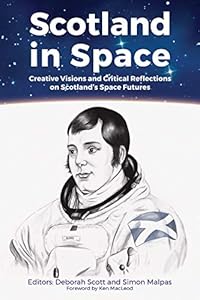
Scotland in Space

Creative Visions and Critical Reflections on Scotland’s Space Futures. Editors: Deborah Scott and Simon Malpas. Foreword by Ken MacLeod

Shoreline of Infinity/The New Curiosity Shop, 2019, 179 p.

Ken MacLeod’s wittily titled foreword “Steam me up Watty” (though he was not the first to it, Watt being apparently one of Birmingham’s finest, according to the Birmingham Mail) sets the scene for Scotland’s entitlement to a share in space endeavours while the editors’ Introduction explains the project’s genesis.

The main body of the book has three sections, each with a story specially written for the book, and academic essays complementing or critiquing the points it brings up.

Scotland and Mars has Pippa Goldschmidt’s Welcome to Planet AlbaTM!, set on the eponymous vistor centre next to a launch pad somewhere in the north of Sutherland, where tourists can experience a VR sensation of walking on Mars at a time when the first humans are actually on their way to the Red Planet. Narrator Ali is of Arabic extraction and spent some time working in the US. The story is about loneliness, rootlessness and fitting in. Alastair Bruce’s essay Mars: There and Back Again relates the hows and when of getting to Mars and the latest plans for that. Sean McMahon discusses what colour Mars really is. (Spoiler: not red – in fact it’s a mixture of browns, beiges and orange with the (very) occasional blue sunset or -rise.) Elsa Bouet in Red Journeys: ‘Welcome to Planet AlbaTM‘! and the Martian Literary Imaginary assesses Pippa Goldschmidt’s story and its themes among the history of Mars in fiction, Wells, Bradbury, Robinson et al.

Fringe in Space begins with Laura Lam’s story A Certain Reverence which is larded with Scottish words and usages. It’s narrated by Blair Orji. She is part of a Scottish contingent, either scientists or entertainers, to a tidal-locked planet orbiting Proxima Centauri b where aliens (who have already given humans access to all-but-light speed technology) are waiting to be exposed to Scots culture. In Life, but not as we know it: the prospects for life on habitable zone planets orbiting low-mass stars Beth Biller considers how we have identified such planets, their nature and how to tell if they are habitable. Tacye Philippson, senior Science Curator at National Museums Scotland, in Alien collecting: speculative museology, assesses what aliens might consider worth collecting from Earth and from Scotland in particular.

Scotland at the end of the Universe starts with Russell Jones’s story Far, in which an (almost literally star-cross’d) love story is blended in with an Inflation Drive which allows a newly independent Scotland to be transferred across the universe. The appearance of the story is notable for its layout which resembles that of modern poetry at times (unsurprisingly as Jones is a poet) but also for the brightly coloured illustrations of drinks glasses and what looks like microwave background images plus a few diagrams and the word ‘Yes’ rendered in blue in the font used for promoting that result during the 2014 Independence Referendum. In The Multiverse Catherine Heymans explains how cosmic inflation (which describes how the early universe must have expanded, its signature left as the cosmic microwave background,) violates Einstein’s General Theory of Relativity but how an Inflation Drive could indeed be a way of travelling faster than light – except for the problems involved in switching it off. Vatjaz Vidmar’s Of Maps, Love Stories and the Universe describes both fiction and science as kinds of maps delineating connectedness and that bonding in this way (as within or between atoms) may be the universe’s resistance to its own demise by heat death.

Colin McInnes’s Afterword notes that the first person to give a description of rocket propulsion (in 1861; well before Goddard and Tsiolkovsky) was a Scot, William Leitch, from Rothesay, and that Scotland is well to the fore in modern space technology, Glasgow now manufacturing more spacecraft than any other European city, a possible proving ground for the exploration of space both fictionally and in reality.

Pedant’s corner:- Jones’ (Jones’s.) “The tourists area” (ought to have an apostrophe; tourists’,) McFadyan (unusual spelling of McFadzean, though presumably pronounced the same way,) “Susan and me carefully wriggled through” (Susan and I,) a missing quotation mark before a piece of direct speech, “about half the diameter Earth” (of Earth,) Marts (Mars’s,) “one variant of these are ion thrusters” (one variant is – even if the ion thrusters are plural they are still the one variant,) Wells’ (Wells’s,) tinging (tingeing,) censors (sensors.) “Scotland’s always dead set on doing it on our own aren’t we?” (either ‘We Scots are always …aren’t we?’ or, ‘on its own, isn’t it?’) “because a shipful of dead humans arrive is likely” (because if a shipful it is likely.) The binary star of Alpha Centauri blaze in two, tiny pinpoints” (stars,) “as we bowed and rose back up, still panting. The humans…” (as we bowed and rose back up, still panting, the humans ….) “Only happened once a millenia or so” (once a millennium,) Anglada-Escud é (Anglada-Escudé,) electronic shocks (electric shocks.) “This class of exoplanet have temperatures…” (This class has …,) “metamorphised limestone” (metamorphosed, or, since this was marble, ‘metamorphic’,) a missing full stop (x 2,) “now the vote and die has been cast” (plus marks for ‘die’ but that ‘and’ makes the verb’s subject plural; ‘have been cast’,) sat (x 2, sitting,) “their owner” (x 2, each time it was a dog, so ‘its owner’,) Heymans’ (Heymans’s,) “using the same physics that can predict the original temperature of your cup of tea 13.8 minutes after you brewed it” (not ‘predict’, it’s already happened; ‘calculate’,) “very epicentre” (epicentre means off-centre; ‘centre’, if you must aggrandise it use the word ‘hypercentre’,) miniscule (minuscule,) the moon (the Moon.)
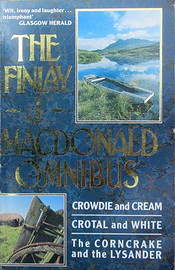
Crowdie and Cream by Finlay J MacDonald

Warner Books. First published 1982. In The Finlay J Macdonald Omnibus, 1988, 174 p.

The Finlay J Macdonald Omnibus cover

This is MacDonald’s memoir of growing up in Harris, (which is known as the Isle of Harris even though it’s only the southern half of an island: ditto the Isle of Lewis, the northern half.)

Between the Twentieth Century’s two great wars the south of Harris was being repopulated with the aid of a Government intiative but this was still a harsh time when there were few amenities in the temporary turf-roofed dwellings the families occupied while they built their own stone ones – and not many in those – though the remains of the houses whose occupants had been cleared several generations earlier were a stark reminder of worse. There were no inside toilets – the great outdoors sufficed. Water for drinking and cooking was drawn from a nearby burn. In the times Macdonald is remembering the more convenient Tilly lamp superseded paraffin lighting and its whiter light was a source of regret. Electricity and gas were not even a dream.

The book embeds a history of Harris as the author explains his family’s circumstances and delves into the customs of the islanders while the delights of Toffee Cow (McCowans Highland Toffee, now sadly no more) become one of the author’s pleasures as he grows.

A lot of the narrative describes MacDonald’s schoolroom reminiscences, especially the initial tribulations of being solely a Gaelic speaker till he attended school (whose medium was of course exclusively English -inevitably the tawse features at times) and despite this not being published till the author was in his fifties he still manages to retain (or simulate) a child’s perspective. “Gillespie and I had long since learned to distrust adults when they were trying to sound reasonable.” He also comments on the curious circumstance by which the education all the parents desired for their children would most likely ensure that those children would leave the island in pursuit of the opportunities which that education had brought.

The coming of the Great Depression brings further hardship as the Harris Tweed trade declines. (Its use of human waste to fix the dyes require for colouring the tweed obliging everyone – visitors included – to avail themselves of the pee-pot when nature called is matter-of-factly described.)

There are several moments of humour, the new schoolteacher’s Word Game foundering on the definition of an organ, the kilted Dr MacBeth misunderstanding the question asked of him by a new father – this last had me giggling for about half a minute; not the usual response to reading tales of bygone Scottish life.

Like many a Scottish novel this autobiography is another of those laments for a past time, of the loss of a way of life, a documentation of things past. MacDonald certainly has an eye for it, and a way with words – even if they are in his second language.

Pedant’s corner:- Port Sunlight in Lancashire (it’s in the Wirral peninsula, not traditionally considered Lancashire,) “ ‘grace and favour ” (this opened quote was never closed,) while pages later we had “ away down in the south’ ” (a closing quote mark for an unopened quote,) bye-blow (by-blow,) “having failed to illicit information” (elicit,) another end quote that had not been opened, another opened quote remaining unclosed, “until we were hustled off the bed” (off to bed,) liguistic (linguistic,) “to smoothe them” (smooth them,) “even the Prince of Wales wears it” – the kilt – “whenever he ventures north of the Caledonian Canal” (I don’t think Balmoral – or Braemar – are north of there,) goloshes (my dictionary gives this as an alternative spelling but it was always galoshes in my day.)

Black Watch Musuem, Perth, Scotland

The Black Watch Regiment’s Musuem is in Perth, Scotland, housed in an old castle, Balhousie Castle, Hay Street.

In the castle/museum grounds are several memorials. The entrance gates are dedicated to the memory of General Wavell.

This is a generalised one of a bagpiper but in Second World War battledress I think:-

Memorial at Black Watch Museum, Perth, Scotland

These are memorials to various other campaigns in which the Black Watch has taken part, most prominently here, Iraq:-

Campaign Memorials at Black Watch Museum, Perth, Scotland

When I visited in April last year this Great War commemoration took up a prominent position:-

Great War Commemoration at Black Watch Museum, Perth, Scotland

The museum itself is very interesting and took us longer to get round than we had anticipated. This cross – an original battlefield one from the Great War – was in memory of Captain W D MacL Stewart, 2nd Lieut P R Husband and 44 NCOs and men of the 1st Battalion Black Watch, who all died on 20/9/1916.

Memorial Cross, Black Watch Museum, Perth, Scotland

As I recall this group of medals was awarded to Fergus Bowes-Lyon the brother of the late Queen Mother and who is commemorated on Glamis War Memorial:-

Medals Black Watch Museum, Perth, Scotland

On a less sombre note the museum has an excellent cafe/restaurant in a modern building connected to the castle via the museum’s entrance and which is always very well patronised.

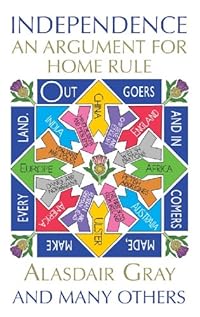
Independence by Alasdair Gray

An Argument for Home Rule.

Canongate, 2014, 130 p.

(This was published in 2014 in the run-up to the Scottish Independence Referendum as a companion piece to Gray’s earlier book Why Scots Should Rule Scotland. I bought it a year or so ago in a second-hand bookshop and took it along on our recent Baltic Cruise.)

 Independence cover

There are many differences between Scotland and the more southerly parts of the British Isles. The geology differs between Scotland and England and land usage is more problematic – one of the factors which led to the Romans withdrawing from what they called Caledonia to behind Hadrian’s Wall. Different attitudes to education (deriving from a desire in mediæval England to keep the lower orders in their place, whereas the Scots valued an educated populace especially after the Reformation in order that the people could read the Bible for themselves) persist to this day. Gray says, “When writer in residence at Glasgow University I was amused when a lecturer in English from Oxford or Cambridge told me, ‘It is amazing that someone of your background knows as much about literature as we do.’ Many Scots friends thought my learning considerable; none thought it strange I had it.” The prospect of a generally poorer standard of living due to agricultural factors led many Scots with a good education to venture abroad.

This book is not an argument that only “indigenous” Scots ought to be allowed to have positions of influence here. Gray is clear about the difference between what he calls settlers who wish to make their lives in Scotland and colonists who will sweep in (and out again) in order to promote their careers. He gives examples. Glasgow European Capital of Culture hired English administrators who did not organise any festivals or exhibitions featuring local or even Scottish authors or artists since they were mostly ignorant of anything good that had been made here. At least two such appointees announced they knew little about Scottish culture but “looked forward to learning about it.” Any such ignorance of English culture on the part of a Scottish administrator wishing to work in England would be laughable – and is difficult to imagine. Nor does Gray ignore the fact that many Scots did very well indeed out of the British Empire.

There is the occasional further barb, “one of those who were then reviled as middle men, and since Thatcher’s time have been praised as entrepeneurs“.

Gray’s argument is well set out but I doubt, in these times, it would convince any who are of an opposite persuasion.

Pedant’s corner:- CO2 (CO2.) “The warlike Irish kings left these monks in to promote their religion in peace” (no [first] “in”; or else, “left these monks in peace to practice their religion,”) Charles’ (Charles’s,) the Scots parliament accepted it and were denounced” (the Scots Parliament accepted it and was denounced,) Burns’ (Burns’s.) “The Jacobite invasion of England by a mainly Highland force, which hoped to succeed with English support, but finding they retreated back to Scotland” (but finding none they retreated.)

Scotland Qualifies for World Cup

No this is not a headline from a science-fictional Altered History.

Scotland’s football team really has qualified for a World Cup finals.

Scotland women, that is – a historic first for them. Congratulations to the team and management.

So we can now definitively say Scotland’s women are better than its men.

Beating Them at Their Own Game

Scotland win by 6 runs

Scotland win by 6 runs.

Over England. In a form of cricket, a game which England invented, at which England are at present the best in the world.

(Well, not now. Now Scotland are surely unofficial World Number 1 in One Day International cricket.)

This is a stunning result, as far as I know the first win Scotland has had over England in any form of cricket.

It shouldn’t be a surprise. Cricket is not really alien to Scotland. There are many practitioners of the art throughout the country. (I was one myself once, playing not only for my school but also for Dumbarton Cricket Club way back in the day. Not in any great capacity; I was only really there to make up the numbers. My proud boast though is that I never scored a duck when batting for the club.)

But back in the nineteenth century Scottish cricket matches used to attract crowds in the 10,000s. J M Barrie (of Peter Pan fame) used to be a member of a travelling cricket side known as the Allahakberries. (Possibly not a name you could get away with these days.)

It’ll be a heady day or two until normal service is resumed.

May Day

So. This is May’s day.

… — … … — … … — …
Dot, dot, dot; dash, dash, dash; dot, dot, dot. Dot, dot, dot; dash, dash, dash; dot, dot, dot. Dot, dot, dot; dash, dash, dash; dot, dot, dot.
Mayday! Mayday!

We in the UK have recently been sailing troubled waters but now we are coming out of a lea shore and are about to enter the full blast of the storm. Who knows what the political landscape of these islands will look like in three years’ time? A second Scottish Independence referendum has been made ever more probable by the UK goverment’s stance on a so-called hard Brexit and deaf ear to other voices.

Scottish independence might have been achieved on a relatively friendly basis in 2014 but I doubt that’s at all likely now.

The febrile English nationalists (for that is what they are) who have driven this headlong rush over a cliff have no thought of (or care for) Scotland – and still less for Northern Ireland for which this represents a double crisis, the “cash for ash” scandal having led to a breakdown of the power sharing arrangements. They will exact a heavy price for what they will no doubt see as a betrayal of “England, their England”.

I believe Theresa May is trying to look stern when she lectures all and sundry in the House of Commons and on television but to me she looks threatening – as in, don’t dare cross me, my revenge will be sweet – despite there being no substance behind her bluster. Scotland can look for no favours from her.

I never thought that another politician could achieve a position lower in my esteem than Margaret Thatcher did but Theresa May has managed it. (David Cameron, aka Mr Irresponsible, though he is entirely responsible for the mess the UK now finds itself in and amply demonstrated his irresponsibility by doing so and more so by running away from the consequences, is merely a buffoon by comparison.) May is potentially dangerous. Not so much in herself as in what may come after her.

The Stuarts on BBC 2

I watched the first episode of The Stuarts on BBC 2 tonight.

It seemed, like on its first showing on BBC 2 Scotland earlier this year, an odd decision to start with James VI (or James I if you prefer.) There were no less than eight Stuart monarchs before him. In the year of the Scottish Independence Referendum that could be interpreted as a slight, another piece of English ignorance/dismissal of Scottish History.

That the first episode dwelt on James’s desire to unite the two kingdoms as Great Britain might also seem like a dark Better Together plot as the Guardian noted today.

Yet (some, though not all, of) James’s ancestors were spoken of in the programme so the ignorance/dismissal angle can on those grounds be discounted. And the differences between the two countries that then existed (of religion principally,) and in some respects still do, were not glossed over but I was left wondering who on Earth thought broadcasting this was a good idea now. It can only lead to accusations of bias

I had another such disjointed TV experience with the BBC recently. Janina Ramirez in her otherwise excellent Chivalry and Betrayal: The Hundred Years War – on BBC 4 last week, this (and next) but also a programme that has been screened before – kept on emphasising how the events she was describing played a large part in how the country “we” live in now came to be as it is. (Note also the “us” on Dr Ramirez’s web page about the programme.)

Yet that country was/is England. Ramirez seemed totally unaware that her programme was to be broadcast not on an England only channel but one which is UK-wide. Indeed that the country all the BBC’s principal audience lives in is not England, but the UK. [Except for powers devolved to the Scottish Parliament and the Welsh and Northern Irish Assemblies legislation at Westminster is for the whole of the UK. No English elected body oversees the equivalent powers to those devolved elsewhere (arguably there ought to be one;) it is the UK Parliament that performs that function.]

Two parts of the UK share none of the history Dr Ramirez was outlining. Wales (having been incorporated earlier) was involved directly in the Hundred Years War but neither Scotland nor Ireland were. Yet she spoke as if that circumstance didn’t exist.

This sort of thing does contribute to a feeling among many Scots (and I suspect Welsh and Northern Irish viewers too) that the BBC is a broadcaster with a mind for England only and too often forgets the three other constituent parts of the UK.

free hit counter script