Archives » Science Fiction

Kings of Space by Captain W E Johns

A Story of Interplanetary Exploration

Hodder and Stoughton, 1954, 181 p, plus 6 p colour illustrations, 1 p Contents, 1 p List of Illustrations (by Stead) and 6 p Foreword.

The author was, of course, the creator of Biggles, Great War fighter pilot and thereafter general man of action. In the 1950s he took to writing science fiction for younger readers and it was in the children’s section housed in the basement of Dumbarton Library where, after I had consumed all their Biggles books, I started on those. It is due to Johns, then – along with the similarly aimed books written by Patrick Moore – that I developed an abiding interest in science fiction as a genre.

The foreword here sets out Johns’s purpose in writing such books, to inspire young people with the sense of adventure, while also pre-empting possible criticism of inaccuracies by emphasizing there was much not known about even the Solar System those 70 years ago. (He specifically mentions Jupiter’s eleven moons. At last count there are 115 of those.)

Now to the story.

Retired Group Captain Timothy Clinton and his son Rex have been stalking deer on a Highland mountain when the mist comes down towards the end of the day. Eventually they spot five red lights in the form of a cross and stumble across a house whose door contains an immobiliser. This is where a Professor Brane stays along with his butler (and factotum) Judkins.

The Professor is partial to coffee and caramels (which he took up since smoking represented too great a danger among the flammable materials he was surrounded by in his lab) and accepts flying saucers are real. He has also invented a spaceship he calls the Spacemaster, which is powered by cosmic rays. The red cross is a navigational aid to finding his way back home. Naturally he invites Clinton and Timothy to join him – and Judkins – on exploratory expeditions beyond Earth.

Various trips see them have a close encounter with a flying saucer, find life on the Moon, dinosaurs on Venus – a planet on which the Professor wants to take the opportunity to empty Spacemaster’s rubbish bins! – a Mars with no mountains but signs of humans; the last of whom are entombed on Phobos, before returning to Earth where they get the better of some foreign spies alerted to the possible existence of a spaceship by newspaper reports of strange apparitions in the Highland skies.

The whole thing is firmly of its time and ineluctably male but for what was back then called a juvenile (nowadays YA) spends very little time focusing on Rex.

Pedant’s corner:- “the stars would be overheard again long before they could reach their lodge” (overhead again,) “before a rough, overgrown track, guided them” (doesn’t need that second comma,) the word ‘professor’ appears within sentences both capitalised and uncapitalised seemingly randomly, “poor Judkins’ great anxiety” (Judkins’s,) “‘water, which is a mixture of hydrogen and oxygen’” (Er, no. A mixture of hydrogen and oxygen would simply be that, a mixture of two gases. Water is a compound of hydrogen and oxygen. Compounds have totally different properties from the elements needed to make them,) “the rudder, insert vertically in the exhaust thrust just below the nozzles” (inserted,) diaphram (diaphragm,) “level with he top of the gorge ” (with the top,) “everywhere there where little flecks” (everywhere there were little flecks.) “The affect of this on the human body” (The effect of this,)  “for the most part outlines were spoiled” (for the most part its outlines were spoiled,) the Professor says stray particles of hydrogen might have been caused to ignite by the ship’s velocity (for hydrogen to burn oxygen is also required,) gasses (gases – which appeared later,) the Professor says petroleum is a mixture of carbon and hydrogen (see above for water. Petroleum is a mixture, yes, but of differing compounds of carbon and hydrogen,) acclerated (accelerated,) “the same state of nuclear fission as the Sun” (nuclear fusion that would be,) a missing quotation mark at the end of a piece of direct speech.
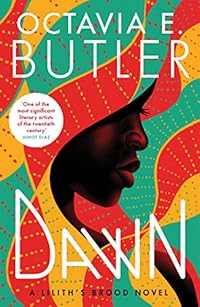
Dawn by Octavia E Butler 

Headline, 2022, 287 p. First published 1987.

When originally published the trilogy of which this is the first instalment was titled Xenogenesis. It now seems to be called Lilith’s Brood.

Lilith Iyapo wakes up in what appears to be a prison cell, provided with bland food. She has memories of this happening previously and also of her life on Earth when her husband and child had died in a traffic accident. This was shortly before a nuclear war left the planet uninhabitable (to humans at least.) She soon learns that a few humans were rescued from the apocalypse by an alien race, the Oankali; a species for which genetic engineering is essential.

The first appearance to her of an Oankali shocks her: they are covered in small tentacles acting as sensory organs, and which are attracted by movement. The Oankali have three sexes; male, female and ooloi. All have the ability to sense the biochemistry of genetics but the ooloi can manipulate it and build offspring from their mates’ genes.

Lilith is told a cancer has been removed from inside her and that the spaceship she is being held on is alive. The Oankali find cancer to be an attractive trait for their genetic manipulation purposes. They want to blend their own and human genetics, in part as their biological imperative but also to eradicate hierarchical tendencies from humans. They envisage Lilith’s part in this as to Awaken other humans and prepare them for this gene trade and a return to Earth. Lilith and the subsequent Awakened find the prospect repugnant.

When a sufficient number of people have been Awakened there are problems within the group. Specifically, some are wary of Lilith not only as a black woman but of her closeness to the Oankali and of the capabilities to manipulate the structure of the ship with which the they have endowed her, abilities naturally seen as suspicious by those not so treated.

In Dawn there are early similarities to other works of SF where people have been kept in captivity. The whole, though, depends on the credibility of the aliens and their motivations. I wasn’t entirely convinced.

Pedant’s corner:- “Where had all this been, Lilith wondered” (needs a question mark,) a missing end quotation mark after a piece of direct speech, “gasses” (gases,) “had come on to the bed with her and lay down” (and lain down,) “clean shaved” (clean shaven,) “Paul Titus’ wall” (Titus’s. Titus’ appeared again later,) “their own betrayal: No trip to Earth” (colons are not usually followed by a capital letter; ‘betrayal: no trip…’) A paragraph beginning with a piece of direct speech without having an opening quotation mark (I know this is a publishing convention but to me it feels wrong,) repellant (repellent.) “She froze where she stood and had all she could to keep from turning and running away” (is expressed awkwardly.) “It said nothing more, made no sound of its own pain” (ditto,) “she recognised Ahajas, Nikanj’s female mate as the owner” (she recognised Ahajas, Nikanj’s female mate, as the owner.) “She waited almost eager for the darkness” (needs a comma after waited,) Ahajas’ (Ahajas’s.)

Ian Watson

I have just seen from various sources that SF writer Ian Watson has died. I’m so sad to hear about this.

I knew he had been ill recently but had been under the impression he was recovering.

I have thirty of his books on my shelves, the most recent of which was The Chinese Time Machine which I reviewed for ParSec in 2023.

The first time I met him was when I attended the signing event for my first short story publication, The Face of the Waters, in New Worlds 2 way back in 1992.

He was a gentleman and had a particularly sharp wit.

Ian Watson: 20/4/1943 – 13/4/2026. So it goes.

BSFA Awards

This year’s BSFA Awards (for works published in 2025) have been announced.

Best novel:- When There Are Wolves Again by E J Swift.

Best shorter fiction (novellas, novelettes):- The Apologists by Tade Thompson.

Best short fiction:- Godzilla as a Young Man Named Mike by E M Faulds.

Best translated fiction:- Liecraft by Anita Moskat, translated by Austin Wagner.

I’d like to add special congratulations to my friend Neil Williamson who, as editor, won in the Best Collection category for Blood in the Bricks.

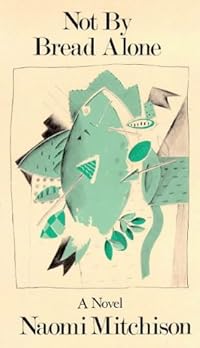
Not by Bread Alone by Naomi Mitchison

Marion Boyars, 1983, 163 p.

A company called PAX has been developing various projects to improve crop types and yields over the world. This culminates in a product known as freefood, which promises to make human existence easier. It is widely welcomed nearly everywhere – a notable holdout is the indigenous Australian community of Murngin in Arnhem Land, North Australia, which has achieved a kind of independence.

Like in Mitchison’s other Science Fiction forays there is in the narration a high degree of telling not showing. Most of the story concerns itself with the scientists involved and interactions among the people running PAX and the reading experience is somewhat dry. Very little of what would be the social ramifications of such an innovation as freefood is explored. War has apparently ended because, as one character says, it was fought for food.

(Well, to a point: water too, and resources, but let’s not forget in these troubled times personal aggrandisement.)

The ‘future that never was’ that bedevils older Science Fiction stories is illustrated by Mitchison’s characters’ long distance communication methods (video calls) anticipating Skype or Zoom but not, of course, the internet or email.

There is an implicit racism – reflecting the times of 1983 but perhaps not Mitchison herself? – in one character referring to ‘Abos’ saying, “‘They could be a no-good mob,’” but admitting, “they got treated in a no-good way in Queensland,’” plus another use of ‘Abos’ in an unflattering context.

The promised paradise of hunger being banished from the world is disturbed when deaths start to occur among some of those using freefood. This is due to a compound called dioscorin which is found in yams and usually removed by the processes of preparing and cooking. Freefood production has omitted these steps.

Mitchison’s writing is usually perfectly agreeable. Her other (ie non-SF) fiction does not suffer from the flaws I have noted above and before here and here – even though some of it is set in such alien (to us) societies as Ancient Greece or Rome. That tendency to didacticism apparent here is missing from those.


Pedant’s corner:- In the inside cover blurb “polictical” (political,) skillfully (skilfully.) Elsewhere; a missing comma before a piece of direct speech embedded within a sentence (x 3, one without a capital letter at the beginning of the dialogue,) “fresh lime, nimbupani” (fresh lime nimbupani,) a switch into a different font size and back again (x 2,) an end quotation mark in the middle of a piece of dialogue, Bangla Desh (nowadays spelled Bangladesh,) Campuchea (nowadays spelled Kampuchea,) Quazulu (nowadays spelled Kwazulu,) grand-parents (nowadays spelled grandparents,) “none of them were any longer newsworthy” (none of them was …,) “nobody would be allowed to turn in into money” (to turn it into money,) Djuvalji (elsewhere always Djiuvalji,) “a dangerous precendent” (precedent,) peole (people.) “‘Still and on’” (isn’t the phrase ‘Still and all’?)

Here We Are Again

Book cover for Green City Wars

Another title to be reviewed for ParSec has duly arrived.


This time it’s the latest from Adrian Tchaikovsky.


It’s called Green City Wars. I’ll get on to it soon.

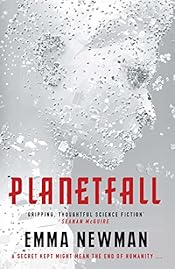
Planetfall by Emma Newman

Gollancz, 2018, 324 p, plus ii p Acknowledgements.

That I have read Newman’s Planetfall sequence in the wrong order (3,4,2,1 to be precise) doesn’t really matter that much as they can all be read as stand alone titles. Here, we are in the years after an expedition to another planet under the guidance of a woman called The Pathfinder in search of God. On landing the expedition’s members found what is now called God’s city. This is an “organic citadel” like a “huge forest of baobab trees tangled round one another,” and, when hot, grows tendrils to manage the heat.

The story is narrated by expedition member Renata Ghali (Ren,) the settlement’s 3D printer engineer, whose later revelation to be a hoarder whose home pod is piled with rubbish stolen from the settlement’s recycling machine, the Masher, is an indication of possible unreliability. She is troubled by fellow expedition member Cillian Mackenzie (Mack,) whose resolve held the community together after the Pathfinder did not return from a foray inside God’s City, saying she was “communing with the creator,” and telling them all to await her return. What has evolved in the colony in the years since is in effect a cult.

Some time after The Pathfinder’s disappearance, other members of the original expedition were lost elsewhere on the planet. Plot kicks in when a lone outsider called Lee Sung-Soo, a survivor of those lost colonists, who is also The Pathfinder’s grandson, turns up at the city.

Ren’s obligations to Mack take her inside God’s city, a strange unsettling place where perspectives shift and passageways can suddenly change orientation. Her explorations lead her to wonder whether the colonists are the first or if there have been previous visitors to the planet; visitors who could only have been alien.

As things unfold we discover what actually happened to The Pathfinder inside God’s city, the revelation of which to the colony has ramifications for Ren, Mack and the settlement as whole.

Newman’s writing is not in question. She is particularly good on Ren’s mental disintegration.

The integration of religious elements with an SF setting is a little awkward though.

Pedant’s corner:- Printed in USian, bacteria (the word is treated as if it’s singular – but that would be bacterium,) outside of (x 2: just ‘outside’; no ‘of’,) “none of them satisfy me” (none of them satisfies me,) “in the opposite direction of God’s city” (it’s ‘opposite direction to’ not ‘opposite direction of’.) “None of them were looking at me” (None of them was looking at me.) “None of them are good” (None of them is good.) “None of them are paying attention” (None of them is paying attention,) “neither of them say anything” (neither of them says anything.) “None of them are listening” (None of them is listening,) “our species’ capacity” (species here is singular; so ‘the capacity of our species would be better.) “None of them are familiar” (None of them is familiar.)

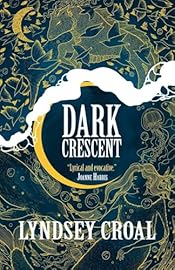
Dark Crescent by Lyndsey Croal 

Luna Press, 2025, 176 p including Author’s note on Finding Inspiration in Scottish Folklore. Reviewed for ParSec 14.

This is a collection of one novella and 22 short stories – some very short; the title story is barely three pages long, a couple are only two, with the longest, The Frittening, just twelve – all taking inspiration from Scotland’s folklore, superstitions, or landscape.

The short pieces are loosely bunched under headings for the four seasons with each section’s stories prefaced with a wood- (or lino-)cut engraving of one of the Moon’s principal phases and a scene illustrative of a story within it. A ‘Bonus Section’ at the end outlines those particular tales and legends which sparked Croal’s imagination.

An individual story here can contain relatively familiar apparitions or hauntings – selkies, kelpies, hagstones, seer stones, magpies, omens and shape shifting, Will-o’-the-Wisp, the Otherworld, Changelings – but others like the Sluagh, the Frittening or the Boneless, the Cat-Sith, the Ghillie-Dhugh, Baobhan Sith and the Fiddlers of Tomnahurich Hill, the Cailleach, the Nuckelavee, the Marool, the Ceasg, Bee-telling, the Sea-Mither, Each Uisge, the Wulver, the Bride and Angus, may be less so. Some are set in depopulated post-disaster worlds and border on Science Fiction; others touch on gothic, weird horror, dark fantasy, and solarpunk. Many draw stimulus from nature, climate, and the environment, with feminist and eco themes prominent. Croal’s Author’s Note informs us three of her tales do not have a specific derivation but are original to her.

Hence, among others, we have omens in the sky, tappings on windows, a strange puddle emerging on a doorstep, pebbles appearing in a nest in the night, a will-o’-the-wisp manifesting more strongly each day, a fiddler finding his muse in a painting whose scene gradually changes, the green man as a malevolent influence, the thoughts of the last surviving whale as it roams the deserted seas. Except for a common thread of the sea there is little beyond the Gaelic names of the various phantasms to mark these stories out as specifically Scottish.

The novella, Daughter of Fire and Water, with its intermingling of gods/goddesses and mortals in fact reads more like a Greek, or perhaps Norse, myth – except for the prince in it being named Angus.

Taken individually the stories here are perfectly fine but the cumulative effect of Croal’s general style tends to the dry. She has a fondness for italicized paragraphs, especially in throat-clearing beginnings, and there is the occasional odd choice of verb, which can be jarring. There tends to be a kind of distance between the tale and the reader and the stories are too often told rather than shown while some are not really given enough room to breathe fully. There is not much emotion evoked in these tales but then stories of weird creatures and the whole apparatus of fairy tale have always been admonitory in intent.

This is a collection to be sipped rather than quaffed. (Not really an option available to a reviewer.)

Curiously, a few lines on Content Notes and Warnings come dead last in the book though a signal to them does lie on the publishing information page. Surely if such warnings are needed they ought to be more prominently placed?

The following did not appear in the published review.

Pedant’s corner:- focussing (focusing,) maw (more than once. A maw is not a mouth,) several USianisms (cookies, snuck, dove [for dive,] inside of, etc,) sunk (several times; sank.) “The only muscle the woman moved was her mouth” (a mouth is not a muscle,) razor—sharp (razor-sharp,) sung (x 2, sang.) “She lay the Seer’s map on the table” (She laid the Seer’s map on the table.) “She was his only companion, his confidant” (she; therefore ‘confidante’,) “Then she said with sharp cruelty, ‘no. Not if you…’” (she said with sharp cruelty, ‘No. Not if you…’,) “Everyone knelt and lay the offerings at her feet” (and laid the offerings,) “all that kept me company were layers of clouds” (all that kept me company was ….) “If I wanted so bad not to be alone” (If I wanted so badly not to be alone,) “and lay it over my chest as a pendant” (and laid it over my chest,) “and lay her in blankets” (and laid her in.) “When the sea witch, turned away and disappeared” (doesn’t need the comma, which in fact detracts from the sense,)  “that I’d wove so carefully” (woven,) “mouth scrunched up into an eclipse” (only makes sense if ‘ellipse’ was meant,) a new paragraph that was not indented, a missing full stop, “span” (spun,) “as if expecting me turn into” (to turn into.) “‘Your association with them isn’t exactly customary’” (sense expects, ‘Your association with them isn’t exactly exemplary’,) sat (seated; or; sitting.) “The fall made the landscape blur, and then a screech” (needs clarification,) “there were no sign of burns or marks” (there was no sign.) “then he swept out the room” (as written this means he cleaned the room with a brush; what was intended was ‘he swept out of the room’,) “the hot water stung into my legs” (the hot water stung my legs,) focussed (focused, annoyingly used two pages earlier.) “They looked between one another” (looked at one another,) galivanted (gallivanted.) “Much of these stories are inspired by” (Many of these stories are.) “I became fascinated in the dark, strange, and rich folklore” (became fascinated by,) “rife with unexplained phenomenon” phenomena makes more sense.) “Hagstones are stones with natural holes bored in centre are thought to be,” (the holes can’t have been bored; plus the sentence needs an ‘and’ before ‘are thought’.)


ParSec 15 Update

ParSec 15 is indeed live and I now have my copy.

I found it does contain my reviews of City of All Seasons by Oliver K Langmead and Aliya Whiteley along with The History of the World by Simon Morden but not that of Project Hanuman by Stewart Hotston.

I have four other reviews there though:-

The Measurement Problem by David Whitmarsh,

Halcyon Years by Alastair Reynolds,

Exiles by Mason Coile,

plus Solstice by Ruth Aylett and Greg Michaelson.

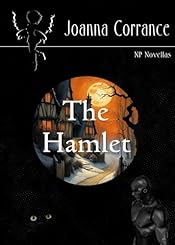
The Hamlet by Joanna Corrance

NewCon Press, 2025, 115 p. Reviewed for ParSec 14.

This was published as a novella but reads more like an assemblage of short stories with characters which cross over from one to the next, though outwith their own tale, usually only in brief appearances. Its background premise – something strange (but unspecified) has happened and people have been advised to remain indoors – may be a literary response to Covid. The setting is a small village in Scotland – locals call it a clachan but incomers have used the description hamlet (which I note is actually a particularly English designation) for so long that it has become more common. The village ‘spinsters,’ however, still frown upon it. Apart from the first, very short, chapter which introduces the strange event, each section is given over to the experiences of different characters, Beth, Polly, Helen, Eve, Robyn and Jeanie, with the novella ending with a sort of epilogue from the point of view someone called the Spaceman.

The stories’ time scales are not always immediately apparent as some chapters start before the strange event or more or less ignore it happening. However, there’s enough oddness going on even without it.

Responding to a voice calling to her, Beth, who has inherited her home from her mother and not improved it in any way, instead letting it run to squalor, manages to move through the pipes in her plumbing, whether by her shrinking or the pipes expanding is moot. Eventually she is drawn down to an underground chamber to chat with the spinsters about the end of the world. The chapters which follow may represent different ways in which that end happens.

Thanks to the green-suited spaceman who appears at her window one night, schoolgirl Polly travels the universe and becomes both a witch and a princess.

Helen begins to produce videos which attract internet followers but increasingly show her lack of control of her life.

To escape the locked down city Eve has come to the cottage she rents out to Matthew (known locally as the Pest.) Not a good choice.

At Helen’s request Robyn builds a doll’s house as an exact replica of Helen’s home but realizes it also needs a doll’s house inside it and then another inside that and so on down.

Jeanie begins to act strangely and eventually locks herself away from everyone. She is however revealed to be a figment, a skin the narrator wore to make her life more amenable. The implication is that all the viewpoint characters are such skins. (But this is the essence of fiction. The reader temporarily becomes – or at least empathises with – a book’s characters.)

The Spaceman is from another world.

The Hamlet has aspects of a fairy tale (but there do not seem to be any happy ever afters, except perhaps for Polly,) has some of the heightened sensibility of magic realism (with a faint echo of John Burnside’s Glister,) moments of horror, and makes a foray into Science Fiction. Whether the disparate elements necessarily cohere into a unified whole is a matter for the individual reader. Corrance can write though.

The following did not appear in the published review.

Pedant’s corner:- “The McIvor’s lived in” (the McIvors lived in,) sat (x 2, sitting, or, seated,) “Mums washing machine” (Mum’s,) “paper mâché” (paper mache:  if its ‘mâché’ then it’s papier mâché,) “it sloped passed me” (past me,) airplane (aeroplane,) “the High-lands” (the Highlands,) curb (kerb.) “‘So where did you learn to cook?’ She asked.” (‘So where did you learn to cook?’ she asked,) “when they played drafts” (draughts,) dollhouse (doll’s house,) “most Saturday’s” (most Saturdays,) “and come pick me up” (come to pick me up,) miniscule (minuscule,) “the little girls’ eyes” (it was only one girl; ‘little girl’s eyes’.)

free hit counter script