I saw (again on the TV news) that well respected Scottish musician and song-writer Rab Noakes has died. Sadly he never achieved much commercial success for himself. His musical talent deserved much more.
I had heard of him as a musician but wasn’t aware of his wider appreciation in the music world outside Scotland till Lindisfarne covered his song Turn a Deaf Ear on their first album Nicely Out of Tune.
This is a version by Rab himself but for some reason this video repeats part of the song once it has finished.
Rab Noakes: Turn a Deaf Ear
Lindsifarne adapted the lyric to mention Rab himself.
Lindisfarne: Turn a Deaf Ear
Barbara Dickson also made a recording of Turn a Deaf Ear.
Early on Noakes had collaborated with Gerry Rafferty and indeed was a fellow member of Stealers Wheel in its earliest days. After Rafferty’s death Rab wrote this song for him.
Rab Noakes: No More Time
A great cover by Rab Noakes and Emma Pollock of Rafferty’s song Get it Right Next Time can be found here.
Robert (Rab) Noakes: 13/5/1947 – 11/11/2022. So it goes.
Just because I’ve been posting about the island from which the band Lindisfarne took its name.
The band had split after their third LP Dingly Dell in 1972 but reformed in 1978. Run For Home was taken from their punningly named comeback album Back and Fourth which featured a photograph of Lindisfarne Castle on its sleeve.
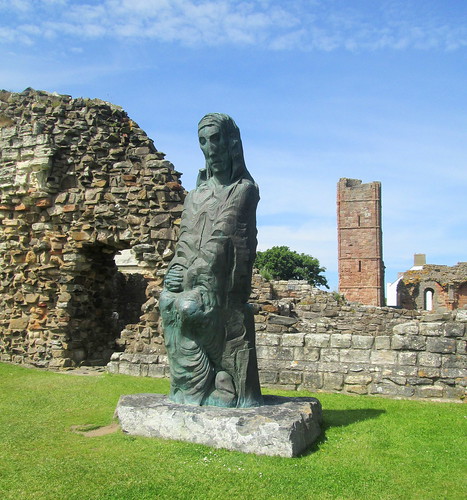
In St Mary’s Church (see above) is this life-size wooden statue of Lindisfarne monks carrying St Cuthbert’s body round Northumbria in an attempt to find a safe place to bury him away from Viking pillagers. (Eventually he was interred in Durham Cathedral.)
The castle entrance is very restricted, up a flight of fairly narrow wooden steps, but there is a wider plaza above:-
One of the rooms has a ship model hanging from the ceiling!
Fireplace in kitchen. (This is flanked by a cupboard and a settle):-
Kitchen cupboard:-
Settle:-
Reverse of settle:-
Walled garden from Lindisfarne Castle. The garden was designed by famous gardener Gertrude Jekyll. The surroundings on Lindisfarne are so bleak and windswept there has to be a wall round it in order for anything to grow.
From the island side the castle looks very different:-
Castle from walled garden. Apparently the area just to the left of the castle in the photo above was where the Vikings would coast up back in the day as the sea reached in further then:-
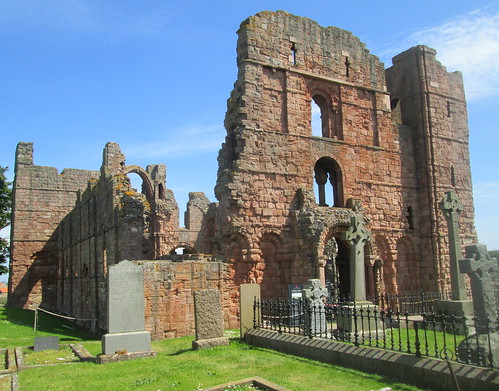
On the way back up from Northeast England last June we took a trip over the causeway (having looked up the tide-tables beforehand) to Lindisfarne, or Holy Island, a place I’d always wanted to visit but somehow had never seemed to find the time before.
It’s an odd experience driving over the causeway – it feels quite long – but the trip was worth it. There was more to Lindisfarne than I’d imagined. Not just the castle and Priory.
Lindisfarne Castle from Approach Road:-
Closer view:-
From the road there’s a good view over the sea to Bamburgh Castle:-
I thought the objects in the next photo were a bit odd, but obviously with some age to them. Only when I got home and looked them up did I find they were Guile Point obelisks and lighthouse. (When lined up the obelisks indicate the safe channel into Lindisfarne harbour.) As seen from Lindisfarne:-
They can be seen again in the background here beyond Lindisfarne’s foreshore with these wooden stumps:-
There is a small village on the island (where lie the remains of Lindisfarne Priory) and a harbour.
Lindisfarne Harbour, Village and Priory from road to Castle:-
This is a track from Lindisfarne’s first album Nicely Out of Tune, my favourite track on there, but I’ve not been able to feature it before as I couldn’t previously find an embeddable example.
I have a thing about lyrics. You know this. (Maybe I’m a frustrated song-writer.)
I particularly like the rhyming in this one but the overall lyric has some great lines.
Who hasn’t been in the situation, “So we sat and watched each other through the fading firelight
Each one waiting for the silence to be broken”? Those lines just ache for resolution.
“The spittle from his twisted lips ran down to his bow-tie,” (and bow-tie rhymed with ‘eye’ and ‘deny’) is nothing short of inspired as is also in the last verse, “Teachers from whose hallowed mouths great pearls of wisdom crawl,” where the emphasis provided by the internal rhymes in, “The joke is on the bloke who never spoke a word at all,” hammers the song’s point home.
Add in the fact that the last line of each verse is not just foreshadowed but fore-ordained by the word immediately preceding, “And the things I should have said,” and you have a lyrical masterpiece.
Posted in BBC, Television at 20:13 on 23 December 2012
In the last episode of Waldemar Januszcak‘s excellent television series on the mostly unheralded art of the Dark Ages, where he covered the Vikings, the Carolingians and The Anglo-Saxons, he referred to Lindisfarne (Holy Island) as being off the North coast of Britain.
Tut-tut, Waldemar. That would make it in the Pentland Firth/Atlantic!
Lindisfarne is actually barely two-thirds of the way up Britain.
It is, however, off the North-East coast of England.
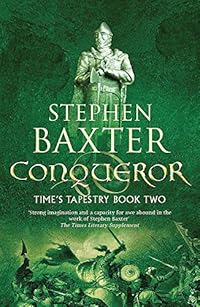
This is the second in Baxterâs series featuring a Weaver of Time, the first of which I reviewed here. The prophecy which guides the charactersâ lives this time â called the Menologium of Isolde and whose utterance came at the end of Book One of Timeâs Tapestry â is linked to the appearances of Halleyâs Comet.
Again the book is in four sections, here set respectively at the time of the expulsion from England of the remnants of the Romanised Britons by the Angles and Saxons, the Viking raid on Lindisfarne, Alfred the Greatâs stemming of the Danish tide and the Norman Conquest. Unlike the earlier book there is also a prologue and epilogue. Had the bookâs title and cover not already been a clue the prologue would in any case have detracted from the impact of the revelation of the date 1066 at the end of section three as the time of the last crucial happening.
An interesting inclusion in the Alfred section is the character of Ibn Zuhr, a Muslim from Al-Andalus, whose knowledge of medicine, other sciences and arithmetic far outstrips that of the locals â as it would have done.
The history of the “Dark Agesâ is fascinating but once more too much has to be conveyed in expository lumps. Baxterâs evocation of these times is well done, though, and his battle scenes are viscerally rendered. There is still a hint of too much modern knowledge and attitudes on the part of some of the characters however.
Events remain the same as in our timeline but the monk Sihtric, both in the prologue and epilogue, states he believes he is living in the wrong history as his reading of the prophecy has been unfulfilled.
After Emperor, I swithered about whether to continue with Timeâs Tapestry. Conqueror has persuaded me to persevere. The harping of various characters on the word Aryan and its appearnce in the Menologium of Isolde is a trifle ominous, though.


:format(jpeg):mode_rgb():quality(90)/discogs-images/R-2165410-1304020547.jpeg.jpg)