Archives » Emily St John Mandel

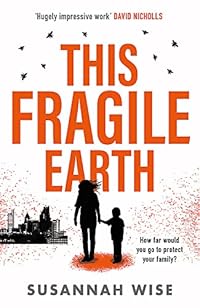
This Fragile Earth by Susannah Wise

Gollancz, 2021, 356 p. Reviewed for ParSec 1.
In the 1950s and up to the mid-1960s British SF consisted mainly of stories of worldwide disaster – a subgenre which Brian Aldiss somewhat unkindly dubbed cosy catastrophes – whose most prolific contributors were the Johns, Wyndham and Christopher, but also to which, at a stretch, J G Ballard’s early novels could be assigned. While the disaster story never disappeared completely the vogue did ebb and British SF began to cleave the paper light years with the best of them.

In recent times SF writers more generally perhaps sensed the coming contagion. Emily St John Mandel’s Station Eleven helped to revive the concept of a fictional worldwide disaster and Caroline Hardaker’s Composite Creatures (also reviewed for ParSec 1) has elements of the form. In this book Susannah Wise inhabits that global catastrophe tradition full on – and in a British context.

It is an altered Britain though, which has a heavy Chinese influence. Six year-old Jed’s schoolteacher is a Miss Yue, a supermarket chain is called Lianhua, noodles and rambutan are common foods and a mysterious company called Shīluò zhì lurks in the background.

The common elements of the catastrophe novel are present: communication breakdown, food queues, barricaded roads, troops on the streets. Less usual ingredients here are that bees have gone extinct (though attempts have been made to restore them synthetically) with their pollination tasks in the meantime replaced by tiny drones; following on from beetle blight a rampant disease called Bovine Staph is apparently transmitted through rainwater and can affect humans; venturing outdoors requires UV goggles to be worn to protect against eye damage from sunlight; the currency is exclusively digital – Litecoin spent via Lite-cards.

Pre-disaster just about every service is accessed wirelessly or via AI robots such as BinX, DoctreX, MediX and WaitreX. GScopes, mediated by a system named GQOS, have replaced mobile phones. Roads are constructed from fibre-glass panelling and road signs are exclusively electronic. Agrico-bots roam the countryside.

Then one day the drones start to malfunction, the electricity goes off and everything shuts down. Viewpoint character Signy comes home to a fridge in meltdown, its food rotting. Despite the resultant lack of amenities her partner Matthew keeps saying things will be all right “tomorrow” but one night, while Signy and Jed hide in the loft, Matthew confronts burglars at their house and is killed. Signy sets off from London with Jed to try to reach her mother’s home in Northamptonshire – by bicycle. Along the way they meet the usual assortment of people who either help or steal from them but also uncover the importance of TrincXcode and its links to musical form.

Wise’s writing is fine but in what is presumably a striving for immediacy she exhibits an over-fondness for verbless sentences. Like this one. Her characterisation is generally convincing enough but her portrayal of Jed is inconsistent. As indications of his youth he sometimes has to have words defined to him and he refers to “Mr Mack Wrecker” from the Peter Rabbit books but he also comes out with absurdly adult phrases supposedly remembered from Miss Yue. Things like, “Quantum field which allows the system to work out infinite possibilities,” and, “The system can work out in milliseconds every possible outcome that can happen from any action it takes in multiple universe models and make the best choice.” OK, the reader is getting the info dump but these sentences read as unlikely to come from the mouth of a six year-old, however tech savvy. There is also his memory from three years earlier of his grandfather telling him something “terrible and important,” to wit, “TrincX is the birth of true Artificial Intelligence – God’s daughter come to walk on Earth,” a warning now come true.

This central role of AIs in the background of the narrative has the effect of making the book’s resolution a literal deus ex machina, or, rather, dei ex machinae. Whether that makes it cosy or not is a fine judgement but it certainly leans towards it.

Pedant’s corner:- GQOS’ (GQOS’s,) “the Orkneys” (the locals prefer the designation Orkney, or, the Orkney Islands,) “more combustible that the old carbon boiler” (than,) gotten (in dialogue? In Britain?) Signy rushes out the front door with no mention of its mechanism previously not working due to the shutdown of communications, hummous (hummus.) “‘Danny!’.” (doesn’t need that full stop, the exclamation mark provides that function.) “It lay uncertain rays across” (It laid uncertain rays,) “‘I bought it from home.’” (brought it.) “‘It’s wasn’t Lau Chen was it?’” (‘It wasn’t’.)
My 2015 in Books

This has been a good year for books with me though I didn’t read much of what I had intended to as first I was distracted by the list of 100 best Scottish Books and then by the threat to local libraries – a threat which has now become a firm decision. As a result the tbr pile has got higher and higher as I continued to buy books and didn’t get round to reading many of them.

My books of the year were (in order of reading):-
Bring Up the Bodies by Hilary Mantel
Electric Brae by Andrew Greig
The Thousand Autumns of Jacob de Zoet by David Mitchell
Station Eleven by Emily St John Mandel
Europe in Autumn by Dave Hutchinson
Traveller of the Century by Andrés Neuman
The Affair in Arcady by James Wellard
Flemington and Tales from Angus by Violet Jacob
The Book of Strange New Things by Michel Faber
Ash: A Secret History by Mary Gentle
Young Adam by Alexander Trocchi
Song of Time by Ian R MacLeod
The Gowk Storm by Nancy Brysson Morrison
The Bridge Over the Drina by Ivo Andrić
To Kill a Mockingbird by Harper Lee
Fair Helen by Andrew Greig
The Dear, Green Place by Archie Hind
Greenvoe by George Mackay Brown
The Tin Drum by Günter Grass
Europe at Midnight by Dave Hutchinson
The Cone-Gatherers by Robin Jenkins
A God in Ruins by Kate Atkinson
Go Set a Watchman by Harper Lee
Born Free by Laura Hird
We Are All Completely Beside Ourselves by Karen Joy Fowler

If you were counting that’s 25 in all, of which 15 were by male authors and 10 by women, 8 had SF/fantasy elements and 11 were Scottish (in the broadest sense of inclusion.)

Clarke Award Winner

I see Emily St John Mandel has won the Clarke Award for her novel Station Eleven. Congratulations to her.

Having now read five out of the six nominees I can’t say I would disagree with the judges’ decision.

The Clarke Award for 2014

Hot from the BSFA website, here’s the shortlist:-

The Girl With All The Gifts – M.R. Carey (Orbit)
The Book Of Strange New Things – Michel Faber (Canongate)
Europe In Autumn – Dave Hutchinson (Solaris)
Memory Of Water – Emmi Itäranta (HarperVoyager)
The First Fifteen Lives Of Harry August – Claire North (Orbit)
Station Eleven – Emily St John Mandel (Picador)

I’ve read four of these! I’m delighted to see both Emmi Itäranta and Emily St John Mandel (who missed out on BSFA Award nominations) on this list.

Station Eleven by Emily St John Mandel

Picador, 2015, 339 p, including 2 p Acknowledgements and 3 p Questions for Discussion.

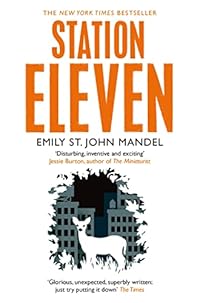
 Station Eleven cover

Well, it’s a long time since I’ve read a good disaster novel. (Or any disaster novel at all really.) Not that this is a disaster novel per se as it spends a good bit of time on pre-apocalypse matters. The third person narrative varies between the viewpoints of actor Arthur Leander, his first wife Miranda, his friend Clark, former paparazzo turned paramedic Jeevan Chaudhary and Kirsten Raymonde, a child, then later an adult, actor.

Arthur Leander collapses on stage of a heart attack on the night the Georgian Flu comes to Toronto. Jeevan Chaudhary is in the audience and tries to aid him but fails to prevent his death. Before the performance Leander had given Kirsten two “issues” of a sumptuously produced limited edition comic book, the Station Eleven of the title. Kirsten values these through the years of travail ahead; for the Georgian Flu turns out to be particularly virulent, causing death within hours, hence civilisation swiftly falls apart. The few survivors eke out their existence as best they can.

The narration flits between pre- and post-apocalypse detailing Leander’s life story; Kirsten’s wanderings in Year Twenty with The Travelling Symphony – despite the name they perform Shakespeare plays as well as music – with its slogan (derived from Star Trek: Voyager) Because survival is insufficient; Clark’s pre-disaster memories of Leander and his post-apocalypse life in Severn City Airport, Michigan, where he sets up a Museum of Civilisation; Miranda’s experiences with Leander; along with Jeevan’s memories of his life. (There is no reason to suppose that Mandel has ever read it – in all probability she hasn’t – but the Travelling Symphony elements reminded me a bit of Larry Niven’s Destiny’s Road. Mandel is a much better writer than Niven, though, and her story more complex.)

This is a very good book indeed, suffused with sadness but still affirming life. The characters all ring true to life – plus of course the inevitable death(s) – and there is a glimmer of hope for the future at the end. A curiosity was that only the odd pages are numbered and that only if they didn’t coincide with a chapter heading. Even though it has more of a mainstream feel had I read this before the cut-off date I would certainly have nominated it for the BSFA Award – the book was first published in 2014 – but sadly I was a month late.

Yet, even in a book as good as this there are entries for Pedant’s Corner:-
“The line of jets, streaked now with rust.” (Only iron – or steel – can form rust. Aeroplanes aren’t made from iron. If they were they’d not get off the ground. Iron is much more dense than the aluminium jets are made from.) “He’d laid awake” (lain.) In one chapter – a supposed transcription of an interview with Kirsten by the editor of the New Petoskey News – King Lear and New York Times are underlined. Is this due to the pre-word processing convention that submitted manuscripts contained underlining where italics were to be used in the final copy – italics being beyond normal manual typewriters – and these instances were missed in the transcription?

free hit counter script