Archives » 2011 » November

US World War 2 Cemetery, Madingley, Cambridgeshire

I scheduled this post for a certain time today as it seemed appropriate.

This is the North entrance to the US WW2 cemetery near Madingley, Cambridgeshire.

North Entrance to US War Cemetery, Cambridge

We visited it just after Grantchester. It’s set in some nice agricultural land a few miles east of Cambridge. The grounds are beautifully kept. Several people were busy keeping the paths clear of leaves while we were there.

The memorial itself is monumental in the same way that the corresponding cemetery at Collevilles-sur-Mer in Normandy is. Though Madingley has less than a third of the burials that are in Collevilles – which we visited over ten years ago now – it is still overwhelming when you pass through the entrance from the car park and see the thousands of grave markers. Most of the interred were airmen killed in the bombing campaign over Europe.

This is from the northern end. It doesn’t show the crescent effect that other angles give but from here the crosses (and stars of David) retreat into the distance.

All the Crosses (and Stars of David.)

The Flagstaff from the North

Long Vista  + Flagstaff from the Memorial Chapel

The flagstaff is massive and there is an avenue leading from it to the memorial chapel on whose steps the photo above right was taken.

The long wall on the left here contains the names of all those who died either in the North Atlantic or Europe but have no known grave. A starred entry denotes a Medal of Honor recipient, Lt Col Leon R Vance, who sadly perished when the aeroplane taking him back to the US after he was wounded, disappeared. The statues along the wall represent the various US services, including coastguards as well as airmen, soldiers and sailors.

The Long Wall

The chapel itself, seen below first from the flagstaff and then from among the graves, is an impressive building.

Long Vista And Water, US WW2 Memorial, Cambridgeshire

The Memorial Chapel from North

The circular pieces in the windows are stained glass images of the seals of the various individual States that make up the Union that is the United States.

The wall on the southern side of the chapel displays a map showing the location of the many US bases in WW2 Britain. The hedge enclosing the grounds made it difficult to get far enough back.

Map Of WW2 US Bases in Britain

The Memorial Chapel Doors
The Memorial Chapel Interior, South Wall

The chapel doors have bronze plaques of the heavy equipment the servicemen may have used and inside, a whole wall is given over to the North Atlantic and European theatres of war, showing the routes of convoys and various air-raids over occupied Europe. Below that, panels show the extent of the Axis advance and the Allied ripostes for both the Africa/Europe and Pacific areas over three different time intervals.

The visitors building near the flagstaff had a well signed visitors book and staff who were welcoming and helpful.

Despite the buzz of the leaf clearer, the overall effect was one of tranquillity and harmony, of a strange sort of peace. US citizens with relatives buried there may find that a small comfort.

The experience, like that of visiting any large war cemetery, was humbling.
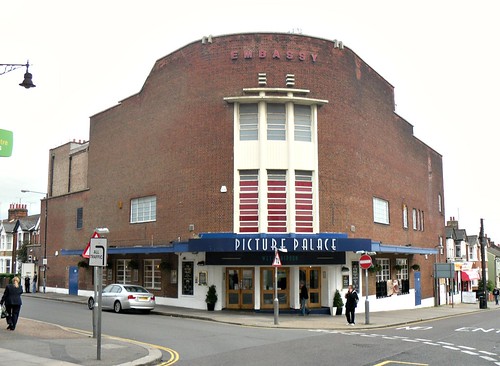
Embassy Cinema, Braintree, Essex

Why Braintree?

Well: the good lady and myself used to live there when I worked as a Research Chemist. We thought we’d see how it had changed in thirty years so made it one of the last stops on our recent trip down south.

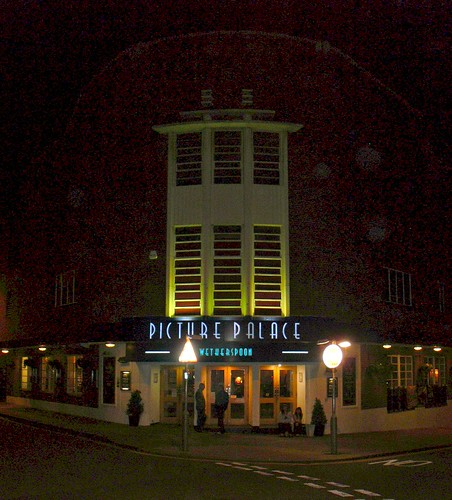
I well remembered the cinema. The Embassy as was. The building is very deco indeed but is now a Wetherspoons pub called the Picture Palace.

Former Braintree Cinema by day

Former Braintree Cinema by Night

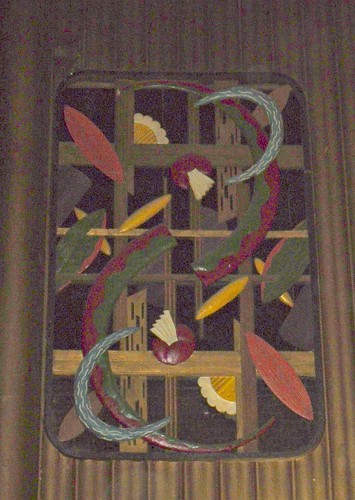
Former Braintree Cinema Interior Panel
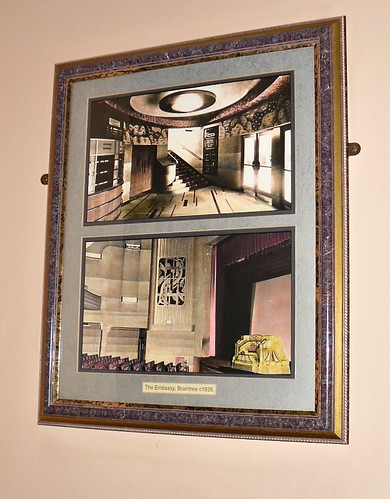
Former Braintree Cinema Photo Panel

Surprisingly the inside has not been mucked about with much. On either side of where the screen was situated – the screen itself appears still to be present behind the bar area – are some original panels one of which I tried to photograph (see left above) but the light level was very low so the result is grainy. Two photographs of the original interior are in a frame on the wall of the foyer (right, above.) The windows are not original but have been replaced very sympathetically. You can just about make them out here.

We astonished the waiter by saying we had actually seen films in it. (By the way, a true life incident – not to do with the film itself – from watching the first Star Trek movie there made it into my novel A Son Of The Rock in somewhat disguised form. It was too good not to use.)

Asteroid 2005 YU55

In case you’re wondering this is the asteroid that had a close encounter with the Earth yesterday; coming nearer than the Moon does.

There was no danger of contact but apparently if it had struck the Earth it would have had the effect of a magnitude seven earthquake – severe enough but imagine if it hit a city. (Worse damage would have been caused if it had fallen in the ocean and triggered a tsunami.)

(Via Astronomy Picture of the Day and NASA.)

The video is of radar images, comprises six stills and is looped five times. At the time it was about 800,000,000 miles away: 3-4 times the Moon-Earth distance.

M5 Crash

The multi-car pile up on Friday night on the M5 near Taunton in Somerset was a horrific occurence and must have been a nightmarish situation for all those involved, the witnesses, the rescue workers and those who cleaned up afterwards. Not to mention a continuing nightmare for the families of the deceased.

But the emphasis of the news coverage seems askew to me. The focus of attention is on whether smoke from a fireworks display (or perhaps fog) was a contributing factor.

In essence it doesn’t matter, either – or both – may have reduced visibility.

And I believe neither was the cause the accident.

It is more likely that drivers did not adjust their driving to the prevailing conditions. Fog, or reduced visibility, means that they should have slowed down; even if the fog was patchy or intermittent. In all probability some (most?) did not.

The accident – like the majority of road “accidents” – was probably the result of poor, perhaps even dangerous, driving. It is that, as a counter to the dangerous notion that drivers are somehow put upon by laws intended to restrict their speed, that should be hammered home time and again, whenever deaths occur on the roads.

Contrary to what some people seem to believe a car is not an expression of individual freedom, it is merely a means to get from A to B in the most efficient way – and it is also a lethal weapon, needing to be handled with care.

I hope that this incident gives pause to those who wish to raise the motorway speed limit. They say people ignore the limit. Is that a good reason to change the law? After all some people rob banks, so should laws against theft then be changed? In any case, the people who break the speed limit now will most likely break the new one too; they don’t care unless they’re caught. Motorways will be many times more dangerous than they are now.

If it doesn’t give them pause and the limit does end up being raised we can expect more Tauntons, or worse, in the future.

Postscripts: The A to Z of Fantastic Fiction Special. BSFA Members Sampler Edition

PS Publishing, 2010, 112p.

This was the collection I mentioned had been in a BSFA mailing about 18 months ago – a taster from Postscripts.
I’ve only just got round to reading it. The authors include Stephen King, Ray Bradbury, Ramsey Campbell and Gene Wolfe.

Most of the stories are not SF but are fantasy or horror; the best of which is Lisa Tuttle’s Closet Dreams where a young girl dreams of her incarceration by a man she calls the monster.

Of the out and out SF Eagle Song by Stephen Baxter concerns messages from Altair which recur at time intervals that decrease in powers of three from 7510 BC to 2210 AD. While clearly not our own history it parallels that closely, so the phrase “hippy chick” and the use of helicopter gunships in Vietnam supposedly in 1967 jarred a little. Footvote by Peter Hamilton relates the consequences of a private venture opening a wormhole to another planet and Gene Wolfe’s Comber is set on a world where cities drift on tectonic plates.

The writing throughout all the stories cannot be faulted but the fantasy and horror didn’t do too much for me.

Poppy Fascism Strikes Again

For a wonder I actually saw poppies on sale this year (in my local Homebase) before there was any sign of one on a TV presenter or politician.

While I bought mine a week ago I haven’t put it on yet. Armistice Day isn’t till this Friday (I’ll have a special post for that) and Remembrance Sunday is seven days away yet. I think wearing one for more than a week is excessive. And I have a category dedicated to War Memorials.

So I wasn’t going to mention it this year. But they’re at it again. Hardly a TV programme I’ve seen during the past couple of weeks has had anyone without a poppy. Even Benjamin Zephaniah had one on Question Time; though his was white. I also find the ostentatious inclusion of a poppy on the shirts of English Premiership football teams in the past two rounds of fixtures somewhat bizarre.

On Saturday, Football Focus (for whom a previous instance has to be considered) interviewed David Beckham – presumably in the US (as he’s just helped LA Galaxy into a final or something) – and there he was sporting a poppy. Now where did he get that? While I fully expect Beckham would be extremely keen to wear one I can’t believe they’re on general sale in the US.

And I noticed on flicking through the channels on the TV that Johnny Depp was wearing one on the Graham Norton Show two nights ago.

However, a real nadir was reached tonight (perhaps last night as I never watch the programme concerned.) After Countryfile – whose presenters both this week and last naturally wore poppies (Naturally? How long ago were the items actually filmed?) – on came the results show for Strictly Come Dancing and we were given the spectacle of a troop of barely clad young women writhing about – all with poppies attached to what little costume they did have.

Might I submit that this display was rather inappropriate, not quite sober enough, as a mark of respect for the sacrifice of the fallen?

Oh for someone to appear on TV in late October or early November with, in place of a poppy, a sign saying, “They died for my right not to wear a poppy.”

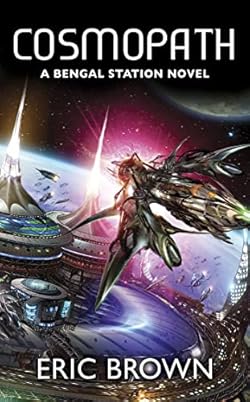
Cosmopath by Eric Brown

Cosmopath cover

Solaris, 2009, 414p.

This is the third of Brown’s Bengal Station novels, which feature the telepath Jeff Vaughan. In Cosmopath someone is asassinating telepaths. In the first two chapters both Vaughan and Parveen Das, another of the viewpoint characters, thwart attempts on their lives and are then separately invited by an extremely wealthy businessman, Rabindranath Chandrasakar, to join him on an expedition to another world. The action thereafter mainly focuses on Vaughan, but Das and Sukari, Vaughan’s wife, have occasional chapters to themselves.

With this third instalment we can see a pattern to the Bengal Station stories.

There will be a threat to Vaughan or those he cares about, or a financial incentive which drives him to undertake a mission for some third party. In Cosmopath his daughter, Li, has leukæmia and Chandrasakar offers to pay for the treatment.

The case will involve a trip off world where events reminiscent of pulp SF take place. In this one, on Delta Cephei VII, the resident aliens don’t wish humans to spread further than they already have.

While Vaughan is away his loved ones will be in danger of some sort. Here, Vaughan’s wife Sukari and his adopted daughter, Pham, are kidnapped to try to force him to reveal the secrets of Delta Cephei VII.

The self-serving Dr Rao will make an appearance or two.

None of this breaks any ground – nor is it intended to, Brown is reworking and updating familiar themes. It’s not cutting edge but it is all very readable.

Reelin’ In The Years 20: Pinball

Brian Protheroe started out in life as an actor and was spotted by a record company employee when playing the part of a pop singer. His first single, Pinball, was something of a one-hit wonder, though.

But it’s just such a good song.

Brian Protheroe: Pinball

He later returned to acting and has had fair success, noted by Wikipedia.

Ely, Cambridgeshire

Ely Cathedral

We hadn’t intended visiting Ely but when we discovered it was only twelve miles from Cambridge we thought we might as well.

Its most striking feature is of course the Cathedral (see left.)

Almost the first house we encountered was in a highly traditional style. We had been forewarned by signs in the car park – and the streets up from it – to “Oliver Cromwell’s House.” This surprised me as I’d always thought Cromwell was a farmer from Huntingdon till the Civil Wars dragged him from hearth and home to military fame – not to mention notoriety – regicide and the Lord Protectorship. Anyway the tacky figures outside put us off entering.

Cromwell's House, Ely, Cambridgeshire.

I had expected the town would contain mostly traditional architecture. There was nothing extremely modern but I was pleasantly surprised to find not one, nor two, nor even three, but four buildings showing deco styling.

The first had “Coronation Building” and a crown inscribed on it. I suspect this would have been the 1937 Coronation (George VI) rather than that of 1953.

Coronation Building, Ely, Cambridgeshire.

The second now hosts WH Smith’s – I had to stitch two photos as the street wasn’t wide enough to allow me to frame the whole thing in one shot.

Smith's, Ely, Cambridgeshire.

The third looked as if it had once been a Woolworths.

Old Woolies? Ely, Cambridgeshire.

The fourth was on another street (Lynn Road?) just off the main one.
Art Deco style building, Ely, Cambridgeshire.

The War Memorial was unostentatious, restrained and dignified, set into a niche in the wall that backs onto the cathedral.

War Memorial, Ely, Cambridgeshire.

There was also a street market which looked pretty thriving. Whether it’s there everyday or merely Wednesdays I don’t know.

Forthbank Stadium, Stirling

Forthbank Stadium* is one of those modern identikit type constructions and a little soulless. But at least it has stands on two sides plus two bits of terracing, one behind each goal – though they are seldom used.

Saturday was a bit gloomy and so the photos are not as sharp as they might be.

This is from the access road, mainly showing the away supporters stand.

Forthbank Stadium, Stirling, from Access Road

This is the home stand.

Home Stand, Forthbank Stadium, Stirling

The terracings behind the goals are opened only when a big crowd is expected – so not for Dumbarton games.
This is the south end – to your left in the photo above.

South Terracing, Forthbank Stadium, Stirling

And this the north.
North Terracing, Forthbank Stadium, Stirling

This is a rather blurry view of the away stand from the north end.

Forthbank Stadium, Stirling, Away Stand

*Edited to add:- I know it’s the Doubletree Dunblane Stadium now.

free hit counter script