Archives » 2010 » June

Friday On My Mind 10: Paper Sun

This was the song that announced Traffic to the world. It’s always been one of my favourites from the sixties.

I remember one of my schoolmates raving about it. Then he discovered Traffic was the new group got together by Steve Winwood (on whom he had a bit of a downer) and went off it.

It was only with the later release of Hole In My Shoe that it actually became evident that Traffic wasn’t just Steve Winwood and a mellotron.

This is what would later be called a video – except in the sixties they were promotional films.

Traffic: Paper Sun

Countdown Over

Big day today.

Especially for South Africa.

Working Legs: a play for people without them by Alasdair Gray

Dog And Bone, 1997, 134p

Gray wrote Working Legs at the request of Birds Of Paradise a Glasgow-based theatre company which stages plays using physically disabled actors.

It is set in a society where to be in a wheelchair is the norm and those who can stand and walk are unusual and frowned upon. The plot concerns the trials and tribulations of Able McMann, who is hypermanic and cannot stop himself using his legs. This is a kind of inversion typical of SF (to which Gray is, of course, no stranger) and while the play is somewhat programmatic at times it does highlight issues surrounding society’€™s treatment of those who are different while incidentally satirising Thatcherite politics of swingeing cuts (now a timely concern again) and the machinations and manipulations of the tabloid press. The resolution could be sentimental were it not undercut by the reappearance of a minor character, but it does round things off satisfactorily.

The book is also copiously illustrated with Gray’s unmistakable idiosyncratic art work.

I don’€™t usually read plays and bought this only as a Gray completist. I did enjoy it, though.

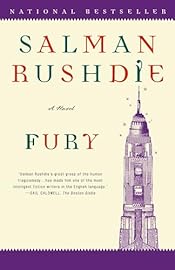
Fury by Salman Rushdie

Modern Library, 2002. 259p

Set mostly in New York Fury is perhaps the fruit of Rushdie’s move to the US after the restrictions necessitated by the fatwa made life in the UK less than congenial for him.

It is not a vintage work, no Midnight’s Children nor Shame. Too much is told, not shown. It also begins inauspiciously; with a very Dan Brownesque first sentence, “Professor Malik Solanka, retired historian of ideas, irascible dollmaker, and since his fifty-fifth birthday celibate and solitary by his own (much criticised) choice, in his silvered years found himself living in a golden age.”

Now, it could be said that Rushdie is playing with the reader, essaying a fable, but, really, three of those crudely dumped slivers of information are examples of newspaper prose and the knowledge they bring us ought to have emerged more organically during the course of the novel.

The novel deals with Solanka’s life after leaving his second wife. He was so full of fury he had almost killed her and their young son and he fled to New York to escape that horror becoming reality. He was also the creator of a TV series in which a doll called Little Brain hosted a kind of chat show where various historical and philosophical figures were interviewed. It became a cult hit, was taken up further, spawning the usual commercial opportunities attendant on success, but in the process was dumbed down. The doll masks which are one of the manifestations of the show-s popularity later become a plot point.

Rushdie’s usual scatter-shot referencing is present, not only to the Erinyes (Furies) of Greek myth – along with allusions to more popular culture – but also copious descriptions of SF stories (eg The Nine Billon Names of God) and films (Solaris, even – heaven help us – Star Wars.) The three Furies have their counterparts in the three women whom Solanka is involved with in the course of the book.

There is a sub-plot involving a republic known as Lilliput-Blefescu (where the doll masks take on a political significance) and which allows Rushdie ample scope for Swiftian allusions.

As a novel, Fury is too tied up in itself. Rushdie is riffing on his concerns but here his orotund, fabular style is distracting, the characters are not as rounded as in his earlier works and the plot not as engaging.

Hill-walking

Just east of Loch Leven, which is in Kinross-shire as was, is a hill known as Bishophill.

This is supposed to be the best place in Britain for the presence of updrafts and consequently is a haven for gliders and hang gliders. They make their ascent from nearby Portmoak airfield. (It’s a glorified name for a strip of grass, really.)

A couple of weeks ago the good lady and myself set off from Scotlandwell to scramble up the hillside.

This is a panorama of Loch Leven from not very far up.

loch1+2+3

A bit further on the path took us past the tip of Bishopshire golf course which is built into the side of the hill. The picture doesn’t convey the steepness of the fairways.

Bishopshire golf course

Much higher up we got a good view of the gliders. They do make a noise as they cut through the air but it is quite strange not to hear engine sounds when something so big breezes past.

glider 1

This one’s a microlight.
microlight

Here’s a hang-glider coming down for a landing on the farmland between the loch and the hill.

hang glider2

We needed more than several stops to catch our breaths before we made it to the ridge at the top.

At the lower summit this dome has been built in the past few years. It wasn’t there the last time we went up, as a family quite a few summers ago now. I suppose it’s a mobile phone booster or something.

dome

Not Friday On My Mind 1: Made My Bed, Gotta Lie In It

The UK B-side to The Easybeats Friday On My Mind was called Made My Bed, Gotta Lie In It.

This was a recording of the band performing the song live, so the quality wasn’t great. The singer’s voice was decidedly ropy. The song’s key was obviously outside his range.

Edited to add: that video has disappeared so this is a replacement.

The Easybeats: Made My Bed, Gotta Lie In It

Some prat on You Tube has titled another version of what seems to be this same clip Made My Bed, Now I Gotta Lay In It. It’s as if they were chickens!

Natural Quarter-Finalists?

With the event looming ever nearer, let us examine the record of “one of the favourites for the World Cup.”

1930: Thought it was beneath them/couldn’t be bothered.

1934: Thought it was beneath them/couldn’t be bothered.

1938: Thought it was beneath them/couldn’t be bothered.

1950: Discovered it wasn’t. Quite the reverse.
Eliminated in first round, famously, in Belo Horizonte, losing to USA 1-0.
An omen? (Also lost 1-0 to Spain.)

1954: Quarter-final, lost to Uruguay 4-2.

1958: First round play-off. Lost to USSR 1-0.

1962: Quarter-final, lost to Brazil 3-1.

1966: Downhill, with a following wind, a suspicious late switch of semi-final venue, not to mention a compliant Azerbaijani linesman, (take a bow, Tofik Bakhramov) drew in final 2-2 with West Germany, then “scored” twice in extra time.

1970: Quarter-final, drew 2-2 with West Germany; lost 3-2 after extra time.

1974: DNQ!

1978: DNQ!

1982: Drew 0-0 in second round (effectively the quarter-finals) not only with West Germany but also with Spain. Eliminated.

1986: Quarter-final, lost 2-1 to Argentina (or, if you like, to the hand of God.)

1990: Semi-final! (which they only reached because Cameroon couldn’t be bothered to sit on a lead.) Drew 1-1 with West Germany after “best goalkeeper in the world” cannot take two steps backwards at a free kick. (1-1 aet.) Lost on penalties.

1994: DNQ!

1998: Second round. Drew 2-2 with Argentina. (2-2 aet.) Lost on penalties.

2002: Quarter-finals. Lost 2-1 to Brazil. Yet another “best goalkeeper in the world” couldn’t stop a lobbed free kick.

2006: Quarter-finals. Drew 0-0 with Portugal. (0-0 aet.) Lost on penalties.

Out of seventeen tournaments only one final – and that at home.

Six no-shows, two first round failures, one (or two) second round exits, four (or five) quarter-final defeats, one loss at the semis stage.

It’s obviously going to be a skoosh, lads.

What If? America. Edited by Robert Cowley. Eminent historians imagine what might have been.

Macmillan, 204, 298p

This volume is a companion piece to What If? and More What If? and is the sort of speculative stuff which I just love. (I don’t much care whether it is as fiction or as historical rumination. Both illuminate how we got here and how it could have been different.) The professional historians call the medium counter-factual, while it is known in speculative fiction as Alternative History. (My preferred term is Altered History.)

This book concentrates mainly on the history of the US. So we have:-
The Mayflower landing in Virginia instead of Massachusetts and so less religious influence on the US.
Pitt the Elder avoiding the American Revolution.
George Washington being trapped by British troops in Brooklyn before the War of Independence gets fully into stride.
No incorporation of Texas into the Union – and no Vice Presidents automatically succeeding on a President’s death.
No loss of Lee’s cigar-wrapped orders before Antietam and hence a Union defeat in the Civil War.
No (possibly unjust) blaming of a certain Civil War Union general for a near catastrophe. (That circumstance eventually gave us Ben-Hur and all the cultural efflorescences that followed from it.)
A second secession (of Mid-West States) during the Civil War.
Andrew Johnson being assassinated along with Lincoln.
A class war in the 1870s.
A US-Britain war in 1896 (over a border dispute in South America!)
FDR delaying the Pacific War.
Eisenhower taking Berlin before Zhukov and Konev get there.
Joe McCarthy as a Soviet agent. (Not too big a leap for the imagination if you apply the old saying “cui bono” to that Senator’s activities.)
A thawing of the Cold War because Gary Powers’s U-2 mission is cancelled.
The Cuban missile crisis is not resolved safely.
An unassassinated JFK reconciling with Cuba (and resisting embroilment in Vietnam.)
Watergate as only a minor scandal.

All fascinating stuff – if perhaps sometimes the historians assume nothing too much would change thereby.

Friday On My Mind 9: America

Not a single, in the UK at least, so it doesn’t really conform to the artificial rules of this category; but hey! It’s perfection.

Simon And Garfunkel: America

Fife’€™s Art Deco Heritage 2: Noridlo, by Thornton

Noridlo, byThornton

Art Deco former house between Kirkcaldy and Thornton.

Noridlo, showiing circular aspect
The circular turret looks like an integral part of the accommodation.

Compare Bennochy Avenue (where the circular part is a staircase.)

Noridlo, showing balcony on circular turret

Side aspect showing balcony. Note stepped arrangement.

Noridlo, from side
Side towards rear. Balcony continues after stepping back down.

The building is now home to a caravan company.

It was given its unusual name because the original owner in the 1930s was a (backwards looking) scrap metal merchant.

free hit counter script