Archives » Ukraine

Ukraine

It goes without saying that what is happening in Ukraine is terrible and totally unjustified.

Sadly it does not look as if it will end any time soon.

As in the law of unintended consequences, Vladimir Putin’s intention to prevent any further expansion by NATO has been thoroughly undermined by his unprovoked attack on a neighbouring country. As a result Finland has pivoted to being amenable to joining NATO and even Sweden, the neutral country par excellence, is thinking about it.

What Putin hoped to achieve by attacking Ukraine and killing its citizens is incomprehensible. What is certain is that he will now have made Ukrainians implacably opposed to close ties with Russia, still less to incorporation into it. I am reminded of the English King Edward I’s campaigns to subjugate Scotland, the single most important factor in forging a sense of Scottish nationhood, and still relevant over 700 years later. Something similar to this will be Putin’s legacy. From now on, no matter the outcome, Ukrainians will not trust Russia or its intentions for a very long time indeed.

On Charles Stross’s blog there is an appeal from the writing community in Ukraine for everyone to make their best efforts to help Ukraine and to inform Russian citizens of the true situation.

The Holocaust and the State

There was an interesting article in the Guardian of 16/9/15 where Timothy Snyder argued that the conditions necessary for the Holocaust of Jews (and others, but mainly Jews) by the Nazis to take place have largely been misunderstood.

Snyder sees it as crucial that in the areas where most killings occurred, principally in the lands of pre-war Poland, the Baltic States and what had been Soviet Belarus and Ukraine, the apparatus of the state was no longer functioning – had indeed been deliberately destroyed. This was the necessary precondition for the activities of the Einsatzgruppen and the SS to be so unconstrained.

Though Snyder’s focus is on Eastern Europe I found myself thinking that in Western Europe too the absence of state institutions was a factor contributing to whether or not transportations to the killing zones of those whom the Nazis saw as undesirables came about. In Denmark, where the king remained and most institutions stayed intact (at least until 1943,) most of the Jews escaped or survived. By contrast in the Netherlands, whose monarch went into exile in Britain, and in France, where the Third Republic collapsed and Vichy was a puppet, deportations were much easier and in some cases even facilitated.

We have seen the consequences of the absence of the state relatively recently in Afghanistan – the Taliban would not have come to power there if not for the chaos engendered by, first, the Soviet presence and then its retreat (effectively driven out by a mujahideen aided and abetted via US and Western support) – in the disarray of Libya and now in Iraq and Syria where ISIS/ISIL/Daesh would not have had the opportunity to grow as quickly or at all if there had not been the vacuum created by the destruction of the Iraqi state and the failure to replace it.

Contrary to what some libertarians appear to think it seems the state really is a force for good.

Postscript:- While looking over the above it also occurred to me that the killing fields in Cambodia, while a consequence of Pol Pot’s take-over, were also due to state collapse, in this case that of the pre-revolutionary government. I suppose too that La Terreur in revolutionary France and the turmoil in the former Russian Empire after the Bolshevik coup are examples of what happens when state organisation suffers disruption. To avoid chaos a polity requires not people with guns but checks and balances; plus a functional judicial system capable of holding those in power to account.

HHhH by Laurent Binet

Vintage, 2013, unpaginated. Translated from the French HHhH (© Éditions Grasset et Fasquelle 2009) by Sam Taylor.
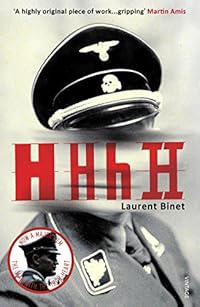
 HHhH cover

HHhH is a strange book, claiming to be a novel, but which is also a historical account of Operation Anthropoid, the British-backed mission to assassinate the head of both the Gestapo and the SD and architect of the Nazis “Final Solution” to what they called “the Jewish Problem,” Reinhard(t) Heydrich, (he removed the final “t” of his forename to make it sound harder) in Prague in 1942. The narrator makes much of his attempts to be true to his characters’ actual lives, saying he will eschew invention of dialogue where possible, commenting on occasions where he does so. He asserts his heroes are the assassins, Jozef Gabčík and Jan Kubiš (one Czech, one Slovak at the insistence of President-in-exile Beneš) and other members of the resistance, yet they and the assassination itself take up only a small portion of the novel which is really the story of Heydrich’s life and an examination of the insanities of the Nazi belief system and organisation. Along the way we delve deep into the roots of the Czech-German dispute – in mediæval times a Bohemian king invited miners from Germany to exploit the silver deposits found in his kingdom – we digress into the origins of the Reformation in the Hussite heresy and, solely because Heydrich visited Ukraine, the heroism of the Ukrainian footballers who took on the previously undefeated Luftwaffe team with ten men and despite being warned to lose at half-time, triumphed 5-1. A few days later they also won the return against a team bolstered by “professional” players from Berlin. [I put that “professional” in quotes because I’m sure I read somewhere else – probably in Inverting the Pyramid – that the pre-war German game was amateur and the Nazis believed only amateur sport was true sport. Professional football only developed in Germany after the war.] The Ukrainians also won the hastily arranged return match and all but three players, who escaped in the confusion of a pitch invasion at the end, were executed.

The narrator mentions the many books and films featuring Heydrich and/or the assassination which he has sought out or encountered – mainly to emphasise their historical inaccuracies – and puts in a good word for Conspiracy where Kenneth Branagh portrayed Heydrich at the Wannsee Conference but scorns most other representations. Despite his apparently encyclopædic knowledge of Heydrich’s afterlife in book and film he makes no mention of the only other I have seen bar Conspiracy, a film called Operation: Daybreak starring Anthony Andrews as Gabčík, but he does dwell on the novel on which the film was based, Seven Men at Daybreak by Alan Burgess.

The first person narration is a piece of authorial trickery. We are invited to believe it is by Binet himself but the narrator does his military service teaching French at an academy in Slovakia, Prague is the city he loves most in the world, yet the author is French – HHhH won the first-novel Prix Goncourt in 2010 – and the constant references to his attempts to establish facts (for example he dithers over whether Heydrich’s Mercedes was black or green; his memory has it as black but the museum exhibit he saw may have been a substitute, an otherwise reliable book has it as green) subtly undermine reliability. In a sly aside he mentions that – contrary to the perennial defence trotted out by ex-Nazis to defray blame for their actions – Heydrich was not averse to disobeying orders when the opportunity to be lenient was available. Heydrich was never lenient.

It seems Heydrich was also supremely arrogant, usually travelling round Prague with no escort, a fact which troubled Albert Speer on his visit to the city and to whom Heydrich says in the novel, “Why should my Czechs shoot me?” Heydrich had previously been shot down on the Eastern Front after a reckless chase of a Soviet plane in an attempt to make himself a war hero, causing great apprehension in Berlin till he got himself back to German lines. Hitler banned any further such adventures. Yet Heydrich didn’t learn. His only companion on the day of the assassination was his driver. After his death the book has Hitler berating his carelessness, saying, “Men as important as Heydrich should always know that they are like targets at a fairground.”

Except for those parts dealing with the narrator’s research and primary readers’ comments the book is for the most part written in the historic present. (John Humphrys would not like it, then.) Its unusual title is from the German Himmlers Hirn heisst Heydrich (Himmler’s brain is called Heydrich.) The original title Operation Anthropoid was apparently “too SF” – !!!! – “too Robert Ludlum.”

The climax of the German hunt for the assassins and their comrades, fruitless until they were betrayed by a fellow parachutist for the reward of twenty thousand crowns, is dealt with in a few pages. Of course, there are no eye witness accounts of the final moments in the crypt at the church of Saints Cyril and Methodius, as the group held out till their ammunition was about to be exhausted and killed themselves with their last bullets.

The narrator quotes George Sand – “Struggle against those who tell you: ‘Work hard to live badly’” – which he says is “not an invitation to digress – it’s a demand.” One of the Nazis is stated as thinking, “Scapegoats at all costs – that could be the Reich’s motto.”

Notwithstanding the lack of tension – surely any interested reader will already know the outcome – and the digressive nature of the treatment the book is immensely readable. It’s easy to see why it won the praise it has received.

The translation was excellent (except for its unfortunate forays into USian – ass for arse, jerked off.)

The Dogs and the Wolves by Irène Némirowsky

Chatto & Windus, 2013, 216 p. Translated from the French Les Chiens et les Loups by Sandra Smith. First published by Éditions Albin Michel, 1940.

The Dogs and the Wolves cover

Of the four Némirowsky novels I have now read this is the one that most engages with the Jewish experience. As in The Wine of Solitude the narrative starts in Ukraine (once again the text has “the” Ukraine) and later shifts to France but the parallels of the main character here, Ada Sinner, with Némirowsky’s own life are less close.

Ada is born into that stratum of Ukrainian society not quite in the ghetto but not elevated from it. Her father is a trader and moves between the milieux. As a girl she catches sight one day of her rich relative Harry and is instantly fascinated. When the inevitable pogrom comes she flees with her cousin Ben and ends up in the richer part of town where the pair temporarily throw themselves on the mercy of their richer cousins, who are horrified by this sudden arrival disrupting their cosy existence.

Years later, in Paris, Ada, now an artist, sketching a party at Harry’s house from afar, mislays the payment for seamstressing work she is taking back to her Aunt Raissa, who throws her out. Ben, besotted with her since childhood, proposes that they marry. Despite her lack of love for him, Ada agrees. On the eve of Harry’s wedding Ada contrives to give him a book in which she knows he’s interested. He in turn is intrigued by her paintings in the book shop window. Eventually they meet as adults and the consequences unfold.

While life in Paris is less on the edge than in Ukraine the sense all the Jewish characters have of never being more than one step away from disaster is brought across firmly. In Ukraine a refrain when any adverse event – drought, famine, disease, political rumblings – occurred the adults would say, “We’re in for it this summer…. or this month, this year, tomorrow,” which I must say is also a very Calvinist, and therefore Scottish, sentiment.

The writing contains the usual bon mots. In one of her father’s trading conversations Ada overhears a nice variation on “fell off the back of a lorry,” in, “What would you say to a batch of ladies’ hats from Paris, just a tiny bit damaged from a railway accident?” Musings during a child’s invented game included, “The grown-ups would be only too happy to be free of all the children! Well didn’t they hear their parents moaning endlessly?” The text also contained aperçus such as, “With that knowing feminine instinct that can aim straight at the vulnerable place in a man’s heart she had sought, and found, the worst insult,” and, of Aunt Raissa’s style in argument, we learn, “Unfortunately she had one fault that was common in women: she loved winning.”

Némirowsky, it seems, never disappoints.

In addition it was again pleasing to see Sandra Smith’s translation, which never felt awkward, utilising the grammatically correct use of whom. “Whom could she turn to? Whom could she beg for help?”

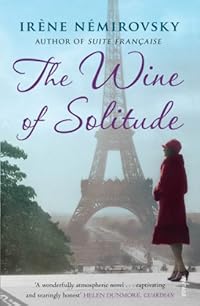
The Wine of Solitude by Irène Némirovsky

Translated from the French, Le Vin de Solitude, by Sandra Smith.

Chatto and Windus, 2011, 248 p. First published by Éditions Albin Michel, 1935.

Hélène Karol is the only child of Bella and Boris Karol. Bella feels she has been forced, for financial security, to marry beneath her – she is self-centred and has expensive tastes. Boris is forced to leave his job as he would be tempted to steal to keep her in style. He leaves for, and makes his fortune in, Siberia. While he is there Bella takes a lover, Max Safronov, who considers the child Hélène a nuisance. Boris refuses openly to acknowledge his wife’s infidelities. Némirovsky notes that “a man needs a certain amount of breathable air, a small dose of oxygen and illusion in order to live.”

The novel traces Hélène’s life from early childhood in Kiev, to St Petersburg, then after the Russian Revolution to Finland and finally France. Hélène loves her father but the only person who has any time for her is her governess Madamoiselle Rose, with whose services Bella eventually dispenses, claiming she has set Hélène against her.

The book’s focus is firmly on Hélène and the effects on her of Bella’s indifference. While still a child she reads a book displaying a happy family she thinks is a fantasy and writes in it, “In every family there is nothing but greed, lies and misunderstanding.” The upheavals of the outside world, the Great War, the Revolution, are mostly off-stage – though one of the scenes in Finland has the White Army gradually nearing the village where the Karols are staying. Even when living through interesting times people still have personal concerns. Wars and revolutions are only the backdrop against which their lives are experienced.

Hélène’s hatred of her mother is such that when she grows up and realises a young woman’s attractiveness to men she determines to win Max’s affections to gain a measure of revenge. More subtly Némirovsky has Max’s mother say to him, in respect of Bella, “Women don’t love a man for himself but as a weapon against another woman,” and doesn’t make those Hélène’s words.

Since Némirovsky was herself Ukrainian and emigrated to France it would be too easy to attribute this novel to autobiography. To do so would be to deny the novelist’s art. As a depiction of an emotionally deprived childhood, and its effects, The Wine of Solitude is exemplary. It also stands as a reminder that those effects need not be determinative. We can choose how to behave.

The translation renders the area of Hélène’s childhood as “the” Ukraine. While this was the Soviet designation and may have been the one in use when the book was written in the 1930s I believe the inhabitants of that country prefer just Ukraine. A pedant’s heart will be gladdened by the fact that in the Finnish scenes Smith rendered a question grammatically correctly as, “Whom were they firing at?” though it does appear fussy to modern eyes.

Art Deco Postcards Plus

One of the presents I received (from my eldest son, for my birthday, not Christmas) was this:-

240 pages crammed full of reproductions of Art Deco postcards of World’s Fairs/Expositions, Public Structures, Places to stay/live, Restaurants/cafés, Cinemas/entertainment buildings, Business/industrial premises, Travel/transport. Plus eight push-out and postable postcards that I shall not be pushing out.

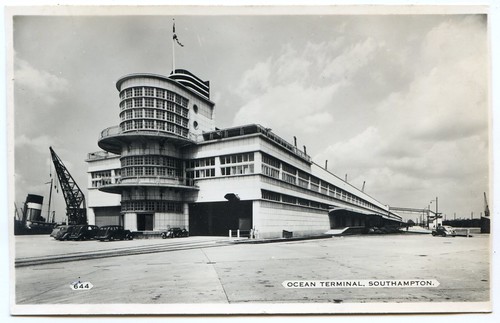
One of my favourite buildings from it is Ocean Terminal Southampton, sadly demolished in 1985, which I had seen portrayed in a jigsaw once. Below is a slightly different view from the one in the book.

Ocean Terminal, Southampton, Hampshire

I was surprised by the fact that the two German buildings featured and the one from Kharkov in Ukraine are survivors. I had thought they might have been blown to kingdom come in World War 2.

Unilever House Memory Book

Also given me (by the good lady) was the book shown right:-

Unilever House Memory Book.

This contains images from the – at time of publishing – 72 year long life of the Art Deco Unilever House, Blackfriars, London.

Euro 2012

I’ve not posted about Euro 2012 yet because I’ve not seen many whole games.

I did catch all of the England – Ukraine game last night, though. If Ukraine had had a striker they’d have won this. England rode their luck and not just with the ball over the line incident.

I take issue with the commmentators over that. In real time I couldn’t tell if the ball was over the line or not. Even with the benefit of the replay using the along the line view I couldn’t tell that the whole ball had crossed the line when John Terry kicked it out. Neither could the fifth official be sure. And he has to be sure to give the goal. It was only when Terry was stripped from the picture and the frame was frozen that I could tell – and how was I to know what other manipulation may have been done to the image? The line official didn’t have that luxury.

Still, roll on goal line technology.

It must be said Uefa haven’t exactly covered themselves in glory over the Niklas Bendtner fine and ban for ambush marketing vivs-a-vis racist chanting and inappropriate banners.

As to possible winners; who knows?

Spain look get-at-able at the back. If it weren’t for Iker Casillas they would have been going home early: both Italy and Croatia would have beaten them. They also seem to have developed this novel way of trying to win football games. It involves not trying to score goals. (To be fair Dumbarton have been using that system for donkey’s years; but not deliberately.)

Against Croatia the Italians did that Italian thing of taking a lead and trying to hold it. The only thing is their defence isn’t good enough these days to sustain it. Had they gone for the second they might have saved themselves a fraught third game. They looked good going forward against Spain though.

Greece? Not likely, but we’ve thought that before.

Germany look impressive and Mario Gomez has morphed from being the German Luca Toni and suddenly found goal scoring form in a tournament.

Czech Republic? I doubt they’ll have enough to beat Portugal who were too fragile at the back against Denmark. But do the Portuguese have enough striking options beyond Ronaldo to get to the final?

France were shown up against Sweden and must play Spain.

England are teed up to lose to a Mario Balotelli goal. They have exceeded their usual Euro performance in getting to the quarter-final, after all.

At this stage it looks like the Germans.

free hit counter script