Archives » Stephen Baxter

Parallax View by Keith Brooke and Eric Brown

Illustrations by Dominic E Harman. Sarob Science Fiction and Fantasy, 2000, 175 p
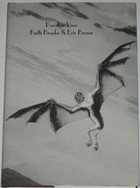
Parallax View cover

This is a collection of short stories, one each written by the individual authors, the remaining six in collaboration. Most of them I have read before on their first appearance.

In his introduction Stephen Baxter says “Science Fiction is the literature of our age….. one way of dealing with [future] shock… the only modern literature which deals seriously with the universe… as a protagonist,” but “the best Science Fiction is, was and always will be about the impact of the universe on the human soul.” All the stories herein illustrate that last point admirably.

Appassionata by Keith Brooke and Eric Brown
In a time of little musical innovation a famous but lonely young pianist is contracted to help a composer improve his work. Unknown to her the composer’s personality has been imprinted with a simulation of Beethoven’s.

Sugar and Spice by Keith Brooke and Eric Brown
A very human tale of loss, revenge and betrayal via the connection between two works of art related to each other through the nursery rhyme suggested by the story’s title.

A Prayer for the Dead by Eric Brown
This is possibly the best of Brown’s stories set on Tartarus, a tale of young love, tragedy and loss, and an enigmatic alien.

The Flight of the Oh Carollian by Keith Brooke and Eric Brown
Julius Frayn is an hereditary fluxmaster capable of guiding ships along the Songlines through time and space generated by the callers of Cynthera. His son Sylvian has not inherited the trait. This one has “had rode” for “had ridden.”

Jurassic and the Great Tree by Keith Brooke
Jurassic is a disposable body inhabited by three personalities hired by an entrepreneur to investigate the reclusive humans called Burul’Chasi whose land he wishes to exploit. The Great Tree is the huge interlocking organism which dominates the Burul’Chasi’s territory. Contains the phrase, “The only Terran life…. are….”

Mind’s Eye by Keith Brooke and Eric Brown
In a setting reminiscent of Brown’s Bengal Station but apparently not offshore, a girl from the lower levels comes up to Sundeck where she is befriended by a telepath on a mission.

Under Antares by Keith Brooke and Eric Brown
Mackendrick is a former Planetary Overseer on Shannon’s Break, second planet of Antares. Six and a half years after his wife’s death as result of an entanglement with the local aliens, the Shandikar, he is called in as blood-tied-speaker when his son trespasses on one of the Shandikar’s holy sites. Dealing with both enigmatic aliens and religious practices, this story bears Brown’s hallmarks.

The Denebian Cycle by Keith Brooke and Eric Brown
An exploration group on Deneb 5 is forced to trek north when their lander and food are destroyed in a forest fire caused by a lightning storm. The local vegetation is all but inedible. Eventually they come upon a stash of food left by the semi-sentient natives and then the natives themselves. Those familiar with John Wyndham’s Survival will not be surprised by the ending. Here there were three instances of the seconds/minutes later formulation, a persona non gratis, (which should be grata,) lay instead of laid as a perfect tense, and the authors felt it necessary to qualify “flayed” with the words “- skinned alive.”

Overall, though, a very good, very readable collection.
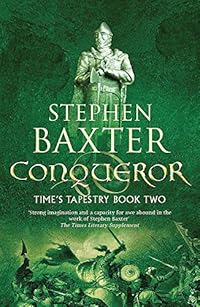
Conqueror by Stephen Baxter

Time’s Tapestry Book Two. Gollancz, 2007, 320p.

 Conqueror cover

This is the second in Baxter’s series featuring a Weaver of Time, the first of which I reviewed here. The prophecy which guides the characters’ lives this time – called the Menologium of Isolde and whose utterance came at the end of Book One of Time’s Tapestry – is linked to the appearances of Halley’s Comet.

Again the book is in four sections, here set respectively at the time of the expulsion from England of the remnants of the Romanised Britons by the Angles and Saxons, the Viking raid on Lindisfarne, Alfred the Great’s stemming of the Danish tide and the Norman Conquest. Unlike the earlier book there is also a prologue and epilogue. Had the book’s title and cover not already been a clue the prologue would in any case have detracted from the impact of the revelation of the date 1066 at the end of section three as the time of the last crucial happening.

An interesting inclusion in the Alfred section is the character of Ibn Zuhr, a Muslim from Al-Andalus, whose knowledge of medicine, other sciences and arithmetic far outstrips that of the locals – as it would have done.

The history of the “Dark Ages” is fascinating but once more too much has to be conveyed in expository lumps. Baxter’s evocation of these times is well done, though, and his battle scenes are viscerally rendered. There is still a hint of too much modern knowledge and attitudes on the part of some of the characters however.

Events remain the same as in our timeline but the monk Sihtric, both in the prologue and epilogue, states he believes he is living in the wrong history as his reading of the prophecy has been unfulfilled.

After Emperor, I swithered about whether to continue with Time’s Tapestry. Conqueror has persuaded me to persevere. The harping of various characters on the word Aryan and its appearnce in the Menologium of Isolde is a trifle ominous, though.

Friday On My Mind 77: The Weaver's Answer

Stephen Baxter’s Emperor, which I have just finished reading, has as its motive force a Weaver of Time’s tapestry. Inevitably it brought to mind this song.

Family: The Weaver’s Answer

Family’s songs didn’t usually have straightforward structures and so they stray into Prog Rock territory.

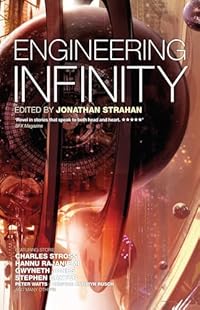
Engineering Infinity edited by Jonathan Strahan. (Solaris, 2010.)

Reviewed for Interzone issue 233, Mar-Apr 2011.

Engineering Infinity cover

According to Strahan’s introduction this anthology is a collection of stories roughly categorisable as hard SF, adding the disclaimer that the term is now a slippery concept hence the stories are inevitably broader in scope than might once have been implied. Whatever his claim that they all invoke the sense of wonder, most exhibit a tendency to be didactic in their narrative styles.

The tone is set early with “Malak” by Peter Watts, the tale of an unmanned airborne war drone that learns from its experiences.

Kristine Kathryn Rusch’s “Watching the Music Dance” deals with the effect of enhanced abilities for children on their dependency and psychological development.

The ghosts of the Soviet space programme are being made real in “Laika’s Ghost” by Karl Schroeder, mainly set in the former cosmodrome in Kazakhstan.

Stephen Baxter’s “The Invasion of Venus” is peculiar in that everything that happens, including the disappearance of the planet Neptune, occurs off stage. Apt, in that humans, and Earth, are of no consequence to the eponymous invaders.

Hannu Rajaniemi’s “The Server and the Dragon” has an intergalactic AI on some inscrutable purpose creating a baby universe as its plaything before being suborned and consumed by a message packet it receives. Extremely dry in the telling, a knowledge of quantum physics and cosmology might be advantageous here.

Charles Stross’s “Bit Rot” is a generation starship type story where the ship is “manned” by cyborgs who are suffering the deleterious aftermath of a gamma and cosmic ray burst. Stross references Tom Godwin’s “The Cold Equations” but overall the story is more reminiscent of John Wyndham’s “Survival.”

In “Creatures with Wings” by Kathleen Ann Goonan the remnants of humanity eke out their lives in what could almost be a zoo which the protagonist leaves to achieve enlightenment. Though Goonan tries to finesse it the story has too large a disjunction when these survivors are taken from Earth by the creatures of wings of the title.

“Walls of Flesh, Bars of Bone” by Damien Broderick & Barbara Lamar is the story from which the collection’s title may have sprung. A man sees himself on a film shot in 1931. The story moves on swiftly to become a concoction of quantum entanglement, self-interference of particles, Bayesian probability, spatial displacements and time travel.

Robert Reed’s “Mantis” concerns the realness (or otherwise) of our experiences and how to tell whether or not we live in stories. The SF gloss involves two way CCTV type screens called infinity windows.

The title of John C Wright’s “Judgement Eve” evokes Edgar Pangborn but unfortunately Wright is no Pangborn. The story, involving angels and Last Judgement, aspires to the condition of myth or Biblicality. As a result the “characters” become cyphers, the prose overblown, the dialogue bombastic and syntactically archaic.

In “A Soldier of the City” by David Moles the eponymous soldier volunteers for the revenge attack on the habitat of the terrorists who attacked his city and killed the goddess whom he loved.

The somewhat loopy protagonist of “Mercies” by Gregory Benford, made rich by inventing a logic for constructing unbreakable codes, invests in and then uses quantum flux technology to “jogg” to nearby timelines in order to execute serial killers before they set out on their sprees; thus becoming himself the object of the same fascination.

In Gwyneth Jones’s ”The Ki-Anna” a man travels to a distant planet to discover the circumstances surrounding his sister’s death and encounters the obligatory strange and disturbing ritual practices.

John Barnes’s “The Birds and the Bees and the Gasoline Trees” features a humaniform who has swum Europa’s oceans and stridden the beds of Titan’s methane seas unravelling the unforeseen consequences of humans trying to offset climate deterioration by seeding Earth’s Southern Ocean with iron from meteorites.

Hard SF? Sense of wonder? In an uneven collection a few stories fail to hit these marks. Enough do, though.

Postscripts: The A to Z of Fantastic Fiction Special. BSFA Members Sampler Edition

PS Publishing, 2010, 112p.

This was the collection I mentioned had been in a BSFA mailing about 18 months ago – a taster from Postscripts.
I’ve only just got round to reading it. The authors include Stephen King, Ray Bradbury, Ramsey Campbell and Gene Wolfe.

Most of the stories are not SF but are fantasy or horror; the best of which is Lisa Tuttle’s Closet Dreams where a young girl dreams of her incarceration by a man she calls the monster.

Of the out and out SF Eagle Song by Stephen Baxter concerns messages from Altair which recur at time intervals that decrease in powers of three from 7510 BC to 2210 AD. While clearly not our own history it parallels that closely, so the phrase “hippy chick” and the use of helicopter gunships in Vietnam supposedly in 1967 jarred a little. Footvote by Peter Hamilton relates the consequences of a private venture opening a wormhole to another planet and Gene Wolfe’s Comber is set on a world where cities drift on tectonic plates.

The writing throughout all the stories cannot be faulted but the fantasy and horror didn’t do too much for me.

BSFA Mailing

The latest BSFA mailing dropped onto my doormat today.

As well as the usual review magazine, Vector, which (unusually, since I’m normally slow at catching up with the latest thing) contains reviews of three books I’ve already read – Hannu Rajaniemi’s The Quantum Thief which I reviewed for Interzone, Ken MacLeod’s The Restoration Game and Ian McDonald’s The Dervish House – the envelope also spilled forth the A4 magazine of those short stories on the ballot for the BSFA Awards for 2010 and an A5 booklet published as a memorial to Robert Holdstock.

Apart from the book reviews this edition of Vector is a special Stephen Baxter issue.

Much of my reading for March is now more or less scheduled. As well as the short stories mentioned above, I have one more of the five novels shortlisted in the BSFA Award novel category in my to be read pile. I’ve just finished Paolo Bagicalupi’s The Windup Girl – review to come. For my thoughts on Ken MacLeod’s The Restoration Game and Ian McDonald’s The Dervish House see previous posts. Tricia Sullivan’s Lightborn awaits. Only Lauren Beukes’s Zoo City will escape my attention.

In addition Interzone has sent me Dominic Green’s Smallworld to review by the end of March. Busy, busy.

free hit counter script