Sceptre, 2017, 283 p.
This is a brilliant debut novel but an odd reading experience, like Science Fiction as if written by Milan Kundera. Some of its tonal quality is, perhaps more understandably, also reminiscent of Stanisław Lem’s Solaris.
The set-up is that a comet has entered the Milky Way “from the Canis Major galaxy” and swept our solar system with a sandstorm of intergalactic dust. Consequently a purple cloud, named Chopra by its New Delhi discoverers, has formed between Venus and Earth. (I wondered here if there is perhaps a nod to M P Shiel’s 1901 novel, The Purple Cloud. Then again there is no reason for Kalfař, Czech born but who emigrated – the blurb says immigrated, there’s an end-point bias for you – to the US when he was sixteen.)
The Spaceman of the title, and our narrator, is Jakub Procházka, a man with a professional fascination with space dust and a professorship in astrophysics. With no other country publicly willing to investigate the Chopra phenomenon, the Czech Republic steps up to the mark, launching him from Petřín Hill on the space shuttle JanHus1. However, the book is not much concerned with the Science-Fictional scaffolding of this premise but more on Jakub’s life before the mission and his mental state while on it.
Not long into his voyage Jakub begins to perceive another living creature in his spaceship, a spider-like being whom he dubs Hanuš, after the maker of Prague’s astronomical clock, and which talks to him and enquires about his life. Kalfař’s writing leaves open the question as to whether this is an actual alien or an hallucination and Hanuš’s philosophy gradually begins to drive Jakub’s actions. Even at the end of the novel Hanuš is still a very real presence to Jakub.
The spaceship chapters are up to the last quarter of the book interspersed with the story of Jakub’s life until he became chosen for the mission. Jakub’s father had been a keen Communist and indeed a state torturer. With the fall of the Soviet Union the family’s fortunes of course changed, not helped by his parents’ death in a car crash, and Jakub’s late childhood, being looked after by his grandparents, was dogged by persecution by his peers. One day a man arrived carrying a rusty metal shoe which he said Jakub’s father once used to torture him. This “Shoe Man” now has the law on his side and causes the Procházkas’ eviction from their ancestral home – a telling reminder that injustice does not only exist under oppressive régimes. The most engaging of these “real life” chapters are those which deal with Jakub’s wife, Lenka, how he met her, their life together, and how, unknowingly to Jakub, they began drifting apart. This is a detailed portrait of a relationship.
In a clever decision by Kalfař the flashbacks are narrated in the present tense while the story of Jakub’s trip in space and its aftermath are in the past tense. This adds to the dreamy, hallucinatory nature of the space-based sections while the Earth bound sections are agreeably gritty. At one point Jakub sees Laika the dog drift past his ship, “her body preserved by the kindness of the vacuum, denying the corrosive effects of oxygen.” (Quite how she escaped the confines of the capsule she had been launched in Kalfař doesn’t explain, but it had me wondering.) This is of course a touch that borders on magic realism, emphasising the strangeness of Jakub’s voyage, but one of the novel’s concerns is the necessity to fight against or to accept the absurdity, the sheer unlikeliness, of the universe. In Jakub’s world even in space persecution cannot be avoided. Hanuš’s species has been pursued across galaxies by creatures called Gorompeds intent on its extinction. It is a neat touch that while Jakub uses the word humanity to describe our kind, Hanuš characterises us as humanry.
The book is also a primer on the history of Prague, the Czechs, and their achievements. To this end we are shown the martyrdom of Jan Hus (though in an apparent aside which is also a neat piece of foreshadowing Kalfař considers the possibility that Hus might have been replaced by a relative lookalike and lived out his days in seclusion,) the tragedy of Vaclav Havel – a man wanting only to write poetry but who instead became public property – who “lost his typewriter,” the plot of the opera Rusalka and the line from it, “All sacrifices are futile” that seems to apply to Jakub’s imminent demise at the hands (tendrils?) of the Chopra cloud, the impossible dilemma faced by Emile Hácha in Hitler’s office as he was offered ignominy or the slaughter of his country.
As the JanHus1 disintegrates in the purple cloud Hanuš disappears and Jakub is rescued by a “phantom” (deniable, incognito) Russian spaceship. He thwarts their authorities’ intention to detain him forever by interfering with the ship’s controls on its landing descent, making it crash, and so limps on into an afterlife in which everyone but the Shoe Man, whom he confronts in a park and whose complicity in his choice for the mission he uncovers, thinks he is dead.
The strangeness of the part of the narrative taking place in space, the distancing Jakub feels even when back on Earth, is echoed by the question he asks himself, “What if our existence is a field of study in probability conducted by the universe?”
My main thought during reading this is that in the flashback sections it bears far more similarity to a mainstream novel from Central/Eastern Europe than to Science Fiction. Kalfař writes in USian but odd word choices, phrases and emphases sometimes make the text seem like a translation – yet all of these add to the overall effect.
To see an examination of the history – and present – of a small country in the guise of a Science Fiction novel is an unusual but welcome phenomenon. But is this a trick Kalfař can pull off again?
One of my books of the year though, without a doubt.
Pedant’s corner:- the Canis Major galaxy (Canis Major is not a galaxy, it’s a constellation,) spit (spat; I know it’s USian usage but it still grates,) “the creature has ahold of me” (a hold,) a missing start quote mark when a chapter began with a piece of dialogue, “over the clothing lines fastened to poles outside their windows” (clothes lines – clothing line is a fashion industry term,) “a deceptively still malt of sand and rock” (malt? Did Kalfař mean meld?) aircrafts (aircraft,) “cut my parents’ retirement” (is this use of retirement in the sense of pension USian? Or is it perhaps a Czech usage?) A missing end quote mark, “to give her a grandchild” (her was Jakub’s grandmother so that would be a great grandchild.) “Millions of eggs circumvent a small planet” (circumscribe,) “I didn’t know what happened to my wife” (what had happened,) by all standards (by any standards is more usual,) scruff (scurf,) a candlewick (it wasn’t a bedspread; so, candle wick.)
Plus points though for the “whom” in “I’m not sure whom to be angry with” and for the use of wee to mean small.
 On a far future Earth from which nearly all humans have fled to Mars and which is dominated by a vast blue creature called Indigo which has been consuming everything, a fourteen-year-old girl named Reee lives alone. Years before, her mother had been snatched away by a Martian space ship. For all the years since Reee has been protected by Emeroo, a shapeshifting green entity who communicates with Reee telepathically. Periodically human like forms whom Reee calls blue boys try to fool her into leaving the safety of her surroundings. Ree also has a flying (what? lizard? dragon?) to help her move about the world. In fah she has two, Belios to begin with, then later Bellis.)
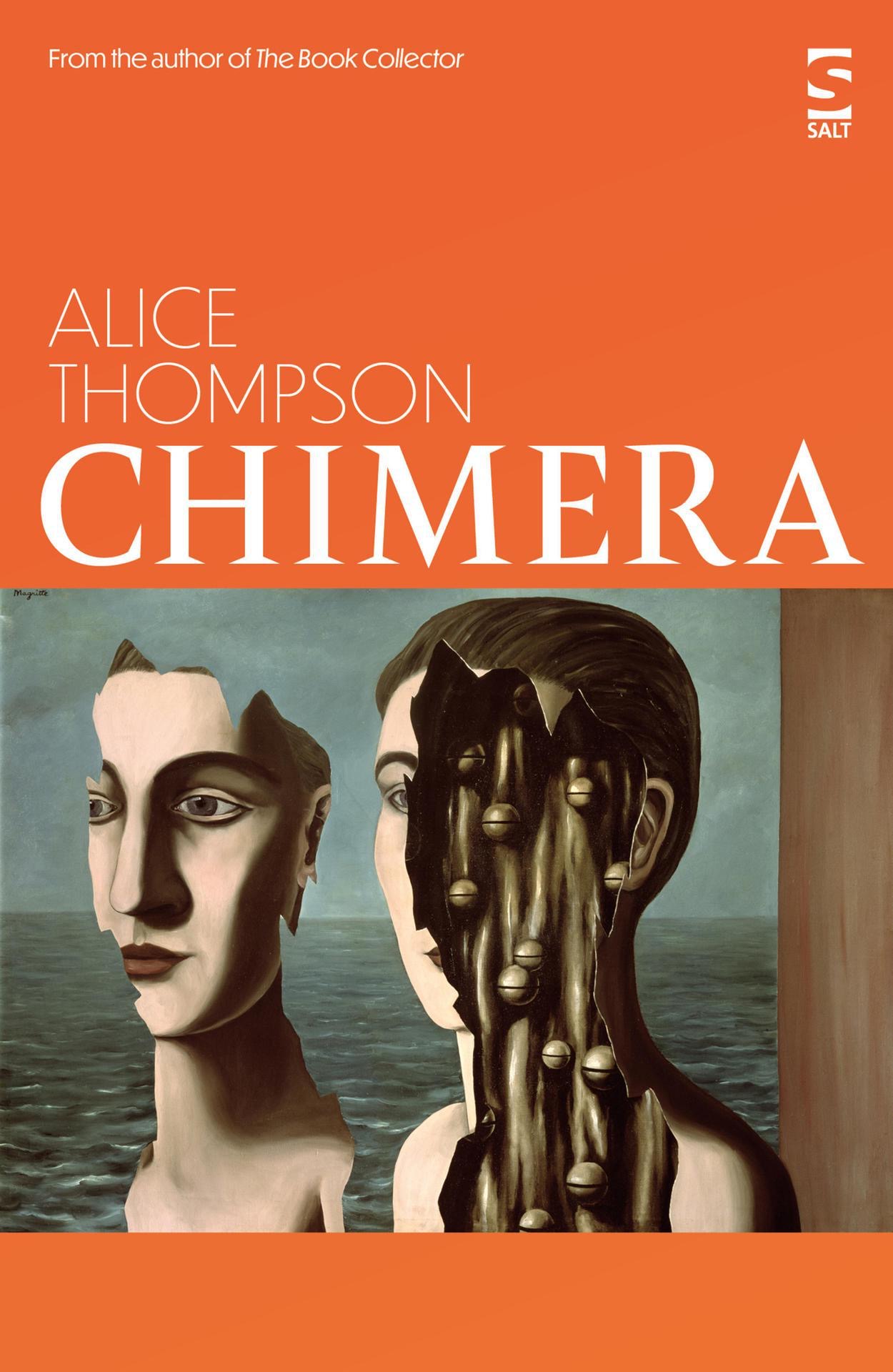 Alice Thompson is a veteran of seven previous novels but as far as I’m aware none of them has been Science Fiction. Concerning as it does a voyage to another planet (or, strictly, to its moon) this book could hardly be described as anything else. Yet it is not a typical exemplar of modern SF. Unlike the brashness of the average space exploration story its tonal qualities are more reminiscent of Stanisław Lem’s Solaris or David Lindsay’s A Voyage to Arcturus. Its epigraph, perhaps the most famous quotation from The Tempest, suggests the trajectory that will follow.