Archives » Scottish Fiction

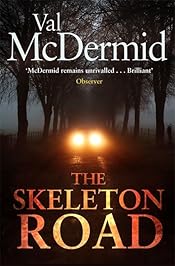
The Skeleton Road by Val McDermid 

Little Brown, 2014, 412 p

I noticed early on while reading this book how different the style was compared to the same author’s Queen Macbeth, which I read only a week or so before. The prose is much less literary, more utilitarian, with more intrusive information dropping. (Once again I only read this because the good lady had borrowed it from the local library.)

The present-day events of The Skeleton Road are set in the run-up to the Independence Referendum of 2014. (Which seems ancient History now and has no actual relevance to the plot.) Karen Pirie – now a DCI in the newly merged Police Scotland – is still in charge of cold cases but due to the reorganisation her office is now in Edinburgh, not Kirkcaldy, necessitating a commute across the Forth Road Bridge.

When an eight-year-old skeleton is discovered hidden in a roof turret on the crumbling John Drummond building in Edinburgh a hole in its head makes it obvious it was murder.

In the meantime the International Criminal Tribunal for the Former Yugoslavia is shaken up by its new boss’s determination to find the identity of the person going around killing the perpetrators of atrocities not yet – and not now (in the 2014 of the book) likely to be – brought to justice. Suspicion falls on former Croatian General Dimitar Petrovic who disappeared around the times these murders started. His wife, Oxford Professor Maggie Blake, in the absence of any other explanation, always assumed he had returned to his former existence in Croatia.

Thus DCI Pirie is launched into an investigation which will reveal to her more horrors about the Balkan Wars of the late twentieth century than she might have wished.

This is not really a surprising subject for McDermid to take on. After all, the first shot of those most recent Balkan Wars was fired in her home town of Kirkcaldy.

It is not hard for the reader to join the dots about the victim. The murderer is initially more of a mystery but a reference about three fifths of the way in rather jumped out.

Crime fiction is how McDermid made her name – and it is what pays her bills – but the contrast between this and Queen Macbeth demonstrates how undemanding the genre can be for a reader (and for its author?) but its consumers can’t seem to get enough of it. And there’s something disturbing about people seeing murder as entertainment.

If the purpose of the fictional detective is to set the world right again after the transgression of the crime, cases such as this give the lie to that assumption of cosiness.


Pedant’s corner:- confectionary (confectionery,) a missing start quotation mark at the beginning of a piece of dialogue, “Dorothy L Sayers’ description” (Dorothy L Sayers’s.) “‘He was as a much a butcher as …’” (He was as much a butcher as …)
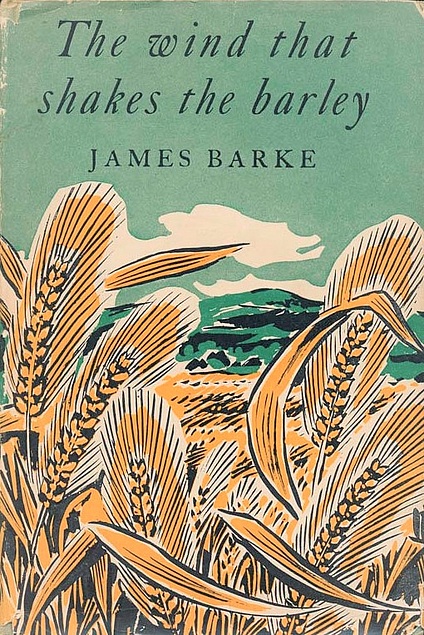
 

The Wind That Shakes the Barley by James Barke

A Novel of the Life and Loves of Robert Burns.

Collins, 1946, 382 p including 2 p Note.

This is the first in Barke’s series of books covering the life of Robert Burns, known collectively as The Immortal Memory. I gather Burns scholars did not look kindly upon them.
This one is a strange concoction, seemingly well researched – in a foreword Barke says he did not want to get anything wrong – yet in parts it does not read like a novel. But it is also not a biography, containing scenes that must be imagined, with dialogue certainly so, and larded with a wheen of Scots words and usages that might be off-putting to those furth of Scotland.

I assume Barke has evidence for his family calling their eldest child Robin unofficially – as do some of his intimates – but it was an odd decision to render throughout the town of Mauchline as Machlin.

The young Robert very early in his life becomes aware that the well-off have it their way and there is little to no justice in the world. This is particularly so in the case of his father, William Burns, a staunch Presbyterian – of the Auld Licht persuasion – passionately opposed to fornication, whose position as tenant farmer on successive poor soils which he did much to improve is taken advantage of by unfeeling (or downright criminal) lessors. William recognizes in Robert an innate potential to make a mark but a tendency to passion which he fears will undo him but strives mightily to ensure his two elder sons, Robert and Gilbert, both gain a good education for themselves.

There is a divagation to Irvine where Robert is set to learn heckling as a prelude to growing linen and entering that trade. It is here he gains his first sexual experience with one of the many Jeans – not to mention other lasses – with whom he will be associated but his sojourn is cut short when the linen shop burns down and it is back to the plough and the land. Robert of course imagines himself in love with all the girls with whom he dallies but does not consider any of them marriageable. Not that he has much to offer them anyway beyond a glad eye and the odd verse.

This first instalment goes up to the point of William Burns’s vindication in the eyes of the law, and final death, worn out by a life of toil; toil which has already taken its toll on Robert.

Barke is not a fine novelist. His prose gets the job done but lacks sparkle and there are occasional passages of purple prose. And at the end I did not feel the text had inhabited Robert as a person. Then again, rendering a fictional account of a real person is the hardest job in writing.

Pedant’s corner:- “Jock Richards’ back room” (x 4, Richards’s,) riccochetted (ricocheted,) “vocal chords” (vocal cords.)

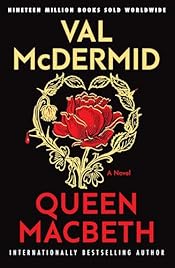
Queen Macbeth by Val McDermid  

Polygon, 2024, 140 p, including iii p Glossary and i p Acknowledgements.

This is one of a series of short novels Birlinn (Polygon’s owner) has commissioned from modern Scottish authors under the rubric Darkland Tales: “dramatic retellings of stories from the nation’s history, myth and legend.” The good lady picked it up from the local library and I thought I might as well read it too.
An author’s note prefaces the tale with a note saying that Shakespeare – like people today – knew little about life in Scotland just over a thousand years ago now and his “Scottish play” about two power-crazed tyrants was an invention (actually taken from Hollinshed’s Chronicles.)

McDermid’s book – like Dorothy Dunnett’s King Hereafter – is an attempt to restore the balance and has two strands; one in the present of Macbeth’s wife Gruoch as she tries to evade capture by Malcolm’s followers (specifically MacDuff) some time after Macbeth’s defeat at Lumphanen by sheltering in a monastery on an island in Loch Leven and the other (printed in italic) her memories of her life when she met and fell in love with Macbeth while in a dynastic – and on her part loveless – marriage to the Mormaer of Moray, Gille Coemgáin, the man who had killed Macbeth’s father Findlaidh. The whole is a love story in which McDermid conjures up late tenth century Scotland admirably.

Macbeth here is not the Earl of Orkney of Dunnett’s imagination but has a power base on the isle of Mull and a prickly relationship with Gille Coemgáin until he takes revenge for his father and establishes his rule by adopting Gruoch’s son Lulach, whom this account asserts is his son anyway.

Within the text there are several sly references to Shakespeare’s play – the handle toward my hand, to the sticking place, untimely ripped etc – but McDermid gives it her own spin.

On the whole I found Queen Macbeth more interesting and writerly than McDermid’s crime fiction. This is Gruoch as a living, breathing – feeling – human being.

Pedant’s corner:- “quantities of ginger and peppermint tea” ( I wondered when ginger came to Britain. It was known in the 11th century so that’s fine. Peppermint was apparently only identified in 1696 but its use will certainly predate this.)


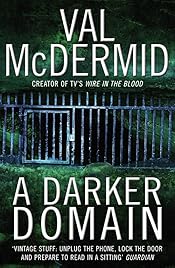
A Darker Domain by Val McDermid 

Harper Collins, 2008, 377 p.

This is the second of McDermid’s Karen Pirie books. I read the first in 2017/8. In this one she is now a DI in charge of the Cold Case Review Team at Glenrothes Police headquarters. A woman, Misha Gibson, has walked into the station and reported her father missing. He was Mick Prentice, a former miner who painted in his spare time, who left during the coal strike of the 1980s and wasn’t heard from again, assumed to have joined the scabs who decamped for jobs in the Nottinghamshire coalfields. Misha’s son has leukaemia, needs a close relative tissue match for him and this is her only hope.

Meantime, freelance investigative reporter Bel Richmond, on holiday in Italy, has stumbled on what looks like a crime scene in an apparently hastily abandoned villa and recognises a poster there as resembling a ransom note from a kidnapping gone wrong years ago. In a proposed money handover, Catriona, only daughter of successful Scottish businessman Brodie Maclennan Grant, was shot and Grant’s grandson, Adam, spirited away by the kidnappers.

How the two cases interlap is what is revealed as the book progresses, with a couple of twists thrown in along the way.

The scenario allows McDermid to illustrate how the legacy of the bitter mining strike of the 1980s endures and poisoned relations between mining communities and the Police. Various locations such as the Wemyss caves are very familiar to anyone who lives in the area, as I do, though some are invented (Grant’s home of Rotheswell Castle) or slightly renamed conflations of real places (the village of Newtown of Wemyss.)

The way the book was structured, with each section preceded by an italicised heading giving its location and date, was slightly intrusive though it did give McDermid the opportunity to present the relevant scene novelistically rather than as being related to Pirie or Richmond as in an interview.

As a character Pirie is engaging but we perhaps don’t see enough of her here.

Pedant’s corner:- “The women who entered” (The woman,) “In his Wham period” (the band was named Wham!) “in Simon Lees’ gut” (Lees’s; there was another Lees’ later,) fit (fitted,) “the big Tesco down by the bus station” (when spoken, yes, but when spoken of, that big Tesco was still a William Low’s supermarket,) sprung (sprang,) “‘not a Raith Rovers shirt’” (I know this was for the benefit of readers furth of Scotland but a Raith fan would have said simply ‘a Rovers shirt’,) “a smile that reminded him of Julia Roberts’.” (Julia Roberts’s,) “her Harvey Nicks’ sundress” (her Harvey Nicks sundress. You don’t say ‘an Armani’s suit’,) Certifcato de Morte (Certificato de Morte,) “scribbling the details down on.” (down on what?) “Toby Inglis’ name” (Inglis’s,) staunch (stanch.)


Best of 2024

19 this year; 12 by men 7 by women, 4 with an SF/fantasy tinge (5 if you count Beloved,) 1 non-fiction, 1 fictionalised memoir. Not in any order; apart from of reading.

News of the Dead by James Robertson

The Gift of Rain by Tan Twan Eng

Tomorrow by Chris Beckett

Purple Hibiscus by Chimamanda Ngozi Adichie

Things Fall Apart by Chinua Achebe

Landmarks by Robert McFarlane

Toby’s Room by Pat Barker

Independent People by Halldór Laxness

Confessions by Jaume Cabré

Sparks of Bright Matter by Leeanne O’Donnell

Navola by Paolo Bacigalupi

The Forty Rules of Love by Elif Shafak

Star of the Sea by Joseph O’Connor

Human Croquet by Kate Atkinson

Lizard Tails by Juan Marsé

Creatures of Passage by Morowa Yejidé

Xstabeth by David Keenan

Borges and Me by Jay Parini

Beloved by Toni Morrison (review to appear here soon.)

The Silver Bough by Neil Gunn

Richard Drew, 1985, 326 p, including 2 p Foreword by Dairmid Gunn. First published 1949.

Archaeologist Simon Grant has been sent north to excavate a previously unexplored chambered cairn surrounded by a ring of stones on the land of Donald Martin. On the way to the site he comes across a mother and daughter sleeping curled up in the heather. These are Anna and Sheena, respectively daughter and granddaughter of Mrs Cameron with whom he takes lodging. At night Mrs Cameron tells Sheena traditional stories of the Silver Bough, a branch with nine golden apples on which music can be played. The Silver Bough “was the passport in those distant days to the land of the gods.” This is one of a few local tales, another is of an urisk which supposedly haunts the stone circle. The text mentions in passing that attempt to define the key to all religions, James Frazer’s The Golden Bough, to which Gunn’s book’s title surely alludes.

Taken by Sheena (whose mother Grant quickly divines is not married, having come back early from service in London in the Second World War as a result of her pregnancy) Grant later has made for her a silver bough made as an item of jewellery “two feet long with nine golden apples pendent.” Sheena’s father is not unknown, though. He is that same landowner, Donald Martin, but his war experiences in the Far East, where he witnessed various atrocities, have left him taciturn and unengaging, prone to wandering the hills or out on his boat, and Anna, in her pride, is content to leave things as they are. There are, in any case, questions of their differing stations in life intervening.

The main plot, though, revolves around the uncovering of the cairn, for which Grant employs for the heavy work the only local help available, a not-fully-there young man dubbed Foolish Andie, who speaks only in grunts. Their first discovery, beside the cairn’s entrance, of a burial cist containing the bodies of a mother and daughter spooned together, reminds Grant of Anna and Sheena as he first encountered them. Inside the cairn itself they find collections of bones and an urn with a hoard of golden objects.

Throughout, Gunn displays a knowledge of archaeological terms and practices which is convincing to the otherwise unversed. Grant’s mistake, though, in returning to the cairn at night unaccompanied seems one a proper professional would not have made. Without it, however, there would have been no remaining plot to unfurl.

On that night visit, Grant is surprised by the appearance of Foolish Andie and knocked unconscious, while the urn disappears, presumably taken by Andie to some hiding place of his. Grant’s discomfiture at this is not helped by the presence nearby of some journalists who quickly latch on to the story and sensationalise it.

There is a lot more to The Silver Bough than this short account might suggest. Each of the characters is finely drawn, even down to Foolish Andie’s mother Mrs McKenzie, Martin’s sister Mrs Sidbury, both protective of their respective close relatives, Grant’s ultimate boss, Colonel Mackintosh, come up from London to verify the hoard.

This is another fine example of Gunn’s œuvre.

Pedant’s corner:- “for appearance’ sake” (appearance’s sake,) “his heart swole up” (old Scots for ‘swelled up’. )

Reading Scotland 2024

I don’t normally do this year summation thing before Christmas (it offends my sensibilities to do such a thing before the full time span has elapsed) but in this case I don’t think I’ll be adding to the total before New Year.

I seem to have read 26 Scottish books so far this year (the definition of Scottish is loose;) 13 by women and 13 by men. Four were Science Fiction, Fantasy or Fable, two collections of shorter fiction, one was poetry and one was a fictionalised memoir. The links below are to my reviews of those books.

World Out of Mind by J T McIntosh

News of the Dead by James Robertson 

The Little Snake by A L Kennedy 

Love and Zen in the Outer Hebrides by Kevin MacNeil

Shrines of Gaiety by Kate Atkinson

The Second Cut by Louise Welsh

Young Mungo by Douglas Stuart

Things We Say in the Dark by Kirsty Logan

Solution Three by Naomi Mitchison

Not to Disturb by Muriel Spark

Dust on the Paw by Robin Jenkins

The Disorderly Knights by Dorothy Dunnett

Queen of Clouds by Neil Williamson

Kitchenly 434 by Alan Warner

An Apple From a Tree by Margaret Elphinstone

Human Croquet by Kate Atkinson

Squeaky Clean by Callum McSorley

The Hothouse by the East River by Muriel Spark

The Other Side of Stone by Linda Cracknell

To the Dogs by Louise Welsh

The Changeling by Robin Jenkins

Aunt Bel by Guy McCrone

Conquest by Nina Allan

Xstabeth by David Keenan

Borges and Me by Jay Parini  

The Silver Bough by Neil Gunn  (review to be posted here soon.)

Xstabeth by David Keenan

White Rabbit, 2020, 172 p

The book is prefaced with a biography of one David W Keenan who committed suicide in 1995, lists his interest in occult matters, his published pamphlets relating to his home town of St Andrews and that he self-published one novel in his lifetime, Xstabeth by David W Keenan, Illuminated Edition with Commentary, reproduced in full thereafter – including various commentaries (as by diverse academics) interpolated between the narrative chapters.
With this I found myself in Russia again, seemingly in the immediate post-Soviet era, though this time St Peters (not for some reason St Petersburg) rather than Moscow where narrator Aneliya is the daughter of a famous musician, who is friends with one “even famouser,” Jaco, though the story later transfers itself to St Andrews.

Jaco is not the type a respectable girl ought to be getting mixed up with. He drinks and frequents strip clubs. But Aneliya is drawn to him nonetheless, with the consequences we might expect. During one of their encounters, in which Aneliya describes one of Jaco’s sexual kinks, she has the disturbing thought that Jaco had performed similar deeds on her mother.

The mysterious Xstabeth enters the story when an impromptu performance by her father in a club is secretly recorded on an old reel-to-reel recorder by one of the staff who is so besotted by it he determines to release it pseudonymously. The music has a force all to itself which is mesmeric but an acquired taste.

The transition to St Andrews is somewhat surprising but gives Keenan an opportunity to display his knowledge of the town. The street known as The Scores – thought to be named after golfing record cards – is said to be a place to pick up prostitutes (think about it) but little evidence is given for this in the text. Nevertheless, the famous golfer – never actually named but sufficiently accomplished to be tied for the lead in the tournament ongoing in the town – Aneliya has met at the hotel asks her to attempt to ply the trade there. It is only he (the famous golfer, who opines that Russian whores are the most desirable,) who obliges himself though.

Aneliya tells us “Naivety gets me every time. Knowledge can be cynical. It just gets used to undermine things. Sarcasm and irony are horrible. Naivety is the deepest form of belief. It’s closer to reality. To wonder. Plus it has more love in it” and “Writing is always starting from scratch. On the blank sheet. Always beginning again. Even when you think you’ve cracked it.”

David W Keenan’s Xstabeth is a strange but compelling confection. The narrative parts are written in short sentences. Sometimes broken up. Into even shorter ones. The effect is as if we are listening to someone speaking to us in staccato fashion. The addition of the commentaries makes David (without the W) Keenan’s Xstabeth even more idiosyncratic. Like the music it is named for, Xstabeth is a genre of one.

Pedant’s corner:- famouser (why Keenan chose to employ this for some while rather than the more familiar ‘even more famous’ is obscure,)  “the lay of the land” (x 3. It wasn’t a tune. The correct phrase is ‘the lie of the land’,) neck-in-neck (it’s neck and neck,) confectionary (confectionery.)

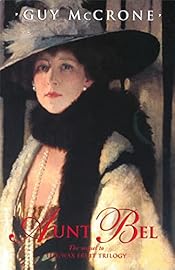
Aunt Bel by Guy McCrone

B&W, 1998, 279 p. First published 1949.

This is the first sequel to McCrone’s Wax Fruit trilogy. For my reviews see here, here and here. I had seen a copy of a further sequel, The Hayburn Family, in a charity shop in Edinburgh’s Morningside but didn’t buy it since I hadn’t read this one. However we were at a book sale in Peebles a couple of months ago and there were copies of both books in this B&W edition so bought both of them.
Bel Moorhouse likes to think of herself as the extended Moorhouse family’s benefactress. When a nephew and niece of hers decide to marry she it is who arranges and pays for the wedding. (Well, her husband pays for it; she takes the credit.) Unfortunately, on the day the organist, Mr Netterton, fails to turn up and she goes to his house along with her almost adult son, Arthur (named after his father,) to see if he can recommend anyone else. No-one coming to mind, he asks his daughter Elizabeth if she could do it. With some hesitation she agrees and carries it off well. Bel is thereafter full of Elizabeth’s praises. Unbeknown to her, however, Elizabeth has attracted the attentions of young Arthur.

The plot revolves around the two youngsters’ suitability – or otherwise – for each other. In her rise through society Bel has developed snobbish attitudes, with which in this case her brother-in-law George agrees – a bit of a cheek considering both  the origins of the Moorhouse family on an Ayrshire farmand her own upbringing.

She manages to offend both Elizabeth’s father and the girl herself before realising the depth of the couple’s feelings for each other. Indeed Elizabeth is so incensed by Bel’s approach she considers not seeing young Arthur any more. The older Arthur has a more sensible attitude to proceedings.

As in Wax Fruit, the prose rarely – I’m tempted to say never – rises above the workmanlike. It is obvious from the moment Elizabeth comes in to the story where it will lead. It is all very easy to read however.

Pedant’s corner:- “the Prince of Wales’ elder son” (Wales’s,) “something about Lady Ruanthorpe’s being very kind” (why that possessive? ‘about Lady Ruanthorpe being very kind’ carries the meaning perfectly well.) Dandy (of a Dandie Dinmont terrier referred to as ‘Dandie’ two lines later.)

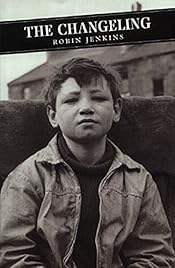
The Changeling by Robin Jenkins

Canongate Classics 22, 1995, 191 p, plus viii p Introduction by Alan Spence.

Charlie Forbes is an English teacher married to Mary, with a daughter Gillian and son Alistair. To the scorn and dismay of his headmaster and colleagues he considers one of his pupils, Tom Curdie, to be highly intelligent and worthy of encouragement. For Tom’s home is in Donaldson’s Court, ‘one of the worst slums in Europe’ and his dress matches that environment. Tom’s mother, her bidey-in – the crippled Shoogle not Tom’s father – and Tom’s brother Alec and sister Molly all share a single room in the Court. That Tom is sensitive – shown by his essays and choice of song at a competition – is a testament to him.

Forbes conceives that taking Tom on their annual holiday with his family “doon the watter” to Argyll will be to Tom’s benefit. (This is set in the grand old days when such expeditions by Clyde steamer were all but mandatory for Glasgow folk.) Forbes’s wife begs to differ about the prospect, Alistair is not bothered either way, but Gillian is suspicious. Prior to the trip we are made privy to Tom’s instincts when he breaks into the school at night to steal some money he knows has been left in a teacher’s desk. Nevertheless, Jenkins engages our sympathy towards him by revealing the circumstances of his home life.

As they approach the holiday destination, Forbes thinks to tell Tom, “‘In no other country in the world, not even in fabled Greece, is there loveliness so various and so inspiring in so small a space,’” but an inner voice, echoing one of his teaching colleagues, says to him “it’s guff, a lot of guff.” On landing, observing the other passengers disembark, Forbes recalls a coast landlady had once told him Glasgow folk were ones to splash the siller, East coasters and the English were far cannier.

A curiosity here is that Jenkins mentions other Clyde ports of call such as Kilcreggan, Craigendoran, Tighnabruaich, Largs, Millport and Rothesay but calls the Forbes family’s destination Towellan and its neighbour Dunroth rather than the Innellan and Dunoon on which they are obviously modelled.

Key incidents involve an encounter with a myxomatosic rabbit, Gillian spying on Tom on a trip to Dunroth where she witnesses him stealing two items of little worth but buying a more valuable present for Mary, the arrival of Tom’s friends Chick and Peerie and later of his mother and her brood, Shoogle and all.

While Forbes oscillates between being understanding to Tom and feeling there is nothing to be done to help him there is an evolution of others’ attitudes as the book progresses. Gillian eventually warms to Tom while Tom himself, having seen the possibilities life could have held for him turns in on himself. To reveal any more would constitute a spoiler.

As always with Jenkins the writing is assured, the insights sharp and his compassion for his characters shines through.

Sensitivity note. The text describes a photographer as a Jew.

Pedant’s corner:-  In the Introduction; V S Naipul (V S Naipaul,) Jenkins’ (x 2, Jenkins’s.) Otherwise none.

free hit counter script