Archives » Scottish Fiction

Life for a Life by T F Muir

Constable, 2013, 394 p. First published 2007.

There is a certain sameness to modern crime fiction; which is to say modern detective fiction. Gone are the days of the gentleman sleuth such as Poirot or Wimsey, and the even more gentle woman, Miss Marple, solving crimes almost at leisure and in relatively salubrious surroundings. Now we have the hard-bitten, hardened police detective dealing with contemporary (well, in this case twelve years old) psychopathic criminality in all its grisly detail.

I would not normally have read this but it is set almost exclusively in Fife, where I live, (with such familiar locations as Boarhills, Kingsbarns, Crail and St Andrews,) and was recommended by our nearest local librarian as an introduction to the author prior to his visit to the library this November. Suitably enough it was published by Constable.

The short Chapter One features a young woman fleeing from a brutal captivity along a Fife coastal path on a freezing night. That is the last time we are given her point of view. It is her body DCI Andy Gilchrist, a widower, and his new DS Jessica (Jessie) Janes, are called to investigate a few days later, dead from a blow to the head, possibly after a fall from the path, and subsequent exposure. They trace her back to a cottage in Kingsbarns where they find two more young women dead, decapitated, and evidence of enslavement into prostitution.

Janes has a sideline in stand-up comedy which she undertakes to try out jokes written by her deaf son, Robert. Her mother has a criminal record but is a constant thorn in her side trying to gain legal access to Robert.  Gilchrist and the forensic pathologist Dr Rebecca Cooper have a mutual attraction complicated by the fact that she is married to someone else (albeit not happily). One of the other female detectives has a problematic relationship with a man who turns out to be unknowingly involved in the case, another has a booze problem.

I thought Janes’s background as teased out by Gilchrist in their conversations and his investigations into her mother’s origins would have made it unlikely for her ever to have been accepted into the police but maybe their standards aren’t too high these days.

This is pretty much the standard police procedural offering but some of the details were perhaps unnecessarily gruesome (of course this may be what the crime fiction market now demands) and there was a cliffhanger scene which stretched credulity by being kept going too long.

On putting this book onto my Library Thing account I found this was actually DC Gilchrist’s fourth appearance in print. I may try one more to confirm my thoughts that it’s not really my thing.

Pedant’s corner:- In the Acknowledgements “whne” (when.) Otherwise; “change in tack” (x 3, the phrase is usually ‘change of tack’,) “chaffed and reddened by a cold Scottish wind” (chafed and reddened,) “all was not as it seemed” (not all was as it seemed,) “oblivious of his presence” (it’s ‘oblivious to’ not ‘oblivious of’,) “as his drove on” (as he drove on,) “the Kingsbarns’ killings” (Kingsbarns here is adjectival, not possessive; ‘the Kingsbarns killings’,) two police acronyms used and immediately explained within two lines (both could have been avoided or worked around without loss of clarity,) “not to help him breath” (help him breathe,) facia (fascia,) “and looked at Gilchrist’s way” (and looked Gilchrist’s way,) “seemed to be order of the day” (to be the order of the day) “toodle-do” (the formulation is usually ‘toodle-oo’.)

Black Sparta by Naomi Mitchison

Travellers’ Library, 1931, 315 p

This is a collection of poems and short stories set in Ancient Greece among the wars between Athens and Sparta. The stories range in date from 500 BC, to 498 BC, 461 BC, 456 BC, 446 BC, 427 BC, 415 BC, 412 BC, 399 BC, 396 BC, 374 BC and finally 373 BC. A few of the poems directly relate to those times but a couple are not so specific.

We start things off with two poems and then each story is followed by a single poem until the last, designated as a song.

Mitchison’s usual facility as a writer is in evidence. There is nothing particularly startling in the contents and she seems to know these times well though bearing her research lightly, but then she did cover similar ground in Cloud Cuckoo Land, and set other books in ancient times: The Corn King and the Spring Queen, Travel Light, Blood of the Martyrs.

She is perhaps strongest when focusing on relationships involving women – the one where one man deceives an ingenuous young girl for his own ends could resonate still, women’s care for each other is displayed but not overly stressed – though those between men are also given weight, in the title story an act of kindness which could be seen as treason being neatly resolved.

While the Ancient Greeks reverence for poetry is not mirrored nowadays there is no reason to suppose human nature two and a half thousand years ago was any different to today. These stories could underline that perfectly.


Pedant’s corner:- shrunk (shrank,) “Hippokleas’ shoulder” (Hippokleas’s: all names ending in s are given s’ as their possessive rather than s’s,) a missing comma before a piece of direct speech, “by and bye” (‘by and by’ as it was rendered later,) a missing end quotation mark after a piece of dialogue (x 2.)

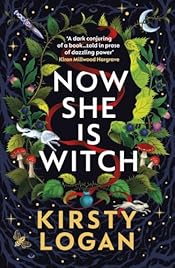
Now She Is Witch by Kirsty Logan

Vintage, 2023, 343 p

Lux was brought up by her mother in a house by the forest. Her mother was a healer and maker of poppets and possets, subject to suspicion because her baby had arrived suddenly with no man on the scene. Her mother gone, and Lux returned to the house after a sojourn in a sanctuary subject to strict religious rules, she is living alone when a woman, Else, arrives seeking her help to poison the local lord “‘who calls women witches so that he has an excuse to kill them.’” That same night Lux’s house is attacked by some of the local boys. They are driven off by a wolf, which may be Else in transfigured form, but not before the house is set on fire. Lux and Else set off together into the forest. The rest of the tale follows both – but mainly Lux – until she eventually finds employment in the lord’s castle, with Else tending to the herb/poison garden, and their misadventures there. I note here that Logan attributes to the lady of the manor more agency than a woman in her situation is likely to have had.

After a “Before” prologue which is unpunctuated (apart from dashes) and printed in italics and with no capital letters, the story is told in five parts. Parts One and Three have section titles all beginning with “Now She Is” followed by one word (in order these were Outcast, Prey, Maiden, Servant, Sacrifice, Whore, Poisoner.)

Part Two is “Lux’s Story” and is given to us also unpunctuated and printed in italics with no capital letters (apart from the words He and Him when describing the lover she had in the sanctuary.) Part Four, “Else’s story,” was similarly unpunctuated but had capital letters where appropriate.

Part Five’s sections have no titles and are in numbered order.

We are here, though, firmly in default faux-mediæval fantasy territory though there is some additional colour, a land bridge between the south and the north, the sea rising, there has been fire in the sky, poison vapours, ash, a sickness spreading supposedly from the north, whose sign is black roses on the skin.

Logan’s almost relentless theme is man’s inhumanity to woman.  “Women are, as Father Fleck used to tell them at the sanctuary, less intelligent, more suggestible, and have more entry points into their bodies. All those orifices ready for a devil to creep into.” In Else’s story she tells Lux “it turns out all that really matters in this world is what a man wants because you either give it to him or he takes it and gives nothing in return” but “Beauty is dangerous. Beauty has power. Beauty has violence.” She outlines “the only available options, Maiden, Wife, Nun, Widow,” adding, “And I could not be any of these even if I wanted to. But there is one other option for a woman and it is the worst of all. Witch. Witch. Witch.”

The plot unfolds slowly to the point where we find the reason for Else’s attachment to Lux.

I suppose it is difficult to write in a contemporary setting a story about the best option for a woman being a witch but I’m really tired of tales such as this adopting a historical template.

On a sentence level Logan is good and her characterization is more than adequate. The whole thing seemed a little bit by the numbers though.

Pedant’s corner:- “Jesus’ birth” (Jesus’s,) “her tongue would not lay still” (would not lie still,) “aren’t I?” (Logan is Scottish; the correct usage is “amn’t I?”)

The Song in the Green Thorn Tree by James Barke

Collins, 1950, 510 p, including 2 p Note, 3 p Contents and 4p list of Characters.

This is the second of Barke’s Immortal Memory sequence chronicling the life of Robert Burns. He is now in young adulthood and has moved to the farm of Mossgiel, near Mauchline, with brother Gilbert and the rest of his family. We meet Jean Armour before Burns does, and she is presented as an obedient, dutiful daughter.

Burns is in trouble with the local minister, known as Daddy Auld. He has already fathered a child to Betty Paton, but his penance for this, on the cutty stool, takes place in the nearby parish of Tarbolton since that is where the offence occurred. He was fined one guinea and his sin considered absolved. (This strikes me as akin to those indulgences of the Catholic Church which so enraged the early Protestant reformers.) It is his poems and intellect which most worry Auld, however, who realizes that the best way to undermine Burns will be through his sexual misdemeanours. To that end he enjoins two of his elders, Willie Fisher and James Lamie, to collect evidence against Burns. Fisher is that hypocritical individual about whom Burns would write Holy Willie’s Prayer. (Another long poem, about Mauchline’s Holy Fair, also excites Auld’s ire.)

Burns and his cronies disparage these prurient creatures as the houghmagandie pack, and the fascination of the Church with controlling sexuality (which seems to be the goal of all religions) is noted. “Auld had long been made aware of the peculiar fact that when any of the congregation had to appear on the sessional carpet for a sexual offence, he could count on a full attendance from his lay-shepherds. No other sin so excited their holy zeal for probing into the mystery of the passionate relationship between man and woman and the theological relationship between both and the Presbyterian conception of God.”

When Burns meets Jean he is immediately smitten (though he does have a weakness for imagining himself in love.) Jean’s father dislikes him on reputation alone and has already forbidden her to have anything to do with him. But the attraction is too strong for both of them and she and Burns sign a paper to the effect that they have married. This is without benefit of clergy but would apparently have been recognised legally. He is too poor to support a wife though. The song in the green thorn tree of the book’s title is the one Jean sings at their trysting site.

The inevitable happens and Jean’s father and mother prevail on her to disown him, paper or no. Incensed, Burns turns to Highland Mary (Campbell) for solace and resolves to leave for the Caribbean, arranging a passage for himself and Mary whom he dispatches to Greenock to hide her pregnancy. Some boy, as they say.

In the meantime his poem some of which Barke has Burns conjure up on the spot, have been gaining a reputation and it is arranged for a book of his poetry (Chiefly in the Scottish Dialect) to be published by subscription, or at least promise of payment. He wrestles over which verses to publish as some may be considered too controversial, publishers then, as now, reluctant to take too much of a risk.

Barke’s writing is workmanlike, with occasional veerings into purple prose when describing landscape. Several of the quoted poems have their verses written as speech which detracts from the ability to read them as poems but since Burns was reciting them to others I suppose that’s fair enough. The characterisation is broad brush.

I note that the Church’s strictures against houghmagandie seem to have been spectacularly unsuccessful as several instances of compearing are mentioned in the book – including that of a couple who married before the evidence blossomed, though their marriage did not in any way mitigate the offence. When Burns has to stand for his “fornication” with Jean Armour there is no room on the cutty stool. He is one of five people, including Jean, arraigned on the same day.


Pedant’s corner:- Barke still spells the town Machlin rather than Mauchline, “womankind were crowding in” (womankind is singular; ‘womankind was crowding in’.) Surgeoners! (it was possessive not plural; ‘Surgeoner’s!’,) “knit his brows” (knitted.) “The company were soon in a grand mood” (The company was soon in a grand mood,) staunched (stanched.)

The Takeover by Muriel Spark

Polygon, 2018, 241 p, plus vii p Introduction by Brian Morton and iv p Foreword. First published 1976.

Some people swear by Spark. For myself I struggle to see what the fuss is about. There is just something about her writing that strikes me as off.

I suspect this one was meant to be a comedic novel. Its tone would certainly suggest that. However, its bittiness and lack of characters with whom the reader can be sympathetic – the book is peopled with an assortment of chancers, frauds, swindlers and charlatans – make it something of a chore to read.

Hubert Mallindaine claims to be a descendant of the union between the Roman Emperor Caligula and the goddess Diana. He is renting a villa at Nemi from Maggie Ratcliffe, fairly recently the new Marchesa di Tullio Friole, who also has a house in the vicinity as well as residences elsewhere. Maggie is much exercised by her collections of jewellery and valuables – paintings, Louis XV chairs etc. The local Italians are not too pleased about these foreigners having houses in the town.

Maggie wishes to evict Hubert but he has various ploys to avoid this, among them setting up a religion based on his claim to be descended from Diana. He treats his secretary Pauline contemptuously and is also systematically replacing Maggie’s paintings and chairs with copies/reproductions.

Maggie meanwhile is having sex with her factotum, Lauro, who is, Brian Morton’s Introduction tells us, “a priapic opportunist” (for which read ‘all-but rapist’) “and kleptomaniac.” In addition, Lauro has fathered a child on a local girl (but blames her as a calculating bitch) and without warning jumps on Maggie’s daughter-in-law Mary, giving her little choice but to succumb to his advance. He tells her that next time she should relax. Not one to brook dissent.

That Introduction describes the motley crew of thieves and conmen surrounding Maggie as, “All as respectably dressed and gentlemanly as the Devil must be in a Scottish narrative.”

Things get murkier as the narrative proceeds; it seems there are other claims on the land the houses are built on, while a dodgy financial adviser worms his way into Maggie’s affairs.

There was a review and article – one each – in The Guardian Weekend supplement on both Sat 07/06/25 and 14/06/25 about the latest biography of Spark (Frances Wilson’s Electric Spark – The Enigma of Muriel Spark. Personally I find her the complete opposite of electric.) The review comments on her elision, “Spark knew what to leave out.” Perhaps it is those “odd gaps” which I find so problematic about her œuvre.


Pedant’s corner:- More than a few USian usages, vide infra.

Inter alia pantyhose (tights,) “a vodka-tonic” (vodka and tonic,) boy-friend/girl-friend (several times: both all one word; boyfriend/girlfriend,) station-wagon (estate car.)

Otherwise; “as if treading a mined field” (why not ‘minefield’?) “set at nought” (set at naught. Nought is the number, zero; naught has the meaning of ‘nothing’,) a missing comma before a piece of direct speech (x 2.)

Rizzio by Denise Mina

Polygon, 2021, 123 p.

This is another of Birlinn’s Darkland Tales which re-examine Scotland’s history from a modern perspective.

David Rizzio, secretary to the heavily pregnant Mary, Queen of Scots, was famously murdered in her presence by courtiers – and especially her husband Lord Darnley – jealous of Rizzio’s supposed influence on her.

This recounting of that incident is necessarily told in the present tense in order to underscore the inevitability of the ongoing rush of events once the assassins’ plot had been set in motion – and the inability of Mary or Darnley to affect those events.

Mina manages to invoke the feelings of the various characters she focuses on but usually by telling not showing. Hers is an omniscient narration laden with the benefit of hindsight.

The novella is perhaps mistitled, though. It is not primarily about Rizzio (he is dead by a third of the way through) but instead charts the relationship of Mary with Darnley and with her Lords. It is also of course an indictment of the misogyny of the times. In that respect Mary never stood a chance. She had flaws enough of her own even without that to contend with.

I note that at the back the description of the Darkland Tales project has Alan Warner’s then forthcoming contribution titled as The Man Who Would Not Be King. It was eventually published as Nothing Left to Fear From Hell.

Pedant’s corner:- “Here the change of seasons are dramatic” (the changes of seasons are,) “and snakes his arm right around her waist until his hand on her swollen belly” (is missing a verb after ‘hand’; rests? lies? settles? is?) “Lady Huntley” (Huntly, as it is always spelled elsewhere in the text.)

Poor Tom by Edwin Muir

Paul Harris Publishing, 1982, 253 p, plus vi p Introduction by P H Butter. First published in 1932.

Edwin Muir is better known as a poet but he wrote three novels of which this is the third.

The plot centres round the conflict arising when Tom Manson finds out his brother Mansie has begun seeing Helen Wiliamson, a girl whom Tom had previously walked out with.

This causes tension within the family, the brothers stop speaking to each other and Tom starts drinking to excess.

For a book published in 1932 and set in 1911 there is a considerable emphasis on sexual matters. Of the imaginings of becoming intimate with a woman we are told, “Such secret pleasures are exciting, but they leave a sense of guilt towards the object that was employed to produce them. Tom was filled with shame that such thoughts should come into his mind when he was with Helen, and told himself he was a waster.”

There is stress too on the attractions of Socialism to those of Mansie’s persuasion and social standing, and of the similarity of its tenets to Christianity.

Tom has a bad fall under the influence of drink and thereafter suffers a series of headaches which increasingly incapacitate him. Both he and Mansie (but not the reader) are confused by the doctors they consult about Tom’s condition asking whether he has ever associated with loose women.

As the illness progresses reconciliation occurs and we are treated more to Mansie’s reflections on having an invalid in the house.

As a novel this is not entirely successful. As an insight into aspects of life in pre-Great War Glasgow (the Mansons had moved there from a farm some time before the novel begins) it is certainly better than Guy McCrone’s books about the extended Moorhouse family.

Pedant’s corner:- in the Introduction; superceded (superseded.) Otherwise; threatingly (threateningly,) Maisie (elsewhere always Mansie,) inimaginable (usually ‘unimaginable’,) excretary (excretory,) “he turned and literally flew downstairs” (not literally.)

Nothing Left to Fear From Hell by Alan Warner 

A Surreal Chronicle, Polygon, 2023, 149 p, including 7 p Afterword.

Nothing Left to Fear From Hell is one of publisher Birlinn’s Darkland Tales which re-examine Scotland’s history from a modern perspective.
In it, a tall man, accompanied by several companions, is making hazardous journeys by small boat between the islands of the Outer Hebrides, mostly under the cover of darkness. They are on the run and at one point the man has to disguise himself as a serving girl, when he is given the name Betty Bourke.

We are of course following the flight of Charles Edward Louis John Sylvester Maria Casimir Stuart (to give him his full complement of names, never used in the text,) otherwise known as Bonnie Prince Charlie, down on his luck but ever hopeful fortune will favour him in the end.

Though the Young Pretender has featured as a character in many of them, most novelistic examinations of the Jacobite inheritance – a perennial subject of Scottish fiction – have focused on that cause’s adherents and their (mis)adventures. I certainly have not before read one in which the Prince is the protagonist. But my acquaintance with the subject is by no means exhaustive.

Warner inhabits the time and its susceptibilities very effectively, presenting a picture of Charles Stuart as a human being, with every necessity and function we all have, along with his convictions of divine right, plus the all but unthinking deference of his comrades. Not that the text confines itself to the viewpoint of the Prince. A particular highlight is a servant girl’s view of the kenspeckle and overly presumptuous Betty Burke

A quirk of this publication is that on even numbered pages between chapters – and before the Afterword – are depictions of that minute pest of the Scottish summer, the midge, with which the travelling party is plagued, starting with one and going up to ten.

In that Afterword Warner speculates on the conundrums of historical fiction, the difficulties of portrayal. As he says, “they were so like us, and they were so unlike us.”

But apart from the drier and necessarily more restricted approach of historical record and academe, fiction is the only way we can explore past times such as these.

This novella gives us Charles Edward Stuart as a believable, if misguided, human being. But he was trapped by his birth; as most of us are.

Pedant’s corner:- “was like a liquified putrescence” (liquefied,) “he crashed items akimbo” (he crashed items with his arms on his hips?) “the riding party were headed onwards making a cover of what might lay over the roads ahead” (the riding party was headed onwards making a cover of what might lie over the roads ahead,) “Robert Forbes’ remarkable” (Forbes’s,) “Winifred Dukes’ The Rash Adventurer” (Dukes’s.)


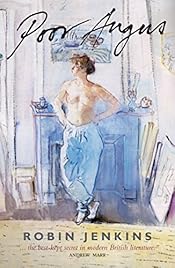
Poor Angus by Robin Jenkins

Canongate, 2000, 237 p.

After a sojourn in Basah in the far East, painter Angus McAllister has returned to his Hebridean roots on the island of Flodday, whose only drawback is that the local women refuse to pose for him.

Janet Maxwell has temporarily left her philandering husband and sought refuge with her brother, the owner of Flodday’s hotel. She is pulling pints in the bar when she and McAllister meet. Eager to incite her husband’s jealousy, she conceives the idea of living at McAllister’s house Ardnave, as his housekeeper. Janet is originally from Skye and has second sight. When she enters McAllister’s living room she immediately feels a tragedy will occur there. This, combined with McAllister’s possession of a blowpipe spear, means Chekhov’s dictum about the gun on the wall will most likely come into play. Brought up a Wee Free, Janet has particular ideas on sex as being a sacrament; an attitude her husband finds both ridiculous and irritating.

Janet also foresees the arrival at Ardnave of a woman and her daughter. This will turn out to be Fidelia Gomez, one of McAllister’s former lovers in Basah, a devout Catholic who could not contemplate divorce from her husband, and her child Letitia. However, she is preceded at Ardnave by the Australian Nell Ballantyne, another of McAllister’s lovers. Such goings-on with three married women eventually occupying the same household, none of them the wife of the owner, set many tongues wagging.

These complications to Angus’s life all take place in Part One. Part Two sees the entry of Janet’s and Nell’s husbands, both golf nuts, and the demand by Fidelia’s to have custody of Letitia which precipitates the novel’s rather sudden climax.

This examination of Hebridean life, the locals’ gossip, the minister’s censure, the frustration and delay incurred by everything being shut on a Sunday reads as being somewhat traditional. Nevertheless, the hotel owner’s daughters are amused by the minister’s reference to God knowing everything since, “It didn’t matter if God knew your secrets. He could be trusted not to clype.”

The novel was first published in 2000 but has the feel of having been written earlier. Yet I suppose it was 25 years ago now.

Poor Angus is not quite perhaps as serious a book as some that Jenkins has written but I still accomplished.

Pedant’s corner:- “looked in stony copulation” (context suggests ‘locked in’,) “‘he’s got to be made understand’” (made to understand,) delf (it was pottery, Delft,) “when it ought to have been growing stranger” (growing stronger makes more sense.) “‘What’s your, then?’” (What’s yours, then?’”) “But what man McAllister’s predicament would not be” (what man in McAllister’s predicament,) clifs (cliffs.) “‘Keep your eyes off her books’” (‘off her looks’? Perhaps even ‘off her boobs’?) a missing end quotation mark, “while he was an his studio” (in his studio,) a missing opening quotation mark, “‘Why do like painting ladies with no clothes on?’” (Why do you like.)

Olivia by O Douglas

Thomas Nelson and Sons, 1951, 279 p. First published as Olivia in India in 1913.

O Douglas was the pen name of Anna Buchan, sister of John. She published ten or so popularly successful novels over her career.

Olivia, her first novel, is the tale of the eponymous narrator’s trip to India to visit a brother called Boggley. It is written, initially in a self-deprecating tone, in the form of letters to a male friend, Arthur, back home.

It is at least semi auto-biographical. “Douglas” visited India herself in 1907 and in Olivia she mentions a brother, John, whose writing has been well-received and asks, “Other members of the family can write, why not I?” (In the novel, Olivia conceives the idea of writing a book about the Mutiny. I don’t think “Douglas” ever did write that though.)

On the boat over, Olivia meets a young woman, Geraldine, swiftly dubbed G, and they become firm friends, their paths criss-crossing through the text from time to time.

There is little plot here – Olivia is not concerned about the time-honoured custom of women going to India to find themselves a husband. It is more an account of experiences with a few insights thrown in. Of the characters of the mem-sahibs she says, “the women who are pure gold grow more charming, but the pinchbeck wears off pretty soon” and finds the desire for one-upmanship of the colonialists unseemly.

There is also a slight dig to Arthur about the urge to explore. “Men at times hear the Red Gods call them (women hear them too, you know, only they have more self-control.)”

As is to be expected of a novel now 110 years old it does display the attitudes of its time.

Pedant’s corner:- wakened (x 2, woken.)

free hit counter script