Archives » Scottish Fiction

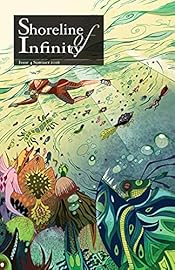
Shoreline of Infinity 4: Summer 2016

The New Curiosity Shop

Shoreline of Infinity 4 cover

In this issue there are interviewsa with Ken Macleod and Tricia Sullivan by Gary Dalkinb. Duncan Lunan reviews Ken Macleod’s The Corporation Wars: Dissidence mainly by way of discussing other works; Iain Maloney mystifyingly likes Yoon Ha Lee’s Ninefox Gambit and praises publisher Unsung Signals for taking a punt on Dan Grace’s long short (or short long) piece of fiction, Winter, not to mention the work itself. Elsa Bouetc likes Lavie Tidhar’s Central Station, Benjamin Thomasd eulogises Guy Gavriel Kay’s Children of Earth and Sky despite its tendency towards info-dumping, Ian Huntere is less generous to Ian Boffard’s Tracer. Ruth EJ Booth’s first column discusses the effect of winning a first award on a writer. Russell Jones’s introductionf to Multiverse (the poetry section) manages to tell us what the poems are about before we read them.
As to the fiction:-
Well Enough Alone1 by Holly Schofield depicts the cognitive decline of an elderly woman. Keen to get rid of her electronic minder by damaging it, she persuades the repair technician to download its programming into her smartcane while awaiting a replacement. The smartcane has programming of its own.
In Senseless2 by Gary Gibson a future National Unity totalitarian government perverts a medical breakthrough by using a device to remove senses from the prisoners it detains. A blind inmate who has developed compensation mechanisms and concocted an escape plan is suspicious of a new cellmate.
Andrew J Wilson’s The Stilt-Men of the Lunar Swamps3 is a typically exuberant piece of Wilsoniana, a Vernian/Wellsian pastiche in which our intrepid adventurers travel into a cavern in the Moon to meet the titular stilt-men and their even more alien controllers. There’s also a character named MacGuffin.
Model Organisms4 by Caroline Grebell relates the last yearnings of a dying life-form.
In Note to Self5 by Michael Stroh a wannabe Science Fiction writer busily piling up the rejection slips receives a package in the post: his first novel, sent to him by his future self.
Robert Neilson’s From the Closet is the somewhat predictable story of a man who tailors himself – literally – to the profile required by his internet dating partner.
The G4.A of geefourdotalpha6 by Clive Tern is a fighting robot which achieves consciousness when brought down in its final battle, surviving hundreds of years before being unearthed by a human anxious to preserve her hunting grounds.
Beachcomber by Mark Toner is a continuation of the graphic/comic strip series introduced in Shoreline of Infinity 3. This episode manages to combine 1950s UFOlogy with the Broons!
Gay Hunter by James Leslie Mitchell (Lewis Grassic Gibbon) is an extract from that author’s novel of the same title, the latest to be considered under Monica Burns’s7 SF Caledonia umbrella.

Pedant’s corner:- aIn the introduction “Ken Macleod and Tricia Sullivan have both have contributed” (remove a “have”.) b“as an writer of the left” (a writer,) “advances are being made bio-engineering” (made in bio-engineering,) “this conservative tenancy” (tendency.) c“the benefits and drawback” (drawbacks make more sense.) dhonorable (honourable, please.) e”the very imposing, nay, ruthless figure, who” (has its second comma misplaced; it ought to be after “ruthless”.) fDodds’ (Dodds’s.) gIn an appeal for subscribers; super nova (supernova.) 1Written in USian, “an sensible-looking brush” (a sensible-looking.) 2”The guard led pushed Bill into a chair” (led, or pushed? Or led/pushed?) plus a missing comma at the end of a piece of direct speech. 3”is audience were in for” (his audience was in for,) there was an unwarranted change in font size part way through, “hoisted by our own petard” (hoist by our own petard.) “There was ghastly, flatulent bang” (a ghastly flatulent bang.) 4”I have laid immersed” (lain immersed,) kilometers (kilometres,) “spermatozoa multiplies in my ovaries” (spermatozoa is plural; so, multiply. Plus spermatozoa are male sex cells, they would multiply in testes, not ovaries.) 5Written in USian. 6Written in USian, “ – hat’s how the file translated” (that’s.) “At the start of its final battle started G4.A controlled the sector” (As its final battle started G4.a; or, At the start of its final battle G4.A,) “advantage point” (it’s vantage point, no “ad”.) 7”The list of his best loved authors ….include (includes,) “the unique SF canon … go virtually ignored” (goes.)

The Hound of the Baskervilles by Arthur Conan Doyle

Headline Review, 2006, 213 p One of the 100 best Scottish Books.

The Hound of the Baskervilles cover

This takes the usual form of the Sherlock Holmes story. A client comes to Baker Street to enlist Holmes’s help in unravelling a mystery, in this case a Dr Mortimer, friend of the late Sir Charles of that ilk, who relates the legend of the hound of the title, said to be the curse of the Baskervilles and apparently responsible for Sir Charles’s death and seeking Holmes’s protection for the heir, Henry, about to arrive in the country from overseas. After some preliminary shenanigans in London our narrator Dr Watson is packed off to the Devonshire countryside to seek information and act as a kind of bodyguard while Holmes does his thing, supposedly on other cases but in reality following his own path to the answer. Throw in a few red herrings like the light on the moor at night, disguises of various sorts, people who are not who they pretend to be, and the mix is complete.

The attractions of the form are readily apparent. The book is easy to read, comforting (Holmes rarely fails to set the world to rights,) as well as formulaic. It is not, though, literature of the highest quality. The prose never rises above the workmanlike, the characters are little more than stereotypes and it surely appears on that “100 best” list only because Holmes has become so familiar as a cultural reference point.

The piece of dialogue, “‘Interesting, though elementary,’ said he,” incidentally shows that Doyle did put that word into Holmes’s mouth (though without appending to it, “my dear Watson.”) It also illustrates Doyle’s irritating use of “said he” rather than “he said.”

Pedant’s corner:- “If he would, confine his energies to this all would be well” (surely has an extraneous comma,) rosterer (roisterer is the best fit.)

Living Nowhere by John Burnside

Vintage, 2003, 377 p. One of the 100 best Scottish Books.
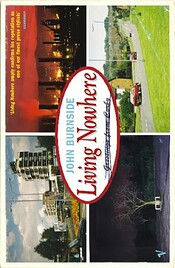
Living Nowhere cover

Some books announce themselves from the outset, one way or the other. Within two sentences (and long before their seven lines ended) I knew this was going to be good; for all that I also knew it wouldn’t be straightforward. This is unapologetically a work that makes demands on its reader; but only in so far as it doesn’t lay its cards on the table openly. Burnside approaches his tale obliquely but in a way that reflects his characters, moreover the book’s structure is unusual in that it starts with sections dedicated to four viewpoints, not always following in the same order but doesn’t stick to those four throughout. They are Alina Ruckert, daughter of immigrants, refugees in World War 2; her mother Alma; Tommy Cameron, come down from Fife to Corby to make a better life for his family; and his son Derek. Alina is a somewhat detached young woman who has made a (non-romantic) friendship with her brother Jan’s bosom companion Francis (another of Tommy Cameron’s sons) who bonded most over photography. Alma feels alienated by her non-Britishness and her husband’s determination to give nothing of himself away. Tommy has brought up his sons to be aware of how tough the world is and always to be on their guard. Derek feels to be not altogether a man as he doesn’t experience the rage all the males around him seem to. That first part of the book is set in Corby, a town which, as Burnside tells it, in the late 1960s/early 1970s was in part a vision of Hell, dominated day and night by main employer The Works, spewing copious amounts of smoke, ash and iron ore into the town’s atmosphere so that clothing always reeked of sulphur and with the threat of violence never far away from its nightlife.

There are strong echoes of previous Scottish literature in the book. Tommy has been influenced by his Uncle Arthur whom he used to visit in rural Scotland and remembers his tales of the old days, “Tommy had never understood how the people tolerated the inhuman behaviour of the rich landlords.” Arthur had once admonished him, “‘Take a look around when you’re back in Cowdenbeath, walking down the High Street. Look carefully and see how many ghosts you can see.’” The tales of supernatural apparitions were about more than superstition, or the casual fatalism of people whose lives were governed by the random, they weren’t about something invented. “They were about something that had been lost. Something important.” Tommy knows to be hard only if the occasion demands it and skewers hard men as, “The boys who sat lonely in their own reputations, cold as stone, afraid to smile or say too much. Tommy knew you had to be afraid of something to spend that much time and energy on an image.”

Alina realises men treated everything they touched with contempt because it was life itself they hated and feared (feared more than hated) and is astonished by her workmate’s determination to get married, recognising, “that real, self-deluding affection that every bride-to-be harbours, against all the odds, till the week, or month, or year after the wedding, when she finds out what the man she married is really like.”

Derek contemplates the oddness of the life of the ex-pat. “He didn’t know what Scotland was. The mythology said it was The Sunday Post. The White Heather Club. The Highlands. But they never had shortbread at home, not in Scotland, and not here, except at Hogmanay when everybody turned into cartoon Highlanders, wandering the glassy streets with coal and bread in their coat pockets, leaving their doors open so anybody could walk in as tradition demanded,” he reflects on the New Year rituals. “Scotland was a myth. Burns suppers, tartan, Bonnie Prince Charlie, knowing what clan you were supposed to be in, it was all a bad myth.” But though none of the people around him at New Year came from that misreflected Scotland of the mind, “they were all going back there to die,” and he knows, “they didn’t want home. They wanted the same Scotland the tourists got.”

He has doubts about religion, “He didn’t want anybody’s love, he just wanted to be treated with basic decency. All these people talking about love, they were lying and cheating and robbing one another all the time, and nobody seemed to care. Maybe that was why they’d made up that impossible religion of love: because it was impossible, and everybody knew it, there was no real pressure to live up to it, no real need to do anything but go through the motions.” In another system based on the “ordinary possible decency of which people were capable, everything would be different.” If instead of having to love them, you just treated your neighbours as human beings.

The first half of the book weaves its overall narrative between the four viewpoints, sometimes seeing the same incident from more than one perspective, and the inevitable incident, brewing for 200 or so pages, which precipitates Francis’s flight from Corby occurs, like so much in this book, off the page, or at least we only come upon it in its aftermath.

Burnside seems to comment on his storytelling when Francis thinks, “the world is divided into two camps: (a) people who believe in stories and (b) people who trust the isolated, fleeting moments that stories seek to string together.” Here it looks as if Burnside has made a novel out of such isolated moments. It’s a bit of a pity that he then then over-eggs this underlining by adding, “like the little black points in one of those old join-the-dots puzzles you used to get in comic books,” but almost saves it with, “It never works. The picture turns out awkward and ugly, the story is, at best, a half-truth.” But Burnside’s story is neither awkward nor ugly.

The second half of the novel is couched as a series of letters from Francis to his absent friend Jan, telling of his life as a wanderer and some of the people he meets, before a coda section provides a resolution of sorts.

Francis meets all sorts, including privileged undergraduates in Cambridge, “they were the inheritors, boys who would be middle-aged in ten years’ time, working in the city or Whitehall, or running the family business, property owners, members of the club, men to be reckoned with….. moral within the narrow bounds of a system that refused to consider the intrinsic immorality of their position.” The pull these types can exert he sees as, “Women are always lamenting the fact that men are attracted to looks and nothing else, but they should see themselves when it comes to men with money.” Not big spenders, not flash but, “that quiet confidence that comes of having a trust fund behind you ….of wearing the right clothes, driving the right car, going to the right ski resorts for Christmas……” In a word, “Glamour.” In this context he tells us, “I love that expression ‘chip on the shoulder’: I bet nobody ever said it who was ever hungry and it was somebody else’s world.”

Of his experience of the US where he works for a while, he suggests, “If these people could only give a damn about something other than their own beautiful lives, they would be extraordinary.”

He excuses his lack of commitment by rationalising, “It’s the best luck a man can have liking women. Not just the pretty ones, or the ones who want to go to bed with you, but all women. It’s the worst luck when he chooses one woman and sets her apart, then lets his imagination go to work on her.”

He winds up in a Fife fishing village, making a living mainly through painting, and characterises the locals, “On the coast the people weren’t so much hard as indifferent,: their regard was fixed wholly upon themselves; if you weren’t from there, born and bred, you didn’t really exist, you were an incomer, a non-person.”

The one woman he settles down with for a while, Sally, eventually says to him, “‘You don’t want to stop moving, you don’t want to belong anywhere, because you think that’s how you are. But it isn’t. It’s because you’re grieving, it’s because you’re angry. Maybe you’re guilty too.’” She adds, “‘Your trouble is that you don’t want to live anywhere.’” And his inevitable reply, the one the book has necessarily been building to, comes. “‘No,’ I said, “my trouble is that I want to live nowhere,” but, crucially, Francis adds, “‘There’s a difference.’” For, “Home, wherever and for however long we find it, is, by its very nature, provisional and tainted.” His knowledge of himself is hard-won. “We think it’s the big dramatic happenings that make a difference, but it isn’t. It’s the long-drawn-out, drip-by-drip processes of loss and betrayal or grief that break us down; it’s the weeks and months of growth after some revelation, and not the revelation itself, that make us wise.”

Perhaps Burnside’s style in Living Nowhere is analogous to Francis’s musings on his painting. “To get it right, I realised, I had to abandon the literal: the meaningful juxtaposition, the telling contrast, no matter how well camouflaged didn’t quite work.” And then there is Francis’s idea of the pentimento. “What if the pentimento was the very point of the painting? What if you did just enough almost to conceal the thing you wanted the viewer to see, almost to hide the image that, because it wasn’t too obvious, would be all the more haunting?”

Substitute reader for viewer and that could describe Burnside’s achievement in Living Nowhere, a novel well worth its place in that list of best Scottish books.

Pedant’s corner:- homeopathic (homoeopathic, please; or even homœopathic,) staunch (stanch,) math (even if he was in the US at the time concerned the narrator here is British; so maths.) “A range of theories were proposed” (a range was proposed.)
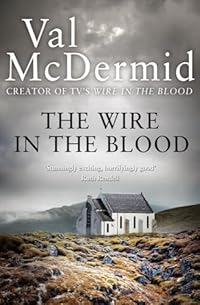
The Wire in the Blood by Val McDermid

Harper, 2010, 537 p. First published 1997. One of Scotland’s favourite books.

 The Wire in the Blood cover

I have not seem the TV series into which this was adapted so had no preconceptions, nor illusions to be shattered, but it wasn’t long into the novel before I was wondering why it made it onto a list of Scotland’s favourite books. It seemed like a reasonably standard crime (or police procedural) novel with nothing particular to distinguish it. Okay there is a twist in the sense that we are in the midst of a newly set up (and experimental – for the UK) psychological profiling unit but we have the usual coppers reluctant to accept something different from their common practice. Then there were the things that swiftly irritated or grated. We discover who the baddy is in the prologue, pretty well dispelling the suspense and rendering the sections where we learn how he got to be psychopathic less revealing than they might be. Several early sections begin in journalese – the first three are, “Tony Hill lay in bed,” “Shaz Bowman understood perfectly,” “Detective Chief Inspector Carol Jordan slipped the original out of the photocopier.” With the odd exception this practice is repeated throughout, though perhaps with surnames omitted. Fair enough we are dealing with a range of viewpoints and authors may need to signal who the relevant character is but this way of doing it is, at the least, inelegant. Then there is the fact that in the text no crime is committed till well after page 100, which for a crime novel, I would submit, is lumberingly slow. The sub-plot, about a fire-raiser in East Yorkshire, seemed only to be there to give one of the characters a tenuous connection to the experiences of the profiling expert. And the victims are portrayed as almost asking for their fate – certainly by the killer but also by the police officers investigating (cursorily) their disappearances – which is disconcerting.

Having said that, McDermid does know her tool – language – and deploys it well (only three entries for Pedant’s Corner is remarkable for a book this length) and her plotting was accomplished even if it unravelled a little slowly and the psychopath’s mistake was obvious from the moment it happened (and somewhat unlikely I’d have thought.)

I have read that McDermid modelled her psychopath on Jimmy Savile (brave for the time, and she expected to be taken up on it) but while he is a very well-known TV personality here and does good works in hospitals as a cover, he is also married – albeit in a sham arrangement – and a former Olympic athlete, sufficient divergence I’d have thought for any resemblance to be muted or passed over. (Plus Savile wasn’t a murderer – as far as I know – and could he have taken the risk of litigation? Might that not have signalled his recognition of himself in the portrayal?)

I suppose the main attraction to this sort of thing is the possible insight into the mind of a killer and in particular in this case to the art of psychological profiling but I’ll not be in a hurry to read another McDermid.

Pedant’s Corner:- fit (fitted,) dissemblement (my dictionary gives dissemblance, but states it is rare. In any case inventing words isn’t impermissible.) “‘Play it as it lays.’” (Should be “as it lies” but it was in dialogue and so may have been true to the character.)

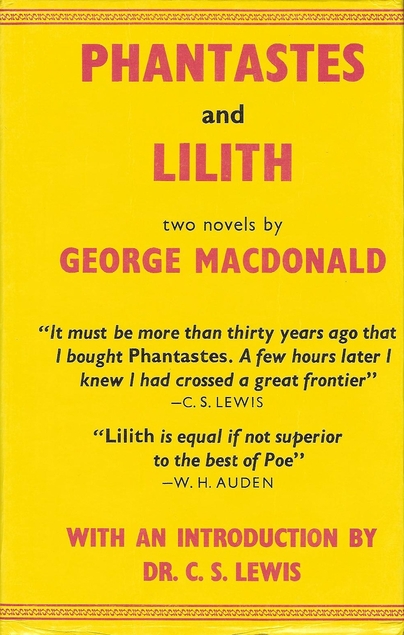
Phantastes by George MacDonald

In Phantastes and Lilith, Gollancz, 1962, 237 p. First published 1858.

 Phantastes and Lilith cover

This takes much the same form as the same author’s Lilith, which was originally published forty-three years after it. The narrator travels to a strange land – in this case Fairy Land – and has there certain adventures. On the face of it MacDonald had learned no new tricks over that time span but there was a slight difference in The Princess and the Goblin (1872) where at least there was in evidence something in the form of characters it was possible to care about.

In Fairy Land – reached seemingly by walking through a wood – the narrator (unnamed here, in Lilith at least he had a surname) among other things encounters a long dark shadow not attached to his body, deaths in various guises and more observations through a mirror.

As to MacDonald’s prose I can only agree with C S Lewis who says in his introduction that, “The texture of his writing as a whole is undistinguished, at times fumbling.” But where Lewis detects a mythopoeic quality in Macdonald, I cannot.

MacDonald’s narrator seems to have forgotten Shakespeare’s dictum that, “there’s no art to find the mind’s construction in the face,” when he pleads, “‘But tell me how it is that she could be so beautiful without any heart at all – without any place even for a heart to live in.’”

Definitely of its time. I would not have read it but for it being in the same set of covers as Lilith (and that I only read because it was in the 100 best Scottish Books list.)

Pedant’s corner:- shrunk (shrank,) drank (drunk,) sung (sang, used correctly four lines later. Were these possibly misreadings of MacDonald’s handwriting by the typesetter?)

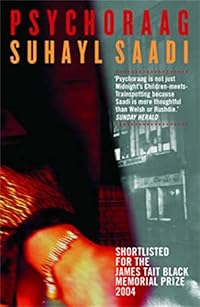
Psychoraag by Suhayl Saadi

Chroma, 2005, 446 p. One of the 100 best Scottish Books.

 Psychoraag cover

From its opening sentence “’Salaam alaikum, sat sri sakaal, namaste ji, good evenin oan this hoat summer’s night!’” this novel proudly proclaims its uniqueness. The tale of the last broadcast of Radio Chaandni, “’Sax oors, that’s right, sax ooors ae great music, rock an filmi an weird, weye-oot there happenins an ma rolling voice,’” on “ninety-nine-point-nine meters” sic FM. The voice is that of Zaf – “’that’s zed ay eff’” – DJ of The Junnune (madness) Show, scion of a pair of romantic (but adulterous) runaways from Pakistan.

As the above quote shows, Zaf’s monologues to his microphone are rendered in a very broad Glaswegian indeed. They are presented on the page with an unjustified right margin, a feature distinguishing them from the more normal narrative interspersed with them which relates the events of the night in a slightly more refined Scots dialect. Meanwhile sections devoted to his parents’ life together are in Standard English (except when their back story has caught up to times Zaf can remember.) To render the Glaswegian Scots, Saadi spells most participles (indeed most words ending with “ng”) without the final g – even when they occur inside longer words as in increasinly.

The music he plays (ranging from Asian Dub Foundation through Kula Shaker and Corner Shop to The Beatles, The 13th Floor Elevators, the golden hour and even Jimmy Page and Robert Plant) is integral to Zaf’s conception of himself and for those interested in such things a Play List and Discography of his many and varied tastes are appended after the glossary of Urdu and other terms with which the novel is liberally sprinkled.

Zaf’s stream of consciousness sees him ruminate on life, the universe and everything, with an emphasis on Scotland and Pakistan, “the land of the pure”, often mixing things to great effect, “if Dante Alighieri, in his exile, had had Irn-Bru, he wouldn’t have needed Beatrice. He wouldn’t have needed poetry.”

His thoughts also whirl around both the important women in his adult life, present girlfriend Babs, prone to jaunts to the wilds on her blue Kawasaki motor bike, and previous occupier of that position Zilla. Babs is white and – once – called him her brown god. Like Zaf, Zilla is of Asian descent but has fallen into drugs and prostitution, a circumstance for which it turns out Zaf is partly responsible.

Considerations of race inevitably loom large in Zaf’s thoughts. “The aspiration of all good Asians, finally, wis to be as white as possible. To marry white, to generate white and to strive incessantly for depigmentation.” To be half white or part white gave you, “one foot in the door… You became an honorary person.” He ponders acronyms and abbreviation as aspects of western life, “the whole pompous culture of indecipherability and wilful obscurantism had arisen from the collective mind of the grey men.” He articulates the Asian experience of Glasgow, especially the part which has become known as Wee Faisalabad, mentions the activities of local gang The Kinnin Park Boys, desirous of taking over the station franchise, and his experience of living in the slightly more upmarket area of the Shiels. He has, too, recognised that Calvinist sensibility, knowing that Glasgow had “turned its hard Presbyterian face away from its own children, it averted its thin lips,” and hence reasoning, “So why on earth should it bother to acknowledge a changeling like Zaf?” Neither does society’s attitude to women escape him, especially that of those keen on patriarchy and the primacy of the word. If they fall from an ideal, women are never forgiven, “There wis no such entity as the prodigal daughter,” he notes. Even the possibility of such a fall proscribes them.

Where the narrative breaks away from Zaf and instead tells the story of his father Jamil Ayaan and his mother Rashida, their meeting and falling in love, their affair and her desire for them to be together (only possible if they left Pakistan,) their long journey in a Ford Popular from Lahore to London then Glasgow; a city Jamil had never heard of before, and which he therefore thought would be safe from “prying eyes, ears tongues,” only to find on arrival the sole job he could find was in the sewers, the prose becomes lyrical. Saadi is no mere Shock Jock, he handles straightforward English narrative with as much skill as his demotic flourishes.

There are dream-like sequences where Zaf seems simultaneously to be in the studio at Radio Chaandni and at the same time roaming the city’s streets. This may or may not be because he has drunk some absinthe lying about the studio or perhaps a result of Zaf’s general sense of dissociation. The scenes where Zilla has turned up in the studio have a particularly hallucinatory feel.

Psychoraag is a tremendous achievement, managing to distil both the essence of immigrant experience and of Scottishness and to embody them in one character. It is certainly an admirable piece of work, utterly memorable, worthy of a place in that list of 100 Scottish Books.

Pedant’s corner:- “ninety-nine-point-nine meters FM” (FM radio tuning is characterised by frequency, not by wavelength; Zaf must mean 99.9 MHz,) “but, to Zaf’s right, was a partition wall” (unnecessary parenthetical commas,) zndabad (zindabad,) off of (just off, please,) “poking out from of the back pockets of their jeans” (from or of; not both,) “on account he was” (on account of he was.) “Cognito ergo sum” (The context implies this re-rendering – I know therefore I am – of Descartes’s philosophical statement, I think therefore I am, is intended,) “more dif icult to maintain” (difficult,) “aren’t I?” (OK Zaf says this to his mum and “Indian” English perhaps uses this formulation; but the Scottish English is “amn’t I?) “‘It’s finishes tonight.’” (It,) “she will have she have OD’d” (no “she have”,) Glasgae (Saadi – as Zaf – often uses this but no West of Scotland person says this; Glesca or Glesga maybe, never Glasgae,) re-appeared (in the middle of a line? reappeared,) outside of (outside; ditto inside of,) “it’s three thirty in the morning” (Zaf thinks this during a disturbance in the show’s fifth hour, ie after four a.m.) posonous (poisonous,) “as if it there had been” (as if it had been.) Peter Sellars (Sellers,) “the music swelled tae a crescendo” (no, the crescendo is the swelling; “swelled to a climax” maybe,) “hud been lain” (laid,) ivirthin (previously, and subsequently, ivirythin, with one iviryhin,) “just a little, as. underneath the sunshine” (no full stop.) Fundmentalist (Fundamentalist.) “A certain section of the community were” (a section was.) Polyethelene (Polyethylene,) “ninety-nine point-nine wave-length” (it’s frequency not a wavelength; and wavelength isn’t hyphenated,) cadeceus (caduceus?)
In the glossary:- a shopkeepers, (a shopkeeper) “the commercial films or South Asia” (of,) “a person who own a lot of land” (owns,) “of which there are an enormous variety” (there is a variety.)

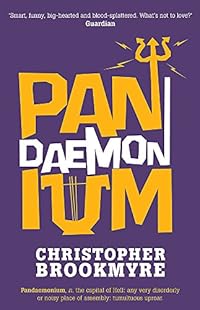
Pandaemonium by Christopher Brookmyre

Abacus, 2010, 397 p.

 Pandaemonium cover

I’ve mentioned before that distinct similarity in the set-up of most of Brookmyre’s non-Jack Parlabane or Angelique Di Xavia stories (and even in some of them) wherein a group of more-or-less innocents come to a confined place – usually in a remote part of Scotland – and are brought into confrontation with others intent on criminality or mayhem, who are overcome in the end. Pandaemonium conforms to these parameters precisely, except in one respect.

The innocents here are a cohort of schoolmates on an Outward Bound type expedition to help them come to terms with the violent deaths of two of their contemporaries. The danger they meet is of an extraordinary kind though, as it is not human. Scientists funded by the US military have been conducting experiments to find the graviton but instead broke the boundaries between the different worlds of the “many worlds” interpretation of quantum mechanics whereby each decision ever made spawns an alternative universe and less than a molecule’s width separates us from universes not our own. In this case daemons – horns and tails and all – have been brought through the portal between the worlds and kept in captivity under the former Fort Trochart. On the basis that the Church knows most about the potential threat from such creatures a Catholic Cardinal has been brought in to help investigate them. It turns out that demons have been “coming through into our world for centuries, most probably for millennia” and the Vatican knows all about it.

At the outset the disconnect between the two story strands is jarring. After a prologue set in the laboratory where the scenes are par for that sort of course, but with the usual conflicts between scientist and soldier exacerbated by the presence of Cardinal Tullian and his acolytes calling the shots Brookmyre’s tone alters considerably as he illustrates the pupils’ attitudes to the other sex and the prospect of the act itself; or, more pertinently, the lack of it. The peculiar mixture of bravado and innocence of the teenage boy is portrayed well enough as is the girls’ cliquishness and stoking of ammunition for point-scoring against each other but there are too many characters and they are insufficiently distinguished. Throw in among the adults in the party a martinet of an older teacher, a youngish Priest unsure of his faith and an unmarried woman of his age and parts of the story could write themselves. The balance between the two strands is also off-kilter.

Brookmyre illuminates the pressures of a Scottish Catholic upbringing and schooling. His clearly left scars. To his three dedicatees he says, “Be glad you went to PGS.” PGS is of course not a Catholic school. The baddies in his scenario are not the daemons – they are merely innocent victims of the project to find the graviton and only cause the destruction and bloodshed that they do because they have been starved of their soul food and in any case see us as the daemons, bent on their destruction. The real villain is the man who lets the daemons out of their confinement.

His later novel Bedlam was presented as Brookmyre’s first foray into SF. In fact, in its serious consideration of the many worlds theory, higher-dimensional space and expounding thereof, this has a greater claim to the title: even if the treatment more belongs to the coming of age and, perhaps, horror genres.

Pedant’s corner:- sat (placed,) crenulated (crenellated,) “none … are” (none is,) rarified (rarefied,) Rocks’ (Rocks’s,) “epicentre of this beam-quake” (not off-centre; so hypocentre,) “gas at peep” (at a peep,) gotten (got,) “an acid and an alkali, these last two of corresponding pH” (an acid and an alkali can not have corresponding pH; one must have pH lower than seven, the other greater than seven,) “a record altitude below sea level” (altitude is a descriptor of height; not depth,) “a strong alkaline solution” (a concentrated alkaline solution: chemically ‘strong solution’ means ‘fully ionised solution’ – it is possible to have a dilute solution that is nevertheless strong, and similarly to have a concentrated solution of a weak [only partly ionised] alkali or acid,) “close enough to the centre” [of the galaxy] “to allow the higher elements to form” (the higher elements form in supernovae, I’m not aware proximity to the galactic centre is pertinent,) Jimmy Hendrix (Jimi,) adrenalin (adrenaline,) Copernicus’ (Copernicus’s,) “when the situation behove it” (behoved,) “‘the most binding non-disclosure agreement outside of Cose Nostre’” (Cosa Nostra,) “‘Our sun isn’t actually hot enough to fuse hydrogen to helium’” (it is and it does,) epicentre (centre,) “and show up all the pooks on their clothes” (???) Miss Ross’ hand (Miss Ross’s.)

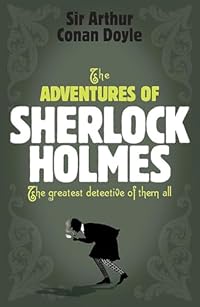
The Adventures of Sherlock Holmes by Sir Arthur Conan Doyle

Headline Review, 2006, 352 p. First published in 1892. One of Scotland’s favourite books.

 The Adventures of Sherlock Holmes cover

Being not much of a fan of crime novels I would not normally have picked this up but it is on that list – it even made the top ten – of Scotland’s favourite books (see link above) of which, having recently ticked off Willa Muir’s Imagined Corners – which is separately among the 100 best Scottish books while this is not – I have worked through all but four now. But it was available at a local Library.

So: how to account for the perennial attraction of these Sherlock Holmes stories? While they are easy to read they are not particularly well-written, being prone to exposition and, taken as a whole, remarkably repetitive in form. Nor are they particularly diverse. Not less than three of the ones here hinge on attempts to thwart possible inheritances. Moreover, our narrator, Dr Watson, is usually not present at the crucial points of an investigation, only for the reveal. And quite often the criminal – or malfeasant, there is not always a crime involved – ends up not being punished.

As to the stories themselves: A Scandal in Bohemia isn’t; either a scandal or set in Bohemia. The Red-headed League is an invented body whose advert is intended to attract applicants for the purposes of diversion from a crime. The perpetrator of the misdemeanour in A Case of Identity is obvious from the moment of its description by the victim. So too from early on is the murderer in The Boscombe Valley Mystery. The Five Orange Pips are the Ku Klux Klan’s equivalent of Treasure Island’s black spot while The Man with the Twisted Lip turns on an ingenious way to make a comfortable living. The Blue Carbuncle is a stolen diamond that ends up in the crop of a Christmas goose. The Speckled Band is a tale of murder by unusual means. The Engineer’s Thumb is barely a mystery at all. The Noble Bachelor’s bride does a bunk almost as soon as the wedding ceremony is over but Holmes soon divines why. The Beryl Coronet is a piece of jewellery entrusted to a banker as security for a loan and part of which is subsequently stolen while in his care. The banker’s dissolute son is given the blame until Holmes gets on the case. Once again the true perpetrator (or at least one of them) is not hard to pick out. The Copper Beeches is the house to which a governess is invited to work but there are odd conditions attached to the post.

Well, I can now say I’ve read Doyle’s Holmes (two years ago I reviewed for Interzone one of James Lovegrove’s homages) but I can’t say I’m keen to repeat the experience. The Hound of the Baskervilles, though, is on that 100 best list. I suppose I can always hope Doyle is better at novel length.

Pedant’s corner:- hurrah for encyclopædias! Otherwise – The King of Scandinavia (there is no such person; but I suppose Conan Doyle did not wish to name actual royalty.) “‘The form do so when the security is good,’” (ought to be “does so” but it was in direct speech,) shrunk (shrank.)

The Magic Flute by Alan Spence

Black Swan, 1991, 410 p. One of the 100 best Scottish Books.

 The Magic Flute cover

Starting from the point at which their destinies are about to diverge The Magic Flute chronicles the lives of four pupils from the same Glasgow Primary School, Tam, Brian, George and Eddie, from when they are about to move on to Secondary School at the turn of 1950s/60s up till just after John Lennon’s death in 1980. When the book starts two are shortly to sit the bursary exam for the fee-paying High School, two to progress to the local Junior Secondary. They all make their way to audition for the Orange Flute Band but only one of them manages to get a sound out of the instrument they are given to try and he gets to take it home. (The next week though it is the Mason’s son who has that privilege.) Inspired by music and especially Mozart’s The Magic Flute Tam becomes a musician, Brian sticks to his studies and ends up as a teacher of English, George drifts even after he is inducted into the Masons following his father, and Eddie escapes a life of crime by joining the Army only to be sent to Northern Ireland.

A possible different path for most of them is signposted by an improvised show in which they perform at the Edinburgh Festival Fringe but only Tam breaks free (set partly on his way by LSD) and even he cannot quite escape the drag such an upbringing imposes. Brian’s aspirations to being a novelist are stunted by that Scottish sense of knowing your place. “Part of him always stood back…. a wee Scottish gremlin that narked in his head. Ach away ye go. I know fine what you really are. He supposed it was a variant of the old put-down. Him? A writer? He couldnae be. I kent his faither. Only this was more insidious, was the end result of such programming, and the form it took was Me? Ach, naw, no me. I couldnae.

Life in the West of Scotland at that time is conveyed well enough, the setting of paths and narrowing of opportunities caused by educational apartheid (long since gone in the main,) the background of sectarianism and the strains it causes (not gone – at least in certain spheres,) the hidebound nature of the older generation, the attraction for some of radical politics.

The initial prose is a touch diagrammatic and the characterisation a little perfunctory so that the boys are not sufficiently distinguished from one another. Also, too many of the scenes in the book start in the middle before flashing back. Spence’s jokes are more intrusive and less integrated than in Way to Go and that signalling of the story’s thrust by the initial scenes is something of a misdirection. For those of sensitive dispositions I note use of the “n” word plus the “d” word and the “p” word.

It’s a good enough read. One of the 100 best, though?

Pedant’s corner:- recordplayer (record player,) the tune from That was the week that was (That Was the Week That Was – very often in this book where Spence quotes a title he only capitalises its first word, which is against the usual convention and looks downright odd at times,) threedimensional (three-dimensional,) had showed (shown, x 2,) “Lose your dreams and you will lose your mind in life unkind” (I believe Spence has misheard these lines from Ruby Tuesday which are, “Lose your dreams and you will lose your mind. Ain’t life unkind?”) workingclass (working class,) beat-up (beaten up,) tryng (trying,) “‘it had it’s moments’” (its,) CSE class (a big blooper: CSEs were a qualification in the rest of the UK but not in Scotland, where we had Standard Grades, so there would not have been a CSE class. Maybe Black Swan made the change in order not to confuse English readers,) alsation (alsatian – used later,) hung (hanged, okay it was in dialogue, but it was uttered by an English teacher, who should know better….) hotching (hoaching.)

“It’s Not Easy Being Iggy Pop in Airdrie”

The above is the first line of the back cover blurb (and a line in the text) of the novel I’ve just started reading.

The second line of the blurb reads, “The year is 1983 and Memorial Device are the greatest band that never existed.”

The book, This Is Memorial Device by David Keenan, claims to be “An Hallucinated Oral History of the Post-Punk Scene in Airdrie, Coatbridge and Environs 1978-1986.” Who could resist reading that?

free hit counter script