Archives » Scottish Fiction

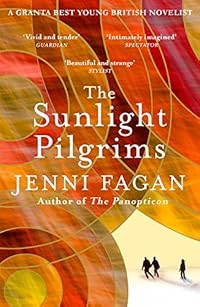
The Sunlight Pilgrims by Jenni Fagan

Windmill, 2016, 314 p.

 The Sunlight Pilgrims cover

Though I have some caveats about it this is a beautifully written, engaging novel touching on those three novelistic perennials love, sex and death, and peopled with sympathetic, rounded characters.

Dylan MacRae’s inheritance, an art-house cinema in London, has been forced to close with heavy debts. With his mother’s – and grandmother’s – ashes he retreats to a caravan his mother had bought in the area of Clachan Fells in Scotland. Once there he finds himself attracted to his next door neighbour, Constance, whose twelve-year old daughter, Stella, is in the process of transitioning from a boy and is the object of local curiosity and sometime bullying from her classmates. All this is occurring as the ice-caps melt, the seas in the northern hemisphere are being diluted by fresh water run-off, the North Atlantic Drift is switching off and Europe is being plunged into a deep winter. The book’s four parts are headed “November 2020, -6 degrees”; “8th December 2020, -19 degrees”; “31st January 2021, -38 degrees”; “The End Has Almost Come 19th March 2021, -56 degrees”. (I have no idea why, in the text, that last date is italicised.)

Those dates might suggest this is a work of Science Fiction but it is hard to sustain that reading. If it is actually a metaphor, which I doubt, the decreasing temperatures are not literalised in the way Science Fiction deals with such things and are not manifested in the characters’ interactions.

Fagan’s story is told through Dylan’s and Stella’s viewpoints and it is in effect one of relationships and family, one that could be told without any reference to external factors of climate or setting. There is a hint of fantasy in the appearances of Dylan’s grandmother to Stella but one of these was in a dream. In addition, Clachan Fells is described as if it is a remote location yet it is near a motorway and there is an IKEA within easy travelling distance, both of which would place it near a city. The deep freeze extends as far as North Africa – a touch unlikely I’d have thought. The metal door of a caravan is mentioned frequently. If anyone touched it at those temperatures their fingers would stick fast to it.

These are cavils and do not reflect on Fagan’s ability to conjure character. Dylan, his mother and grandmother, Constance, Stella, even local vagrant Barnacle, felt like living, breathing people. If the circumstances of, and reasons for, Dylan’s mother’s purchase of the caravan strain credulity a little it does not detract from the depiction of the characters and their relationships.

Constance mentions trick-or-treating to Dylan. The Scottish (and Northern Irish) term is guising. Fagan may have placed the USianism in Constance’s mouth when speaking to him since he grew up in London and she might have assumed he wouldn’t be familiar with it. In Stella’s thoughts, though, the activity is described as guising. This is a very subtle piece of writing by Fagan which would go over the heads of those unfamiliar with the original term.

It is somewhat ironic that the woman who has for years had ongoing relationships with the same two men, adds Dylan to the list, and has had other liaisons, is named Constance. I’ll presume Fagan intended this though.

The Sunlight Pilgrims contains excellent writing and utterly believable characters. Stella’s voice in particular is a joy. In The Panopticon Fagan has previously shown ability to get inside the head of a troubled teenager. In that book the adults were slightly less to the fore. Here all are wonderfully realised.

Pedant’s corner :- morgue (mainly USian, the British term is mortuary,) and later, mortician (the British usage is undertaker,) “a trail of empty wine glasses lead to” (a trail leads to,) “a pile of unpaid bills are stacked” (a pile is stacked,) “a stack of records have still not been put back in their sleeves” (a stack has not,) “none of these things are going to happen” (none is going to happen – after a while I gave up counting these failures of verbs to agree with their subjects,) “the wind farm’s nacelle rotate” (I doubt the plural of nacelle is irregular as in “sheep” or “aircraft”, so nacelles,) Ikea (it’s IKEA,) in the corner of her eyes (corners,) then they gone (they’re,) bended heads (I know “bent heads” would have meant something different but so does bended [compare bended knee,] bowed heads conveys the sense, though bowed is used on the next line,) a quoted news report says “there have barely been any bird sightings for weeks now. Those that are in nests have just frozen,” (no birds would have been nesting as late as November, when the freeze is said to have started.)

Imagined Corners by Willa Muir

Canongate Classics, 1987, 285 p plus iv p Introduction by J B Pick.

 Imagined Corners cover

Through its own Calvinistic lens the Scottish novel treats as much of the three novelistic perennials love, sex and death as any other. In this, Imagined Corners, the first book Canongate published in its Classics series, is no exception. It contains, however, not much of a preoccupation with death but a more unusual emphasis on love – and (I would have thought for 1931) a quite startling discussion of sex in its philosophical aspects; though Muir somewhat euphemistically refers to “embraces” when alluding to such relations between her characters.

The book is set in the seaside town of Calderwick, on the Edinburgh to Aberdeen railway line north of Dundee, and starts off in the household of William Murray, the local United Free Church Minister, where his sister Sarah is worried about their brother Ned’s mental wellbeing. Even though they are returned to at several points affairs at the Murrays are something of a red herring as the bulk of the book is concerned with the doings of the Shand family. Black sheep Hector, who had had to sojourn in Canada for a few years after an unfortunate incident involving a local girl, Bell Duncan, has returned to the town with his bride Elizabeth, a University graduate. His elder half-brother John owns a mill in the town in which he has placed Hector in a job. John’s wife Mabel, very mindful of the proprieties of life in a small town, has managed to “hook” him, marrying him for his money. Aunt Janet Shand is a prime example of the upright old school. In the first two parts of the novel the claustrophobia of small town life is well-established as are the accommodations (or lack of them) newly married couples have to make to one another. The third part brings into the equations the return of the Shand brothers’ sister Lizzie, who many years ago ran off with a married man, and a foreigner to boot. She quickly dumped him but is now a respectable widow. However, such scandalous behaviour runs in the Shand family. Their father Charles in his day was a notorious womaniser and drunkard, Hector a chip off the old block.

The strands of the novel are not particularly woven together. The dilemmas of characters from the different families do not really illuminate each other. They relate only in so much as they come into contact because they live in the same town. William Murray’s crisis of conscience in relation to the degree of his responsibility for his brother Ned’s mental instability is not germane to the marital difficulties of the younger Shands nor Mabel’s lack of excitement in her own marriage.

It could never have been described as such in its day but Imagined Corners is in fact a feminist novel avant la lettre. Such thoughts as, “All men were queer and unaccountable,” and, “‘It’s damnable the way a girl’s self-confidence is slugged on the head from the beginning,’” illustrate the point, while, “all men… accepted unthinkingly the suggestion that women were the guardians of decorum – good women, that is to say, women who could not be referred to as ‘skirts’. Good women existed to keep in check men’s sexual passions,” depicts the curious – and still prevalent – notion that women are the necessary gatekeepers to men’s sexuality.

Muir applies this curious bind to Elizabeth who, “had been subjected to the subtle pressure of the suggestion that a husband is the sole justification of a woman’s existence, that a woman who cannot attract and keep a husband is a failure,” and then explores its ramifications in the conclusion, “That some such theory should emerge in a society which regarded the sexual act as sinful was inevitable; one cannot train women in chastity and then expect them to people the world unless the sinfulness of sex is counterbalanced by the desirability of marriage.”

At a time when, “In Scotland man’s chief end was to glorify God and woman’s to see that he did it,” women’s responsibilities were strict. “The perfect wife was not only selfless and loving – she was sympathetic, understanding, tactful, and above all, charming…. she must always look ‘nice’,” and demanding, “The perfect wife is bound to assume that without her” her husband “would be ‘lost’. This …. fits loosely over the real problem, of one individual’s relationship to another.”

The manifestations of this include, “The sexual instinct has such complicated emotional effects on men and women that its masquerade as a simple appetite ought not to be condoned. Mankind has an inkling of this fact, and much ingenuity is applied to shielding the young and inexperienced from the bewildering effects of sex,” which is an approach that still holds true.

When such thoughts pervade society, innuendo and gossip are never far away, and the slightest deviations pounced upon. But there is a counterbalance, “an undercurrent of kindly sentiment that runs strong and full beneath many Scots characters, a sort of family feeling for mankind. … It is a vaguely egalitarian sentiment, and it enables the Scot to handle all sorts as if they were his blood relations.” Yet that too has its darker side, “Consequently in Scotland there is a social order of rigid severity, for if people did not hold each other off who knows what might happen? The so-called individualism of the Scots is merely an attempt on the part of every Scot to keep every other Scot from exercising the privileges of a brother.” Heaven forfend!

Elizabeth’s confusion over her role, Mabel’s susceptibility to flattering attention, Aunt Janet’s rigidity, John’s stolidity, all bear the stamp of authority. In this small world Lizzie is almost an alien, a pointer to another way of living. Hector as a roué is close to being a type, though. William Murray’s crisis over being his brother’s keeper can only be resolved one way, Sarah’s frustration an expression of constrained life but Ned edges towards being a device to highlight his siblings’ natures.

Among the grace notes Muir deploys that wonderful Scottish phrase black affronted, ‘Oh, no, John, no John, no!’ reminded me of a song while there is a wonderful aside in the thought, “Surely? People who defend an indefensible position always begin with ‘surely’.”

Imagined Corners is a vivid slice of early Twentieth Century Scottish life, a life still lived in the shadow of the Reformation.

Pedant’s corner:- someting (something,) “laid a paw on on Ned’s knee” (only one “on” needed,) againt (against,) a closing quote mark with no preceding opening one, recoverd (recovered,) powered (powdered,) gong (going,) grandiose (grandiose,) “‘so far I know’” (so far as I know,) extentions (is this a 1930s spelling of extensions?) “in another world that this” (than this,) “‘I’d throw up the sponge’” (nowadays it’s “throw in the sponge”,) discovered (discovered,) tranquillity (tranquillity,) Mains’ (Mains’s,) “we’re all John Tamson’s bairns” (more usually rendered as “we’re all Jock Tamson’s bairns”.)

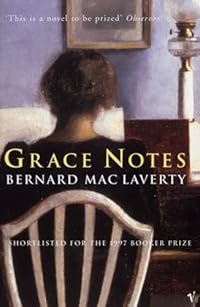
Grace Notes by Bernard MacLaverty

Vintage, 1998, 281 p. One of the 100 best Scottish Books.

 Grace Notes cover

MacLaverty is from Belfast but moved to Scotland in his thirties. Grace Notes is partly set on Islay, with some scenes in Glasgow. However, Part One occurs entirely in Northern Ireland to where Catherine Anne McKenna is returning to her childhood home for the funeral of her father. She has been estranged from her Catholic parents for years, effectively since leaving home to go to University. They were very strict when she was young, with an embedded sense of right and wrong, and she drifted away from them, her failure to come home one Christmas causing her father to say she would no longer be welcome. In the meantime she has, unknown to them, had a child, Anna, out of wedlock; a child whose father, Dave, “is no longer on the scene.” She still suffers from the effects of post-natal depression but has begun to ascend out of it. While back “home” she takes the opportunity to visit her first piano teacher, Miss Bingham, showing us the roots of her vocation as a composer. Before she leaves again, her mother seems to be coming round to her situation but is still aggrieved at the thought of a grandchild her husband never knew.

Part Two deals with Catherine’s early composing career while a teacher on Islay, her relationship with Dave, Anna’s birth, the descent into depression, Dave’s increasing distance as his alcohol consumption gets out of control, and Catherine beginning to come out of her despond on a beach as she hears in her head a set of notes which will become the new symphony whose first performance ends the book.

The portrait of Catherine’s feelings as she gives birth and the ensuing onset of her depression is finely done and Dave is a familiar enough character if a little undercooked. In the end though the novel is about music (grace notes being non-essential “notes between notes” but which add colour to a piece – the literary equivalent being detail in description of scene and action.) MacLaverty conveys music’s power and atmosphere very well and at one point deploys that tremendous Scottish phrase “black affronted”.

Throughout we get the sense of Catherine as a real person. So too are her parents and Miss Bingham but Dave seemed less of an individual and more of a type. It has to be acknowledged though that there are many versions of him about.

MacLaverty’s skill as an author means the book is very readable. One of Scotland’s 100 best? Better than quite a few which feature on the list.

Pedant’s corner:- Lilliburlero (Lillbulero,) the Ukraine (Ukraine,) “neither of whose name was” (neither of whose names was,) thran (Irish, the apparently identical in meaning Scottish word is spelled thrawn,) Miss Bingham had arthritis (as I read it this was at a time before Catherine went back to Ireland for the funeral and hadn’t yet been told Miss Bingham had the disease,) Capercaille (Capercaillie, more properly Capercailzie as it derives from the old Scottish letter yogh, written as ȝ,) jamjar (jam jar,) huzzies (usually hussies,) a pain in the ass (Catherine is Irish, she would say arse,) “what was bad were her nerves” (nerves is the object of this sentence; its subject is what, so, “what was bad was her nerves”,) the orchestra …. are playing (is playing.)

Star Rider by Doris Piserchia

Women’s Press, 1987, 221 p. Another I didn’t catch up with at the time of publication.

Star Rider cover

In Star Rider humans have differentiated into different strains, jaks and dreens. Narrator Lone, or Jade as she becomes, is a Jakalowar (jak.) Along with her dog-ancestried mount Hinx she can teleport easily across space. This is an ability which seems to be mixed in with a sort of telepathy/awareness called jink. All jaks are searching for the lost planet of Doubleluck, finding which would make their fortune. Jade is dogged by Big Jak, who knows where Doubleluck is and wishes to stop her finding it. He traps her but they are attacked by dreens and Jade is imprisoned, without Hinx, on a planet called Gibraltar. Separation from a mount normally makes a jak go mad but Jade manages to stay sane. This middle part of the novel is tonally somewhat at odds with what came before and what is to come. Eventually Jade persuades a dreen mount to let her jink, escapes, finds Hinx again and heads for old Earth where she uncovers Doubleluck inside a mountain. She is chased there by the dreens, whose leader Rulon wants to force her into marriage but who are eventually overcome in a sort of space battle and Jade then reveals to the victorious jaks her ability to jink to other galaxies, a jak goal for millennia.

The twists and turns of the story don’t seem to follow much logic and the text is occasionally embellished with unusual syntax which either I got used to as the novel progressed or, more likely given my attention to the minutiae of text, Piserchia tended to forget about. Neither are the characters very memorable; Piserchia’s focus is more on ongoing plot, with the occasional feminist aside. I would hazard Star Rider is not among the best SF from the 1970s.

Pedant’s corner:- sat (seated, x2.) “As for us humans, we looked at the ground” (I agree “as for us” is the normal phrase but“humans” is the subject of that sentence so it should be “we” humans,) “had showed him” (shown.) “Matbe everything in it was a predator, which meant that everything in it was also a prey,” (not “a” prey, just prey,) grill (grille – is grill a US spelling for this?) “Was sewed up” (sewn,) a missing full stop, abolishment (abolition,) “he removed ten appendixes” (the plural of appendix is appendices,) “there were plenty of game and plant life” (there was plenty,) laid down (lay down.)

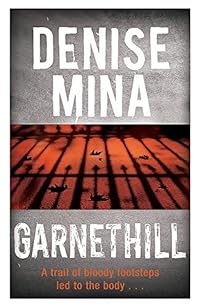
Garnethill by Denise Mina

Orion, 2014, 427 p.

One of the 100 best Scottish Books. One of Scotland’s favourite books.

 Garnethill cover

Maureen O’Donnell is an abuse survivor in a relationship with a psychiatrist at the same hospital where she is receiving treatment for her continuing trauma. After a night out with a friend she tumbles straight into bed and wakes up in the morning to find her (married) boyfriend tied up in her living room with his throat slit. The police, the man’s wife and politician mother all believe Maureen, or her drug dealing brother, did it. In an attempt to make sure her name is cleared Maureen begins to investigate the crime herself.

The proximal subject matter, sexual abuse in institutions, is an important issue but I am astonished that this book could appear on anyone’s list of best or favourites as Mina’s writing leaves a lot to be desired. There is a profusion of telling not showing plus acres of unconvincing dialogue. Chapter titles tend to be people’s names but quite often those people barely appear within them. Every time there is a police interview we are told about the tape recording protocol. It is as if Mina believes the reader must be shown every little detail of her hero’s experience. We really don’t. In what must surely be a breach of police good practice one of the investigating officers conveniently gives her privileged information.

The novel is set in Glasgow but the city itself seems absent. None of its vibrancy or character comes across. Also there are constant references to the Byres Road, the Great Western Road, the Maryhill Road. No Glaswegian I have met has ever mentioned a street by name and used the definite article. It’s always just Byres Road, Great Western Road, Maryhill Road. No “the”.

Yes, the purpose of this sort of thing is the unfolding of the plot and the unravelling of “whodunit” and in this respect it just about meets the need. Yet even here there was a hiccup. Quite near the novel’s end Maureen is told the name of the murderer by one of her interviewees but Mina does not let the reader know it at that point. I don’t read much crime fiction but I would submit such an attempt to prolong suspense artificially is unfair on the reader. (That the murderer’s identity could be worked out fairly easily vitiated that attempt in any case.)

The more the book progressed the harder my suspension of disbelief became. Towards the end I wasn’t believing any of it.

Moreover the book is riddled with punctuation errors (see Pedant’s corner.) The edition I read was a reprint; the latest of numerous editions. (Goodreads lists well over ten.) How can these errors not have been spotted and rooted out long before this? Does no-one care about quality control? Some might say these are niggling concerns but when they stop a reader in his/her tracks and force a line, sentence or paragraph to be re-read to decipher the sense it becomes non-trivial.

This one is for die-hard crime fans only.

Pedant’s corner:- cagoul (cagoule,) no start quote mark for a piece of dialogue (x 9,) a missing full stop (x 7,) for badness’ sake (badness’s, x 2,) butt naked (I believe the phrase is buck naked,) a missing comma before a speech quote (x 3,) snuck (please use sneaked instead of snuck,) smokey (smoky,) “really don’t want to tell you” (I really don’t want to tell you,) “for implicately slagging her mammy” (implicitly,) the team are known (is known,) teathings (tea things,) Germoline (Germolene.)

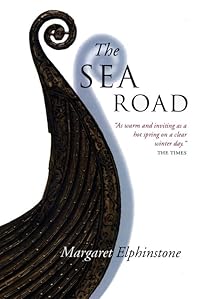
The Sea Road by Margaret Elphinstone

Canongate, 2002, 254 p including ii p list of principal characters and ii p map of the North Atlantic Ocean. One of the 100 best Scottish Books.

 The Sea Road cover

This is the story of Gudrid Thorbjarnardóttir, who sailed beyond the end of the world, gave birth to the first European to be born in the Americas beyond Greenland, voyaged to the court of the King of Norway and made a pilgrimage to Rome. Her tale is so extraordinary that I was irresistibly drawn to the parallel of Poilar Crookleg, whose first sentence (see here) I have echoed above.

Expanding on her source material in the Icelandic sagas, Elphinstone in The Sea Road has Gudrid’s story framed by a Praefatio and Postscriptum written by Icelandic monk Asgar Asleifarsson who is – at the behest of Cardinal Hildebrand for the sake of some ephemeral Vatican political intrigue – taking down the memories of a Gudrid now a grandmother. On her dark (to Icelanders) appearance – though in Italy she is fair – she says, “Now it makes no difference. Old women are the same the world over.” The text is mostly Gudrid’s as supposedly written down by Asgar but there are occasional scenes observed in the third person and rendered in italics.

Elphinstone’s handling of her tale is exquisite. The characters live on the page and the relationship between Gudrid and Asgar is deftly portrayed. Despite his replies to her never being transcribed we still get insights into his thoughts and feelings. There is a prefatory list of principal characters which is unnecessary as there is never any difficulty in distinguishing them.

Gudrid was born just after Christianity had come to Iceland and on the death of her mother was fostered out by her father to his sister’s home. She herself was baptised when she was fourteen. There is tension between the old religion and the new in Iceland and Greenland both and some in Gudrid herself. Her first crisis comes when she is asked as a young girl to help a witch (this is the word used in the text) by singing along with the old songs.

Her father Thorbjorn, a friend of Eirik Raudi (Eric the Red) had always hankered after adventure and finally undertakes the voyage to Greenland taking Gudrid with him. Though of course the winters are harsh, through Asgar Gudrid tells us that “Eirik’s land is better than any she saw till she went to Norway” and at least till the time she left, “There have been no killings in the Green Land.” Leif Eiriksson, Raudi’s son, has by this time discovered Vinland. Gudrid might have been married to him but for his dalliance with an earl’s daughter in Ireland. Instead she marries another of Raudi’s sons, Thorstein, with whom she made her first voyage to Vinland, but he falls sick one winter in Greenland and dies along with Grumhild, the wife of their host Thorstein the Black. The two survivors spend five months in the same hut with the dead bodies, haunted by their ghosts. “In that place the dead watched everything,” she tells Asgar. “All that winter we were outside the boundaries of this world of yours,” and, “You look as if my callous attitude shocked you, and yet you’d not be shocked at all if I were a man and told you I’d wiped out a whole settlement in blood feud.” Spirits were never very far away in Gudrid’s world. “The launching of a ship is no place for new gods.” It is with a second husband, Thorfinn Harlsefni, come to the Green Land to make profit, that she again sails to Vinland and this time beyond.

Among Gudrid’s many insights we have, “You think there is a pattern to the way people behave… But I have never got to know any household well, when I didn’t find out quite soon that they don’t keep to the pattern….. the pattern doesn’t exist. I’ve never met a family that behaved normally. Have you?” which may be a comment on Tolstoy’s dictum about happy families. Then we have, “Girls are much harder to deal with generally but as far as I can make out boys of that age never think about anything except sex.” Make that boys of any age perhaps.

The Sea Road is a wonderful reminder that the Dark Age world was not as parochial as we might believe; a magnificently told tale about an extraordinary woman and extraordinary times, yet times which to Gudrid herself were unexceptional.

Pedant’s corner:- In the list of characters; Chirstianity (Christianity.) Otherwise:- Asgar mentions the clock; mechanical clocks were not invented till the late 1200s – but water clocks were well known, “the herd of ponies come out” (comes out,) Halldis’ (Halldis’s,) “the family quarrel with their neighbours” (the family quarrels with its neighbours,) Eirik says ‘Aren’t I enough for you?’ (Do Icelanders say this so ungrammatically? Wouldn’t they say, “Amn’t I?”) “none of her children believe” (none believes,) “the household have discussed” (has discussed,) staunch (stanch,) unfocussed (x2, unfocused,) “In the darkness Gudrid eyes escape the blank face of the dead” (Gudrid’s eyes,) Freydis’ (Freydis’s,) Chistendom Christendom.)

The Stornoway Way by Kevin MacNeil

Hamish Hamilton, 2005, 269 p

The Stornoway Way cover

“If you are easily offended, consign this book to the flames immediately, or return it to the shop from which you stole it.” So begins The Stornoway Way, but not the novel of that name contained within this book. The conceit is that the embedded novel is a manuscript sent to our author Kevin MacNeil by one R Stornoway (yes, the schoolboy joke is acknowledged) whose real identity – the town of the surname being one where everyone knows everyone else; and their business – MacNeil has sworn to keep secret. I doubt we are supposed to be taken in by any of this. In any case there is not really too much to be offended by; except I suppose if you are one of those determined killjoys for whom “the Old Testament was a good start, but it didn’t go far enough” with which the Western Isles and Scotland generally have historically been saddled.

The cover is a work of genius, by the way, invoking both Whisky Galore and the island obsession, also shared by much of the mainland, with alcohol. The cartoon figure, blotto, with bottle still in hand, is a particularly apposite touch. Unlike in Compton MacKenzie’s book though, the dark side of alcohol dependency gets an airing here. In case this sounds gloomy I should say that in many ways The Stornoway Way is an amusing book, but while at times comedic it is never light, and always serious. (The recitation entitled “The Neighbours We Could Have Had” might not find favour in southern parts of these islands though.) And it has copious footnotes!!!! Who doesn’t love footnotes? Admittedly a lot of these are translations of various Gaelic terms – some of which aren’t even in the text – but better footnotes than a glossary. In them for example we find the Gaelic Sasanach has no pejorative connotations, unlike its Scots/English borrowing.

Before the internal novel begins we are presented with a map of Scotland upside down compared to the usual occidentation*. This helps to illustrate the point that in Stornoway, “We do not live in the back of beyond, we live in the very heart of beyond…. Our blood relatives in Scandinavia to the left, our blood relatives in Ireland to the right.” Though “R Stornoway” perhaps overdoes it when he says, “The Western Islander’s response to our diminishing way of life is that of the oppressed the world over, from Native American to Australian aborigine: a powerful urge to drink oneself underground.” The Western Islanders – and the Scots – have been drinking themselves underground for centuries.

When the novel proper starts, poverty has brought would-be artist “R Stornoway” back to Lewis and his childhood home, which he had been avid to leave as soon as possible. From there we range over various incidents from his life, his first experience with alcohol being a seminal moment. In all of these, even his relationship with Eva, a student from Hungary, alcohol plays a significant part – as it does for Stornoway the town.

An example of the narrator’s sardonic humour occurs when he is accused of being uncaring – and an alky. He replies, ‘Some people will believe anything if you tell them it’s a rumour.’

His existential crisis comes when he wakes up beside a beautiful woman and, due to the booze, cannot remember who she is, how she came to be there, nor exactly what happened between them the night before. His decision to fetch the ingredients for breakfast without waking her backfires when he returns to find her gone. At this point there is still a substantial part of the novel to come though. Eventually he comes to terms with himself and his relationship with alcohol. “Drink doesn’t give you a better sense of who you are, it gives you a nonsense of who you are.”

The latter part of the novel has a more downbeat nature than the delicious early chapters, concomitant with the cumulative effects of alcohol on the individual personality, but even with that The Stornoway Way is overall brilliant stuff.

*One of MacNeil’s coinages, see also gloominous clouds, muselicious.

Pedant’s corner:- smoothe (smooth,) Captain Moses’ place (Moses’s, several instances,) Stevens’ (Stevens’s.)

Waverley by Walter Scott

Or: Tis Sixty Years Since.

The Edinburgh Edition of the Waverley Novels, Edinburgh University Press , 2012, 368 p, plus 90 p Essay on the Text, 38 p Emendation list, 2 p list of end-of-line “hard” hyphens, 26 p Historical Note, 98 p Explanatory Notes, 21 p Glossary, i p Dedication, vi p General Introduction to the Edinburgh Edition, and iii p Acknowledgements. One of the Scotsman’s 20 Scottish Books Everyone Should Read.
See my review of The Heart of Mid-Lothian for the intent behind the Edinburgh Edition of the Waverley Novels.

averley

This is the one that started it all off for Scott in the prose sense and was also the beginning of the historical novel in the Western tradition. Its title has resounded down through the years, giving its name to a whole series of Scott’s novels, to Edinburgh’s main railway station, to a kind of pen nib (They come as a boon and a blessing to men, the Pickwick, the Owl and the Waverley Pen,) a class of GWR locomotives and to the last ocean-going paddle steamer in the world.

Our hero, Edward Waverley, English and heir to an estate there, is encouraged by his uncle to take up a commission in the army. After arriving with his troop in Scotland he receives leave of absence to visit an old friend of his father, the irredeemably Jacobite Baron Bradwardine of Tully-Veolan. Events and an indisposition contrive to keep him there beyond his commanding officer’s pleasure, an unfortunate circumstance as this is 1745 and historic events are afoot. His troop has shown rebellious leanings and this along with his absence leads to his commission being revoked. At the same time comes news his father has been disgraced and removed from his government post in London. The friendship Waverley has struck at Tully-Veolan with Fergus Mac-Ivor (also known as Vich Ian Vohr, the latest of his line to accede to this honorific,) Waverley’s change in circumstances and the interference in Waverley’s affairs by one Donald Bean Lean, delivers him into the company of Charles Edward Stuart and the Jacobite Army now in Edinburgh. Waverley’s presence as an English adherent is a boost to the Prince’s cause, as it promises more such support.

As a member of the Jacobite Army Waverley takes part in the Battle of Prestonpans – or Preston as it is usually described by Scott (except when Jacobites call it Gladsmuir,) where he saves the life of a Government officer, Colonel Talbot, who knows his father well. Waverley goes all the way down to Derby and back up before he is separated from the retreating army during a skirmish at Clifton south of Penrith and makes his way to London to try to reinstate his reputation with the paroled Colonel Talbot’s help.

I would not advise anyone to start their reading of Scott’s novels with this book. In addition to his usual long-windedness, here it is more or less obvious that Scott is feeling his way into the writing of a novel. In the last chapter “A Postscript, which should have been a Preface” Scott informs us he had at one time abandoned the book but some years later came across the papers again and went on to complete it, an interval which could not have helped. Later novels of his are more approachable but in Waverley there are many longueurs in the early passages and too much of a rush towards the end. That Scott himself makes the point in the text, “earlier events are studiously dwelt upon, that you, kind reader, may be introduced to the character rather by narrative, than by the duller medium of direct description; but when the story draws near its close we hurry over the circumstances,” does not render this imbalance any less marked. Certain of the characters are fond of Latin tags; which was to be a recurrent trait in Scott’s works. Some names are also clearly jocular, there is a Laird of Killancureit, and a pair of lawyers, Messrs Clippurse and Hookem.

Waverley is, though, necessary reading for anyone interested in the history of the Scottish novel.

Pedant’s corner:- By my reckoning, when Waverley was first published in 1814 it was more like seventy years since the 1745 Jacobite Rebellion, not sixty. The narrator’s comment that the novel was being written in 1805 would make more sense but the Essay on the Text reveals that may have been an insertion by Scott’s publisher, a man notorious for being overly literal, but also that Scott’s original subtitle was actually ‘Tis Fifty Years Since’. That abandonment of the project only to take it up again, could account for some of the slippage.
I found I could skate over Scott’s 19th spellings – eg dulness, chuse, expence, centinel, whiskey, stupified, extacy, cieling – and once again we have the archaic sunk, sprung, sung, rung for sank, sprang, sang, rang.
Otherwise: “resumption of his commission” (resumption is here used in the sense of revoking,) the English flag (this must actually have been the Union flag,) feodal (feudal, possibly due to a misreading of Scott’s handwriting.)
In the essay on the text:- there are a number (there is a number.) “There are number of surviving anecdotal records.” “… two female Scottish writer” (writers,) and an opened parenthesis which is never closed. In the Historical Note:- events relating the 1745 rising (relating to the,) of Highlands (of the Highlands,) the visits the (then visits the,) raising of the ‘the Standard’ (raising of ‘the Standard’,) epicentre when centre was meant, “there are a number” (is,) “another body of MacIvers were” (another body was.) In the Explanatory Notes:- to the ‘the Seven Lovers’ (to ‘the Seven Lovers’,) Latin literally (several instances) – and French literally (once) – (there is no need for “literally” to be italicised, it’s not in a foreign language,) Domincan (Dominican,) Lindor is is not (only one “is” necessary,) Great Britian (Great Britain,) “in opposition the Engagers” (to the Engagers,) Janazaries (usually Janizaries or Janissaries,) fiar price (fair price?) insignium (the Latin singular of insignia is insigne – neuter of insignis – not insignium,) medieval, Lillibuero (Lillibulero, as elsewhere,) the Jacobites army (Jacobite or Jacobites’,) enaged (engaged,) Abbotford (Abbotsford,) “refers to indecisive battle” (to the indecisive battle,) one the seven (one of the seven,) hung (hanged.) In the Glossary:- Latin, short for (Latin, short for,) all the words glossed are in bold except the entry for een, the Scots word for eyes.

To The Lighthouse by Virginia Woolf

Penguin, Reprint of 1964 edition, 237 p. One of the 100 best Scottish Books.

To The Lighthouse cover

Quite why this is on any list of Scottish books is something of a mystery. Yes, the nominal setting is somewhere in the Western Isles but it could really be anywhere. There is nothing intrinsically Scottish about the subject matter nor the characters and certainly not their speech patterns. I always suspected that Scottishness would be a false premise under which to read the book. Granted, there are references to the Waverley novels, but that is not enough to make a book Scottish. Neither are there sufficient descriptions of the landscape to bring it under the umbrella.

I understand Woolf is revered by some (a cover quote from Jeanette Winterson says, “Woolf is Modern. She feels close to us. With Joyce and Eliot she has shaped a literary century.”) Yet I found this novel to be …. odd.

To The Lighthouse is structured in three sections, The Window, Time Passes and The Lighthouse, of which the first is the longest and the second not much more than a placeholder but mercifully more cogent than the other two. We begin eavesdropping on the Ramsay family and their acquaintances as they contemplate a visit to the titular lighthouse the next day. There is little conflict between the characters (except in their unspoken thoughts) – certainly none that is dramatised, only Mr Ramsay saying he doubts they will be able to make the trip. Not a lot happens. Arguably the most important event in the book occurs offstage in Time Passes and is only reported – but people reflect on the little that does happen either at length or a tangent.

I have no problem with stream of consciousness as a technique – Jenni Fagan’s The Panopticon uses it well – but without a focus it can reel off into irrelevance. The narrative viewpoint here can flit from mind to mind within the same paragraph (sometimes it felt like the same sentence.) As a result any insight into the human condition ends up drowned in the deluge. Any wood here is difficult to distinguish amongst all the trees. The copy I read was the good lady’s and she has told me she didn’t take to the book either.

I note from the entry on Woolf in The Oxford Companion to English Literature that she co-founded Hogarth Press – the original publishers of To The Lighthouse and others of her works: this is surely tantamount to self-publishing – and from her Wikipedia entry that her first novel was published by her half-brother’s company; which smacks of nepotism to me.

It’s the first of her works I have read and maybe I ought to sample more but I’d be delighted if someone could tell me just why Woolf is supposed to be good. On this evidence, and as that advert used to have it, her writing is dull, dull, dull.

Pedant’s corner:- galoshes (galoshes,) stood (x2, standing,) trapesing (I had not previously come across this alternative spelling of traipsing,) a comma at the end of one paragraph, shrunk (shrank,) waterily (what an ugly word; “like water” would have conveyed the sense,) sunk (sank.)

The Panopticon by Jenni Fagan

William Heinemann, 2012, 333 p. One of Scotland’s favourite books.

The Panopticon cover

Narrator Anais Hendricks has spent her life in care; from birth to her age now, fifteen. There was a short period when she had what was in comparison a stable home life when she was adopted by a prostitute. Unfortunately her adoptive mother was killed while Anais was in the room next door. Anais has been in and out of homes fifty-one times and in more trouble at school (which, of course, she barely attends) and with the police than you could count. She has a particular bent for stealing school minibuses then crashing them; and for fire-raising. The book, then, does not promise to be a bundle of laughs and Anais not a likely candidate for salvation. She is bright, though, and reads voraciously, has a keen sense of herself; and of injustice. As a sort of compensation she plays what she calls the birthday game, imagining all sorts of different beginnings for herself, and she dreams of a life in Paris.

We meet her when, under suspicion of having put a policewoman into a coma (of which she vehemently denies her guilt,) she is being transferred to the Panopticon of the title, a building from the centre of which the inmates are under the view of the staff at all times. A clue to her possible mental state is when she sees the stone cat at the entrance – which she dubs Malcolm – move its wings. She also thinks she is the subject of what she calls the Experiment, the project of a mysterious group which may be from another universe or dimension – and for whom the only evidence the reader has is Anais’s words – and she is being tested to destruction in the sense she thinks the Experiment wants her to commit suicide. But, despite the Experiment, she feels that, “I, the young miss Anais, understand wholly that I am just a human being that nobody is interested in.”

She has a keen sense of morality, “I’d lay (sic) down and die for someone I loved; I’d fuck up anyone who abused a kid, or messed with an old person. … I’m honest as fuck and you’ll never understand that. …. I’ve read books you’ll never look at, danced to music you couldnae appreciate, and I’ve more class, guts and soul in my wee finger than you will ever, ever have in your entire, miserable fucking life.” However she cannot reveal this to any of the care workers; not even Angus Everlen, who is the only care worker who has seen any good in her.

Her relationships with fellow inmates, Tash, Isla (a very well-drawn picture of a mother devastated that her HIV positive status has been passed on to her twin children) and Shortie are vividly realised. They become almost a surrogate family but of course cannot look out for each other as much as each of them needs.

Anais’s biological mother may have had psychotic schizophrenia, as may Anais. A man who claims to have witnessed Anais’s birth tells her she is the daughter of an Outcast Queen, who could fly (as Anais imagines she does. But, then, she does take a lot of drugs.)

A rumbling sub-plot concerning Anais’s boyfriend, who it is always apparent has used her (very few of her acquaintances don’t) but is now in prison and owes people a lot of money, comes to a hideous head, triggering Anais’s resolve.

This is a book about the lives of those who are not often represented in fiction – nor ever sympathetically in the normal way of public discourse – and so of course acts a necessary corrective.

It is not an easy read but it is so well written it was easy to read – at least I found it so. The stream of consciousness had a flow to it, logic even, though perhaps it helps to have some knowledge of the culture from which it springs. The splattering of the text with Midlothian demotic and expletives did not offend me (as it might others.) This is the way some people talk, especially those who tend to be discounted by the organs of the state. Anais has a distinct voice – even if you cannot quite be certain what to believe of what she says and it is at times perhaps a little too assured. “I’m a bit unconvinced by reality full stop. It’s fundamentally lacking in something and nobody seems bothered…” “…all the time this infinite universe surrounds us, and everyone pretends it’s not there.” The details of life as an inmate in the care system were convincing enough, though.

The symbol of a Panopticon as a metaphor for teenage existence – especially in the care system – was potentially a good one but at times became a trifle overblown and wasn’t actually entirely justified by the set up shown us in the book.

As a novel I’ll doubtless remember The Panopticon for a long time. I don’t think I’ll ever describe it as a favourite, though.

Pedant’s corner:- Anais refers to The Experiment as plural throughout, also – apart from one “lie” – she uses “lay” for being horizontal and “kosh” for cosh: all of these are direct expressions of Anais though. Otherwise; “he’s always owe them money” (owed,) take the edge of the colours (off, I think,) “‘Vive le révolution’” (Vive la révolution: the speaker is supposed to know her French, she’d get the noun’s gender right,) ditto “vive le” 3 lines later, naïvist (naïvest,) “for something I dinnae do” (didnae.)

free hit counter script