Archives » Russian Revolution

Skaill House, Orkney

Skaill House is Orkney’s biggest mansion house. It overlooks the Bay of Skaill and in its grounds were discovered the remains of the neolithic village of Skara Brae (see earlier posts.) Since the ticket for Skara Brae also conferred entry to the house we had a look round.

Skaill House from path from Skara Brae:-

Skaill House, Orkney

Skaill House Entrance:-

Skaill House Entrance

Skaill House, cartouche above entrance:-

Skaill House Cartouche Above Entrance

Skaill House Library:-

Skaill House Library

Skaill House Library circular window. This is the window you can see in the rightmost part of the house in the first photograph above:-

Skaill House Library Circular Window

Skaill House Library, books:-

Skaill House Library, Books

Skaill House, framed crest and flags. The flag and naval ensign surmounting crest of Imperial Germany:-

Skaill House Framed Crest and Flags

Skaill House Armada Chest. Many of the ships from the Spanish Armada made their way up round the top of Great Britain (and Orkney) and were wrecked. Some settled in Orkney:-

Skaill House Armada Chest

On one of his voyages Captain Cook’s ship landed at Stromness, and he was entertained at Skaill House. His dinner service from the Resolution was acquired later by the house and can be seen in the press (cupboard) to the left in the photo below:-

Skaill House Captain Cook's Dinner Service

One of the house’s past owners had a model of St Magnus Cathedral, Kirkwall, built for him and it sits behind glass in a bedroom:-

Skaill House Model of Saint Magnus Cathedral

A son of the house was involved in the British intervention in Russia after the second Revolution of 1917. Photographs and other memorabilia:-

Skaill House Memorabilia of Russia

Le Bal by Irène Némirovsky

Chivers, 2008, 142 p. Translated from the French by Sandra Smith.

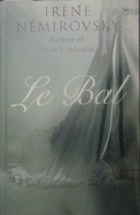
Le Bal cover

The good lady noticed this (very) large print book in a local library. As every Némirovsky I have read so far has been excellent I immediately borrowed it. This is a thin volume with very large print but still contains two novellas.

Le Bal © Éditions Bernard Grasset, 1930.
Catholic Rosine Kampf is a selfish would-be social climber with a less than reputable past. Her husband Alfred (a Jew who converted on marriage) made a sudden killing in currency dealings to transform their fortunes. Rosine now sees this as her time and sets out to exploit it. They have a fourteen year old daughter, Antoinette, who is straining on the verge of adulthood. As her mother does nothing but scold and deride her Antoinette harbours intense feelings of dislike and frustration. All this has ramifications for the ball (Le Bal of the title) Rosine is planning to hold to lever up the Kampfs’ place in society. In a story as short as this characterisation could be problematic but Rosine is well drawn, as is Antoinette, and Alfred shows that greater degree of indulgence fathers often have towards daughters.

Snow in Autumn © Éditions Bernard Grasset, 1931 as Les Mouches d’automne.
This is another of Némirovsky’s tales of Russian émigrés covering the years just before and after the cataclysm of the Revolution. The viewpoint is that of Tatiana Ivanovna, the aristocratic Karine family’s nanny. In a statement redolent of the pre-war times she reminds her employer, “You know very well that cockroaches are a sign of a wealthy household.”
Left behind to look after the house when the older family members fled to Odessa, she witnesses the murder of the Karines’ son, Youri, in the revolutionary takeover and then treks after them with their jewels sewn into her skirts. Later, in exile in Paris, she tries to uphold standards that seem pointless to people who have lost everything, who are “like flies in autumn” as the French title has it.

There was one curious piece of translation where the description sleeping room (rather than bedroom?) was used.

Like all Némirovsky’s fiction the two stories in Le Bal do not disappoint.

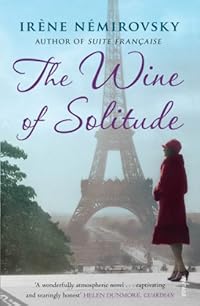
The Wine of Solitude by Irène Némirovsky

Translated from the French, Le Vin de Solitude, by Sandra Smith.

Chatto and Windus, 2011, 248 p. First published by Éditions Albin Michel, 1935.

Hélène Karol is the only child of Bella and Boris Karol. Bella feels she has been forced, for financial security, to marry beneath her – she is self-centred and has expensive tastes. Boris is forced to leave his job as he would be tempted to steal to keep her in style. He leaves for, and makes his fortune in, Siberia. While he is there Bella takes a lover, Max Safronov, who considers the child Hélène a nuisance. Boris refuses openly to acknowledge his wife’s infidelities. Némirovsky notes that “a man needs a certain amount of breathable air, a small dose of oxygen and illusion in order to live.”

The novel traces Hélène’s life from early childhood in Kiev, to St Petersburg, then after the Russian Revolution to Finland and finally France. Hélène loves her father but the only person who has any time for her is her governess Madamoiselle Rose, with whose services Bella eventually dispenses, claiming she has set Hélène against her.

The book’s focus is firmly on Hélène and the effects on her of Bella’s indifference. While still a child she reads a book displaying a happy family she thinks is a fantasy and writes in it, “In every family there is nothing but greed, lies and misunderstanding.” The upheavals of the outside world, the Great War, the Revolution, are mostly off-stage – though one of the scenes in Finland has the White Army gradually nearing the village where the Karols are staying. Even when living through interesting times people still have personal concerns. Wars and revolutions are only the backdrop against which their lives are experienced.

Hélène’s hatred of her mother is such that when she grows up and realises a young woman’s attractiveness to men she determines to win Max’s affections to gain a measure of revenge. More subtly Némirovsky has Max’s mother say to him, in respect of Bella, “Women don’t love a man for himself but as a weapon against another woman,” and doesn’t make those Hélène’s words.

Since Némirovsky was herself Ukrainian and emigrated to France it would be too easy to attribute this novel to autobiography. To do so would be to deny the novelist’s art. As a depiction of an emotionally deprived childhood, and its effects, The Wine of Solitude is exemplary. It also stands as a reminder that those effects need not be determinative. We can choose how to behave.

The translation renders the area of Hélène’s childhood as “the” Ukraine. While this was the Soviet designation and may have been the one in use when the book was written in the 1930s I believe the inhabitants of that country prefer just Ukraine. A pedant’s heart will be gladdened by the fact that in the Finnish scenes Smith rendered a question grammatically correctly as, “Whom were they firing at?” though it does appear fussy to modern eyes.

free hit counter script