Le Bal by Irène Némirovsky
Posted in Irène Némirovsky, Other fiction, Reading Reviewed at 12:00 on 8 July 2014
Chivers, 2008, 142 p. Translated from the French by Sandra Smith.
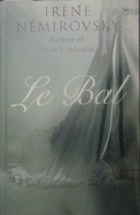
The good lady noticed this (very) large print book in a local library. As every Némirovsky I have read so far has been excellent I immediately borrowed it. This is a thin volume with very large print but still contains two novellas.
Le Bal © Éditions Bernard Grasset, 1930.
Catholic Rosine Kampf is a selfish would-be social climber with a less than reputable past. Her husband Alfred (a Jew who converted on marriage) made a sudden killing in currency dealings to transform their fortunes. Rosine now sees this as her time and sets out to exploit it. They have a fourteen year old daughter, Antoinette, who is straining on the verge of adulthood. As her mother does nothing but scold and deride her Antoinette harbours intense feelings of dislike and frustration. All this has ramifications for the ball (Le Bal of the title) Rosine is planning to hold to lever up the Kampfs’ place in society. In a story as short as this characterisation could be problematic but Rosine is well drawn, as is Antoinette, and Alfred shows that greater degree of indulgence fathers often have towards daughters.
Snow in Autumn © Éditions Bernard Grasset, 1931 as Les Mouches d’automne.
This is another of Némirovsky’s tales of Russian émigrés covering the years just before and after the cataclysm of the Revolution. The viewpoint is that of Tatiana Ivanovna, the aristocratic Karine family’s nanny. In a statement redolent of the pre-war times she reminds her employer, “You know very well that cockroaches are a sign of a wealthy household.”
Left behind to look after the house when the older family members fled to Odessa, she witnesses the murder of the Karines’ son, Youri, in the revolutionary takeover and then treks after them with their jewels sewn into her skirts. Later, in exile in Paris, she tries to uphold standards that seem pointless to people who have lost everything, who are “like flies in autumn” as the French title has it.
There was one curious piece of translation where the description sleeping room (rather than bedroom?) was used.
Like all Némirovsky’s fiction the two stories in Le Bal do not disappoint.
Tags: Irène Némirovsky, Russian Revolution, Translated fiction
